

Search visibility is no longer limited to earning a top position in Google’s traditional organic results. In 2026, users can increasingly ask complex questions in conversational language and receive AI-generated responses that synthesize information from multiple sources. Google’s AI Overviews and AI Mode are central to this shift, with both experiences using Google’s search systems to surface relevant web content and provide links to supporting sources.
This changes what it means to rank in Gemini. You are not simply competing for a blue-link position. Your content needs to be discoverable, understandable, relevant to the question, and credible enough to be selected as a supporting source in an AI-generated answer.
Two concepts are particularly useful for understanding this environment: extraction and authority.
Extraction is about making information easy for search systems and AI models to identify, interpret, and use. Clear headings, concise explanations, logical page structures, descriptive titles, internal links, and properly implemented structured data can all contribute to better machine understanding. Authority, meanwhile, is about establishing why your website, authors, brand, and claims should be trusted.
The important caveat is that Google does not provide a separate “Gemini ranking factor” or a special optimization checklist that guarantees inclusion. Google explicitly states that the same foundational SEO practices remain relevant for AI Overviews and AI Mode, and pages generally need to be indexed and eligible to appear with a snippet in Google Search to be eligible as supporting links.
Therefore, the goal should not be to manipulate an AI system into mentioning your brand. Instead, build content that is genuinely useful, technically accessible, semantically comprehensive, and supported by strong evidence and recognizable expertise.
That means a successful Gemini SEO strategy in 2026 combines traditional technical SEO with deeper topical coverage, entity optimization, structured information, authoritative references, and ongoing monitoring of how AI systems represent your brand.
Understanding the Difference Between AI Overviews and AI Mode
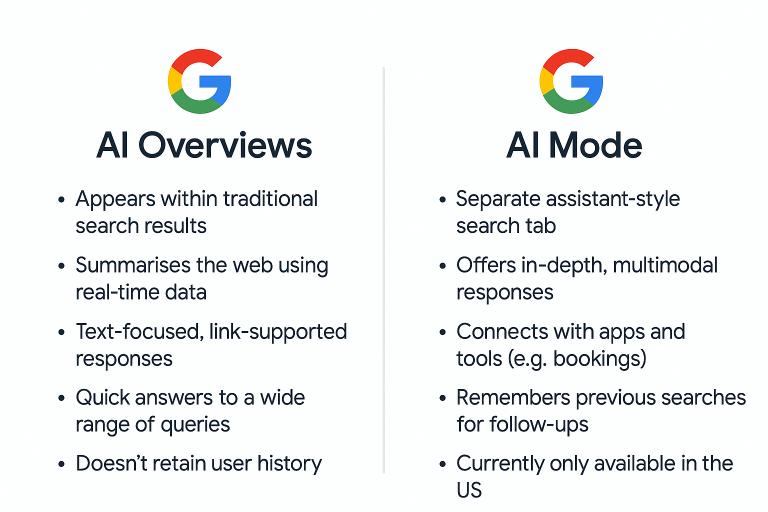
AI Overviews and AI Mode are closely related, but they serve different search experiences. Treating them as interchangeable can lead to an incomplete AI-search strategy.
Google describes AI Overviews as an experience designed to help users understand complicated topics or questions more quickly, while AI Mode is intended for deeper exploration, reasoning, comparisons, and more complex queries. Both can use multiple searches and sources to construct an answer, but the resulting responses and links can differ because the systems may use different models and techniques.
AI Overviews: Fast synthesis inside Search
AI Overviews appear within the conventional Google Search experience when Google’s systems determine that an AI-generated summary adds value to the query. Rather than requiring users to open several pages and synthesize the information themselves, the system presents an AI-generated overview alongside links that allow users to investigate the underlying sources.
This creates an important opportunity for publishers.
A page does not necessarily have to occupy the first traditional organic position to contribute to an AI Overview. What matters is whether the page is eligible for Search and contains information that Google’s systems determine is useful for answering the query. Google says AI features can provide opportunities for a wider variety of sites to appear, while emphasizing that there are no additional technical requirements specifically for AI Overviews or AI Mode.
For content creators, this makes extractability particularly important.
Consider an article explaining email deliverability. A dense paragraph might contain the correct answer, but a clearly structured section such as:
What is email deliverability?
Email deliverability is the ability of an email to reach a recipient’s inbox rather than being rejected, bounced, or routed to spam.
The second format makes the relationship between the question and answer immediately apparent to both readers and automated systems.
This does not mean Google simply copies the first sentence it finds. AI-generated search experiences synthesize information, so the broader context, relevance, quality, and reliability of the source still matter.
AI Mode: Deeper reasoning and exploration
AI Mode takes a more conversational and exploratory approach. Users can ask longer, nuanced questions, provide follow-ups, compare alternatives, and progressively refine what they are looking for.
Under the hood, Google says AI Mode can use query fan-out: the system breaks a complex request into related searches across different subtopics and sources, then combines the resulting information into a response.
For example, imagine someone asks:
“What is the best project management software for a 20-person marketing agency, and which option has strong time tracking, client management, automation, and reporting?”
That is not really one keyword query. It contains multiple information needs:
- Project management capabilities
- Agency suitability
- Team size
- Time tracking
- Client management
- Automation
- Reporting
- Comparative evaluation
AI Mode can investigate these dimensions rather than treating the query as a single keyword string. Google’s documentation specifically notes that query fan-out allows AI features to issue multiple related searches across subtopics and data sources.
This has major implications for content strategy.
A page optimized around only the phrase “project management software” may be relevant to the overall topic but fail to provide enough useful information for every dimension of a complex question. A more comprehensive resource that addresses use cases, features, limitations, pricing considerations, team sizes, implementation, and comparisons creates more opportunities to satisfy different retrieval paths.
AI Overviews vs. AI Mode: The practical SEO difference
| Factor | AI Overviews | AI Mode |
|---|---|---|
| Primary experience | AI summary within Search | Conversational, exploratory Search |
| Best suited for | Getting the gist quickly | Complex research and reasoning |
| Query style | Often straightforward or moderately complex | Longer, nuanced, multi-part queries |
| Information processing | Summarization and synthesis | Deeper exploration and synthesis |
| Search behavior | Can surface supporting links | Can perform query fan-out across subtopics |
| Content implication | Make important information easy to identify and extract | Build comprehensive, authoritative resources that address multiple intents |
The distinction should not be interpreted as two completely separate SEO systems. Google’s own guidance says AI Overviews and AI Mode both build on Search’s underlying systems and that standard SEO fundamentals remain important.
The better strategy is therefore to create content that works at both levels: concise enough for important facts to be identified quickly, but comprehensive enough to support deeper conversational research.
How AI Overviews Select and Extract Content
AI Overviews are designed to provide users with a concise understanding of a query while connecting them to relevant websites for further exploration. This means content has to pass an initial eligibility threshold before its information can potentially contribute to the generated experience.
The first point to understand is that there is no special AI Overview markup or secret schema type required for inclusion.
Google’s current documentation states that pages need to be indexed and eligible to appear in Google Search with a snippet to be eligible as supporting links in AI Overviews or AI Mode. Google also says there are no additional technical requirements specifically for these AI features.
1. The page must be discoverable and indexable
Before an AI system can potentially use your content, Google needs to be able to access and understand it.
That means fundamental technical SEO still matters:
- Allow appropriate crawling by Googlebot.
- Avoid accidentally blocking important pages with
robots.txt. - Ensure important content is available in textual form.
- Use internal links to make valuable pages discoverable.
- Maintain sensible canonicalization.
- Avoid unnecessary technical barriers to crawling and rendering.
- Make sure important pages can actually be indexed.
Google specifically recommends ensuring crawling is allowed, making content easy to find through internal links, and providing important information in textual form.
This is why AI optimization cannot compensate for a technically inaccessible website. If Google cannot properly crawl, index, or serve a page, formatting it for AI extraction will not solve the underlying problem.
2. Clear structure makes information easier to interpret
Once a page is eligible, its structure becomes important for helping systems understand what information the page contains.
Well-organized content typically uses:
- Descriptive H2 and H3 headings
- Short paragraphs
- Direct answers
- Bulleted lists
- Numbered steps
- Comparison tables where appropriate
- Definitions
- Supporting examples
- Clear relationships between questions and answers
For example, instead of writing a 500-word section that eventually explains “what email authentication is,” create a dedicated heading and answer the question directly before expanding on the details.
This approach benefits humans first—and that is important. Google’s guidance continues to emphasize helpful, reliable, people-first content rather than content created primarily to manipulate search systems.
3. Semantic relevance matters more than keyword repetition
Traditional SEO often encouraged marketers to focus heavily on matching specific keywords. AI-powered search makes a broader understanding of the topic increasingly important.
Suppose the query is:
“How can a small business reduce customer churn?”
A useful source might discuss:
- Customer onboarding
- Product adoption
- Customer satisfaction
- Retention campaigns
- Support quality
- Customer feedback
- Usage monitoring
- Subscription cancellation patterns
The page does not need to repeat “reduce customer churn” dozens of times. Instead, it should demonstrate a comprehensive understanding of the concepts surrounding the question.
This is particularly important as AI Mode can explore multiple related searches rather than relying on one literal query. Google’s description of query fan-out confirms that AI search can break a user’s question into multiple subtopics and search across them.
4. Direct answers can improve extractability
A useful content pattern is answer first, explanation second.
For example:
What is local SEO?
Local SEO is the process of improving a business’s online visibility for searches associated with a specific geographic area.
Then expand:
- How local rankings work
- Google Business Profile optimization
- Local citations
- Reviews
- Local landing pages
- Location-based content
- Measurement
This layered structure gives readers an immediate answer while preserving the depth required for more complex research.
It also creates clearly defined information units that search systems can more easily associate with specific questions.
5. Structured data helps search engines understand page information—but it is not a shortcut to AI visibility
Structured data can help Google understand entities and information represented on a page. However, it should not be treated as a mechanism for forcing content into AI Overviews.
Google explicitly says there is no special Schema.org structured data required for AI Overviews or AI Mode. It also recommends ensuring that structured data accurately matches the visible content on the page.
Therefore, use relevant structured data where it genuinely describes the page rather than adding markup simply because you want to “rank in Gemini.”
For example, appropriate structured data can help clarify things such as:
- Organization information
- Article details
- Author information
- Products
- Services
- Breadcrumbs
- Other supported content types
The principle is simple: markup should clarify the content, not manufacture relevance.
6. Source quality still matters
Extraction is only one side of AI visibility. A perfectly formatted page is not automatically a trusted source.
Google’s AI-search guidance continues to point site owners toward its established principles for helpful, reliable, people-first content. AI features use Google’s broader Search systems and quality signals rather than operating as a completely independent ranking ecosystem.
That means your content should demonstrate:
- First-hand knowledge where appropriate
- Accurate and current information
- Clear sourcing for important claims
- Appropriate expertise
- Original analysis
- Useful examples
- Transparent authorship
- Strong editorial standards
This is especially important for subjects where incorrect information could cause meaningful harm.
7. AI visibility is not guaranteed by traditional rankings—or by eligibility
One of the biggest misconceptions about AI search is that achieving a high organic ranking automatically means your page will be cited in an AI-generated answer.
It doesn’t.
Google states that meeting technical requirements and following best practices does not guarantee that a page will be crawled, indexed, or served.
Likewise, AI Overviews and AI Mode can surface different links because they may use different models and techniques.
The practical takeaway is to think in terms of eligibility → relevance → usefulness → trust, rather than assuming:
#1 organic ranking = #1 AI citation.
How Gemini Chat Determines Authority and Inclusion
The authority side of AI visibility is more difficult to optimize because there is no publicly documented formula that says exactly why a particular source will be selected in every Gemini response.
What can be established is that modern AI-powered Search combines language models with Google’s information systems, web retrieval, and other sources of information. AI Mode can perform query fan-out and retrieve information from multiple searches and data sources before generating its response.
That makes authority and corroboration increasingly important strategic concepts.
Topical depth establishes relevance
A website that publishes one article about a subject has a weaker topical footprint than a site that consistently demonstrates expertise across the subject’s important subtopics.
For example, a company targeting the topic of enterprise cybersecurity could develop resources covering:
- Network security
- Endpoint protection
- Identity and access management
- Cloud security
- Zero-trust architecture
- Security monitoring
- Incident response
- Compliance
- Security awareness
- Vulnerability management
These interconnected resources create a broader representation of the organization’s expertise.
This is the underlying logic behind topical clusters: instead of optimizing isolated pages for isolated keywords, build a network of useful resources that collectively demonstrate subject-matter depth.
Entity recognition gives the brand context
AI systems need to understand not only what a page says but also who is saying it.
A recognizable organization with a consistent website, author information, business descriptions, publications, mentions, and other corroborating information provides more context than an anonymous page making unsupported claims.
That is why entity-oriented SEO increasingly involves consistency across:
- Brand name
- Organization description
- Authors
- Expertise
- Products or services
- Business information
- External publications
- Industry references
Structured data can help communicate some of these relationships, but the underlying information must be genuine and consistent. Google recommends using structured data to help it understand content while emphasizing that the markup should correspond to what users can actually see on the page.
Cross-source agreement can reinforce credibility
AI-generated answers frequently synthesize information from several sources. When multiple reputable sources independently support a fact, definition, trend, or industry position, that information has stronger corroboration than an isolated unsupported claim.
For content creators, this means important statements should not simply be asserted.
Instead:
- Make the claim clearly.
- Support it with appropriate evidence.
- Cite authoritative research when available.
- Add original analysis or interpretation.
- Keep the information current.
- Distinguish established facts from opinions or predictions.
This creates what can be thought of as a consensus signal around the topic.
It does not mean repeating whatever other websites say. In fact, original information can be particularly valuable. Google’s recent AI Search updates emphasize helping users discover original content, perspectives, and useful websites.
External mentions strengthen the broader entity footprint
A brand does not exist only on its own website.
Its broader online presence can include:
- Industry publications
- News coverage
- Expert interviews
- Research reports
- Professional organizations
- Podcasts
- Conference appearances
- Reviews
- Relevant directories
- Partner and customer references
These mentions can help establish context around the organization and its expertise.
However, this should not be interpreted as a recommendation to manufacture mentions or purchase links. Google’s spam policies explicitly prohibit manipulative link practices and scaled content created primarily to manipulate Search or generative AI systems.
The better approach is to earn legitimate recognition by producing research, original insights, useful resources, expert commentary, and genuinely newsworthy information.
Logical completeness matters for complex questions
A source can be authoritative yet still be a poor answer for a particular query.
Imagine a highly respected website has an article explaining what CRM software is. A user asks:
“Which CRM is best for a 50-person B2B sales team that needs Salesforce integration, advanced reporting, and automated lead routing?”
General CRM knowledge may establish topical authority, but the page does not necessarily answer the user’s specific requirements.
For AI Mode, query-to-content fit therefore matters.
A strong resource should address the actual decision factors behind the query rather than simply targeting the broad topic.
This is one reason long-form content can perform well in AI-search environments—but only when the additional length contributes useful information. More words alone do not create authority.
Freshness can matter when the query depends on current information
AI search increasingly handles questions where information changes quickly: product availability, software features, pricing, regulations, company information, current events, and other time-sensitive subjects.
Google’s AI Search guidance recommends keeping relevant information current and maintaining accurate business information where applicable.
For publishers, that means reviewing content when:
- Statistics become outdated
- Products change
- Features are discontinued
- Regulations are updated
- Industry standards evolve
- Pricing changes
- New research becomes available
- Previously valid recommendations are no longer accurate
An outdated page can remain technically indexed while becoming less useful for current queries.
The real objective: become a source worth retrieving
Ultimately, trying to reverse-engineer an exact “Gemini ranking factor” is less useful than building the characteristics that make a source valuable to an AI-powered search system.
A strong source should be:
Discoverable — Google can crawl and index it.
Understandable — The page has clear structure and unambiguous information.
Relevant — It addresses the user’s actual intent.
Comprehensive — It covers the important dimensions of the topic.
Credible — Claims are supported by expertise and appropriate evidence.
Recognizable — The authors and organization have clear identities and consistent information.
Current — Time-sensitive information is maintained.
Original — The content adds genuine value rather than merely reproducing existing pages.
This is where the distinction between extraction and authority becomes especially useful. Extraction helps make your information accessible to AI-powered search systems; authority and relevance determine whether that information is compelling enough to be selected in the first place.
And importantly, these principles align with Google’s current position that there is no separate set of secret technical requirements for AI Overviews or AI Mode. Strong fundamentals remain the foundation, while the AI-search environment increases the value of clarity, comprehensiveness, originality, and credible information.
8 Tips to Rank in Gemini in 2026
Ranking in Gemini is not about finding a single optimization trick or adding a special piece of markup to your website. Google’s current guidance makes an important point: the same foundational SEO principles that help pages perform in Google Search also underpin visibility in AI Overviews and AI Mode. At the same time, generative search changes how information is discovered, retrieved, synthesized, and presented.
The practical goal, therefore, is to make your content easy to discover, easy to understand, relevant to complex queries, and credible enough to be selected as a source. The following eight strategies combine those principles with the extraction-and-authority framework outlined above.
1. Build Deep Topical Clusters
A single page targeting one keyword is rarely enough to establish meaningful authority around a competitive subject. Instead, build topical clusters: a central pillar resource supported by interconnected pages that address the important subtopics, questions, use cases, comparisons, and related concepts within the broader subject.
For example, a company targeting email marketing could create a pillar guide supported by content covering:
- Email marketing strategy
- Email segmentation
- Email automation
- Email deliverability
- Email personalization
- Email A/B testing
- Email analytics
- Transactional email
- Lifecycle email marketing
- Email marketing for specific industries
The objective isn’t to publish dozens of pages simply because they contain related keywords. Each page should answer a distinct user need and contribute something useful to the broader topic.
This becomes particularly relevant to AI search because complex queries can involve several related concepts. Google’s documentation explains that AI features can use query fan-out, generating multiple related searches to gather information across different subtopics before constructing a response.
A deep topical cluster gives your site more opportunities to satisfy those related retrieval paths.
Create relationships between your pages
Your cluster should also have a logical internal-linking structure. Link the pillar page to supporting resources and link relevant supporting pages back to the pillar.
For example:
Pillar: Email Marketing Guide
→ Email Marketing Automation
→ Email Segmentation
→ Email Deliverability
→ Email Conversion Rates
→ Email A/B Testing
This creates a coherent information architecture for both users and search systems.
However, don’t interpret topical authority as a requirement to create hundreds of pages. Google’s current guidance explicitly warns against creating content primarily to manipulate generative AI search and says there is no ideal page length or requirement to break content into tiny pieces. The priority should remain valuable, unique, people-first content.
2. Use Structured, Extraction-Friendly Formatting
If your content contains the right information but buries it inside walls of text, both users and automated systems have to work harder to understand it.
Make important information immediately accessible through a logical structure.
Use:
- Descriptive H2 and H3 headings
- Short paragraphs
- Direct answers
- Bulleted lists
- Numbered processes
- Comparison tables
- Definitions
- Examples
- Supporting explanations
- Clear internal links
A useful pattern is answer first, expand second.
For example:
What is email deliverability?
Email deliverability is the ability of an email message to reach a recipient’s intended inbox rather than being rejected or filtered into spam.
Then explain the factors that affect deliverability, such as authentication, sender reputation, engagement, list quality, and content.
This gives users an immediate answer while retaining the depth needed for more sophisticated queries.
Importantly, structured formatting should serve the reader rather than attempt to “hack” AI systems. Google’s current guidance specifically says there is no requirement to rewrite content in a special format for generative AI, no ideal page length, and no requirement to split content into tiny chunks.
So think clarity, not artificial fragmentation.
3. Implement Robust Schema Markup
Structured data provides machine-readable information about the entities and content represented on a webpage. Google says it uses structured data to understand page content and information about entities such as people, organizations, and other types of content.
For an AI-search strategy, this makes schema worth implementing—but with an important qualification.
Schema markup is not a secret ranking mechanism for Gemini.
Google’s current generative-AI guidance explicitly says there is no special schema.org markup required for AI Overviews or AI Mode. Structured data should instead be treated as part of your broader technical SEO strategy.
Depending on the page, relevant markup may include:
- Organization
- Person
- Article
- Breadcrumb
- Product
- LocalBusiness
- Service
- Other supported schema types
The markup should accurately describe the visible content on the page. Google’s structured-data guidelines emphasize that structured data must represent the page’s actual content and should not be used to mislead search systems.
For example, if an article clearly identifies its author, publication date, organization, and subject, appropriate structured data can help communicate those relationships in a standardized format.
The strategic objective is therefore not:
“Add as much schema as possible.”
It is:
“Make important entities and relationships unambiguous.”
4. Strengthen Author and Brand Entity Signals
AI systems need context around information. A page isn’t simply a collection of words; it is information associated with an author, organization, brand, product, service, and broader subject area.
That makes entity consistency increasingly important.
Strengthen your author and brand signals by maintaining consistent information across your digital presence.
For authors, provide:
- A clear author name
- Relevant biography
- Professional expertise
- Author pages
- Links to appropriate professional profiles
- Content demonstrating subject-matter knowledge
- Editorial/review information where appropriate
For brands, maintain consistency in:
- Brand name
- Company description
- Products and services
- Organization information
- Business details
- Authors and experts
- Industry specialization
Schema can help communicate some of these relationships, but the underlying entity information should exist beyond the markup itself.
For example, if a cybersecurity company publishes extensive security research, has identifiable security experts, contributes to industry publications, and maintains consistent information about its expertise across the web, those signals collectively provide much stronger context than a generic company publishing occasional cybersecurity articles.
The goal is to make your organization recognizable as an entity associated with the subject, rather than simply another URL competing for a keyword.
5. Optimize for Multi-Intent Queries
AI-powered search increasingly allows users to ask questions that contain several intents at once.
Consider this query:
“What is the best CRM for a 50-person B2B company that needs automation, reporting, integrations, and affordable pricing?”
The user isn’t asking only for “CRM software.”
They want information about:
- Best options
- B2B suitability
- Company size
- Automation
- Reporting
- Integrations
- Pricing
- Potentially implementation and limitations
Your content should anticipate these layers.
A strong page might include:
- A concise definition or recommendation
- Key options
- Feature comparisons
- Pricing considerations
- Use cases
- Advantages and limitations
- Best-fit scenarios
- Alternatives
- Implementation considerations
- Frequently asked questions
This creates a layered content experience: concise information for users who need a quick answer and deeper analysis for users conducting research.
The strategy also aligns with Google’s description of AI search, where users increasingly ask longer, more specific questions and use follow-up questions to explore a subject further.
Don’t try to insert every imaginable keyword variation. Google specifically says its systems can understand synonyms and general meanings, so there is no need to artificially target every possible long-tail variation.
Instead, cover the underlying information needs behind the query.
6. Create Consensus-Based Content
AI-generated answers often need to reconcile information from multiple sources. That makes unsupported claims less useful than information that can be substantiated through credible evidence.
When making important claims, strengthen your content with:
- Original research
- First-party data
- Industry studies
- Government sources
- Academic research
- Expert commentary
- Transparent methodology
- Relevant citations
- Clearly attributed statistics
For example, instead of writing:
“Email personalization dramatically increases conversions.”
Explain what personalization you’re discussing, provide supporting evidence where available, and distinguish between established findings and your own interpretation.
This creates a stronger information environment around your content.
But consensus does not mean copying everyone else.
Your objective should be to understand what authoritative sources establish, identify gaps or disagreements, and then contribute something useful of your own.
Google’s current guidance emphasizes creating unique, valuable, non-commodity content rather than simply reproducing information that already exists elsewhere.
A powerful approach is:
Established evidence + expert interpretation + original insight.
That combination can make content both trustworthy and genuinely differentiated.
7. Earn Mentions Across Authoritative Domains
Your website is only one part of your brand’s information footprint.
Relevant third-party references can provide additional context around your organization, people, products, research, and expertise. These may include:
- Industry publications
- News outlets
- Professional organizations
- Expert interviews
- Podcasts
- Conference appearances
- Research citations
- Partner websites
- Reputable industry directories
- Independent reviews
The emphasis should be on earned authority, not manufactured mentions.
This distinction matters because Google’s current guidance explicitly cautions against pursuing inauthentic mentions simply to influence AI search. Its generative AI systems still rely on broader quality and spam-detection systems.
Therefore, don’t build a strategy around generating hundreds of low-quality brand mentions.
Instead, create things that reputable sources have a reason to reference:
- Original research
- Industry statistics
- Proprietary studies
- Expert commentary
- Useful tools
- Unique datasets
- Strong thought leadership
- Newsworthy findings
- High-quality educational resources
For example, publishing an original industry survey can generate legitimate references from journalists, bloggers, researchers, and other businesses. Those references are much more meaningful than artificially creating profiles or low-value mentions across unrelated websites.
Think of this as entity reinforcement through genuine recognition.
8. Monitor AI Citations and Mentions
Traditional SEO reporting typically focuses on rankings, impressions, clicks, and conversions. Those metrics remain important, but they don’t fully explain how your brand performs inside AI-generated search experiences.
Start monitoring questions such as:
- Does the brand appear in AI-generated answers?
- Is the brand cited as a source?
- Which URLs are being cited?
- Which competitors appear more frequently?
- Which topics generate the most visibility?
- Are your product or service recommendations accurate?
- Which content formats appear most often?
- Are AI systems associating your brand with the correct entities and topics?
Create a representative prompt set around your most commercially important topics.
For example:
Informational
- “How does [topic] work?”
- “What are the benefits of [topic]?”
Commercial
- “Best for [use case]”
- “[Product category] comparison”

Branded
- “What is [brand] known for?”
- “Is [brand] good for [use case]?”
Competitive
- “Best alternatives to [competitor]”
- “[Brand] vs [competitor]”
Run these prompts periodically and record:
- Presence
- Citation frequency
- Cited URLs
- Competitor mentions
- Recommendation position
- Accuracy of brand information
There is now an important development for measurement: Google introduced a dedicated Search Console reporting view for generative AI visibility in June 2026, covering impressions from generative AI features such as AI Overviews and AI Mode.
That makes AI visibility less theoretical and gives site owners a more direct way to evaluate performance.
Putting the 8 Strategies Together
These eight tactics work best as an integrated system rather than isolated optimizations:
Topical clusters establish depth.
Structured formatting makes information easier to understand.
Schema clarifies entities and content relationships.
Author and brand signals establish identity and expertise.
Multi-intent optimization increases relevance across complex queries.
Consensus-based content strengthens factual credibility.
Authoritative mentions reinforce the brand beyond its own website.
AI monitoring shows whether those efforts are actually translating into visibility.
Most importantly, don’t approach Gemini optimization as a collection of shortcuts. Google’s latest guidance makes clear that there are no special AI-search hacks that replace foundational SEO. Crawlability, indexability, helpful content, strong technical foundations, and genuine value remain central to visibility.
LLM Retrieval Mechanics, Embeddings, and RAG: What Actually Powers Gemini
To understand how to improve visibility in Gemini-powered search, it helps to move beyond traditional SEO concepts and understand what happens between a user’s question and the final AI-generated answer.
Modern AI search does not simply look for a page containing the exact words used in a query. It can interpret the meaning of a question, identify related concepts, retrieve relevant information, evaluate multiple sources, and then synthesize an answer. Google’s current AI Search documentation describes AI Overviews and AI Mode as experiences built on top of Google’s existing Search systems, with AI Mode capable of using query fan-out to issue related searches across different subtopics and data sources.
That makes three concepts particularly useful for understanding AI visibility: embeddings, retrieval, and retrieval-augmented generation (RAG).
What are embeddings?
An embedding is a numerical representation of information that captures semantic relationships. Instead of treating a webpage as nothing more than a sequence of keywords, an embedding represents concepts in a mathematical space where semantically related pieces of information can be positioned closer together.
For SEO, the practical implication is important.
A user might search:
“How can I get more customers from Google Maps?”
A relevant page might use different language, such as:
“Optimize your Google Business Profile to improve local discovery and generate more calls, direction requests, and website visits.”
The page does not need to repeat the exact phrase “get more customers from Google Maps” to be conceptually relevant. The underlying concepts—Google Business Profile, local discovery, Maps, customer acquisition—are related.
This is why semantic coverage is generally more valuable than keyword repetition when creating content for AI-powered search.
However, marketers should avoid assuming that they can reverse-engineer a precise embedding algorithm or manipulate semantic similarity with a particular word formula. Google does not publish an SEO formula for how Gemini calculates embeddings or decides which individual passage will be used in every generated answer.
Instead, focus on making the meaning of your content unambiguous.
Retrieval comes before generation
A useful simplified model of AI-powered search is:
User query → query understanding → retrieval → source selection → synthesis → generated answer
The model first needs access to relevant information. It can then use retrieved information as context for generating the response.
This is fundamentally different from asking a language model to answer exclusively from its internal training knowledge.
Google’s AI Search experiences can use Search systems and multiple related searches to find relevant information before generating a response. Google calls this process query fan-out, where a complex question can be broken into multiple searches covering different aspects of the user’s request.
For example, consider:
“What’s the best accounting software for a small construction company with five employees that needs invoicing, payroll, expense tracking, and mobile access?”
A retrieval system may need information about:
- Accounting software
- Construction businesses
- Small-business use cases
- Invoicing
- Payroll
- Expense tracking
- Mobile functionality
- Pricing
- Product comparisons
A page that only discusses “accounting software” at a generic level may be less useful than a resource that addresses these connected needs.
This is one reason deep topical coverage and multi-intent content are important components of an AI-search strategy.
Where RAG fits in
Retrieval-augmented generation (RAG) is a general architecture in which an AI model retrieves relevant external information and uses that information as context when generating its answer.
A simplified RAG workflow looks like this:
- The user asks a question.
- The system interprets the query.
- Relevant information is retrieved from available sources.
- The retrieved information becomes context for the model.
- The model synthesizes an answer from that context.
- The system may provide citations or links to the underlying sources.
For SEO professionals, the critical step is retrieval.
If your content is never retrieved, the model cannot use it as supporting context in that response.
That does not mean every AI search product uses exactly the same RAG architecture. Google does not publicly describe Gemini’s complete production retrieval pipeline in enough detail to reduce it to one simple formula. So marketers should treat RAG as a useful conceptual model rather than a claim that every Gemini response follows one identical technical pipeline.
The practical lesson remains valuable: content needs to be discoverable and relevant before it can influence an AI-generated response.
Why passage-level relevance matters
AI systems can work with information at a more granular level than the traditional idea of “this entire page ranks for this keyword.”
Imagine a 4,000-word article about digital marketing containing one excellent section explaining local SEO.
A user asks:
“How do Google Business Profile reviews affect local visibility?”
The entire article may not be about reviews. But the specific section could contain exactly the information required.
This is why individual sections should be self-contained and contextually clear.
Instead of:
“This can also improve visibility and trust.”
Write:
“Responding to Google Business Profile reviews can help a local business demonstrate active customer engagement and provide additional context about its services.”
The second statement identifies the subject, action, and outcome without requiring the reader—or an automated system—to infer what “this” refers to.
Retrieval favors meaning, but traditional SEO still matters
Semantic retrieval does not make traditional SEO obsolete.
Google explicitly states that AI Overviews and AI Mode use the same foundational Search systems and that pages generally need to be indexed and eligible to appear with a snippet in Google Search to be eligible as supporting links. Google also says there are no additional technical requirements specifically for appearing in these AI features.
So your AI-search strategy still starts with:
- Crawlability
- Indexability
- Search-friendly architecture
- Internal linking
- Useful content
- Relevant titles and headings
- Strong technical performance
- Clear entity information
- Appropriate structured data
AI retrieval essentially adds another layer: can the system understand how your information relates to the question?
That is why a technically perfect page with thin or vague information may still be less useful than a well-structured page that clearly explains the subject.
Gemini vs ChatGPT vs Perplexity: Key Differences for SEO Strategy
Optimizing for AI visibility is becoming less about one platform and more about understanding how different AI-search environments discover and present information.
The three most important ecosystems for many businesses are Google’s Gemini-powered Search experiences, ChatGPT Search, and Perplexity. They overlap, but their search experiences and source presentation are not identical.
Gemini: Search ecosystem integration
Google’s advantage is its deep integration with the existing Google Search ecosystem.
AI Overviews and AI Mode operate within Google Search, and Google says AI Mode can perform query fan-out across multiple related searches and sources. In January 2026, Google also announced Gemini 3 as the default model for AI Overviews, with AI Overviews supporting follow-up exploration.
For SEO, this means your Gemini strategy should remain strongly connected to conventional Google SEO.
Prioritize:
- Strong organic-search fundamentals
- Crawlable and indexable pages
- Topical authority
- Helpful content
- Structured information
- Entity clarity
- Local SEO where relevant
- Original research and expertise
- Content that satisfies complex, multi-part queries
In other words, don’t abandon Google SEO to chase “AI SEO.” Build a strong search presence that can also support AI retrieval.
ChatGPT: Search plus conversational synthesis
ChatGPT Search is designed around conversational questions and can retrieve information from the web when current information is useful. OpenAI says its search system may rewrite a user’s query into one or more targeted queries and use search providers to retrieve relevant information. Responses can include citations and links to sources.
This creates a strong incentive to optimize for clear relevance and source accessibility.
OpenAI also states that websites need to allow OAI-SearchBot to crawl them to be eligible for inclusion in ChatGPT Search.
For businesses, that means your AI visibility strategy should include:
- Making important content crawlable
- Publishing genuinely useful resources
- Building topical authority
- Answering specific questions
- Maintaining accurate information
- Developing recognizable brand and author entities
- Earning authoritative third-party references
ChatGPT also demonstrates why query optimization should not focus exclusively on exact-match keywords. A conversational system may transform a user’s original question into several more targeted searches before producing its response.
Perplexity: Source-heavy answer engine
Perplexity positions itself as an AI-powered search and answer engine that searches the web, synthesizes information, and provides citations to original sources. Its current documentation says Pro Search can conduct multiple searches across articles, academic papers, forums, videos, and other sources before producing a synthesized response.
This makes source quality and citation-worthiness particularly important.
Perplexity’s current source-labeling system also identifies some domains as Government, Academic, or Trusted based on its source-review process.
For SEO, that reinforces the value of:
- Original research
- Expert authorship
- Primary sources
- Transparent methodology
- Credible citations
- Authoritative third-party mentions
- Accurate, current information
The strategic differences
| Platform | Search behavior | SEO priority |
|---|---|---|
| Gemini / Google Search | Search-integrated AI answers, including AI Overviews and AI Mode | Google SEO + topical authority + structured, relevant content |
| ChatGPT Search | Conversational search with query rewriting and web retrieval | Crawlability + relevance + authoritative, useful sources |
| Perplexity | Search-first answer generation with prominent source citations | Source quality + citation-worthiness + research depth |
The important takeaway is that you shouldn’t create three completely separate content strategies.
Instead, build a strong underlying information ecosystem that works across platforms.
That means:
One authoritative source → multiple AI discovery opportunities.
Measuring Success in an AI-First Search Landscape
Traditional SEO reporting revolves around rankings, impressions, clicks, organic traffic, and conversions. Those metrics remain valuable, but they don’t capture the full picture when search engines and AI assistants increasingly answer questions directly.
An AI-first measurement framework should track both visibility and business impact.
Track AI citations and mentions
Start with a representative set of prompts related to your business.
Include:
- Informational questions
- Commercial investigation queries
- Product comparisons
- Service searches
- “Best” queries
- Problem-solving questions
- Branded questions
- Competitor comparisons
- Local-intent queries
Then record whether your brand appears.
Track:
- Mention rate: How often the brand appears.
- Citation rate: How often your website is cited.
- Cited URL frequency: Which pages are repeatedly selected.
- Competitor visibility: Which competing brands appear.
- Share of AI answers: Your presence relative to competitors.
- Accuracy: Whether the AI system describes your company correctly.
- Sentiment/context: Whether the brand appears in a positive, neutral, or negative context.
Don’t evaluate a single prompt and assume it represents overall AI visibility. AI-generated answers can vary based on query wording, timing, context, location, and the sources retrieved.
Monitor Google Search Console’s generative AI reporting
Measurement is becoming more directly available within Google’s own reporting ecosystem.
In June 2026, Google announced new Search Console generative AI performance reports designed to show visibility from generative AI features such as AI Overviews and AI Mode. Google initially described the reports as rolling out to a subset of websites while it tested and gathered feedback.
This is significant because it moves AI visibility measurement beyond manually checking prompts.
Where the reporting is available, use it alongside your existing Search Console data to compare:
- Traditional Search performance
- Generative AI visibility
- Pages receiving AI-related impressions
- Query patterns
- Overall organic performance
Measure downstream business outcomes
Visibility is not the final goal.
A brand could receive thousands of AI mentions without generating meaningful revenue. Conversely, a small number of highly relevant citations could influence valuable customers.
Connect AI visibility with:
- Organic conversions
- Branded search growth
- Direct traffic
- Assisted conversions
- Lead generation
- Demo requests
- Sales opportunities
- Revenue
- Returning visitors
For example, if your brand begins appearing frequently for high-intent questions about a specific service and branded searches subsequently increase, that is potentially more valuable than simply increasing the number of informational mentions.
Monitor AI referral traffic—but don’t rely on it alone
AI systems can send users directly to cited websites. Track referral traffic where analytics platforms identify it.
But referral traffic will not capture every influence an AI answer has on a customer.
A user may:
- Discover your brand in an AI answer.
- Remember the name.
- Search for the brand later.
- Visit through organic search.
- Convert during a later session.
In that situation, the original AI interaction may not appear as a simple AI referral.
That is why brand visibility, branded search, direct traffic, assisted conversions, and customer research should complement referral metrics.
Create an AI visibility dashboard
A practical dashboard can combine:
| Metric | What it tells you |
|---|---|
| AI mention rate | Whether AI systems recognize your brand |
| Citation rate | How often your content becomes a source |
| Cited URLs | Which content attracts AI visibility |
| Competitor mentions | Where competitors outperform you |
| AI impressions | Generative Search exposure where available |
| Organic traffic | Traditional search impact |
| Branded search | Potential awareness effects |
| AI referral traffic | Direct visits from AI platforms |
| Assisted conversions | Potential influence on customer journeys |
| Revenue/leads | Actual commercial impact |
The objective is to move from “Are we mentioned?” to “Is AI visibility contributing to business growth?”
How Pro Real Tech Helps Brands Win in Gemini and Beyond
Winning visibility in Gemini and other AI-powered search environments requires more than publishing more blog posts. Brands need an integrated strategy that combines technical SEO, content quality, topical authority, entity development, digital PR, and measurement.
A strong AI-search program starts by understanding how a brand is currently represented across search and AI experiences.
That means auditing:
- Organic search visibility
- AI Overview and AI Mode presence
- Brand mentions
- Existing citations
- Author entities
- Organization information
- Topical coverage
- Content gaps
- Internal linking
- Structured data
- Third-party references
- Competitor visibility
From there, the strategy should focus on creating the information ecosystem that AI systems can reliably discover and understand.
Build topical authority around commercial priorities
Instead of creating disconnected articles based solely on keyword volume, develop topic clusters around the questions your customers actually ask.
A commercial topic can be supported by:
- Foundational guides
- How-to resources
- Comparisons
- Use cases
- Industry-specific content
- FAQs
- Original research
- Data-driven studies
- Expert commentary
This gives AI systems more opportunities to encounter the brand across related searches.
Make content retrieval-friendly
Every important page should make its core information easy to identify.
That means:
- Clear headings
- Direct explanations
- Logical content hierarchy
- Descriptive anchor text
- Concise definitions
- Supporting evidence
- Helpful tables and lists
- Strong internal linking
- Accurate structured data
The objective isn’t to write for a machine instead of a human. It is to create content that humans can understand easily and machines can interpret accurately.
Build authority beyond the website
AI visibility increasingly exists within a broader information ecosystem.
Brands should therefore invest in activities that create legitimate external recognition, including:
- Digital PR
- Original research
- Expert contributions
- Industry publications
- Thought leadership
- Interviews
- Data studies
- Partnerships
- Relevant editorial mentions
The strongest entity signal isn’t a manufactured profile or a collection of low-quality links. It is a consistent pattern of credible information about the organization across independent sources.
Measure, learn, and iterate
AI search is evolving rapidly, so an AI visibility strategy cannot be a one-time technical project.
Continuously monitor:
What are we being asked about?
Are we being mentioned?
Which pages are being cited?
Which competitors are appearing instead?
Is the AI describing us accurately?
Are AI-driven interactions contributing to leads and revenue?
The answers should feed directly back into content planning, technical SEO, digital PR, and brand strategy.
The broader lesson is that Gemini optimization is not a replacement for SEO—it is an evolution of search visibility. Google’s AI experiences still rely on foundational Search systems, while AI Mode expands the search process to handle more complex, conversational information needs.
Brands that succeed will therefore be the ones that build more than keyword rankings. They’ll build retrievable knowledge, recognizable entities, credible sources, and authoritative digital footprints that can support visibility across Gemini, ChatGPT, Perplexity, and the next generation of AI-powered discovery.
Turning AI Search Disruption Into Strategic Advantage
Search is entering a fundamentally different era. Visibility is no longer driven by blue-link rankings alone. To succeed in an AI-first search landscape, brands need a dual approach—one that makes their content easy for AI systems to extract while building the authority and credibility needed to be recognized across the broader information ecosystem.
Brands that prioritize clear content structures, comprehensive topical coverage, and strong entity signals can improve their chances of appearing in AI Overviews while building influence across conversational search experiences. For organizations ready to adapt, generative search is more than a disruption—it is an opportunity to strengthen visibility, establish authority, and gain a competitive advantage. Ready to improve your AI search strategy? Contact us today to explore how we can help.
Read More: Paid Media Forecasting: How to Predict Ad Performance


