


The way people discover and choose businesses has fundamentally changed. Traditional search engines once relied heavily on keywords, backlinks and on-page optimization to rank websites. Today, that model is evolving rapidly.
Modern search experiences — including AI-generated answers — no longer just rank pages. They interpret, summarize and recommend brands based on trust signals collected from across the web. These signals include customer reviews, ratings, brand mentions and overall sentiment.
In many cases, users now make decisions before ever visiting a website. AI tools aggregate information from multiple sources and present a single, synthesized answer — often highlighting only a few businesses.
This shift means reputation is no longer just about perception. It directly influences:
- Whether your business appears in search results
- Whether AI systems recommend your brand
- Whether users choose you over competitors
In this environment, reputation has become a core driver of visibility, credibility and revenue.
Online Reputation Management Now Impacts Visibility (Not Just Perception)
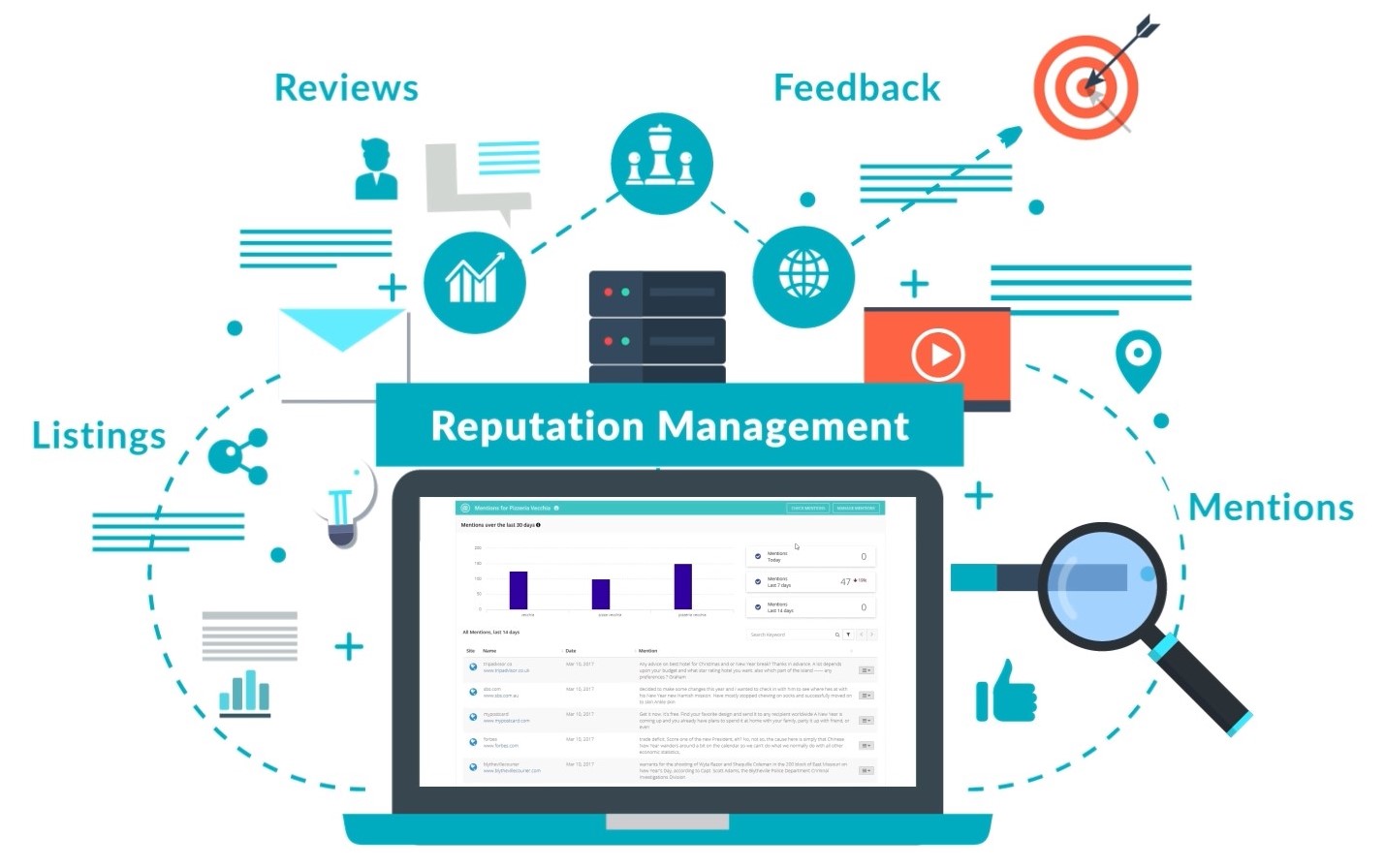
Online reputation management used to be treated as a branding exercise — something that influenced how people felt about your business after discovering it.
That is no longer the case.
Today, reputation plays a direct role in whether your business gets discovered at all.
AI-powered search engines and modern algorithms evaluate a wide range of external signals, including:
- Customer reviews and ratings
- Response consistency and engagement
- Third-party mentions and validation
- Accuracy of business listings
These signals help systems determine whether your business is trustworthy enough to recommend.
In fact, visibility is increasingly dependent on whether your brand is:
- Included in AI-generated answers
- Featured in local search results
- Selected as a recommended option
If your reputation signals are weak or inconsistent, your business may be excluded entirely — even if your website is well-optimized.
This marks a critical shift:
Visibility is no longer earned solely through SEO — it is earned through trust and reputation signals across the web.
Reputation and SEO: How Reviews Influence Organic Visibility

Online reviews have become one of the most influential factors in organic search performance. They affect not only rankings but also how users interact with your listing.
1. Local Pack and Map Visibility (Discovery Stage)
When users search for local services, search engines prioritize businesses that demonstrate strong credibility.
Reviews play a major role in this process by influencing:
- Local pack rankings
- Map visibility
- Proximity-based recommendations
Data shows that reviews contribute significantly to local ranking factors, helping search engines determine which businesses deserve prominent placement.
Key elements that impact visibility include:
- Volume of reviews
- Average rating
- Recency of feedback
- Consistency across platforms
Businesses with strong review profiles are more likely to appear during the initial discovery stage, where users are exploring options.
2. Click-Through Rate (CTR) and Selection Behavior (Decision Stage)
Even when your business appears in search results, reputation determines whether users click.
Listings with:
- Higher star ratings
- Positive review snippets
- Strong brand perception
…consistently attract more clicks.
This directly impacts click-through rate (CTR), which is an important behavioral signal for search engines. A higher CTR indicates relevance and trustworthiness, reinforcing your position in search results.
However, the rise of AI search introduces a new challenge:
- Many searches now end without a click because answers are displayed directly
This means your reputation must be strong enough to:
- Earn a mention in the AI-generated answer
- Influence the user’s perception instantly
- Stay memorable even without a website visit
3. Sentiment as a Quality Proxy
Search engines and AI systems no longer rely solely on numerical ratings — they analyze the actual content of reviews.
This includes:
- Language patterns
- Emotional tone
- Repeated themes
AI models interpret sentiment to understand real customer experiences. Positive sentiment signals quality and reliability, while negative patterns can reduce visibility.
For example:
- Consistent praise for service and product quality increases trust
- Repeated complaints about delays or poor support weaken credibility
AI systems then summarize this sentiment into recommendations or descriptions, shaping how your brand is presented.
In this sense, sentiment acts as a quality proxy, helping platforms determine:
- Whether your business is worth recommending
- How it should be described to potential customers
How Online Reviews Support SEO Beyond Just Star Rating

While star ratings are important, the true SEO value of reviews goes far beyond a simple score.
Search engines and AI systems extract deeper insights from review content, including:
1. Keyword Relevance From Real Customers
Reviews naturally include keywords that reflect how customers describe your business. This helps search engines better understand:
- Your services
- Your strengths
- Your relevance to specific queries
Unlike traditional keyword optimization, this content is authentic and continuously updated.
2. Fresh Content Signals
Regular reviews signal that your business is active and engaged.
Fresh content:
- Improves crawl frequency
- Keeps listings up to date
- Strengthens relevance over time
Search engines favor businesses that show ongoing customer interaction rather than static profiles.
3. Increased Engagement and Trust Signals
When businesses respond to reviews, it demonstrates:
- Customer care
- Responsiveness
- Operational reliability
These engagement signals contribute to overall trust, which plays a role in both rankings and user decisions.
4. Broader Digital Footprint
Reviews appear across multiple platforms — not just your website.
AI systems aggregate data from:
- Review platforms
- Directories
- Third-party sites
This creates a multi-source reputation profile, which is far more influential than on-site content alone.
5. Influence on AI Recommendations
In AI-driven search, reviews are one of the most important data sources.
AI tools:
- Analyze review trends
- Summarize customer experiences
- Recommend businesses based on consensus
This means reviews don’t just support SEO — they directly shape how your brand is presented in AI answers.
3 Ways Reviews Can Affect Paid Ad Costs and Returns

Online reviews don’t just influence organic search — they play a powerful role in how paid ads perform, how much you pay, and the quality of results you get.
Advertising platforms like Google Ads increasingly rely on user behavior signals and trust indicators to determine ad visibility, cost efficiency and performance. Reviews directly shape those signals.
1. More Skeptical Clicks = Lower Conversion Rates
Not all clicks are equal — and reputation determines whether clicks turn into actual customers.
When users see ads from businesses with weak or inconsistent reviews, they often click with hesitation. These are skeptical clicks, driven by curiosity rather than trust.
This leads to:
- Higher bounce rates
- Lower conversion rates
- Wasted ad spend
Even if your ad copy is compelling, poor reputation creates friction after the click.
In contrast, strong reviews pre-qualify users before they click. People who engage with highly rated businesses are already confident in their decision, which significantly improves conversion outcomes.
Data shows that businesses with stronger review profiles see substantially higher conversion rates and customer trust, with conversion rates rising from 18% to 38% as review volume and quality improve.
This means reputation doesn’t just influence whether users click — it determines whether those clicks are valuable.
2. Reputation Affects Expected Click Behavior
Paid advertising platforms predict how users will interact with your ads. This prediction — known as expected click-through rate (CTR) — is a critical factor in ad performance.
Reviews directly influence this expectation.
Ads that display:
- High star ratings
- Positive review snippets
- Strong brand perception
…naturally attract more attention and engagement.
Higher CTR signals relevance to platforms like Google Ads, which leads to:
- Better ad placements
- Higher Quality Scores
- Lower cost-per-click (CPC)
CTR is one of the key components of Quality Score, and improving it can significantly reduce advertising costs while increasing visibility.
Additionally, ads featuring reviews consistently outperform generic ads by:
- Increasing engagement
- Building immediate trust
- Driving more qualified clicks
Reputation shapes how platforms predict user behavior — and those predictions directly affect how efficiently your budget is spent.
3. Trust Impacts Lead Quality
Beyond clicks and conversions, reputation also influences the quality of leads your ads generate.
When your brand has a strong reputation:
- Users arrive with clear expectations
- They are more aligned with your pricing and offering
- They are more likely to convert into long-term customers
Research shows that businesses with strong review profiles attract customers who:
- Spend more
- Return more frequently
- Refer others more often
This happens because reviews act as a filter. They communicate:
- What your business does well
- Who your services are best suited for
- What customers can expect
As a result, your ad traffic becomes more qualified and conversion-ready, improving overall return on ad spend (ROAS).
On the other hand, poor or unclear reputation attracts mismatched leads — increasing refund rates, dissatisfaction and wasted budget.
How Reviews Affect Conversions (Organic, Ads and Beyond)

Reviews influence conversions across every stage of the customer journey — not just in ads or search results.
They act as decision accelerators, helping users move from consideration to action faster.
1. Reviews Reduce Decision Friction
When users evaluate multiple options, uncertainty is the biggest barrier to conversion.
Reviews eliminate that uncertainty by providing:
- Real experiences
- Social proof
- Risk reduction
Users trust other customers more than brand messaging, and that trust often forms in seconds.
In fact, consumers rely heavily on reviews to validate decisions, often choosing businesses with stronger social proof even if they are not the cheapest option.
2. Reviews Influence Both Click and Post-Click Behavior
The impact of reviews doesn’t stop at the click.
Before clicking:
- Reviews influence CTR
- They determine which brand gets attention
After clicking:
- They reinforce confidence
- They increase the likelihood of completing an action
Strong review signals can lead to:
- Longer time on site
- Higher engagement
- Improved conversion rates
This dual impact makes reviews one of the most powerful conversion drivers across both organic and paid channels.
3. Reviews Shape Zero-Click Decisions
In modern search experiences, many users make decisions without ever visiting a website.
Search engines and AI platforms often display:
- Ratings
- Review summaries
- Key feedback highlights
This means users can:
- Compare businesses
- Form opinions
- Make decisions
…directly within search results.
Positive reviews increase the likelihood of being chosen — even in zero-click environments.
4. Reviews Build Long-Term Conversion Momentum
Reviews don’t just influence individual conversions — they compound over time.
A strong review profile:
- Builds brand credibility
- Improves repeat purchase rates
- Increases referrals
This creates a cycle where:
Better reputation → Better conversions → More positive reviews → Even stronger reputation
Over time, this becomes a sustainable competitive advantage that is difficult for competitors to replicate quickly.
Your Online Reputation Shapes How Platforms Describe Your Brand

In the era of AI-powered search, platforms don’t just display your business — they interpret and describe it.
These descriptions are heavily influenced by your online reputation.
1. AI Uses Reviews to Summarize Your Business
AI systems analyze large volumes of review data to generate summaries such as:
- “Known for fast service”
- “Highly rated for customer support”
- “Customers frequently mention delays”
These summaries are not written by you — they are derived from customer sentiment.
This means your reputation directly controls how your brand is presented.
2. Consistent Feedback Creates Stronger Brand Positioning
When reviews consistently highlight specific strengths, platforms begin to associate your brand with those qualities.
For example:
- Repeated mentions of “affordable pricing”
- Frequent praise for “quick delivery”
These patterns help AI systems confidently recommend your business for relevant queries.
Inconsistent or mixed feedback, however, weakens this positioning.
3. Negative Patterns Can Define Your Brand
AI doesn’t ignore negative feedback — it identifies patterns.
If multiple reviews mention the same issue (e.g., poor communication or delays), platforms may highlight those concerns in summaries.
This can:
- Reduce trust before users even engage
- Lower your chances of being recommended
In many cases, these summaries influence perception more than your own marketing content.
4. Third-Party Sources Matter More Than Your Website
Your website describes your brand from your perspective.
But AI systems prioritize independent, third-party validation, including:
- Review platforms
- Directories
- Forums and mentions
This creates a more objective brand profile — one that is shaped by public perception rather than internal messaging.
5. Reputation Determines Inclusion in AI Answers
AI-generated answers often highlight only a small number of businesses.
To be included, your brand must demonstrate:
- Trustworthiness
- Consistency
- Positive sentiment
If your reputation signals are weak, your business may not appear at all — regardless of your SEO or ad spend.
5 Practical Tips to Maintain Good Standing With Search Engines and Customers
Managing your reputation requires consistent effort, not occasional fixes. The following strategies help ensure your brand remains visible, trusted and competitive.
1. Monitor and Respond Consistently
Active engagement is a strong trust signal.
Responding to reviews shows:
- Accountability
- Customer care
- Transparency
It also helps mitigate negative feedback by demonstrating that issues are addressed.
Search engines and users both favor businesses that engage consistently.
2. Encourage Detailed, Authentic Feedback
Not all reviews are equally valuable.
Detailed reviews provide:
- Rich context for AI systems
- Keyword relevance for search engines
- Better insights for potential customers
Encourage customers to share:
- Specific experiences
- Outcomes
- Use cases
Authenticity matters more than perfection — a mix of reviews often appears more trustworthy than flawless ratings.
3. Address Recurring Issues Revealed Through Reviews
Reviews are not just feedback — they are a diagnostic tool.
Look for patterns such as:
- Repeated complaints
- Service bottlenecks
- Product issues
Fixing these problems improves:
- Customer satisfaction
- Future reviews
- Overall reputation
Ignoring patterns allows negative sentiment to accumulate, which can harm both visibility and conversions.
4. Maintain a Consistent Brand Voice Across Platforms
Your brand should feel consistent everywhere users encounter it.
This includes:
- Review responses
- Business descriptions
- Social media interactions
Consistency reinforces trust and helps platforms better understand your brand identity.
It also ensures that users receive the same message regardless of where they engage with you.
5. Keep Listings Accurate Everywhere
Inaccurate information can damage both trust and visibility.
Ensure consistency across:
- Business name
- Address and contact details
- Operating hours
- Service descriptions
Search engines rely on this data to validate your business. Inconsistencies can reduce credibility and impact rankings.
How Pro Real Tech Helps You Turn Reputation Into Visibility
Building a strong online reputation is no longer just about managing perception — it’s about actively influencing how search engines, advertising platforms and AI systems evaluate and recommend your business.
This is where Pro Real Tech plays a critical role.
As a full-service digital agency, Pro Real Tech combines online reputation management, SEO, and digital marketing strategies to help businesses transform reputation signals into measurable visibility and growth.
1. Strategic Reputation Management That Goes Beyond Damage Control
Pro Real Tech approaches reputation management as a proactive growth strategy, not just a reactive fix.
Instead of only addressing negative reviews, their ORM services focus on:
- Strengthening positive brand perception
- Amplifying customer feedback
- Creating a consistent and trustworthy online presence
They emphasize that a damaged reputation can significantly impact customer trust and business growth — making proactive management essential in today’s digital landscape.
This aligns directly with modern search behavior, where:
Platforms prioritize businesses with strong, consistent and positive sentiment signals.
2. Review Management That Drives Trust and Conversions
Reviews are one of the most influential signals across SEO, ads and AI systems — and Pro Real Tech treats them as a core asset.
Their review management services help businesses:
- Encourage authentic customer feedback
- Improve review quality and consistency
- Address negative reviews strategically
By ensuring reviews accurately reflect the business experience, they help build trust signals that influence both visibility and conversions.
This directly supports:
- Higher click-through rates
- Better conversion rates
- Stronger AI-generated recommendations
3. Local SEO and Google Business Optimization for Discovery
Visibility in local search and map results depends heavily on reputation signals.
Pro Real Tech enhances this through:
- Google Business Profile optimization
- Local SEO strategies
- Accurate business listing management
Their approach ensures businesses appear more prominently in:
- Local pack results
- Map searches
- Location-based queries
By combining SEO with reputation management, they improve both:
- Discovery (being found)
- Selection (being chosen)
4. Content and Brand Narrative Control
AI systems and search engines increasingly rely on external content to understand and describe your brand.
Pro Real Tech helps shape that narrative through:
- Content management strategies
- Positive brand storytelling
- Consistent messaging across platforms
They actively manage how your business is presented online, ensuring that:
- Positive experiences are highlighted
- Brand positioning remains consistent
- Trust signals are reinforced
This is critical in AI-driven search, where platforms generate summaries based on aggregated content.
5. Continuous Monitoring, Analysis and Optimization
Reputation is not static — it evolves constantly.
Pro Real Tech uses ongoing monitoring and analysis to:
- Track review trends
- Identify emerging issues
- Adjust strategies in real time
Their process includes:
- Online presence audits
- competitor analysis
- performance tracking and reporting
This ensures your reputation remains:
- Relevant
- Competitive
- Optimized for visibility
6. Crisis Management and Reputation Recovery
Negative feedback, misinformation or sudden reputation issues can quickly impact visibility.
Pro Real Tech provides structured crisis management to:
- Mitigate negative impact
- Restore brand trust
- Rebuild credibility
Rather than reacting late, they develop proactive plans to handle potential risks effectively.
This is especially important in AI environments, where negative sentiment can be quickly amplified and summarized.
7. Integrated Digital Marketing for Full Visibility Growth
What makes Pro Real Tech particularly effective is its integrated approach.
They combine:
- SEO
- Social media marketing
- content creation
- paid advertising
…with reputation management to create a unified visibility strategy.
This ensures that:
- Reputation signals support SEO rankings
- Reviews enhance ad performance
- Brand perception aligns across all platforms
The result is not just better reputation — but measurable improvements in traffic, conversions and revenue.
Frequently Asked Questions (FAQs) About Reputation’s Impact on Search, Ads and AI Answers
HOW REPUTATION AFFECTS SEARCH RANKINGS FOR LOCAL BUSINESSES?
Reputation plays a significant role in local search rankings. Search engines evaluate factors such as:
- Review quantity
- Average rating
- Recency of feedback
- Overall sentiment
Businesses with stronger reputation signals are more likely to appear in local pack results and map listings. These signals help search engines determine which businesses are trustworthy and relevant for local queries.
WHAT IS ONLINE REPUTATION MANAGEMENT?
Online Reputation Management (ORM) is the process of monitoring, influencing and maintaining how a business is perceived online.
It includes:
- Managing customer reviews
- Responding to feedback
- Improving brand sentiment
- Controlling online narratives
ORM ensures that your digital presence reflects a positive and accurate image of your business.
WHAT IS THE LINK BETWEEN REPUTATION AND SEO?
Reputation and SEO are closely connected because search engines use trust signals to rank businesses.
Reviews contribute to:
- Keyword relevance
- content freshness
- user engagement signals
Positive reputation strengthens SEO performance, while negative sentiment can reduce visibility.
DO ONLINE REVIEWS AND SEO REALLY IMPACT EACH OTHER?
Yes — reviews directly influence SEO.
They:
- Provide fresh, user-generated content
- Improve click-through rates
- Signal trust and authority
Search engines analyze both the quantity and quality of reviews when determining rankings.
WHAT IS THE REPUTATION IMPACT ON GOOGLE RANKINGS?
Reputation impacts rankings by influencing:
- Local search placement
- user behavior signals (CTR, engagement)
- trustworthiness of your business
A strong reputation increases your chances of ranking higher, especially in local and competitive search results.
HOW DO REVIEWS AFFECT CONVERSIONS?
Reviews act as social proof, reducing uncertainty and building trust.
They:
- Influence decision-making
- Increase confidence in your brand
- encourage faster conversions
Businesses with strong reviews typically experience higher conversion rates across both organic and paid channels.
HOW DOES REPUTATION AND PAID ADS PERFORMANCE CONNECT?
Reputation affects paid ads through:
- Click-through rate (CTR)
- conversion rate
- lead quality
Ads from well-reviewed businesses attract more qualified users and perform better, often reducing cost-per-click and improving return on ad spend.
WHAT SHOULD A REPUTATION MANAGEMENT STRATEGY INCLUDE?
An effective strategy should include:
- Review monitoring and response
- Feedback collection systems
- sentiment analysis
- consistent brand messaging
- crisis management planning
It should also integrate with SEO and marketing efforts for maximum impact.
CAN AI TOOLS SUMMARIZE MY BUSINESS USING REVIEWS?
Yes. AI tools analyze review content to generate summaries of your business.
They identify patterns such as:
- common strengths
- recurring issues
- overall sentiment
These summaries influence how your brand is presented in AI-generated answers.
WHAT’S THE FASTEST WAY TO IMPROVE BRAND REPUTATION ONLINE?
The fastest way is to focus on:
- Encouraging recent, authentic reviews
- Responding to all feedback quickly
- Fixing recurring customer issues
- Ensuring accurate business information
Consistency is key — even small improvements in review quality and engagement can quickly enhance perception and visibility.
Read More: Secondary Keywords: What They Are and How to Use Them


