


Getting your business to show up in ChatGPT is becoming an important part of modern search visibility. People are increasingly asking AI assistants questions such as “What are the best marketing agencies near me?”, “Which accounting firms specialize in small businesses?” or “What company should I use for this service?” Instead of returning a traditional list of blue links, ChatGPT can use web information to generate a direct answer and provide links to relevant sources.
However, there is no simple submission form or guaranteed ranking position that puts a business at the top of ChatGPT results. ChatGPT Search considers multiple factors when determining which information is relevant and useful, and placement is not guaranteed. OpenAI also states that websites need to allow its search crawler, OAI-SearchBot, to access their content if they want their pages to be eligible for inclusion in ChatGPT search results.
That means the goal is not to “rank in ChatGPT” in exactly the same way you would rank a page in Google. Instead, businesses should build a strong digital presence that makes their information discoverable, understandable, relevant, consistent and trustworthy.
A practical ChatGPT visibility strategy starts with several fundamentals:
- Make important website content accessible to search crawlers.
- Create content around real conversational questions.
- Give direct, well-structured answers.
- Clearly explain what your business does and who it serves.
- Keep business information consistent across online platforms.
- Build credible third-party mentions and reviews.
- Demonstrate expertise through useful, original content.
- Strengthen local relevance when location influences purchasing decisions.
The objective is to create a business presence that AI systems can confidently understand and connect with relevant user questions.
What Does Showing Up in ChatGPT Actually Mean?
Showing up in ChatGPT does not necessarily mean that your homepage will appear as a traditional search result for your brand name. There are several ways your business information can become visible in an AI-generated response.
One possibility is source visibility. When ChatGPT searches the web to answer a question, it can use information from relevant webpages and provide citations or links to those sources. A business can therefore gain visibility when one of its pages contains useful information that directly supports a user’s question. ChatGPT Search is designed to provide answers using web information and may include links to relevant sources.
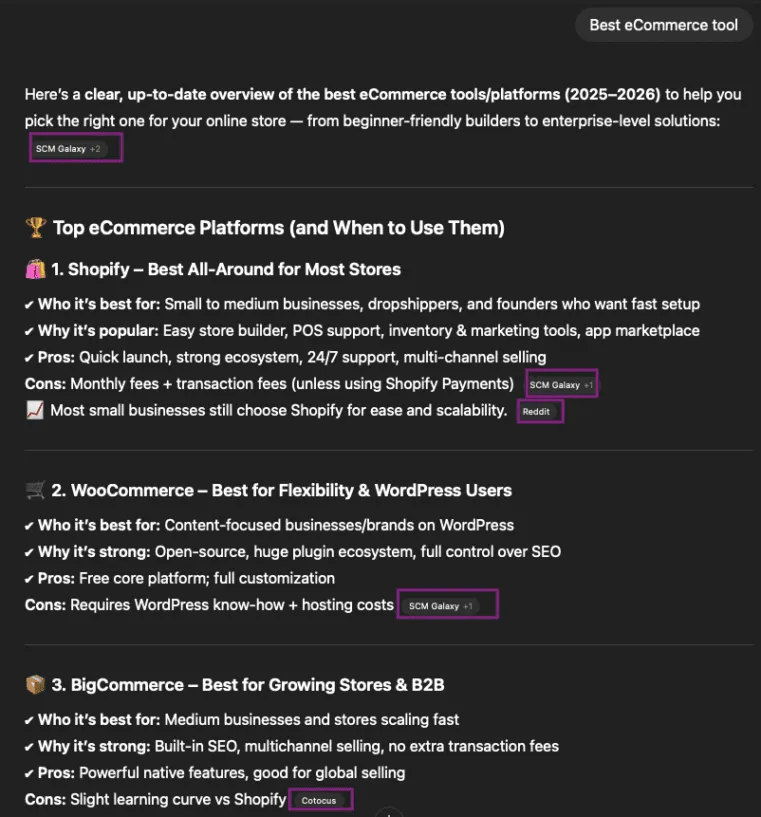
Another possibility is recommendation visibility. Someone might ask:
“What are some good digital marketing agencies for a small business?”
In this situation, ChatGPT may recommend several businesses based on information it can find about their services, expertise, location, reputation and relevance to the request.
These two types of visibility require slightly different thinking.
Source visibility depends heavily on whether your website contains useful, accessible information that can support a particular question. Recommendation visibility requires a broader digital footprint because the AI needs enough reliable information to understand what your business is known for and when it may be an appropriate recommendation.
For example, a company that clearly identifies itself as a B2B SEO agency, publishes detailed SEO resources, has consistent business information across major platforms, receives relevant industry mentions and has customer reviews discussing its expertise gives AI systems considerably more context than a company with only a basic homepage.
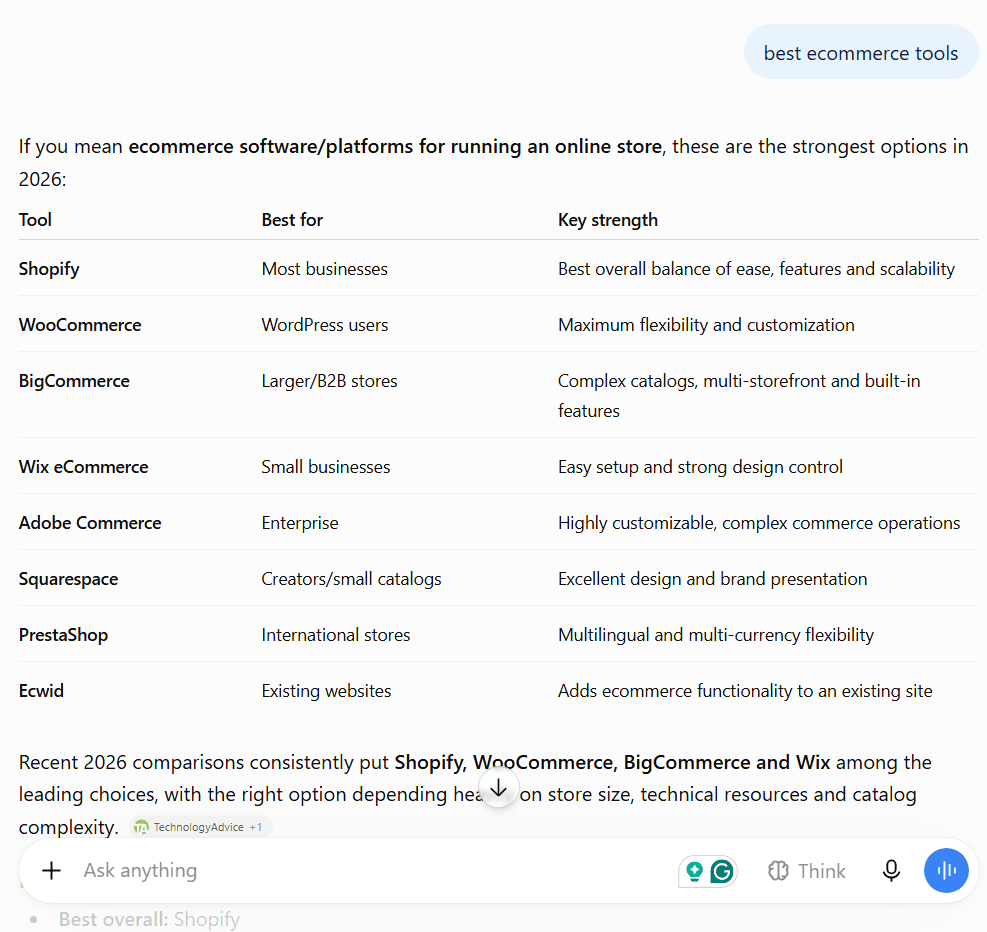
This is why ChatGPT visibility should be viewed as an entity and information-discovery problem, not simply a keyword-ranking problem.
The more clearly the web communicates who you are, what you offer, where you operate and why customers trust you, the easier it becomes for AI systems to associate your business with relevant questions.
Make Sure ChatGPT Can Crawl Your Website
Before worrying about content optimization, make sure ChatGPT can actually access the pages you want discovered.
OpenAI states that public websites can be eligible for inclusion in ChatGPT Search and recommends allowing OAI-SearchBot to crawl website content. Website owners should also make sure their hosting environment or content delivery network permits traffic from OpenAI’s published searchbot IP addresses.
This makes technical accessibility an important foundation for AI search visibility.
Check your robots.txt file
Review your site’s robots.txt configuration and make sure you are not unintentionally blocking OAI-SearchBot from important pages.
A website can have excellent content and strong authority, but if relevant pages cannot be accessed by the appropriate crawler, that content may not be available for search discovery.
Do not assume that allowing every crawler is automatically the best choice. Review your site’s crawling policies deliberately and decide which content should be publicly discoverable.
Keep important content publicly accessible
Important business information should not depend entirely on logins, registration walls or inaccessible interfaces.
For example, make essential information such as these pages publicly available:
- Services and product pages
- About page
- Location and contact information
- Pricing information, when appropriate
- Industry or solution pages
- Helpful educational resources
- Case studies
- Frequently asked questions
- Authoritative guides and articles
If an important page requires a user to log in before the information can be viewed, a crawler may not be able to use that information in the same way as publicly accessible content.
Build a logical website structure
Your most important pages should be easy to discover through normal navigation and internal links.
A simple structure might look like:
Homepage → Services → Specific Service → Supporting Guides → Case Studies
For example, a digital marketing company might have:
Digital Marketing → SEO → Local SEO → Local SEO Guide → Local SEO Case Study
This creates meaningful relationships between related pages and helps both users and search systems understand how the site’s information fits together.
Fix broken links and technical barriers
Regularly check for:
- Broken internal links
- Incorrect redirects
- Pages returning server errors
- Orphan pages
- Accidentally blocked resources
- Incorrect canonical tags
- Poor mobile usability
- Extremely slow-loading pages
- Unnecessary URL complexity
Technical SEO remains important for AI visibility because AI search still depends on accessible web content. Clean architecture makes it easier for search systems to discover and interpret the information you publish.
Use clear HTML and page structure
Organize each page with a meaningful hierarchy of headings and content.
Use one clear H1 for the primary topic, followed by logical H2 and H3 sections. Keep related information together rather than scattering essential facts across unrelated pages.
Structured data can also provide machine-readable context about certain types of content. Schema markup should not be treated as a guaranteed method for appearing in ChatGPT, but it can help clearly communicate information about supported entities and content types.
The broader principle is simple: make your website easy for both people and machines to understand.
Target Conversational, High-Intent Queries
Traditional SEO often begins with keyword research. ChatGPT optimization requires going one step further by thinking about the questions and situations behind those keywords.
A customer rarely thinks only in keywords when talking to an AI assistant. Instead, they describe a problem, provide context and ask for a recommendation.
For example, someone searching traditionally might type:
“best accounting firm Dallas”
The same person could ask ChatGPT:
“Can you recommend a reliable accounting firm in Dallas for a small business that needs monthly bookkeeping and tax preparation?”
The second query contains substantially more context.
It identifies:
- The desired service
- The location
- The business type
- The customer’s needs
- The decision criteria
- The desired outcome
Your content should therefore answer the kinds of detailed questions potential customers are likely to ask.
Move beyond individual keywords
Instead of creating a page around only:
“digital marketing agency”
consider the wider set of questions surrounding the customer’s decision:
- What does a digital marketing agency do?
- How much does digital marketing cost?
- How do I choose a digital marketing agency?
- What services should a small business expect?
- Which agency specializes in local businesses?
- What should I ask before hiring an agency?
- How long does SEO take to produce results?
- Which digital marketing services are best for generating leads?
These questions reveal search intent, not just search vocabulary.
Creating useful content around them gives your business more opportunities to become relevant to conversational searches.
Focus on high-intent questions
Not every query has equal commercial value.
Informational questions such as “What is SEO?” can generate awareness, but high-intent questions such as “Which SEO agency should I hire for a healthcare business?” are closer to a purchasing decision.
Prioritize questions across the customer journey:
Awareness
“What is local SEO?”
Consideration
“How do I choose a local SEO agency?”
Evaluation
“What should I compare when choosing between local SEO agencies?”
Decision
“Which local SEO agencies specialize in multi-location businesses?”
This approach creates a stronger connection between your content and real customer needs.
Write for natural language
Do not force awkward exact-match phrases into your content simply because they contain a target keyword.
Instead of repeatedly writing:
“best SEO agency for small business”
write naturally:
“Small businesses should look for an SEO agency that understands their target market, service area, competition and budget.”
This provides semantic context around the topic while remaining useful to the reader.
The goal is not to predict one exact sentence someone will type into ChatGPT. It is to build comprehensive topical relevance around the problems your business solves.
Create Clear, Easy-to-Extract Answers
Once your website is crawlable and your content addresses relevant questions, the next step is making the information easy to understand and extract.
ChatGPT can search the web and synthesize information into an answer rather than simply reproducing an entire webpage. That makes content clarity particularly important.
A useful rule is:
Answer the question first, then explain it.
If a page asks, “How much does local SEO cost?”, do not make the reader search through five paragraphs before discovering the answer.
Start with a concise explanation, then provide the supporting details.
Put the answer near the beginning
For example:
Local SEO costs vary depending on the business’s location, competition, number of locations and required services. Monthly pricing can range from basic local optimization to comprehensive campaigns that include content, reputation management and ongoing technical SEO.
The reader immediately understands the main point. The sections that follow can explain the variables in greater detail.
Use short paragraphs
Large blocks of text make important information harder to scan.
Break complicated subjects into manageable sections. A strong structure might include:
- A direct answer
- A short explanation
- Key factors
- Examples
- Practical steps
- Frequently asked questions
This format benefits human readers while also creating clearly separated pieces of information that search systems can interpret.
Use lists when information is naturally list-based
Bullets and numbered steps are especially useful for:
- Features
- Benefits
- Selection criteria
- Procedures
- Requirements
- Comparisons
- Common mistakes
- Frequently asked questions
For example, if explaining how to choose an agency, a numbered list could identify:
- Define your business goals.
- Identify the services you actually need.
- Review relevant experience.
- Examine case studies and evidence.
- Compare communication and reporting processes.
- Evaluate pricing and expected deliverables.
Use descriptive headings
Headings should tell the reader exactly what the section contains.
Weak:
“Some Important Things”
Better:
“What to Look for When Choosing an SEO Agency”
The second heading establishes clear topical context before the paragraph even begins.
Keep important business facts explicit
Do not make readers or search systems infer basic information.
Clearly state:
- Business name
- Main services
- Products
- Locations served
- Industries served
- Areas of expertise
- Years of experience, when relevant
- Certifications or qualifications
- Contact information
- Unique capabilities
For example, instead of:
“We help businesses grow online.”
use something more specific:
“ABC Digital provides SEO, paid advertising and conversion optimization services for B2B software companies in the United States.”
The second statement gives substantially more context about who the business is, what it does and whom it serves.
Clear information architecture and explicit answers do not guarantee that ChatGPT will cite or recommend a business. However, they improve the quality and accessibility of the information that AI-powered search can evaluate. ChatGPT itself notes that search placement depends on multiple factors and is not guaranteed.
Strengthen Brand and Entity Signals
For ChatGPT to recommend a business accurately, it needs more than a collection of keywords. It needs enough information to understand who the business is, what it does, where it operates, whom it serves, and what it is known for. This is where brand and entity signals become important.
An entity is a distinct, identifiable business or organization that can be associated with a set of attributes across different sources. Your website may describe your company one way, while business directories, review platforms, industry publications, social profiles and other websites may provide additional information. The stronger the connections between these sources, the easier it is for AI-powered search systems to build a consistent understanding of your business.
Make your business identity explicit
Your website should clearly communicate your core identity rather than leaving important information implied.
Include consistent information about:
- Business name
- Main products or services
- Primary industry
- Target customers
- Geographic coverage
- Areas of specialization
- Physical location, when relevant
- Contact information
- Company history
- Credentials and certifications
- Important team members
- Distinctive expertise or capabilities
Your homepage and About page are particularly important because they provide foundational context about the organization.
For example, instead of saying:
“We help companies grow with innovative solutions.”
a stronger description would be:
“ABC Digital is a digital marketing agency specializing in SEO, paid advertising and conversion optimization for small and mid-sized businesses in the United States.”
The second description establishes several clear relationships: business → industry → services → target audience → market.
Build a recognizable brand footprint
Your brand should not exist only on your own website.
Create and maintain legitimate profiles and references on relevant platforms, such as:
- Business directories
- Industry associations
- Professional organizations
- Review platforms
- Social media profiles
- Local business listings
- Relevant publisher websites
- Partner websites
- Industry communities
The objective is not to create hundreds of low-quality profiles. It is to establish a credible and consistent presence in places where customers and industry participants would reasonably expect to find the business.
Connect your brand to your expertise
A business becomes easier to associate with a particular topic when its content, mentions and services consistently reinforce that expertise.
For example, if your company specializes in local SEO, your website could publish detailed resources about:
- Google Business Profile optimization
- Local search visibility
- Local citations
- Reputation management
- Location pages
- Local search analytics
- Multi-location SEO
Over time, these related signals can help establish a clearer association between the company and its area of expertise.
The important point is to demonstrate expertise rather than simply claiming it.
Use structured data where appropriate
Schema markup can provide machine-readable information about entities and content. Depending on the business and website, relevant structured data may include Organization, LocalBusiness, Product, Service, Article, Person or other supported types.
Structured data is not a shortcut to ChatGPT recommendations, and adding schema does not guarantee AI visibility. Its value is in making information more explicit and machine-readable when the markup accurately reflects visible content.
The broader objective is consistency: your structured data, visible website content and external business information should describe the same real-world entity.
Keep Business Information Consistent Across the Web
AI systems often have to reconcile information from multiple sources. If your company has different names, addresses, phone numbers, service descriptions or locations across the internet, it becomes harder to determine which information is accurate.
That is why consistency is an important part of building trust around your business entity.
Maintain consistent core business information
Start by auditing your most important business details across your online presence.
Check whether the following information matches:
- Official business name
- Website URL
- Phone number
- Physical address
- Service area
- Business category
- Opening hours
- Main services
- Product information
- Company description
- Social profile information
For a local business, even small discrepancies can create confusion. For example, one listing might use “ABC Engineering Ltd.” while another uses “ABC Engineering & Consultancy,” with a different phone number and address.
If both refer to the same company, make the relationship clear and standardize the information wherever possible.
Keep your website as the primary source of truth
Your website should contain accurate, up-to-date information about your business.
If your company moves to a new location, launches a new service or changes its phone number, update the website and then review other important listings and profiles.
This is especially important for businesses with multiple locations. Each location should have accurate information rather than copying outdated details from another branch.
Audit important third-party profiles
Create a list of the platforms where your business appears and periodically check them.
Look for:
- Duplicate listings
- Outdated descriptions
- Incorrect addresses
- Old phone numbers
- Incorrect categories
- Closed locations that still appear active
- Old branding
- Broken website links
- Outdated service information
You do not need to update every mention of your business on the internet. Prioritize authoritative, relevant and customer-facing sources.
Avoid inconsistent claims
Consistency also applies to what your business claims to be.
Suppose your website describes the company as a cybersecurity consultancy, your LinkedIn profile calls it an IT support provider, and several directories describe it as a web development company. Even if the company genuinely offers all three services, the lack of a consistent primary positioning can make its expertise less obvious.
Create a clear core description and use variations only when they accurately reflect the context.
This does not mean copying the exact same sentence everywhere. It means maintaining the same underlying facts and positioning.
Earn Third-Party Mentions and Citations
Your own website tells AI systems what you say about your business. Independent sources can provide additional evidence that other people and organizations recognize the business for those same capabilities.
This makes third-party mentions and citations an important part of building a stronger online presence.
A mention can come from an industry publication, news website, professional organization, podcast, conference, partner, supplier, local publication or other relevant source.
Prioritize relevance over quantity
A hundred irrelevant directory links are not necessarily more valuable than a handful of genuine mentions from respected sources.
For example, a software company would benefit more from being discussed by a respected technology publication or industry analyst than from appearing on dozens of unrelated general-purpose websites.
Look for opportunities that naturally fit your business:
- Industry publications
- Local news outlets
- Professional associations
- Relevant podcasts
- Expert interviews
- Industry conferences
- Partner websites
- Supplier or client stories
- Business awards
- Research collaborations
- Expert commentary
Create something worth mentioning
The easiest way to earn legitimate citations is to produce information other people actually have a reason to reference.
Consider publishing:
- Original statistics
- Industry surveys
- Research reports
- Expert commentary
- Proprietary benchmarks
- Market analysis
- Detailed case studies
- Unique tools or calculators
- Comprehensive industry guides
For example, an SEO agency could conduct a survey of 500 small businesses about their local search challenges and publish the findings. Other websites may then reference those statistics when discussing local SEO.
This creates a much stronger reason for third parties to mention the company than simply asking them to add a link.
Participate in genuine industry conversations
Businesses can also strengthen their visibility by contributing expertise to relevant discussions.
This could include:
- Answering journalist requests
- Appearing on industry podcasts
- Speaking at professional events
- Contributing expert opinions
- Participating in industry research
- Collaborating with complementary businesses
- Publishing guest contributions on relevant publications
The emphasis should be on real expertise and genuine contribution, not manufactured mentions.
Think beyond backlinks
For traditional SEO, marketers often focus heavily on links. For AI visibility, it is useful to think more broadly about brand references and corroborating information.
A relevant article that describes what your company specializes in can help establish context even when the purpose of the article is not primarily to provide a backlink.
Your objective should therefore be to build a web presence in which independent sources repeatedly and naturally associate your business with the topics, services, locations and expertise you want to be known for.
Build and Monitor Customer Reviews
Customer reviews provide another source of information about your business. They show how real customers describe their experiences and can reveal the specific qualities associated with your products or services.
For local and service-based businesses especially, maintaining an active and credible review presence should be part of the broader visibility strategy.
Ask customers for genuine feedback
After a successful purchase or completed project, make it easy for customers to leave an honest review on the platforms that matter most to your business.
You can:
- Send a follow-up email
- Provide a review request after service completion
- Include a review link in customer communications
- Add review instructions to appropriate receipts or follow-ups
- Ask customers at an appropriate point in the customer journey
The important distinction is between requesting honest feedback and attempting to manufacture positive reviews.
Pay attention to what customers actually say
Do not look only at your average star rating.
Read the text of reviews and identify recurring themes.
Customers might repeatedly mention:
- Fast response times
- Technical expertise
- Friendly service
- Product quality
- Transparent pricing
- Reliable delivery
- Specialized knowledge
- A particular service
- A particular location
These repeated descriptions can reveal how customers naturally associate your business with specific attributes.
They can also provide ideas for future website content.
If customers repeatedly ask about the same service or praise a particular capability, consider creating a dedicated page, guide or case study addressing that topic.
Respond professionally to reviews
Review management is not just about collecting ratings. Responding appropriately to both positive and negative feedback demonstrates that the business is active and engaged.
For positive reviews, acknowledge the customer’s experience without using repetitive promotional language.
For negative reviews, address the concern professionally and, where appropriate, explain how the issue can be resolved.
Never create fake reviews or manipulate customer feedback. Artificial reputation signals can damage trust and may violate platform policies.
Monitor your reputation regularly
Set up a process for monitoring reviews across your important platforms.
Track:
- New reviews
- Recurring complaints
- Common positive themes
- Changes in average ratings
- Customer questions
- Service-specific feedback
- Location-specific feedback
Reviews can become a valuable source of customer language. The phrases customers use can help you understand how your market describes problems, expectations and desired outcomes.
Publish Case Studies and Original Research
Generic marketing claims are easy for almost any competitor to make.
“Experienced team.”
“High-quality service.”
“Customer-focused solutions.”
“Proven results.”
These statements provide little evidence on their own.
Case studies and original research make your expertise more concrete.
Turn successful work into case studies
A strong case study explains what happened before, during and after a project.
A useful structure is:
- Client or business context
- Initial challenge
- Goals
- Strategy or approach
- Implementation
- Obstacles encountered
- Measured results
- Lessons learned
Where confidentiality allows, include meaningful details.
For example, instead of:
“We significantly improved organic traffic.”
provide measurable context:
“After implementing the technical SEO and content strategy, organic sessions increased by X% over Y months, while qualified leads increased by Z%.”
Specific evidence gives readers a much clearer understanding of the company’s capabilities.
Publish original research
Original research can be even more valuable because it creates information that did not previously exist in the same form.
Businesses can collect and publish:
- Customer survey results
- Industry statistics
- Pricing studies
- Performance benchmarks
- Market trends
- Product usage data
- Internal experiments
- Comparative testing
- Annual industry reports
The research should explain the methodology clearly enough for readers to understand where the findings came from.
Make proprietary information easy to understand
Do not bury important findings inside a massive report.
Summarize the key results near the beginning, then provide methodology and supporting details.
For example:
Key finding: 64% of surveyed small businesses reported that local search visibility was a major source of qualified leads.
Then explain:
- Who participated
- When the research was conducted
- How many responses were collected
- How questions were structured
- How results were analyzed
- What limitations apply
This makes the content useful to both human readers and systems attempting to understand the information.
Update research as new data becomes available
Original research can become a long-term authority asset when it is maintained.
If you publish an annual report, maintain a consistent methodology where possible and clearly distinguish new findings from historical data. This creates an evolving source of information that journalists, researchers, industry professionals and other websites may have reasons to reference.
Ultimately, the objective is bigger than simply getting a business mentioned in ChatGPT. Build a web presence where your business identity, expertise, reputation and evidence are consistently reinforced by your own content and credible independent sources. The stronger and clearer that information ecosystem becomes, the easier it is for AI-powered search systems to understand when your business is relevant to a customer’s question.
Strengthen Local Relevance
For businesses that serve a specific city, region, or service area, local relevance can play an important role in ChatGPT visibility. ChatGPT Search can use location context when generating local results, so businesses should make it clear where they operate and which customers they serve.
Start by making your location information explicit across your website. Your contact page, service pages, About page, and relevant location pages should clearly identify your primary market and service areas.
For example, instead of simply saying:
“We provide plumbing services for residential and commercial customers.”
a locally focused business could say:
“We provide residential and commercial plumbing services throughout Denver and the surrounding metropolitan area.”
That gives search systems useful context about both the service and geographic relevance.
Strengthen local signals across important platforms
Keep your core business information consistent across your website, Google Business Profile, relevant directories, review platforms, social profiles, and local publications.
Important local signals include:
- Business name
- Physical address
- Phone number
- Service areas
- Business category
- Opening hours
- Local services
- Location-specific customer reviews
- Local media mentions
- Relevant local directory listings
For businesses with multiple locations, create useful location-specific pages rather than publishing dozens of nearly identical pages with only the city name changed.
Each location page should provide genuinely useful information about that branch, such as services available there, service area, staff, facilities, customer questions, local projects, or relevant case studies.
Earn local recognition
Local authority can also come from sources outside your website.
Look for legitimate opportunities to be mentioned by:
- Local news publications
- Chambers of commerce
- Industry associations
- Community organizations
- Local event websites
- Regional publications
- Local business directories
- Relevant neighborhood or industry resources
The goal is not to accumulate arbitrary local links. It is to establish a credible connection between your business, your services, and your geographic market.
Create content around local customer needs
A local business can also strengthen relevance by answering questions that customers in its market actually ask.
For example, a roofing company could publish content about:
- Roofing requirements for homes in its area
- Common weather-related roofing problems
- Local roof maintenance considerations
- Typical project timelines
- Questions homeowners should ask before hiring a roofer
This creates a stronger topical and geographic relationship than repeatedly inserting a city name into generic articles.
Optimize for Recommendation-Style Searches
Showing up when someone searches for your exact business name is useful, but recommendation-style queries can create a different opportunity.
A customer might ask:
“What are the best digital marketing agencies for a small B2B company?”
or:
“Can you recommend a reliable accounting firm for a startup?”
or:
“Which web design companies specialize in ecommerce businesses?”
These questions require an AI system to determine which businesses are relevant to a particular need, rather than simply retrieving a page that matches a brand name.
That means your website should make your competitive positioning extremely clear.
Clearly explain what makes your business different
Identify the characteristics you want customers to associate with your business.
These might include:
- Industry specialization
- Geographic expertise
- Specific services
- Business size served
- Product specialization
- Technical expertise
- Certifications
- Experience
- Unique methodology
- Pricing model
- Specialized customer support
- Particular outcomes or capabilities
For example, “We provide SEO services” is broad.
A more useful positioning statement might be:
“We specialize in technical and local SEO for multi-location healthcare businesses.”
The second statement creates much stronger context around service + specialization + customer type.
Build content around recommendation questions
Think about the questions customers might ask before choosing a provider.
Create useful content addressing topics such as:
- How to choose a provider in your industry
- What services a customer should expect
- How much a service typically costs
- What qualifications to look for
- Which factors matter when comparing providers
- Common mistakes when hiring a provider
- Questions to ask before signing a contract
- How different solutions compare
This content can help establish your business as knowledgeable about the decision-making process, not merely as a company trying to sell something.
Earn inclusion in legitimate comparison content
Third-party comparison articles, industry roundups, expert lists, interviews, and reviews can also contribute to your broader digital footprint.
If independent publications discuss your company alongside other relevant providers, they create additional context around your business.
However, do not try to manufacture mentions through low-quality directories or spammy “best companies” pages. The strongest approach is to earn coverage because your company has something genuinely useful, distinctive, or authoritative to contribute.
Make your strengths easy to verify
If you claim that your company is highly experienced in a particular area, support that claim with evidence.
For example:
Claim: “We specialize in ecommerce SEO.”
Supporting evidence:
- Ecommerce SEO service page
- Ecommerce optimization guides
- Ecommerce case studies
- Client results
- Industry commentary
- Relevant customer reviews
- Third-party mentions
This creates a much stronger evidence trail than repeating the same claim throughout your website.
Ultimately, recommendation visibility is about making the answer to this question easy to establish:
“Why would this business be a relevant choice for this particular customer?”
Get Recommended More by ChatGPT
Getting your business discovered in ChatGPT is not about finding a shortcut or paying for a guaranteed position. It is about building a digital presence that makes your company easy to discover, understand, verify, and trust.
Start with the fundamentals: make your website accessible to search crawlers, publish useful answers to real customer questions, and clearly communicate your services, expertise, locations, and differentiators. Then strengthen those first-party signals with consistent business information, authentic customer reviews, credible third-party mentions, detailed case studies, and original research.
The goal is to create a connected ecosystem of trustworthy information around your brand. When your website and external presence consistently demonstrate what your business does and why it is relevant, you give AI-powered search systems stronger context for matching your company with the right customer questions.
If you want to strengthen your brand authority, content strategy, and visibility across AI-powered search, contact Pro Real Tech to develop an AI search optimization strategy designed to make your business more discoverable, credible, and competitive.
Frequently Asked Questions (FAQs) About Businesses on ChatGPT
How long does it take to show up in ChatGPT?
There is no fixed timeframe. A business may already appear in ChatGPT Search if its public information is discoverable and relevant to a particular query. Improving broader visibility can take longer because it involves technical accessibility, content, brand recognition, external mentions, reviews, and other signals.
There is no guaranteed three- or six-month timetable. OpenAI states that ChatGPT Search uses multiple factors to rank results and that placement is not guaranteed.
Can I guarantee my business will appear in ChatGPT?
No. You cannot guarantee that ChatGPT will mention, cite, or recommend your business for a particular query.
OpenAI states that search-result placement is not guaranteed. Public websites can be eligible for ChatGPT Search, but eligibility does not mean guaranteed visibility or a particular position.
The practical approach is to improve the accessibility, relevance, accuracy, authority, and consistency of your online presence.
What is the difference between how to rank in ChatGPT and traditional SEO?
Traditional SEO primarily focuses on improving a website’s visibility in conventional search results for relevant queries.
ChatGPT Search can retrieve web information and synthesize it into conversational answers, with citations and links to sources.
There is significant overlap between the two strategies. Technical SEO, useful content, search intent, authority, internal linking, and crawlability remain important.
However, AI search also makes it particularly important to communicate entities, context, expertise, relationships, and direct answers clearly.
Think of traditional SEO as competing for visibility among search results, while AI search increasingly requires your business to become a relevant and trustworthy source or recommendation within an answer.
Does getting your business on ChatGPT require paid advertising?
No, paid advertising is not required for organic ChatGPT Search visibility.
OpenAI says public websites can appear in ChatGPT Search and that allowing OAI-SearchBot to crawl your site helps make content eligible for inclusion.
Paid advertising is a separate channel and should not be confused with organic search visibility.
How often should I update my content for ChatGPT SEO?
There is no universal update frequency specifically required for ChatGPT.
Update content when the underlying information changes, when new evidence becomes available, or when an article becomes outdated. For time-sensitive subjects, review content more frequently.
Prioritize accuracy over artificial publishing frequency.
For example, update a pricing page when prices change, a service page when your offerings change, and an industry guide when important developments make the original information outdated.
What role do keywords play in how to get recommended by ChatGPT?
Keywords still matter because they help communicate what a page is about, but keyword density should not be the primary objective.
Instead, use natural language that clearly covers the topic and its related concepts.
If you want to be associated with “commercial real estate SEO,” for example, your content should naturally discuss the relevant services, customer types, problems, locations, strategies, and outcomes associated with that subject.
The better objective is topic and intent coverage, not repeating one phrase as many times as possible.
Does how to show up in ChatGPT involve social media?
Social media can contribute to your overall brand presence, but maintaining social profiles does not guarantee ChatGPT visibility.
Use social platforms to establish and reinforce your legitimate brand identity, communicate expertise, distribute useful content, and engage with customers.
Your most important business facts should still be clearly represented on your website and other authoritative business profiles.
Think of social media as one component of your broader digital presence rather than a standalone ChatGPT optimization tactic.
Can I improve visibility in ChatGPT quickly?
You can fix obvious problems relatively quickly, but there is no reliable shortcut to sustained visibility.
For example, you can immediately:
- Correct inaccurate business information.
- Improve unclear service descriptions.
- Fix broken pages and internal links.
- Make important content publicly accessible.
- Review crawler access.
- Improve poorly structured pages.
- Add missing business details.
Building meaningful authority, reviews, original content, and third-party recognition generally requires sustained effort.
How does building a strong brand help with optimizing a website for ChatGPT?
A strong brand gives AI systems more consistent information to associate with your business.
When your business name, services, expertise, location, customer base, reviews, and external mentions repeatedly reinforce the same identity, the business becomes easier to distinguish from unrelated companies with similar names or services.
Brand building therefore complements website optimization. Your website provides first-party information, while independent references can provide additional context and validation.
What if my competitors already dominate ChatGPT visibility?
You do not necessarily need to compete with them across every possible query.
Instead, identify areas where your business has a genuine advantage.
For example, competitors may have strong visibility for broad queries such as “best SEO agency,” while you could build authority around a narrower area such as:
- SEO for dental practices
- Local SEO for franchises
- Ecommerce SEO for fashion brands
- SEO for businesses in a specific region
- Technical SEO for SaaS companies
Then create comprehensive content, demonstrate relevant experience, publish case studies, earn industry mentions, and strengthen your reputation around that niche.
Specificity can be a competitive advantage. A smaller business may have a better opportunity to become strongly associated with a particular problem, audience, service, or location than to immediately compete with established brands for every broad recommendation query.
Read More: How To Rank In Gemini: 8 Tips & Strategies for 2026


