

AI-powered search has changed how people discover and evaluate businesses. Instead of visiting several websites, checking directory listings, or manually comparing search results, a customer can now ask an AI system a direct question such as, “What services does this company offer?”, “Where is this business located?”, “Is this company still operating?”, or “What are its current opening hours?”
The answer may be useful, but it is not automatically accurate.
AI systems can combine information from multiple webpages, business profiles, directories, reviews, databases, search indexes, and other sources to generate an answer. When one or more of those sources contain outdated information, the AI-generated response can repeat or combine those inaccuracies.
This creates a different type of reputation and visibility problem for businesses. Correcting the information on your own website is important, but it may not be enough if an old address remains on a directory, a former service is still listed on a third-party page, or an outdated article continues to describe the company incorrectly.
Modern AI search also makes this issue more complex because different AI systems can use different retrieval methods and sources. Google says its AI Overviews and AI Mode can use information retrieved from its Search index, while Microsoft’s AI search experiences can use content discovered and indexed through Bing. ChatGPT can also search the web for current information and provide links to sources.
The solution is not to think of AI as a database that you can simply edit. Instead, businesses need to identify where incorrect information exists, correct the underlying sources, strengthen authoritative first-party information, and monitor how the brand is represented across AI-driven search experiences.
That process starts with understanding why outdated information can become a serious business problem.
Why Outdated AI Business Information Is a Serious Threat
Outdated business information has always been a local SEO and reputation problem. AI search increases the potential impact because customers may receive a synthesized answer instead of a list of individual pages to investigate themselves.
Consider a business that moved to a new location six months ago. Its website and Google Business Profile show the new address, but several older directories still display the previous location. An AI system researching the company may encounter information from multiple sources. If the old address is retrieved or referenced, the generated response could potentially present the wrong location.
The same problem can occur with:
- Business hours
- Phone numbers
- Email addresses
- Physical locations
- Service areas
- Products and services
- Pricing
- Company ownership
- Business status
- Years in operation
- Brand names
- Product availability
- Professional qualifications
- Company descriptions
- Locations that have opened or closed
- Old promotions or offers
- Outdated company history
The problem is particularly serious when the incorrect information affects a customer’s ability to take action.
A wrong phone number can send a potential customer to another business. An old address can cause someone to visit the wrong location. Incorrect opening hours can result in a missed appointment. An outdated service list can make a customer believe a company offers something it no longer provides.
AI-generated answers can become the first impression
Traditional search generally gives users a collection of links. If a search result contains outdated information, users can potentially compare it with other pages and discover the discrepancy.
AI-generated search experiences can compress that research process into a single conversational answer.
Google’s current AI Search documentation explains that AI Overviews and AI Mode can retrieve supporting information from the Search index and use techniques such as query fan-out to explore related searches and sources. Google also states that the underlying SEO fundamentals remain relevant to these AI experiences.
This means businesses should not assume that AI visibility is completely separate from conventional search visibility. The quality, accessibility, consistency, and clarity of information available across the web can influence what search systems are able to retrieve and understand.
Incorrect information can spread across multiple sources
Another problem is that business information rarely exists in only one place.
A company may have:
- Its official website
- A Google Business Profile
- Bing Places information
- Industry directories
- Social media profiles
- Review websites
- Chamber or association listings
- Local news articles
- Press releases
- Partner websites
- Marketplace profiles
- Maps and navigation services
- Archived pages
- Old blog posts
- Third-party databases
If the same incorrect information appears across several sources, identifying the original cause can become difficult.
Google confirms that information in Business Profiles can come from several sources, including publicly available webpages, licensed third-party data, user contributions, business owners, and Google’s own interactions with local businesses.
Therefore, updating one profile does not necessarily eliminate every conflicting version of the information.
Inconsistent information can create entity confusion
AI systems also need to determine whether different pieces of information refer to the same business.
For example, imagine a company appears online as:
- ABC Marketing
- ABC Marketing LLC
- ABC Marketing Agency
- ABC Marketing & Consulting
If these references are connected to different addresses, phone numbers, websites, or service descriptions, a search system may have difficulty determining which information belongs to the current organization.
This becomes even more important for companies that have changed names, merged with another company, moved locations, acquired another business, or expanded into new markets.
Google’s Organization structured-data documentation specifically notes that organization information can help Google understand an organization and disambiguate it from other organizations.
Outdated information can undermine customer trust
Customers do not necessarily know why an AI answer is wrong.
If an AI system tells someone that a business has an old address or offers a service it discontinued, the customer may simply conclude that the business is poorly managed.
That perception can be damaging even when the business itself has done everything correctly on its official website.
For this reason, businesses should treat AI-generated misinformation as an information-consistency problem rather than simply an AI problem.
The goal is not to manipulate an AI response. The goal is to make the authoritative information about the business as accurate, consistent, accessible, and current as possible.
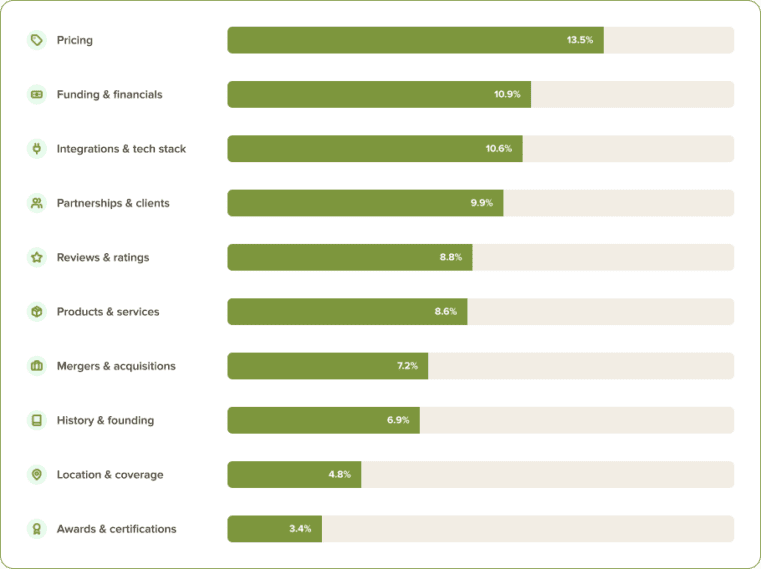
What Type of Information Does AI Get Wrong Most Often About Brands?
Not every business fact has the same risk of becoming outdated. Information that changes frequently, exists across many third-party sources, or is difficult to verify can be particularly vulnerable to inconsistency.
Business location and address
Location information is one of the most important facts to monitor.
Businesses move, open additional branches, close locations, change office addresses, or switch from physical storefronts to service-area operations. Older webpages and directories may continue showing the previous address long after the business has moved.
For multi-location businesses, the problem can be even more complicated because information from one branch can potentially become associated with another.
Each location should have clearly defined and consistent information across the official website, relevant business profiles, maps, and important third-party listings.
Phone numbers and contact information
Phone numbers are another common source of outdated information.
A business may change:
- Main phone number
- Local branch number
- Customer support number
- Sales number
- Booking number
- Toll-free number
Old numbers can remain visible in directories, PDFs, social profiles, press releases, and archived webpages.
If an AI system retrieves an old number, customers may be directed to an inactive line or, in some cases, an unrelated person or business.
Opening hours
Opening hours can change because of seasonal schedules, holidays, staffing changes, renovations, or permanent operational changes.
Google specifically recommends keeping business hours and special hours current in the Business Profile because customers use this information to determine when they can visit a business.
Businesses should pay particular attention to special hours and temporary changes rather than assuming that updating their regular schedule is enough.
Products and services
AI can also describe products or services that a business no longer provides.
This can happen when an old service page remains online, an outdated directory description is still indexed, or a third-party article continues describing the previous offering.
For example, an agency may have stopped offering traditional web hosting but still have an old directory profile describing hosting as one of its primary services.
The problem becomes more confusing when the company’s current website, old pages, and third-party listings describe different service portfolios.
Pricing and offers
Prices can become outdated quickly.
A company may change subscription fees, consultation charges, package prices, minimum order requirements, membership costs, or promotional offers. An old blog post or comparison page may continue displaying the previous price.
Pricing information therefore needs clear dates and regular review.
Businesses should be particularly careful about publishing evergreen statements such as “our service costs $X” when that price is likely to change.
Business status
AI systems may sometimes encounter conflicting signals about whether a company is operating, closed, acquired, renamed, or temporarily unavailable.
This is especially relevant for businesses that have:
- Rebranded
- Merged
- Been acquired
- Changed ownership
- Closed a branch
- Relocated
- Changed domains
- Consolidated several websites
A company can be active while old sources still describe it using its former name or status.
Company history and leadership
Company history can also become outdated.
Information about founders, executives, ownership, establishment dates, acquisitions, awards, and milestones may change over time. Old articles can continue to circulate long after the information has changed.
This does not mean every historical reference needs to be removed. Historical information can remain useful when it is clearly presented as historical.
The important distinction is between what was true and what is true now.
Areas served
Service-area businesses should also monitor geographic information.
A contractor, law firm, healthcare provider, cleaning company, or home-service business may expand into new cities or stop serving certain areas.
If different sources show different service areas, an AI system may provide an answer that does not accurately reflect the company’s current coverage.
Business categories and attributes
Business categories can influence how a company is understood.
For example, a company may have evolved from a small design studio into a full-service digital agency. If third-party sources still categorize it only as a graphic design company, AI systems may describe its capabilities too narrowly.
This is one reason businesses should maintain consistent descriptions across important profiles while avoiding keyword-stuffed or exaggerated descriptions.
Where AI Gets Your Business Information
There is no single universal database containing every fact an AI system knows about a business.
Different AI products can use different combinations of model knowledge, search indexes, retrieved webpages, business databases, structured information, user-provided information, connected services, and other sources.
The exact process also changes over time.
Your official website
Your website is one of the most important sources of first-party information about your company.
Important business facts should be clearly stated in crawlable text rather than hidden only inside images, PDFs, scripts, or interactive elements.
Google’s current guidance for AI search emphasizes making important content available in textual form, keeping structured data consistent with visible content, and maintaining up-to-date Business Profile information.
Important information should therefore be easy to locate on relevant pages such as:
- Homepage
- About page
- Contact page
- Location pages
- Service pages
- Product pages
- Pricing pages
- FAQ pages
- Store or branch pages
Google Business Profile and local listings
For businesses with physical locations or local service areas, Google Business Profile is a critical source of business information.
Google says Business Profile information can be combined with information from public webpages, third-party data, users, business owners, and Google’s own interactions with a business.
This makes accuracy particularly important.
A verified business should regularly check its:
- Name
- Address
- Phone
- Hours
- Special hours
- Category
- Website
- Services
- Attributes
- Photos
- Location information
Google also provides mechanisms for suggesting edits or reporting inaccurate information in local listings.
Bing and Microsoft search ecosystems
Bing is another important part of the AI-search ecosystem.
Microsoft’s Bing Webmaster Tools now provides an AI Performance report showing how website content is used in AI-generated answers across Microsoft Copilot, Bing’s AI-generated summaries, and selected partner experiences.
For local businesses, Microsoft specifically recommends maintaining accurate business information through Bing Places.
This matters because correcting information for one search ecosystem does not automatically correct it everywhere else.
Business directories and citation sources
Third-party directories can remain influential because they provide structured business information that search systems can discover and compare.
Depending on the industry and market, these may include:
- Local directories
- Industry associations
- Professional organizations
- Review platforms
- Chamber of commerce profiles
- Franchise directories
- Marketplace profiles
- Business databases
- Regional business portals
A business does not necessarily need to update every website on the internet. The practical objective is to identify the sources that are authoritative, prominent, indexed, relevant to the industry, or repeatedly appearing when the business is researched.
News articles and third-party publications
News stories, interviews, press releases, partner pages, and industry publications can also become part of the information environment surrounding a brand.
An old article may correctly describe a company at the time it was published but become misleading years later.
For example, a 2022 article might identify a company’s former CEO, old headquarters, previous product line, or former business model.
The historical article does not necessarily need to be deleted. Instead, businesses should make sure that current information is clearly established through newer authoritative sources.
Social media and public profiles
Social profiles can contribute to how a business is understood online.
A company that changes its name, URL, location, or service offering should review important social profiles and public-facing descriptions.
An old profile with thousands of followers can continue appearing in search results even if the company has moved to another platform.
Structured data on your website
Structured data provides search engines with machine-readable information about a webpage.
Google’s documentation recommends using appropriate Organization or LocalBusiness structured data to help its systems understand business details. For local businesses, relevant information can include business type, address, contact information, hours, and other applicable details.
Structured data should not be treated as a magic instruction that forces an AI system to use particular information.
Instead, it should reinforce the information that is already visible and accurate on the page.
Google specifically recommends that structured data match the visible content on the website.
Search indexes and retrieved web content
AI search systems can also obtain current information by searching the web.
For example, ChatGPT’s web-search documentation explains that search can retrieve current information from the internet and provide citations to sources. It also warns that search results and citations can sometimes be incomplete, outdated, or incorrect.
Google similarly explains that its generative AI Search features can retrieve information from its Search index and use multiple searches and sources to construct responses.
This distinction is important: an AI answer may not be coming from the model’s original training data at all. It may be based on information retrieved during the search process.
Reviews and user-generated information
Customer reviews, photos, comments, and user-contributed business information can also influence how a business is represented.
Google states that user contributions can be among the sources used for local business information, while review summaries are generated from customer reviews.
Businesses cannot control every customer statement, nor should they try to manipulate genuine customer feedback. However, they can make sure that official business facts are clearly and consistently established through authoritative channels.
The key takeaway: think in terms of an information ecosystem
The most important point is that AI does not necessarily have one “wrong database” that a business can correct.
Instead, think of your brand information as an ecosystem.
Your website, business profiles, directories, maps, reviews, social profiles, news coverage, industry listings, structured data, and search indexes can all contribute to the information available to search and AI systems.
That is why correcting outdated AI business information usually requires more than changing one webpage.
The most reliable approach is to identify the incorrect claim, determine where conflicting information exists, correct the relevant authoritative sources, make the current information clear on your website, and then allow search systems time to recrawl and process those changes.
Google notes that changes can require time for crawling and re-indexing, while Bing provides tools such as IndexNow to notify its systems when URLs have been updated or removed.
you cannot directly rewrite an AI’s answer, but you can improve the information environment from which many AI search systems retrieve their answers.
How To Correct Outdated Business Information in AI
You generally cannot log into an AI model and directly replace one incorrect fact about your company. The more practical approach is to identify the inaccurate claim, trace where the information is coming from, correct the underlying sources, and make the current information easy for search systems to discover and understand.
Think of the process as source correction + consistency + recrawling + monitoring.
1. Identify exactly what AI is getting wrong
Start by testing your brand across the AI and search experiences your customers are likely to use.
Ask specific, fact-based questions such as:
- “What is [Business Name]’s current address?”
- “What services does [Business Name] offer?”
- “What are its current opening hours?”
- “What phone number should I use?”
- “Does the company serve [city]?”
- “Who owns the company?”
- “What products does the company currently sell?”
- “Is [Business Name] still operating?”
Do not rely on one prompt or one AI response. Ask the same question several ways and, where practical, test multiple AI-powered search products.
Record the exact incorrect statement, date, platform, prompt, cited sources, and correct information. This creates an audit trail and makes it easier to determine whether the problem is coming from your website, a business listing, a third-party page, or another source.
This step is important because an AI response is an output, not necessarily the original source of the misinformation.
2. Find the source of the outdated information
Once you identify an incorrect answer, investigate the sources behind it.
For example, suppose an AI system says your company operates from an old address. Search the old address alongside your business name. You may discover:
- An outdated directory listing
- An old location page
- A former Google Business Profile
- An old press release
- A social media profile
- An industry association listing
- A news article
- A PDF containing the previous contact information
- A partner website
- An old page that was never redirected
Google explains that business-profile information can come from publicly available webpages, licensed third-party data, user contributions, business owners, and Google’s own interactions with businesses.
That means correcting your website alone may not resolve every conflicting signal.
3. Establish one authoritative version of the truth
Your website should clearly communicate the current business facts.
Review the pages that contain information about:
- Company name
- Address
- Phone number
- Opening hours
- Services
- Products
- Pricing
- Service areas
- Locations
- Leadership
- Company history
- Contact information
Avoid creating contradictory versions of the same fact across different pages.
For example, if your contact page says one address while an old location page says another, a crawler can encounter both. If the old page is no longer needed, redirect or remove it appropriately rather than leaving conflicting information indefinitely.
Google’s search documentation emphasizes that search systems crawl and index pages before serving information from them, and that updated pages can take time to be recrawled and reprocessed.
4. Correct your Google Business Profile
For local businesses, update the verified Google Business Profile with the current information.
Google allows verified businesses to edit information such as address, hours, contact information, and photos directly through Search or Maps.
Also check whether Google has added updates from other sources. Google says its Business Profiles can receive updates based on information from sources such as users and licensed data providers.
If Google is displaying an incorrect third-party update, review the profile and use the available correction or feedback mechanisms rather than assuming your manually entered information is the only signal Google considers.
5. Correct important third-party listings
Next, identify high-value websites that contain outdated information.
Prioritize sources according to factors such as:
- Authority and relevance
- Visibility in search
- Industry importance
- Geographic importance
- Whether the page is indexed
- Whether AI systems cite it
- Whether it contains a major factual error
- Whether customers actually use the listing
You do not need to chase every obscure website immediately.
If ten websites contain your old phone number, start with the sources that are most visible, authoritative, frequently indexed, or repeatedly referenced in AI answers.
6. Fix old pages on your own domain
If the outdated information exists on your own website, correct or remove it.
Depending on the situation, you may:
- Update the page
- Redirect an obsolete URL
- Remove duplicate pages
- Add a canonical URL where appropriate
- Return the correct HTTP status for permanently removed pages
- Update XML sitemap information
- Request recrawling of important updated URLs
Google provides a URL Inspection tool that allows site owners to request recrawling for individual URLs. Google notes that crawling can take anywhere from a few days to a few weeks and that requesting indexing does not guarantee immediate inclusion.
For larger sites, maintaining an accurate sitemap can also help search engines discover updated URLs.
7. Make the current information machine-readable
Use appropriate structured data where it genuinely applies.
For example, an organization or local-business page may use relevant structured data to communicate information such as organization details, address, telephone number, opening hours, and other applicable attributes.
However, structured data should not contradict what users see on the page. It should reinforce accurate visible information.
Google’s current guidance says the same foundational SEO practices apply to AI Overviews and AI Mode, and there are no special technical requirements that guarantee inclusion in those AI experiences.
8. Keep important information consistent across formats
Consistency matters beyond text.
If your website says one thing but your:
- Logo/profile information
- Business listing
- Social profile
- Images
- Videos
- PDFs
- Location pages
- Directory listings
say something different, you are creating multiple versions of the same entity.
Bing’s 2026 AI Performance guidance specifically highlights the importance of reducing ambiguity across formats by keeping text, images, and video aligned around the same entities, products, and concepts.
9. Monitor AI answers after making corrections
Do not assume that an update has propagated simply because you corrected the original webpage.
Repeat your original prompts after the changes have had time to be discovered.
Track:
| Item | What to monitor |
|---|---|
| Business name | Correct current name |
| Address | Current location |
| Phone | Current contact number |
| Hours | Regular and special hours |
| Services | Current offerings |
| Products | Current availability |
| Service area | Current geographic coverage |
| Ownership | Current organizational information |
| Citations | Which sources AI references |
| Incorrect claims | Whether old information remains |
Bing now provides an AI Performance report in Webmaster Tools that can show how site content appears as citations in supported Microsoft AI experiences, including Copilot and AI-generated Bing summaries.
The broader objective is not to make an AI system repeat a preferred answer. It is to make the underlying information accurate enough that search and AI systems have strong current sources to retrieve.
When to DIY vs. Bring In an Agency To Fix Your Brand Information in AI
Whether you should handle AI-information cleanup internally or use an agency depends largely on the size and complexity of the business.
DIY makes sense when the problem is small
A business can often manage the process internally when it has:
- One location
- A simple website
- A limited number of directories
- Few historical pages
- A small number of outdated facts
- Someone who can access the website and business profiles
- No major rebrand or merger history
For example, if a single-location business recently changed its phone number, an internal team may be able to update the website, Google Business Profile, important directories, social profiles, and other high-priority sources without outside assistance.
An agency becomes useful when the information ecosystem is complicated
Professional assistance can become more practical when a business has:
- Dozens or hundreds of locations
- Franchises
- Multiple brands
- Frequent mergers or acquisitions
- A major rebrand
- Large numbers of outdated citations
- Conflicting business entities
- Significant local-search visibility
- Large websites with thousands of URLs
- Technical indexing problems
- Multiple countries or languages
- A need for ongoing AI-search monitoring
An experienced SEO or digital marketing team can combine technical SEO, local SEO, reputation management, content auditing, entity research, structured data, analytics, and monitoring into one workflow.
The important thing is to evaluate an agency based on what it can actually do, rather than promises that it can “control” AI answers.
Google’s third-party Business Profile policies also make clear that agencies managing profiles must ensure that changes are accurate and comply with Google’s policies.
What should you look for in an agency?
Ask prospective agencies whether they can provide:
- AI visibility auditing
Can they test how your company appears in relevant AI-search experiences? - Source tracing
Can they identify the websites and listings associated with inaccurate claims? - Technical SEO
Can they diagnose crawling, indexing, canonicalization, redirects, and structured-data issues? - Local SEO
Can they manage business-profile and citation consistency? - Entity consistency
Can they distinguish your business from similarly named companies? - Monitoring and reporting
Can they demonstrate what changed after corrective work? - Evidence-based reporting
Can they show the original inaccurate information, the correction, and the subsequent status?
Be cautious of anyone promising guaranteed placement in ChatGPT, Google AI Overviews, or another AI system. Search and AI systems use their own retrieval and ranking processes. Google explicitly states that meeting its technical requirements does not guarantee that a page will be crawled, indexed, or served, while ChatGPT’s search documentation says search placement is not guaranteed.
Frequently Asked Questions (FAQs) About Fixing Outdated Brand Information in AI
DOES AI JUST USE DATA FROM THE INTERNET?
No. The exact sources vary by AI system and whether it has access to search or other external information.
Some AI responses can be generated from information learned during model training. Search-enabled AI can also retrieve current information from the web. ChatGPT, for example, can search the web and provide citations when current information is needed.
Google’s AI search features can retrieve supporting information from its Search ecosystem, while Microsoft describes its AI experiences as using web content and search infrastructure.
So businesses should think beyond a single “AI database.”
CAN AI KNOW INFORMATION THAT ISN’T ONLINE?
Yes, depending on the system and context.
An AI model may have learned information during training that is no longer publicly available or may receive information from a user, connected application, private database, or other authorized source.
However, businesses should not assume that AI will reliably know private or newly changed business information.
For current public business facts, maintaining accurate online sources remains important because search-enabled AI can use those sources when generating answers.
WHICH SOURCES SHOULD I GO FIX FIRST?
Start with your official website and primary business profiles, then move to important third-party sources.
A practical order is:
- Official website
- Google Business Profile
- Bing Places and relevant search-platform profiles
- Major industry directories
- Important local directories
- Review and marketplace profiles
- Social profiles
- High-visibility third-party articles and pages
Prioritize sources that contain the most important errors or repeatedly appear in search and AI responses.
CAN I MAKE AI STOP USING AN OLD LISTING?
Not directly in every case.
If the old listing belongs to you, update, remove, redirect, or replace it as appropriate. If another website owns it, contact the publisher or use that platform’s correction process.
For your own website, removing an old page does not necessarily make the outdated version disappear instantly from search indexes. Google explains that crawling and indexing take time, and its systems may need to revisit the URL before changes are reflected.
The practical objective is to eliminate or correct the underlying outdated source and strengthen current authoritative information.
CAN I CONTACT OPENAI OR GOOGLE TO CORRECT INFORMATION ABOUT MY BUSINESS?
Yes, but the appropriate route depends on where the incorrect information appears.
For Google Business Profile information, verified owners can edit their profiles, and users can suggest edits to profiles they do not manage.
For ChatGPT, web-search results can be reviewed through their cited sources, and OpenAI provides support channels for product issues. However, contacting an AI provider does not mean it can manually rewrite every fact generated in a response. ChatGPT search retrieves web information dynamically when search is used, and the resulting sources can change.
HOW LONG DOES IT TAKE FOR LLMS TO STOP SURFACING OUTDATED DATA?
There is no universal timeline.
It depends on where the outdated information exists, whether the source is crawled again, how quickly search indexes update, whether the AI system is using live retrieval or previously learned information, and how frequently the relevant sources change.
For Google, requesting a recrawl can help discovery, but Google says crawling can take days to weeks and does not guarantee immediate indexing.
For AI systems using live search, corrections can become discoverable after the underlying search index or source changes. For information embedded in model training, the correction may not immediately change the model’s underlying knowledge.
WHICH DIGITAL MARKETING COMPANIES ARE BEST AT OPTIMIZING FOR LLM SEARCH?
There is no universal company that can guarantee that a brand will be selected or cited by every LLM.
When evaluating a digital marketing company for AI-search work, look for demonstrated capabilities in:
- Technical SEO
- Local SEO
- Entity optimization
- Business-profile management
- Digital PR and authoritative mentions
- Structured data
- Content strategy
- Citation management
- AI-search monitoring
- Search analytics
- Data and source auditing
Ask for concrete examples of how the agency identifies inaccurate AI information, traces the underlying source, corrects it, and measures changes afterward.
A credible provider should also distinguish between improving the information available to AI systems and guaranteeing a particular AI response.
WHY DOES AI GIVE DIFFERENT ANSWERS ABOUT MY BUSINESS THAN GOOGLE SEARCH DOES?
Because AI search and conventional search can use information differently.
Google Search may present a set of ranked pages, business information, maps, and other search features. AI systems can synthesize information from multiple sources into a conversational response.
Even within Google, AI Overviews and AI Mode can use different models and techniques, so their responses and supporting links can vary.
ChatGPT can also conduct a web search and generate an answer from retrieved sources rather than simply reproducing a traditional search-results page.
This means a discrepancy does not necessarily indicate that one system has a single definitive database and the other has a different one. It may reflect differences in retrieval, indexing, source selection, query interpretation, freshness, and synthesis.
The practical response is to identify which sources support the incorrect claim, correct those sources, strengthen your authoritative information, and continue monitoring how your business is represented across the search and AI systems your customers use.
Read More: How Brands Are Leveraging Retail Media Networks in 2026


