

Search is becoming increasingly conversational. Instead of entering a short keyword and scanning several blue links, users can now ask detailed questions and receive AI-generated answers that synthesize information from multiple sources. Google’s AI Overviews and AI Mode, for example, are designed to help users understand complicated topics more quickly while providing links to supporting websites for deeper exploration. These systems can also use multiple related searches to gather information across different aspects of a question.
This shift makes content clarity and information accessibility more important than ever. A well-written article should still provide depth, original insights, evidence, and useful context, but readers and AI systems also need to identify the page’s main answer efficiently. A TL;DR (Too Long; Didn’t Read) section can help accomplish this by placing a concise summary of the article’s central conclusion near the beginning of the page.
However, TL;DR should not be treated as an AI-search shortcut or a replacement for traditional SEO. Google states that there are no special optimization requirements for appearing in AI Overviews or AI Mode. The same foundational practices remain important: create helpful, reliable, people-first content, make the page crawlable and indexable, provide important information in text, and ensure that the content delivers genuine value.
The real advantage of a TL;DR is that it creates a clear, immediately accessible answer layer on top of comprehensive content. It can help a reader quickly determine whether the article addresses their question while giving search and AI systems an explicit, concise representation of the page’s primary subject. When combined with useful key points and well-structured supporting sections, this approach can make long-form content easier to understand without sacrificing depth.
What Is TL;DR in Content?
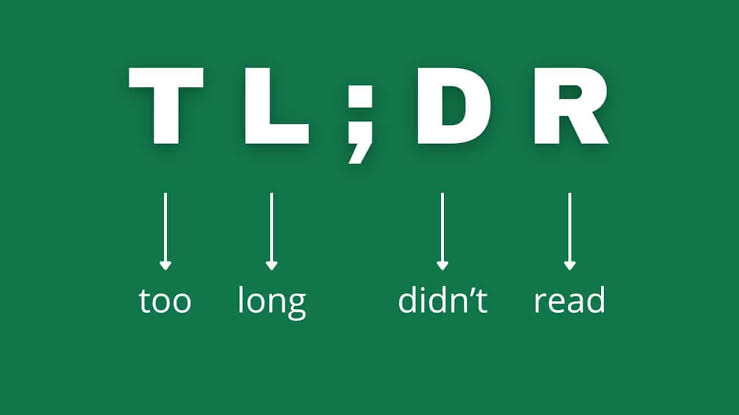
TL;DR stands for “Too Long; Didn’t Read.” In digital publishing, the term traditionally referred to a short summary provided for people who did not have time to read an entire piece of content. Today, a TL;DR can be deliberately incorporated into an article as a concise overview of its main answer, findings, recommendations, or conclusions.
For example, if an article explains how businesses can improve email deliverability, the TL;DR might quickly state that deliverability depends on factors such as sender reputation, authentication, list quality, engagement, and appropriate sending practices. The rest of the article can then explain each factor in detail.
A useful TL;DR generally answers three questions:
- What is the main answer?
- What are the most important supporting points?
- What should the reader understand or do after reading the article?
The goal is not to summarize every paragraph. Instead, it should distill the central value of the article into a compact block that readers can understand without navigating through the entire page.
What Makes a Good TL;DR?
An effective TL;DR should be:
Concise: Keep it short enough to scan quickly. For many blog posts, a few sentences are sufficient.
Direct: State the answer instead of beginning with unnecessary background.
Accurate: Every statement should be supported by the detailed content that follows.
Self-contained: Someone who reads only the summary should understand the article’s basic conclusion.
Specific: Avoid vague statements such as “there are many ways to improve SEO.” Identify the actual methods, factors, or recommendations discussed.
Consistent with the article: The TL;DR should summarize the page rather than introduce information that appears nowhere else.
A TL;DR can be presented under a clearly identifiable label such as TL;DR, Quick Answer, In Short, or Key Takeaway. The exact label matters less than the clarity of the information itself.
TL;DR Is Not a Replacement for Comprehensive Content
Adding a summary does not mean turning a 2,000-word article into a 100-word page. The summary and the main article perform different functions.
The TL;DR provides the fast answer. The full article provides the depth needed to understand, evaluate, and act on that answer.
This distinction is particularly important for SEO and AI search. Google explicitly says there is no ideal page length and that publishers should create content for their audience rather than attempting to make pages a particular length for generative AI systems. Google also notes that there is no requirement to break content into tiny pieces for AI systems to understand it.
Therefore, a TL;DR should complement comprehensive content rather than encourage publishers to remove useful explanations simply to make a page easier for machines to process.
How TL;DR Improves AI Visibility
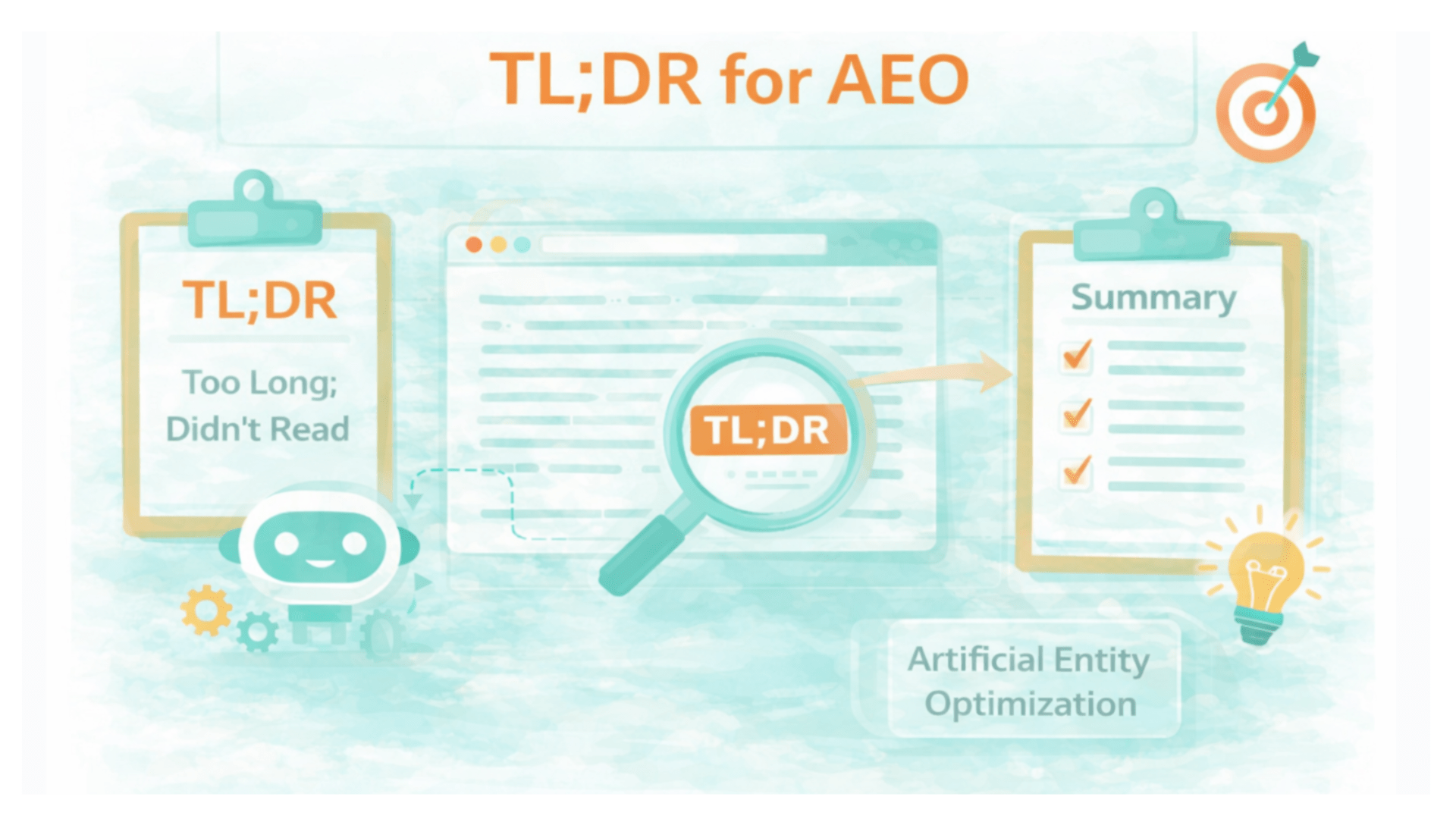
A TL;DR can support AI visibility primarily by making the main subject and answer of a page easier to identify. It is important, however, to distinguish this practical benefit from claiming that TL;DR itself is a ranking factor. There is no official Google requirement stating that pages must contain TL;DR sections to appear in AI Overviews or AI Mode. Google specifically says that no additional optimization or special markup is required for these AI features.
Instead, think of a TL;DR as a content clarity technique that aligns with broader principles of machine-readable, people-first content.
It Places the Primary Answer Near the Beginning
Long articles often spend several paragraphs establishing context before answering the reader’s actual question. That may be appropriate for human storytelling, but it can make the page less efficient for someone who wants an immediate answer.
A concise summary near the top creates a clear starting point. It tells readers—and systems processing the page—what the article is fundamentally about before the supporting details begin.
This aligns with Google’s broader emphasis on helping users find the information they need quickly and reliably in AI search experiences.
It Clarifies the Page’s Central Topic
AI search systems need to determine how a page relates to a user’s question. Clear language helps establish that relationship.
Suppose an article targets the question “How does local SEO help small businesses?” A weak opening might spend 200 words discussing the history of digital marketing before eventually explaining the answer.
A stronger opening could immediately state:
Local SEO helps small businesses become more visible to nearby customers by improving their presence in location-based search results, business listings, maps, and relevant local queries.
The detailed article can then explain Google Business Profile optimization, local citations, reviews, localized content, links, and other factors.
The summary does not guarantee that the page will be selected by an AI system. Instead, it makes the page’s primary proposition explicit and easier to interpret.
It Creates a Clear Summary Layer for Complex Content
AI-generated search experiences often synthesize information from multiple sources. Google explains that AI Overviews and AI Mode can use related searches across subtopics and data sources when developing responses.
For publishers, this makes topical clarity valuable. A page that clearly communicates its main answer and then supports that answer with detailed, logically organized information gives systems more understandable context to work with.
For example, a comprehensive guide about technical SEO might cover:
- Crawlability
- Indexing
- Internal linking
- JavaScript rendering
- Structured data
- Canonicalization
- Page experience
- Core Web Vitals
A concise opening summary can establish that the article is fundamentally about making a website easier for search engines to crawl, understand, and index. The subsequent sections provide the evidence and detail behind that conclusion.
It Improves the Human Experience That Supports Search Success
AI visibility should not be considered separately from user experience. Google continues to emphasize unique, valuable content that satisfies users, along with a page experience that makes information easy to find and consume.
A TL;DR helps visitors decide quickly whether they are on the right page. Someone looking for a quick answer can read the summary, while someone who needs detailed guidance can continue into the article.
That creates a useful two-layer content experience:
Fast layer: TL;DR and key points for quick understanding.
Deep layer: Detailed explanations, examples, evidence, data, expert insights, and actionable guidance.
This structure can be especially valuable for informational content where readers have different levels of intent.
It Can Make Existing Content Easier to Interpret Without a Full Rewrite
One of the practical benefits of adding TL;DR sections is that publishers can improve the accessibility of existing high-value articles without completely rewriting them.
A strong existing article may already contain the right information but bury its most important conclusions several paragraphs or sections below the introduction. Adding a concise, accurate summary near the top can make the page’s purpose clearer while preserving the original depth.
That said, the summary should be based on the article’s actual content. It should not be created simply by inserting keywords or generating generic statements for AI systems. Google’s guidance emphasizes useful, original, people-first content rather than content created primarily to manipulate search rankings.
TL;DR Does Not Automatically Increase Rankings
This distinction is critical.
Adding a TL;DR does not guarantee higher rankings, AI citations, AI Overview inclusion, or increased organic traffic. Google says that there are no additional technical requirements for appearing as a supporting link in AI Overviews or AI Mode beyond being indexed and eligible for normal Search, and indexing or serving is never guaranteed.
Therefore, the right strategy is not:
“Add TL;DR → rank in AI search.”
It is:
“Create valuable content → make its answer clear → structure information logically → maintain strong technical SEO → make important information accessible to people and search systems.”
A TL;DR is one useful component of that broader strategy.
TL;DR vs. Key Points: How to Pair Both for Maximum Visibility
TL;DR and Key Points are closely related, but they should not be treated as identical elements.
A TL;DR provides a compact narrative summary of the article’s primary answer.
Key Points break the most important supporting ideas into individual, scannable statements.
Using both can create a stronger opening structure for long-form content.
TL;DR: The Big-Picture Answer
The TL;DR should answer the main question in a few concise sentences.
For example:
TL;DR: Local SEO helps businesses attract customers searching for products or services in a specific geographic area. Improving local listings, maintaining consistent business information, earning relevant reviews, creating useful local content, and building authority can increase a business’s visibility for location-based searches.
This gives the reader the central answer immediately.
Key Points: The Supporting Takeaways
Key points can then expand the answer into several individual takeaways:
- Optimize your Google Business Profile and keep business information accurate.
- Create useful content around relevant local services and locations.
- Maintain consistent business information across important directories.
- Encourage genuine customer reviews and respond appropriately.
- Build relevant local authority through links, partnerships, and community involvement.
The reader can scan these points in seconds and understand the article’s major recommendations.
Why the Combination Works
The combination creates a logical information hierarchy:
TL;DR → Main answer
Key Points → Supporting answers
Body Content → Detailed explanation
This structure benefits people who skim while preserving comprehensive information for readers who want more context.
It can also help publishers make important information more explicit without resorting to artificial “AI-friendly” writing techniques. Google currently advises that there is no need to rewrite content in a special style solely for generative AI search, nor is there a requirement to create unnaturally short content chunks.
A Simple Example
Imagine an article titled “How Often Should You Update Your Website Content?”
The opening could look like this:
TL;DR: Most website content should be reviewed according to how quickly the information changes and how important the page is to your audience. High-value pages should be monitored regularly, while outdated statistics, pricing, regulations, product information, and time-sensitive recommendations should be updated whenever the underlying information changes.
Key Points:
- Review high-priority pages regularly rather than relying on a fixed annual schedule.
- Update statistics, examples, links, and references when they become outdated.
- Refresh pages when search intent or industry standards change.
- Remove or correct inaccurate information rather than simply adding more text.
- Preserve useful historical information when it provides legitimate context.
The remainder of the article can then explain how to identify outdated content, prioritize URLs, measure performance, and determine whether a page needs a minor refresh or a substantial rewrite.
Best Practices for Using TL;DR and Key Points
Adding a summary block is easy. Creating one that genuinely improves the content requires more discipline. The objective should be clarity, accuracy, and usefulness, not simply adding another SEO element.
1. Put the TL;DR High on the Page
Place the summary near the beginning of the article, ideally after the introductory context and before the main body sections.
Readers should not have to scroll through hundreds of words to find it.
The exact placement does not need to follow a rigid SEO formula. What matters is that the summary is visible, logically positioned, and part of the page’s primary content.
2. Answer the Main Search Intent Directly
Your TL;DR should respond to the primary question behind the page.
If the article is “What Is Technical SEO?”, the summary should define technical SEO and explain its purpose—not summarize unrelated information about keyword research, link building, or social media marketing.
Before writing the TL;DR, ask:
“If someone could read only three sentences from this article, what would I want them to understand?”
That answer should become the foundation of the summary.
3. Keep the Summary Concise
A TL;DR should be substantially shorter than the article itself.
For most blog posts, two to four sentences can provide enough space to communicate the primary answer without turning the summary into another introduction. If the topic is unusually complex, a somewhat longer summary may be appropriate.
Do not force every article into the same word count. Google’s current guidance explicitly says there is no ideal page length and that content should be created according to the audience and subject matter.
4. Follow the TL;DR With Useful Key Points
Use key points when the article contains multiple recommendations, findings, steps, advantages, disadvantages, or considerations.
Three to five strong bullets are often enough for a straightforward article.
Avoid creating ten or fifteen bullets simply to make the section appear comprehensive. Each point should communicate something independently useful.
5. Make Every Statement Verifiable From the Article
Your TL;DR should accurately represent the information that follows.
Do not make a bold claim in the summary and then provide no evidence or explanation for it later.
For evidence-based topics, support important claims with appropriate sources, original research, expert commentary, examples, or first-hand experience where applicable. Google’s guidance continues to emphasize accuracy, quality, relevance, and original value.
6. Use Natural Language Instead of Keyword Stuffing
Do not write TL;DRs as collections of search queries.
For example, avoid:
SEO services, SEO agency, best SEO services, local SEO services, SEO strategy, SEO company—these are important for SEO rankings.
Instead, communicate the answer naturally:
A strong SEO strategy combines technical optimization, useful content, internal linking, authoritative references, and a clear understanding of search intent.
Google’s systems can understand related language and concepts, so there is no need to force every keyword variation into a summary. Google’s current generative AI guidance specifically says publishers do not need to worry about capturing every possible query variation.
7. Keep the TL;DR Consistent With the Page’s Heading Structure
A clear hierarchy makes long-form content easier to navigate.
For example:
H1: How to Improve Email Deliverability
TL;DR: Main answer
Key Points: Major recommendations
H2: Authenticate Your Sending Domain
H2: Maintain a Healthy Email List
H2: Monitor Engagement
H2: Avoid Spam Triggers
This organization creates a predictable relationship between the page’s primary topic, summary, supporting concepts, and detailed explanations.
8. Don’t Hide Important Information From Users
The summary should be visible as normal page content. Avoid creating information solely for crawlers or placing important statements where users cannot reasonably access them.
Google recommends making important content available in textual form and ensuring structured data matches the visible content on the page.
9. Don’t Create a Separate TL;DR Page for Every Query Variation
AI search may involve multiple related questions and subtopics, but that does not mean a website should create dozens of thin pages targeting every possible variation.
Google’s current guidance warns against creating separate content for every possible query variation primarily to manipulate rankings or generative AI responses. The emphasis remains on satisfying users with useful, original content.
A better approach is to create one authoritative resource that answers the primary question and naturally covers closely related subtopics when they genuinely help the reader.
10. Treat TL;DR as Part of Your Overall SEO Strategy
TL;DR should complement—not replace—technical SEO, internal linking, quality content, structured data where appropriate, page experience, and other established practices.
Google’s current guidance makes this particularly clear: foundational SEO remains relevant for generative AI experiences, and there is no special schema or AI-specific markup required to qualify for AI Overviews or AI Mode.
As AI search continues to evolve, the most sustainable approach is therefore to make valuable information easy to discover, easy to understand, and genuinely useful. A well-written TL;DR helps accomplish that by giving readers an immediate answer while preserving the detailed content needed for deeper understanding.
Don’t write a TL;DR for AI instead of people; write it for people in a way that also makes your content’s core answer clearer to AI-powered search systems.
How to Add TL;DRs to Existing Content for AI Search
You do not need to rewrite your entire content library to make older articles easier to understand in AI-driven search. A more practical approach is to identify valuable existing pages, extract their strongest conclusions, and add a concise summary near the top of each page. The goal is to improve information accessibility without weakening the depth, originality, or usefulness of the original article.
The process below follows the four-step approach outlined in the linking content, while also aligning it with current guidance for Google’s AI search experiences. Google emphasizes that there is no special AI-only optimization requirement; pages still need to be crawlable, indexable, helpful, original, and technically sound.
Step 1: Audit and Select Target URL Candidates
Do not begin by adding TL;DR blocks to every article on your website. Start with pages where a clearer opening answer could have the greatest business and search value.
Use Google Search Console, analytics data, and your SEO platform to identify URLs that already demonstrate value but may have opportunities for improvement. Prioritize pages that:
- Generate meaningful organic impressions or traffic.
- Rank on the first or second page for valuable queries.
- Target informational or commercial-intent questions.
- Have strong backlinks or established topical authority.
- Contain substantial useful information but take too long to reach the main answer.
- Receive impressions for multiple related or long-tail queries.
- Are still relevant but have not been refreshed recently.
The linking content specifically recommends looking at pages already ranking around positions one through twenty and identifying articles where the strongest answer is buried beneath a lengthy introduction. That is a sensible place to begin because you are improving an existing asset rather than starting from zero.
However, rankings alone should not determine your priorities. Consider business value and user intent as well. A page ranking well for a low-value informational query may be less important than a page ranking moderately well for a question closely connected to your products or services.
You should also check whether the target page is technically eligible for search. Google recommends ensuring that Googlebot can access the page, that it returns a successful HTTP response, and that its important content is available for indexing.
A simple prioritization model is:
Business value + existing search visibility + content quality + opportunity for clearer answers = TL;DR candidate
This prevents your team from treating TL;DR implementation as a mass formatting exercise.
Step 2: Extract Key Takeaways From Existing Body Copy
Once you have selected a URL, read the entire article before writing the summary. The objective is not to create a new introduction based solely on the target keyword. Instead, identify the actual answer and conclusions already supported by the page.
Start by determining the article’s primary search intent:
What question is this page ultimately trying to answer?
Then identify:
- The primary answer or conclusion.
- The most important supporting points.
- The recommendations or actions provided.
- Important qualifications, limitations, or exceptions.
- The concepts that receive substantial explanation later in the article.
Turn those findings into a short TL;DR followed by several key points.
For example, suppose an existing article explains how to improve local SEO. After reviewing the content, you might discover that its core recommendations are optimizing the business profile, maintaining consistent business information, earning legitimate reviews, developing location-specific content, and building relevant local authority.
The new opening could summarize those conclusions without changing the underlying article.
This approach is important because a TL;DR should represent the content rather than invent a new claim. Google continues to emphasize accuracy, quality, relevance, and original value, including when AI tools are involved in content creation or editing.
Also, avoid turning the summary into a keyword list. Write complete, natural sentences that provide an actual answer. The purpose is to make the page easier to understand—not to manufacture text specifically for crawlers.
Step 3: Retrofit the Opening Block High in the Page Code
After extracting the takeaways, add the summary near the beginning of the article.
A practical structure is:
H1: [Article title]
TL;DR: Two to four concise sentences explaining the primary answer.
Key Points:
- Important supporting takeaway.
- Important supporting takeaway.
- Important supporting takeaway.
- Important supporting takeaway.
H2: [First major section]
The linking content recommends placing the TL;DR immediately after the H1 or opening sentence, followed by three to five key points before the first major H2. It also recommends making the summary visually distinguishable with a subtle callout or border so readers can identify it quickly.
The phrase “high in the page code” should not be interpreted as meaning you need hidden content or special code exclusively for AI systems. The summary should be genuine, visible page content.
Google specifically advises that structured data should correspond with visible content and that important information should be accessible to its systems.
The same principle applies here: make the useful answer visible to users first.
You can also connect individual key points to their corresponding sections using internal jump links. For a long guide, this creates a useful navigation layer:
- Optimize your business profile → corresponding H2
- Build local citations → corresponding H2
- Earn relevant reviews → corresponding H2
- Create localized content → corresponding H2
This can improve usability while establishing a clearer relationship between the summary and the detailed information below it.
One important caution: do not create a separate block containing information that exists nowhere else on the page merely because you believe an AI system might cite it. Your summary should accurately reflect the article’s substantive content.
Step 4: Update Internal Links and Request Re-indexing
Once the TL;DR and key points are added, review the page’s internal linking structure.
Link relevant summary points to the sections where readers can find the supporting information. Also look for opportunities to connect the updated page with other authoritative pages on your website.
For example, an article about technical SEO might link naturally to related resources covering:
- Crawlability
- XML sitemaps
- Internal linking
- Structured data
- Core Web Vitals
The goal is not to add links simply for the sake of increasing their number. Each link should help users discover relevant information and understand how your content fits together.
After publishing the update, use Google Search Console’s URL Inspection tool to request crawling when appropriate. Keep in mind that requesting indexing does not guarantee immediate crawling, indexing, ranking changes, or inclusion in an AI-generated result.
Google’s current guidance makes an important distinction here: there are no special technical requirements specifically for AI Overviews or AI Mode beyond the normal requirements for Search eligibility.
After the page has been recrawled, monitor changes in impressions, clicks, queries, rankings, engagement, and conversions. As of June 2026, Google has also introduced dedicated Search Console reporting for generative AI visibility for a subset of sites, providing more direct insight into impressions from generative AI features such as AI Overviews and AI Mode.
The workflow should therefore become continuous:
Audit → Summarize → Publish → Request crawling → Monitor → Refine
Optimize Content for AI Search With Pro Real Tech
Making your content easier to understand for both users and AI-powered search systems starts with clear, concise summaries. By incorporating TL;DR sections into your content strategy, you can surface the most important information earlier on the page while creating a more accessible experience for readers and search technologies.
At Pro Real Tech, our content optimization services integrate AI-search best practices into your broader digital marketing strategy. We help identify high-value existing content, develop concise summaries, improve content structure, and optimize new pages to communicate key information more effectively.
Whether you’re updating existing articles or publishing new content, our team can help create AI-friendly content summaries that strengthen clarity, usability, and search visibility. Don’t let valuable content get overlooked while competitors gain attention in evolving search experiences.
Contact Pro Real Tech today to build a content strategy designed for modern search and long-term digital visibility.
Frequently Asked Questions (FAQs) About TL;DR and Content Summaries for AI Search
What Is a TL;DR and Why Is It Important for My Blog?
A TL;DR (Too Long; Didn’t Read) is a concise summary that communicates the primary answer or conclusion of an article near the top of the page.
For a blog, it gives readers an immediate understanding of what they will learn without requiring them to read the entire introduction first. It can also make the page’s central topic and answer more explicit for systems processing web content.
A TL;DR should complement—not replace—the complete article. The detailed content remains important for providing evidence, context, examples, expertise, and actionable information.
How Do Content Summaries for AI Search Impact My Rankings?
A TL;DR is not a guaranteed ranking factor and should not be treated as a shortcut to higher rankings or AI citations.
Google’s current guidance says there are no additional technical requirements or special optimization requirements for appearing in AI Overviews or AI Mode. The same foundational SEO principles continue to apply: create useful, original content, make it accessible to search engines, and provide a good page experience.
A well-written summary can nevertheless improve content clarity and usability. It makes the page’s main answer easier to identify, which is particularly useful as search becomes more conversational and users ask longer, more specific questions.
How Does an AI Search Content Structure Affect Article Readership?
A clear structure can help readers get value from an article at different levels of depth.
A TL;DR provides the immediate answer. Key points allow users to scan the major takeaways. Headings, examples, supporting evidence, and detailed explanations then provide depth for readers who want to explore the topic further.
This creates a progressive information structure:
Quick answer → Key takeaways → Detailed explanation → Supporting evidence
That approach can be particularly effective for long-form articles because users no longer have to choose between a very short answer and an extremely detailed resource.
Google also emphasizes the importance of a good page experience, including making it easy for visitors to find the information they need.
How Do AI Search Engines Read Short Summaries?
AI search systems use automated processes to crawl, retrieve, interpret, and synthesize information from web pages. A concise summary can provide a clear representation of a page’s main subject and answer.
However, it is too simplistic to assume that every AI search engine merely reads a page from top to bottom and selects the first paragraph. Different systems use different retrieval and generation processes, and their behavior can change over time.
Therefore, a TL;DR should not be written as though it is a special instruction to an AI crawler. Instead, use it to clearly communicate the page’s answer to both people and machines.
The rest of the article should provide the supporting information needed to substantiate that answer.
What Is the Best Way to Format a Summary Block for Machines?
There is no special “AI summary” HTML format or schema that Google requires for AI Overviews or AI Mode.
A straightforward format is usually best:
TL;DR: A concise paragraph answering the primary question.
Key Points:
- Supporting takeaway one.
- Supporting takeaway two.
- Supporting takeaway three.
- Supporting takeaway four.
Use normal HTML text, headings, paragraphs, and lists. Keep the information visible to users and ensure that it accurately represents the content below.
If you use structured data for an eligible search feature, Google recommends that the structured data accurately represent visible page content and follow the relevant guidelines.
How Can a TL;DR SEO Strategy Be Applied to Existing Blog Posts?
Start by identifying valuable existing pages that already receive search visibility but could communicate their answers more efficiently.
Then:
- Audit existing URLs and prioritize high-value candidates.
- Identify the primary answer and major takeaways.
- Create a concise TL;DR and supporting bullet points.
- Place the block near the beginning of the page.
- Connect relevant points to deeper sections with internal links.
- Publish the update and request crawling through Search Console when appropriate.
- Monitor search performance and user behavior.
- Refresh the summary whenever the underlying article changes.
This is generally more efficient than rewriting an entire content library. The linking content similarly recommends retrofitting valuable existing pages rather than rebuilding every article from scratch.
Where Should the Summary Be Placed on the Page?
Place the TL;DR near the top of the main content, where users can see it without having to navigate deep into the article.
A strong structure is:
H1 → TL;DR → Key Points → Main H2 sections
The linking content recommends placing the TL;DR immediately after the H1 or initial opening sentence and positioning key points directly beneath it.
The exact position can vary depending on the design and purpose of the page. What matters most is that the summary is visible, accessible, and clearly associated with the article’s main topic.
How Does Summarizing Content for AI Systems Differ From Writing Meta Descriptions?
A TL;DR is on-page content. A meta description is metadata intended primarily to describe a page in search results.
A TL;DR can contain a more complete explanation of the article’s answer and is available to users directly on the page. A meta description is typically much shorter and functions as a search-result snippet candidate.
They also serve different purposes:
| TL;DR | Meta Description |
|---|---|
| Visible on the webpage | Metadata in the HTML |
| Summarizes the article’s main answer | Describes the page for search-result presentation |
| Can contain multiple supporting ideas | Usually a concise promotional/descriptive summary |
| Primarily supports page comprehension | Primarily supports search-result context and click decisions |
| Part of the actual page content | Not the main body content |
Do not simply copy your meta description into the TL;DR. The TL;DR should provide a useful, substantive answer that reflects the article itself.
Do I Need to Change My Writing Style to Accommodate AI Crawlers?
No.
You do not need to abandon your brand voice, storytelling, expertise, or natural writing style simply because AI search exists.
Instead, improve the information architecture of your content. Answer important questions clearly, use descriptive headings, provide useful context, eliminate unnecessary filler, and make your conclusions easy to locate.
Google’s guidance continues to emphasize content created primarily for people and stresses that publishers should focus on unique, satisfying, valuable information rather than trying to produce content designed primarily to manipulate search systems.
Your writing can remain conversational, authoritative, technical, or brand-specific. The key is making the information understandable and useful.
What Is the First Step to Implementing an AI-Readable Content Format for Generative Search?
The first step is auditing your existing content and identifying high-value pages where the primary answer is difficult to find quickly.
Do not start by adding TL;DR blocks indiscriminately.
Look at your strongest existing URLs, their search performance, target queries, user intent, and content quality. Then select pages where a concise opening summary could make the article substantially easier to understand.
From there, extract the article’s genuine conclusions and create a short TL;DR plus relevant key points.
Most importantly, remember that an AI-readable content format is not about writing exclusively for machines. It is about making valuable information clear, accessible, logically structured, and easy for both people and search systems to understand. That principle fits Google’s current approach to AI search: create useful content for users first, maintain strong technical accessibility, and continue applying established SEO fundamentals as search evolves.
Read More: How To Build Trust Signals That AI Systems Recognize


