


Search is increasingly moving from a list of links toward experiences where artificial intelligence summarizes information, compares businesses, answers questions, and recommends products or services. Google’s AI Overviews and AI Mode are examples of this shift. For businesses, that creates a new challenge: it is no longer enough to be discoverable; your brand also needs to be understandable and credible across the sources AI systems can access. Google confirms that the same foundational SEO practices remain relevant to AI search, including technical accessibility, helpful content, internal linking, strong page experience, and accurate structured data.
This is where AI trust signals become important. They are not a secret optimization technique or a single ranking factor. Instead, they are the collection of evidence that can help an AI system form a clearer picture of who a business is, what it does, whether its information is current, and whether its claims are supported elsewhere.
A brand’s website may say it has extensive experience, excellent customer service, or a particular area of expertise. But AI-generated answers can draw from much more than the company’s own website. Public business listings, reviews, third-party publications, social profiles, industry websites, and other publicly available information can all contribute to the picture an AI system forms about a business. Recent research and industry observations also show that AI search is becoming an increasingly important part of how people discover and evaluate information.
That makes credibility a cross-channel responsibility. Businesses should aim for accurate information on their own websites while also making sure their broader digital footprint reinforces the same facts. When important details conflict—for example, different business names, addresses, services, phone numbers, or descriptions—AI systems may have a harder time determining which information represents the business accurately.
The goal, therefore, is not to “trick” AI into trusting a brand. It is to build a trustworthy digital presence that is clear, consistent, verifiable, and useful to both people and machines.
What Are AI Trust Signals?
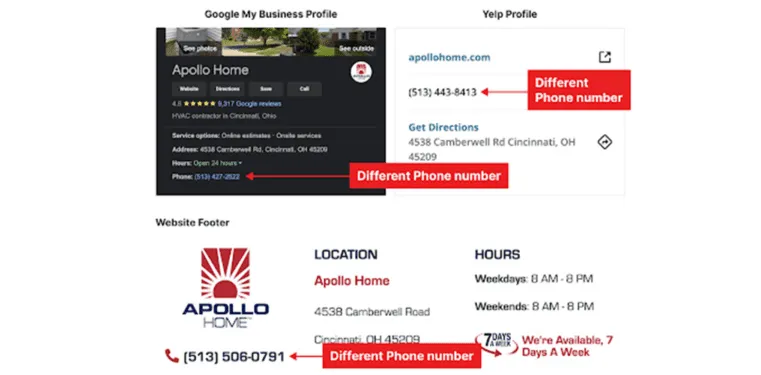
Image: Example of inconsistent contact information across online channels
AI trust signals are credible pieces of information and evidence that help AI systems understand and assess a brand, business, website, or content source. They can appear on a company’s own website as well as across independent sources throughout the web.
Traditional trust signals have always mattered to consumers. Reviews, testimonials, awards, certifications, transparent policies, contact information, secure websites, and third-party mentions can reduce uncertainty before someone decides to buy. In AI-assisted search, these forms of evidence can also contribute to the information ecosystem from which systems build answers and summaries.
However, it is important to avoid thinking of AI trust signals as a fixed checklist. There is no publicly documented universal score called an “AI trust score” that businesses can optimize. Different AI products use different systems, models, retrieval methods, indexes, and source-selection processes. Google specifically states that AI Overviews and AI Mode do not require special optimization or additional technical requirements beyond being eligible for normal Google Search.
Instead, think of AI trust as the result of multiple reinforcing signals.
Common AI trust signals include:
- Accurate business information: Name, address, phone number, website, hours, services, locations, and other core details agree across important sources.
- Helpful, factually accurate content: Pages clearly explain what the business does and provide useful information rather than vague marketing claims.
- Demonstrated expertise: Author information, professional experience, qualifications, original research, case studies, and first-hand knowledge can make expertise more apparent.
- Customer reviews: Authentic reviews provide independent evidence about customer experiences, service quality, and reputation.
- Professional review responses: Thoughtful responses demonstrate that a business is active and engaged with customers.
- Third-party mentions: Relevant coverage, industry references, partnerships, interviews, and other independent mentions can provide corroborating evidence.
- Consistent brand identity: The business is described similarly across its website, business profiles, social channels, directories, and other relevant sources.
- Transparent website information: Clear About, Contact, service, pricing, privacy, terms, and other relevant pages reduce ambiguity.
- Structured data: Appropriate structured data can provide explicit clues about the meaning and relationships within website content. Google describes structured data as a standardized way to classify page information.
- Strong local signals: For local businesses, accurate Business Profile information, location details, opening hours, services, and local references can help establish the business’s identity and geographic relevance.
These signals work best when they support one another. For example, suppose a plumbing company states on its website that it serves three cities. Its Google Business Profile lists the same service area, local directories contain matching information, customers mention those services in reviews, and local publications reference the company in those communities. Taken together, those sources create a much clearer digital identity than a single page making the same claim.
The underlying principle is simple: make the facts about your business easy to discover, understand, corroborate, and verify.
Why Trust Signals Matter in AI Search
AI search changes the way information is presented to users. Instead of requiring someone to open several search results and compare them manually, an AI-powered search experience may synthesize information into a conversational answer.
Google describes AI Overviews as a way to help users understand complicated topics more quickly while providing links that allow them to explore the information further. AI Mode similarly uses different models and techniques to respond to searches, meaning the sources and responses can vary depending on the query.
For businesses, this creates an important visibility and reputation issue.
A customer might ask:
“What are the best HVAC companies near me?”
Or:
“Which accounting firms specialize in small businesses?”
Or:
“Is this company reputable?”
The answer may be influenced by information available across multiple sources. If a business has a clear and consistent digital footprint, an AI system has more useful information with which to identify the entity and understand its relevance.
If that information is incomplete, outdated, contradictory, or difficult to verify, the resulting description may be less accurate.
Trust can influence how AI understands a brand
AI systems need to distinguish between different businesses, topics, claims, and sources. Consider two companies with similar names. If one has a well-established website, consistent business listings, clear location information, active profiles, reviews, and third-party mentions, while the other has very little reliable information online, the first company presents a much clearer entity.
This matters because AI visibility is not simply about publishing more content. The system needs enough context to understand what the content is about, who created it, what entity it refers to, and whether the information is useful and credible.
Google’s guidance reinforces this broader principle. Its E-E-A-T framework considers Experience, Expertise, Authoritativeness, and Trustworthiness, with trust described as the most important aspect. Google also makes clear that E-E-A-T itself is not a single ranking factor; rather, its systems use various signals that can help identify content demonstrating these qualities.
Trust also affects what happens after AI mentions your brand
Being mentioned by an AI system is only one part of the customer journey.
A prospective customer may see your company in an AI-generated answer and then visit your website, Google Business Profile, review platforms, social accounts, or other sources to verify the recommendation.
If the information matches, the AI-generated recommendation is reinforced.
If the customer discovers contradictory information—such as outdated hours, a different phone number, inconsistent services, questionable reviews, or claims that cannot be substantiated—the initial recommendation can lose credibility.
This is particularly important because AI-generated answers can create a compressed first impression. Users may encounter a summary of your business before they ever reach your website.
Trust signals are especially important for local businesses
Local businesses have an additional challenge: identity and location accuracy.
Google allows businesses to establish and manage information such as their address, contact details, business type, photos, and other details through their Business Profile. Google also explains that its systems use publicly available information to understand a site’s name, contact information, social profiles, and other business details.
That means local businesses should pay close attention to information such as:
- Business name
- Physical address or service area
- Phone number
- Website URL
- Opening hours
- Primary and secondary services
- Business category
- Locations served
- Customer reviews
- Brand descriptions
The objective isn’t to make every profile artificially identical. Rather, the core facts should accurately describe the same real-world business.
Accuracy Is the Foundation of AI Trust Signals
Of all the trust-building principles, accuracy should come first.
An AI system cannot reliably understand a business when the underlying information is wrong or contradictory. A polished website, thousands of social followers, or a strong review profile cannot fully compensate for basic factual errors such as an incorrect address, outdated opening hours, wrong service information, or an inaccurate company description.
Google’s current guidance for AI features specifically recommends keeping important business information up to date and ensuring that structured data matches the visible content on the page.
Start with your core business facts
Create a definitive source of truth for your most important business information.
Depending on the business, this may include:
| Business information | What to verify |
|---|---|
| Business name | Official spelling and branding |
| Address | Current physical location |
| Phone number | Correct primary contact number |
| Website | Correct canonical/official domain |
| Hours | Current opening and holiday hours |
| Services | Services currently offered |
| Service areas | Cities, regions, or neighborhoods served |
| Business category | Accurate primary category |
| Team information | Current leadership and professional details |
| Company description | Accurate description of what the business does |
Then compare those facts against the places where customers and search systems are likely to encounter the business.
Keep website information current
Your website should clearly communicate fundamental facts about the business.
For example, a service page should not claim that you provide a service that the company stopped offering months ago. A location page should not list an office that has closed. An About page should not contain outdated leadership information. Contact pages should use current contact details.
This sounds basic, but outdated information can become especially problematic when different pages preserve different versions of the same fact.
A simple content audit can identify:
- Old addresses
- Former employees presented as current team members
- Discontinued products or services
- Expired offers
- Outdated statistics
- Incorrect pricing
- Broken links
- Old business hours
- Duplicate or conflicting location pages
- Claims that no longer have supporting evidence
Make important claims verifiable
Accuracy is more than avoiding obvious errors. Important claims should have evidence behind them.
Instead of saying:
“We are the leading provider in the region.”
A stronger approach is to explain what supports the claim, where appropriate—for example, relevant awards, independently verifiable achievements, years of experience, documented results, certifications, or customer outcomes.
Google’s guidance on helpful content specifically encourages content that demonstrates expertise, provides evidence of the expertise involved, and avoids easily verifiable factual errors.
This principle is particularly useful for AI search because clear, evidence-backed statements give systems more concrete information to interpret.
Ensure structured data matches visible content
Structured data can help search engines understand the meaning and classification of information on a page. But it should not be used to communicate facts that users cannot see or that contradict the visible page.
Google explicitly recommends ensuring that structured data matches the visible content.
For example, if your website’s visible content says your business operates Monday through Friday but your structured data contains outdated hours, you have created conflicting signals.
For eligible businesses, LocalBusiness structured data can communicate information such as business hours and other business details to Google.
The key principle is alignment: structured data should accurately represent what users can actually find on the page.
Audit third-party information, too
Your website is only one part of your digital footprint.
Review:
- Google Business Profile
- Relevant business directories
- Industry directories
- Social media profiles
- Review platforms
- Local publications
- Chamber or professional organization listings
- Partner websites
- Author profiles
- Company profiles
- Location-specific websites
You do not necessarily need to control every mention of your business. That is unrealistic. But you should identify important inaccuracies and correct information where you have the ability to do so.
This matters because AI-generated brand descriptions can draw on information beyond a company’s own website. Recent reporting has highlighted real-world cases where outdated or conflicting web information contributed to incorrect AI-generated descriptions of businesses, demonstrating why maintaining an accurate digital footprint has become a practical reputation-management issue.
Accuracy should be an ongoing process
Business information changes constantly. Companies move locations, add services, change hours, hire new leaders, retire products, update policies, and expand into new markets.
Therefore, building AI trust signals is not a one-time SEO task.
A practical maintenance cycle is:
- Establish the authoritative version of your business information.
- Audit your website and major third-party profiles.
- Correct outdated or contradictory information.
- Check that structured data reflects visible content.
- Monitor reviews and public mentions.
- Update important information whenever the business changes.
- Periodically check how AI search experiences describe your brand.
The goal is not to manipulate an AI system into saying something favorable. It is to make the real, accurate story of your business easier to understand and verify.
That distinction is important. There is currently no special AI markup, secret “AI trust score,” or guaranteed optimization technique that makes a business appear in AI-generated answers. Google explicitly states that there are no additional technical requirements or special schema required for inclusion in AI Overviews or AI Mode.
Instead, the strongest foundation remains the fundamentals: accurate information, helpful content, clear entity information, credible evidence, technical accessibility, and a consistent presence across the web. When those fundamentals reinforce each other, your brand gives both users and AI-powered search systems a clearer basis for understanding who you are and what you can legitimately claim.
Consistency Helps AI Systems Connect the Dots
AI systems need to understand not only what a business says about itself, but also whether that information forms a coherent picture across the wider web. When your website, business profiles, review platforms, social accounts, directories, and third-party mentions consistently describe the same business, it becomes easier for search systems to connect those references to the same real-world entity.
This does not mean every mention needs to use identical wording. What matters is that the important facts remain accurate and compatible. Your business name, location, services, contact information, industry, areas served, leadership, and other defining details should not conflict from one source to another.
Google’s current guidance for AI features emphasizes the continued importance of foundational SEO, including making important content available in text, keeping Business Profile information up to date, and ensuring structured data matches the visible content on a page. Google also explains that publicly available information across the web can contribute to how it understands a site’s name, contact information, and social profiles.
Why consistency matters for AI visibility
Consider a hypothetical digital marketing agency whose website says it serves businesses in New York, its Google Business Profile lists a New Jersey address, LinkedIn describes it as a software company, and several directories use an old phone number.
A person might eventually figure out which information is correct. An automated system has a harder job: it must determine which pieces of information belong together and which are outdated.
Now consider the opposite situation. The company’s website, Business Profile, social profiles, relevant directories, and third-party mentions consistently identify it as a digital marketing agency serving businesses in New York, with the same official website and current contact details.
That creates a much clearer entity.
The practical lesson is that AI visibility benefits from reducing ambiguity.
Focus on the facts that define your business
You do not need to make every sentence across the web identical. Instead, prioritize consistency around your core entity information:
- Official business name
- Website and official domain
- Physical address or service area
- Phone number
- Business category
- Primary services
- Products or specialties
- Locations served
- Opening hours
- Leadership and key team information
- Professional qualifications or certifications
- Brand description
- Social media profiles
For local businesses, this is particularly important because Google uses business information to help users identify businesses in Search and Maps. Business Profiles allow verified businesses to manage information such as their address, contact details, business type, and photos.
Build a single source of truth
A useful way to manage consistency is to maintain an internal business information master sheet.
Record the official version of every important fact and use it whenever you update a profile, directory listing, location page, social account, press mention, or other public-facing resource.
This becomes especially valuable when a business:
- Moves to a new location
- Changes its phone number
- Adds or removes services
- Expands into a new market
- Changes opening hours
- Rebrands
- Changes leadership
- Launches a new product
- Closes a location
- Changes its service area
After a significant change, audit the most important online properties rather than updating only your website.
Keep structured data aligned with visible content
Structured data can provide explicit clues about what information on a page represents. However, it should accurately reflect what users can see.
Google specifically recommends that structured data match the visible content on the page.
For example, if a company’s visible page lists its current opening hours but its structured data contains old hours, the website is sending conflicting information. Similarly, adding information to markup that is not actually supported by the visible page can create unnecessary ambiguity.
Structured data is therefore best treated as a way to clarify accurate information, not as a place to add claims simply because they might be useful for search.
Consistency is not the same as duplication
Businesses sometimes interpret consistency as a reason to copy the exact same description everywhere. That is unnecessary.
A LinkedIn profile, Google Business Profile, company About page, industry directory, and social profile have different purposes. Their descriptions can naturally vary.
For example:
- Your homepage can provide a concise company overview.
- Your service pages can explain specific capabilities.
- Your LinkedIn profile can emphasize the organization and its people.
- Your Business Profile can focus on local business information.
- An industry directory can provide category-specific details.
The context can change while the underlying facts remain consistent.
That is the type of consistency that helps create a coherent digital identity.
Customer Reviews Reinforce Credibility
Customer reviews provide something a company’s own marketing content cannot provide on its own: independent customer experiences.
A business can describe itself as reliable, responsive, affordable, experienced, or highly skilled. Reviews allow customers to describe what actually happened when they interacted with that business.
For AI search, reviews are therefore an important part of the broader information environment surrounding a brand. Google itself says reviews can help businesses stand out and give potential customers useful information. It also notes that honest and balanced reviews can help potential customers make decisions.
This does not mean reviews are a guaranteed AI ranking factor or that accumulating a particular number of reviews will make an AI system recommend a business. There is no publicly documented formula that works that way. Instead, reviews can provide useful third-party context about a business’s reputation and customer experience.
Reviews provide real-world evidence
Imagine a home remodeling company whose website says it specializes in kitchen renovations.
If customers independently leave reviews discussing:
- Kitchen remodeling projects
- Communication with the project team
- Project timelines
- Workmanship
- Design assistance
- Specific neighborhoods served
those reviews add context around the company’s services and customer experience.
For service businesses, Google can also collect ratings around specific aspects of customer experience. Google explains that some service businesses may receive ratings associated with aspects of the service, and information about the jobs performed can come from sources such as the business’s service list and website.
This makes it especially valuable for businesses to ensure that their actual services are clearly and accurately represented across their website and business profiles.
Fresh reviews add current context
A review from five years ago may still provide useful historical information, but recent reviews can tell prospective customers more about the company’s current experience.
Businesses change. Employees change. Services improve. Locations move. Policies evolve.
A healthy review profile can therefore provide an ongoing stream of customer-generated context.
However, businesses should never manufacture that activity.
Google explicitly prohibits offering free or discounted goods or services in exchange for reviews, changing reviews, or removing negative reviews. Reviews and other user contributions should reflect genuine experiences.
A balanced review profile can be more credible
Trust does not necessarily require a perfect rating.
A profile containing only flawless praise can sometimes provide less useful context than a profile containing a range of genuine customer experiences. Google itself notes that honest and balanced reviews can help potential customers decide.
The objective should therefore be to earn authentic positive feedback, not manufacture an artificial reputation.
Businesses can make the process easier by legitimately asking customers to leave feedback after a completed purchase or service. Google provides businesses with a review link and QR-code option for requesting reviews, provided the resulting reviews represent genuine customer experiences.
Don’t focus only on your average rating
A 4.8-star average does not tell the entire story.
Look at what customers repeatedly mention.
For example, if dozens of customers independently praise:
- Fast response times
- Friendly staff
- Emergency service
- Transparent pricing
- Specific expertise
- Convenient scheduling
those recurring themes can reveal what customers actually associate with your brand.
They can also identify gaps between your marketing claims and real customer experiences.
If your website says “24/7 emergency support” but customers repeatedly complain that emergency calls go unanswered at night, the issue is bigger than reputation management. Your public claims and customer experience are misaligned.
That is why reviews should be treated as feedback for the business, not simply as a score to display on a website.
Reviews should support—not replace—your website
Reviews are powerful third-party evidence, but they should not carry the entire burden of explaining your business.
Your website should still clearly communicate:
- What you offer
- Who you serve
- Where you operate
- Who is behind the business
- What experience or expertise you have
- How customers can contact you
- What makes your offering different
- Evidence supporting important claims
Reviews then provide an external layer of customer experience around those claims.
The strongest digital presence is therefore not one where the website makes impressive claims and reviews exist separately. It is one where your own information and genuine customer experiences tell a compatible story.
Review Responses Show That Your Brand Is Engaged
Getting reviews is only part of reputation management. How you respond to those reviews also becomes part of the public record of your business.
Google explicitly says that replying to customer reviews shows customers that you value their feedback. It also recommends professional, relevant, concise, and helpful responses.
For AI search, review responses should not be viewed as a secret optimization technique. There is no evidence that simply replying to every review guarantees greater AI visibility.
Their value is more practical: responses add another layer of public context about how a business interacts with customers.
Respond to positive reviews naturally
A response to a positive review does not need to be elaborate.
Instead of repeatedly posting:
“Thank you for your five-star review!”
make the response relevant to the customer’s actual experience.
For example:
“We’re glad the installation was completed ahead of your planned move-in date. Thank you for trusting our team.”
That response acknowledges a specific part of the customer’s experience without turning the interaction into an advertisement.
Google recommends keeping review responses short and simple and making them relevant rather than using the same generic response for everyone.
Handle negative reviews professionally
Negative reviews deserve particular attention because future customers can learn as much from the company’s response as from the complaint itself.
A strong response should generally:
- Acknowledge the customer’s concern.
- Remain calm and professional.
- Avoid revealing private customer information.
- Correct factual errors when necessary without becoming defensive.
- Apologize when the business genuinely made a mistake.
- Explain what can reasonably be done to address the issue.
- Move sensitive details to a private communication channel when appropriate.
Google recommends protecting privacy, avoiding personal attacks, being honest about limitations, apologizing when appropriate, personalizing responses, and responding in a timely manner.
For example, a response such as:
“We’re sorry to hear that the appointment did not meet your expectations. We understand your concern about the scheduling delay. We’d like to review what happened with our team and find a way to address it. Please contact us directly so we can discuss the details privately.”
is generally more constructive than:
“This review is completely false. You don’t understand how our business works.”
The first response demonstrates professionalism even if the complaint itself is disputed.
Don’t try to manipulate negative reviews
A negative review should not automatically be treated as something that needs to disappear.
Google states that businesses should report reviews when they violate its policies, but businesses should not report a review simply because they disagree with it or dislike it. Negative feedback can identify genuine areas for improvement.
Likewise, businesses should not offer incentives to customers in exchange for positive reviews or ask them to change or remove negative reviews. Those practices violate Google’s policies.
The better strategy is to earn better reviews through better customer experiences and handle legitimate criticism transparently.
Review responses contribute to a larger trust picture
Think of your review profile as a conversation rather than a collection of star ratings.
A potential customer can see:
Customer experience → business response → evidence of accountability
That sequence can communicate something valuable about the organization.
If customers repeatedly mention the same strength and the company responds thoughtfully, the brand’s public reputation becomes easier for people to understand. If customers repeatedly identify the same problem and the business acknowledges and addresses it, the review history can demonstrate responsiveness and improvement.
This is especially relevant to the broader concept of AI trust signals because AI systems need context to understand entities and information. Reviews, business information, website content, and other public sources can collectively contribute to that context, while Google’s own documentation emphasizes keeping business information current and maintaining helpful, reliable, people-first content for AI search experiences.
Ultimately, the goal is not to optimize reviews for AI. It is to create a genuine reputation that is visible, current, and supported by real customer experiences. When that reputation aligns with the information on your website and other authoritative business profiles, it creates a stronger and more coherent trust foundation for both customers and AI-powered search experiences.
Social Media Adds Real-Time Brand Context
Social media can add an important layer of real-time context to the way a business is understood online. A company’s website may explain what it does, but social profiles can show what the brand is doing now: announcing new services, sharing projects, introducing team members, responding to customers, participating in industry conversations, and communicating changes.
For AI search, this matters because understanding a business often requires more than one source. Google explains that its local business information can be compiled from multiple sources, including a business’s official website, third-party data, user contributions, and information from Google’s interactions with a local place.
Social profiles can therefore help reinforce the identity established elsewhere. Google Business Profiles can also include links to social profiles such as Facebook, Instagram, LinkedIn, Pinterest, TikTok, X, and YouTube in supported regions.
Keep social profiles consistent with your brand
Your social profiles should reinforce the same fundamental facts found on your website and business listings.
Check that your:
- Business name is accurate
- Website links point to the official domain
- Location or service area is current
- Business description accurately reflects your services
- Contact information is not outdated
- Profile images and branding identify the same organization
- Services and products mentioned are actually available
- Team and leadership information is current
The wording does not have to be identical across platforms. A LinkedIn company description can be more professional, while an Instagram profile may be shorter. What matters is that the underlying facts do not contradict each other.
Use social content to demonstrate what your business actually does
Social media becomes more valuable when it provides evidence rather than simply promotional slogans.
For example, a construction company could share:
- Completed projects
- Before-and-after images
- Project walkthroughs
- Team expertise
- Safety practices
- Customer experiences
- Industry certifications
- New equipment
- Community involvement
A software company might demonstrate:
- Product updates
- Feature releases
- Customer use cases
- Expert commentary
- Product demonstrations
- Webinars
- Industry research
This kind of content gives people—and potentially the systems interpreting public information—additional context about the business.
Google’s current guidance for generative AI search emphasizes creating unique, valuable content based on genuine expertise and first-hand experience rather than simply reproducing information already available elsewhere.
Don’t confuse activity with trust
Having hundreds of social posts does not automatically make a company more trustworthy.
A business could post every day while publishing inaccurate information, making unsupported claims, or providing little useful evidence. Conversely, a smaller business with fewer but genuinely useful posts can present a much clearer picture of its expertise.
The objective should therefore be relevance and authenticity, not volume.
Keep your profiles active enough to reflect meaningful business activity, but prioritize content that demonstrates real experience, answers customer questions, and accurately represents your organization.
Connect social profiles to the broader brand identity
When appropriate, link your official social profiles from your website and add supported social profile links to your Google Business Profile. This helps users move between the different parts of your digital presence.
For local businesses, this can be particularly useful because Google may combine information supplied by the business with information from other sources when building local business profiles.
Think of your website, Business Profile, social accounts, review profiles, and third-party mentions as different pieces of the same identity.
The stronger the relationship between those pieces, the easier it is for customers to verify that they are looking at the same legitimate business.
Website Trust Signals for AI
Your website remains one of the most important places to establish your brand’s identity, expertise, and credibility.
Google’s current guidance is particularly clear on this point: there is no special AI markup or separate technical optimization required to appear in AI Overviews or AI Mode. The foundational SEO requirements and best practices still apply. Pages need to be accessible, indexable, useful, and supported by clear content.
That means website trust signals should be approached as an extension of good SEO and good user experience—not as a collection of tricks designed specifically for AI.
Make your business identity obvious
Your website should make it immediately clear:
- Who the company is
- What it offers
- Where it operates
- Who it serves
- How customers can contact it
- Who is responsible for the business
- What experience or expertise it has
A clear About page can explain the company’s history, people, experience, qualifications, and mission. Service pages should explain exactly what is offered rather than relying on vague promotional language.
For organizations with multiple locations, each legitimate location should also have accurate information rather than generic pages that create uncertainty about where the company actually operates.
Demonstrate experience and expertise
Trust becomes stronger when a business can demonstrate what it claims.
Depending on the industry, useful evidence can include:
- Author biographies
- Professional qualifications
- Certifications
- Licenses
- Years of relevant experience
- Case studies
- Original research
- First-hand observations
- Project examples
- Customer results
- Industry awards
- Expert contributions
- Testimonials
- Detailed product information
Google’s E-E-A-T guidance emphasizes experience, expertise, authoritativeness, and trustworthiness, while noting that E-E-A-T itself is not a single ranking factor. Google also states that trust is the most important aspect of E-E-A-T.
The practical takeaway is to show evidence of credibility instead of merely claiming credibility.
Create helpful, people-first content
AI search does not eliminate the importance of high-quality website content. In fact, Google’s current generative AI guidance says valuable, unique, non-commodity content can be important for visibility in generative AI search.
Avoid producing pages that exist primarily to target keywords.
Instead, answer the questions customers actually have.
A strong service page might explain:
- What the service includes
- Who needs it
- How the process works
- What it costs or what affects pricing
- How long it typically takes
- What customers should prepare
- Common mistakes
- Alternatives
- Limitations
- Frequently asked questions
- Relevant examples or results
This gives both users and search systems substantially more context than a short page filled with generic marketing statements.
Keep important information in text
AI search systems need accessible information to understand a page.
Google recommends ensuring important content is available in textual form and that pages are technically accessible for crawling and indexing.
That does not mean avoiding images, video, graphics, or interactive elements. Rather, don’t hide essential business information exclusively inside an image, video, or inaccessible interface.
For example, if a page contains an important service description only inside an image, provide the relevant information as HTML text as well.
Use structured data accurately
Structured data can help search engines understand the entities and information represented on a page.
For example, appropriate structured data can communicate information about a business, organization, products, articles, events, and other supported entities.
But structured data should describe reality rather than manufacture it.
Google recommends that structured data match the visible content on the page.
So if your page says your business operates in one location, don’t use structured data to imply that it operates somewhere else. If information has changed, update both the visible content and the relevant structured data.
Make your website easy to verify
A trustworthy website should not make visitors hunt for basic information.
Consider including clear access to:
- About Us
- Contact information
- Service pages
- Location information
- Team or author information
- Customer reviews or testimonials
- Case studies
- Privacy policy
- Terms and conditions where relevant
- Returns/refund information for applicable businesses
- Licensing or certification information where relevant
The exact pages will depend on the business model, but the principle is consistent: remove unnecessary uncertainty.
How to Build AI Trust Signals Across Your Brand
Building AI trust signals is best treated as a brand-wide information management process, not a one-time SEO campaign.
The objective is to create a consistent digital ecosystem in which your website, business profiles, social accounts, reviews, third-party references, and other legitimate sources reinforce the same underlying facts.
Google’s latest guidance confirms that the fundamentals of SEO remain applicable to generative AI features, including making content accessible, creating helpful content, maintaining good page experience, using internal links, and keeping Business Profile information current.
A practical process looks like this:
Step 1: Establish your core brand facts
Document your official:
- Business name
- Website
- Address
- Phone number
- Service areas
- Business category
- Products and services
- Leadership
- Key qualifications
- Social profiles
- Opening hours
This becomes your internal source of truth.
Step 2: Audit your digital footprint
Check how the business is represented across:
- Your website
- Google Business Profile
- Major directories
- Review platforms
- Social media
- Industry websites
- Professional organizations
- Local publications
- Partner websites
Look specifically for contradictory or outdated information.
Step 3: Strengthen your website
Build pages that demonstrate what your company actually knows and does.
Prioritize:
- Helpful service content
- Original insights
- First-hand experience
- Author expertise
- Case studies
- Customer evidence
- Clear business information
- Accurate structured data
- Strong internal linking
- Accessible text content
Google’s guidance recommends unique, useful content with genuine value rather than simply repackaging existing information.
Step 4: Improve your review ecosystem
Encourage genuine customers to leave honest feedback where appropriate.
Then monitor and respond to reviews professionally.
Don’t purchase reviews, manufacture testimonials, or offer incentives in exchange for positive ratings. Authentic customer experiences are considerably more valuable than artificial reputation signals.
Step 5: Keep social profiles useful and current
Make sure official profiles are identifiable and connected to the correct website.
Share meaningful updates, original expertise, customer work, product information, team activity, and other content that accurately represents the organization.
Where available, Google allows businesses to add supported social profile links directly to their Business Profile.
Step 6: Strengthen third-party credibility
Look for legitimate opportunities to earn references from relevant sources.
Depending on your industry, these might include:
- Industry publications
- Professional organizations
- Local news outlets
- Business associations
- Suppliers and partners
- Conference websites
- Educational institutions
- Relevant review platforms
The emphasis should be on earned and relevant mentions, not mass-produced directory listings or low-quality link schemes.
Step 7: Monitor what AI search says about your brand
Search for your business using realistic customer questions.
For example:
- “What does [brand] specialize in?”
- “Is [brand] a good option for [service]?”
- “Who are the best [service providers] in [location]?”
- “What services does [brand] offer?”
- “How does [brand] compare with [competitor]?”
Look for factual inaccuracies, outdated information, missing services, incorrect locations, or confusing descriptions.
Don’t assume every AI response is authoritative. Treat the results as a diagnostic tool that can reveal where your public digital footprint may be unclear.
Step 8: Correct the underlying source
If an AI-generated answer contains incorrect information, don’t focus exclusively on trying to change the AI response.
Instead, investigate why the information may be unclear or incorrect.
Check your website, business profiles, reviews, social accounts, and other relevant sources. Correct inaccurate information wherever you control it and strengthen the authoritative evidence supporting important facts.
This approach is much more sustainable than attempting to optimize for individual AI responses.
Build a Brand AI Systems Can Trust
AI-powered search is changing how businesses build visibility, but trust still starts with the fundamentals. Both customers and AI systems benefit from information that is accurate, consistent, credible, current, and easy to verify.
Brands that want to strengthen their presence in AI search should focus on creating a connected digital footprint. Accurate business listings, genuine customer reviews, thoughtful review responses, helpful website content, and relevant social media activity can work together to create a clearer and more credible picture of the brand.
For businesses looking to strengthen AI trust signals, Pro Real Tech can help improve local SEO, business listings, online reputation, review management, and other digital marketing efforts that support a more consistent brand presence. By bringing these elements together, businesses can make it easier for both customers and AI-powered search systems to understand what they offer and why they are credible.
Ready to strengthen your brand’s trust signals for AI search? Connect with Pro Real Tech today.
Frequently Asked Questions (FAQs) About AI Trust Signals
WHAT ARE AI TRUST SIGNALS?
AI trust signals are credible pieces of information that help AI-powered search systems understand a business, website, organization, or content source. They can include accurate business information, helpful content, customer reviews, professional credentials, first-hand experience, consistent brand information, third-party references, and other evidence of credibility.
There is no single universal “AI trust score.” Different AI systems use different models, retrieval methods, data sources, and ranking systems.
WHY DO AI TRUST SIGNALS MATTER?
AI search systems increasingly provide synthesized answers and recommendations rather than simply presenting traditional search-result lists. Strong, consistent information gives these systems better context for understanding your business and gives users more evidence to verify what an AI-generated answer says.
Google’s AI Search guidance emphasizes the continued importance of helpful, reliable content and foundational SEO practices.
HOW DO AI SYSTEMS EVALUATE CREDIBILITY?
There is no single publicly documented process shared by every AI system.
In general, AI-powered search experiences can retrieve and synthesize information from relevant sources. Google’s current documentation explains that AI Overviews and AI Mode can use multiple related searches and supporting web pages to develop responses.
Businesses should therefore focus on making their information accurate, useful, accessible, consistent, and supported by credible evidence rather than attempting to reverse-engineer one universal AI ranking formula.
WHAT ARE EXAMPLES OF AI SEARCH TRUST SIGNALS?
Examples include:
- Accurate business and contact information
- Consistent brand information across legitimate sources
- Helpful and original content
- Demonstrated expertise
- Author credentials
- First-hand experience
- Authentic customer reviews
- Professional review responses
- Relevant third-party mentions
- Case studies and original research
- Accurate structured data
- Clear About and Contact information
- Current local business information
No individual signal guarantees AI visibility. The broader credibility of the digital presence matters.
HOW CAN BUSINESSES BUILD AI TRUST SIGNALS?
Start with accurate foundational information. Then make your website demonstrate genuine expertise and first-hand experience, maintain your business profiles, earn authentic reviews, respond professionally to customers, keep social profiles current, and correct inconsistencies across important third-party sources.
Most importantly, focus on building a trustworthy business rather than trying to manufacture signals for AI.
WHY ARE REVIEWS IMPORTANT FOR AI SEARCH?
Reviews provide independent customer perspectives that complement information published by the business itself. They can reveal recurring themes about service quality, customer experience, products, and reputation.
Reviews should be genuine. Businesses should not purchase reviews, create fake reviews, or incentivize customers to provide positive feedback.
WHAT ARE WEBSITE TRUST SIGNALS FOR AI?
Website trust signals include clear business identity, accurate contact and location information, helpful content, author information, demonstrated expertise, case studies, customer evidence, transparent policies, accessible text, good technical performance, and accurate structured data.
Google states that websites appearing in AI features should follow the same foundational SEO practices used for Google Search, rather than implementing special AI-only requirements.
HOW DOES LOCAL SEO SUPPORT AI VISIBILITY?
Local SEO helps establish who a local business is, where it operates, and what it offers.
Accurate Business Profile information, consistent location details, relevant reviews, service information, local content, and legitimate local references can all contribute to a clearer local presence.
Google says business information in local results can come from multiple sources, including official websites, third parties, users, and Google’s own interactions with places and businesses.
WHAT IS E-E-A-T FOR AI SEARCH?
E-E-A-T stands for Experience, Expertise, Authoritativeness, and Trustworthiness.
It is useful as a framework for creating credible content, but E-E-A-T is not a single ranking factor. Google specifically states that its systems use a combination of signals to identify content demonstrating these qualities and that trust is the most important aspect of E-E-A-T.
For AI search, businesses can apply the same principles by demonstrating who created the content, why they are qualified to discuss the subject, what first-hand experience they have, and what evidence supports their claims.
Read More: AI Search Still Runs on SEO: Why Technical Foundations Matter More Than Ever


