


Search is changing from a system where users primarily choose from a list of links into one where search engines and AI systems increasingly interpret queries, retrieve information, and generate direct answers. Google’s AI Overviews and AI Mode, along with other AI-powered search experiences, are changing how people discover information online. But this does not mean search engine optimization has become obsolete. In fact, the technical foundations of SEO have become even more important.
AI search still needs access to reliable web information. Before a search engine or AI system can understand, summarize, cite, or recommend information from a website, it needs to discover and process that information. That means fundamental SEO processes such as crawling, rendering, indexing, content interpretation, internal linking, canonicalization, and structured data still play an important role.
Google’s current guidance is particularly clear on this point: its generative AI search features are built on core Search systems, and pages generally need to be indexed and eligible to appear in traditional Search before they can be considered for generative AI features. Google also states that existing SEO best practices remain relevant because AI features use its Search index to retrieve information for generated responses.
The important shift is therefore not SEO versus AI search. It is SEO as the foundation for AI visibility.
Traditional SEO asks whether a search engine can discover, understand, and rank a page. AI search adds another layer: can the system identify the most useful information on that page, connect it to the user’s intent, understand the context, and use it as evidence for an answer?
This makes technical quality especially important. A page can contain excellent information, but if important content is inaccessible to crawlers, hidden behind technical barriers, difficult to render, poorly structured, duplicated across multiple URLs, or disconnected from the rest of the site, its ability to contribute to search and AI-generated answers can be weakened.
AI search also places greater emphasis on extractability and evidence. Search systems increasingly need to identify specific passages, facts, entities, relationships, and supporting information rather than simply decide whether an entire page deserves a ranking position. Microsoft’s recent documentation around AI-powered search similarly describes a movement toward grounding AI answers in content that can be retrieved, evaluated, and used as evidence.
For businesses, the practical lesson is straightforward: don’t abandon SEO because search is becoming more conversational. Instead, make your SEO foundation stronger. Create content that is useful to people, ensure search engines can access and interpret it, make important answers easy to extract, and build consistent signals across your website and the wider web.
Why AI Search Still Depends on SEO
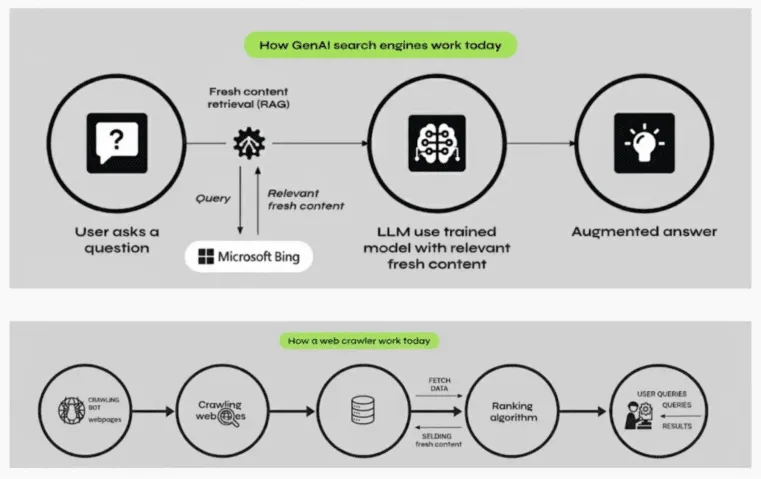
AI search may look very different from traditional search, but it still depends heavily on the infrastructure that makes web information discoverable.
An AI-generated answer cannot reliably reference a page that a search system cannot find, crawl, process, or index. Search engines still maintain large indexes of web content, and AI-powered search experiences can use those indexes to retrieve relevant information before generating an answer.
Google’s current documentation describes this directly. Its generative AI features use techniques such as retrieval-augmented generation, or RAG, to retrieve relevant and up-to-date information from the Search index and use that information to help generate responses. Google also states that the underlying Search ranking and quality systems continue to support these experiences.
That creates a simple chain:
Crawl → Render → Understand → Index → Retrieve → Generate → Cite or Surface
Technical SEO influences the early stages of this chain, while content quality and relevance influence what happens later.
Crawling remains the starting point
Search engines cannot understand pages they cannot access. Google’s search process still begins with crawling, where automated systems discover URLs and download page resources. Google then renders pages when necessary, processes their content, and decides what information can be included in its index.
Technical problems can interrupt this process.
For example, a website may accidentally block important resources through robots.txt, use incorrect noindex directives, create inaccessible navigation paths, generate excessive duplicate URLs, or rely heavily on JavaScript in ways that make important information harder to process.
These issues are not suddenly irrelevant because AI is involved. If anything, they become more consequential when visibility depends on multiple layers of retrieval and interpretation.
Indexing remains essential
Crawling and indexing are not the same thing. A search engine may successfully access a URL without ultimately including it in its index.
During indexing, Google analyzes elements such as the textual content, title, images, videos, and other page information. It also evaluates canonicalization and duplication, among other factors.
For AI search, indexability is equally important because retrieval systems need a reliable corpus of information from which to find potential sources.
This means businesses should continue monitoring:
- Index coverage
- Canonical URLs
noindexdirectives- Robots.txt rules
- XML sitemaps
- Internal links
- Redirects
- Duplicate or near-duplicate pages
- Server response problems
- JavaScript rendering
- Important content that may not appear in the rendered page
A sitemap can help search engines discover URLs, but it does not guarantee indexing. Google explicitly notes that sitemap submission does not guarantee that a page will be crawled or indexed.
AI needs retrievable information, not just good writing
A common misconception is that AI search replaces the need for traditional optimization because large language models can understand natural language.
The reality is more nuanced.
AI systems may be excellent at interpreting language, but they still need trustworthy information to ground an answer. In search-based AI experiences, retrieval systems help locate relevant sources before information is incorporated into a response.
This changes the optimization objective slightly. Instead of thinking only about:
“How do I rank this page?”
businesses should also consider:
“How easily can the important information on this page be discovered, understood, retrieved, and supported as an answer?”
That is why technical SEO, information architecture, content structure, and authority continue to matter.
Traditional ranking signals still contribute to discovery
AI search does not necessarily select information from the web randomly. Search systems use relevance, quality, freshness, authority, and other signals to determine which information is useful for a query.
Google’s guidance emphasizes creating unique, helpful, satisfying content for users rather than producing material specifically designed to manipulate AI systems.
This means businesses should not replace SEO with a collection of artificial “AI optimization tricks.” The stronger approach is to build a technically sound website and publish information that genuinely satisfies the underlying search intent.
AI visibility is becoming measurable
The growing connection between SEO and AI search is also becoming visible in webmaster tools.
In June 2026, Google announced Search Console reports designed to provide dedicated visibility into impressions from generative AI features such as AI Overviews and AI Mode, with the rollout initially limited to a subset of sites.
Microsoft has also introduced AI Performance reporting in Bing Webmaster Tools, allowing publishers to see citation activity across supported AI experiences, including which URLs are referenced and which queries are associated with those citations.
This reinforces an important point: AI visibility is increasingly becoming an extension of search visibility rather than a completely separate discipline.
How Technical SEO Supports AI Search Discovery
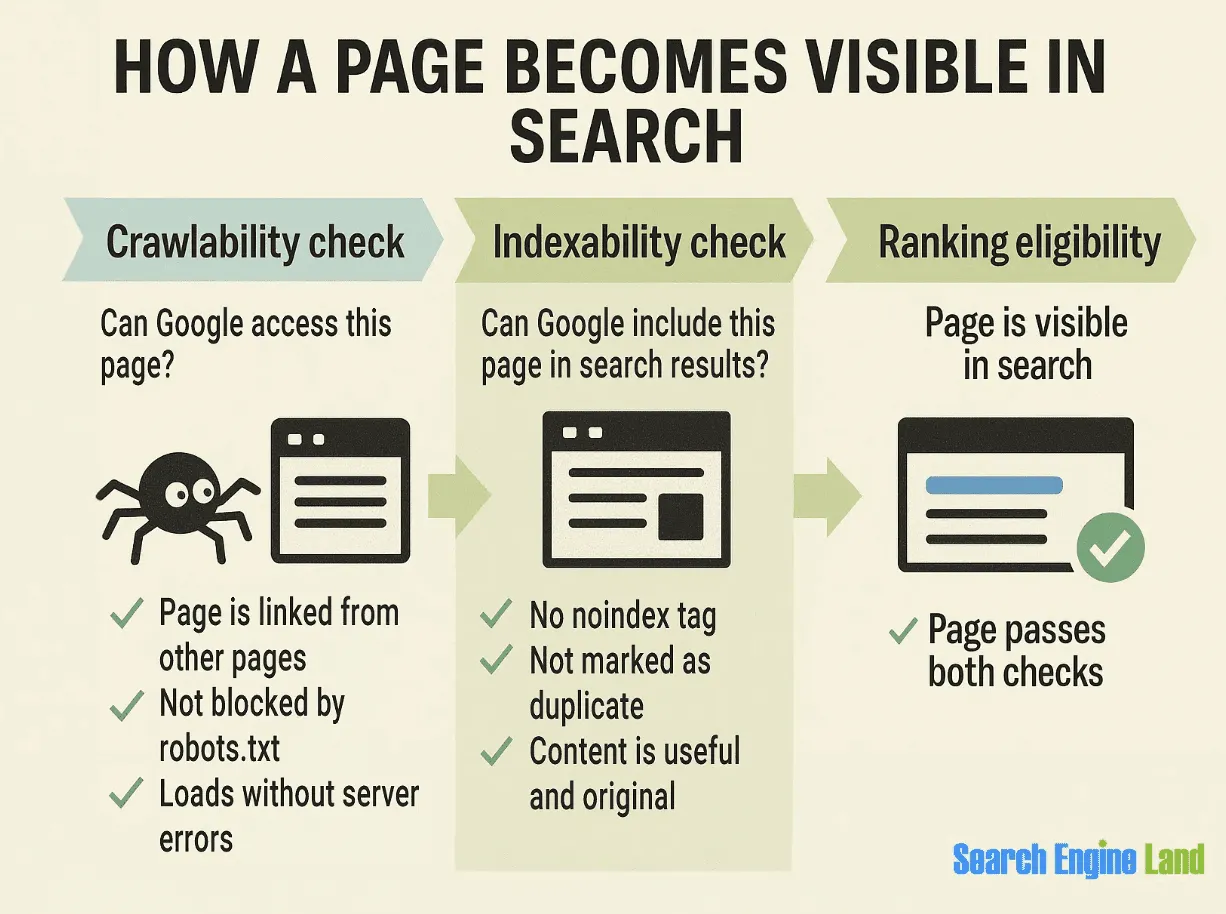
Technical SEO provides the infrastructure that allows search engines and AI-powered search systems to discover, process, interpret, and retrieve website information.
It is useful to think of technical SEO as the access layer between your content and search systems. Your content may contain the exact answer a user needs, but that value cannot contribute to search visibility if the system cannot reliably access or understand the page.
Crawlability makes content discoverable
Search engines need paths to discover pages. Internal links, XML sitemaps, external links, and other discovery mechanisms can help search engines identify URLs.
A logical internal linking structure is especially useful because it connects related pages and helps search engines understand how different pieces of content relate to one another.
For example, a website selling accounting software might organize its information around:
Accounting Software → Features → Invoicing → Automated Invoicing → Invoicing FAQs
This structure gives both users and search systems a clearer understanding of the relationship between the pages.
Technical SEO should therefore ensure that important pages are:
- Linked from relevant pages
- Not unnecessarily buried deep within the site
- Included in appropriate sitemaps
- Accessible without requiring problematic interactions
- Free from accidental crawl blocks
- Served with appropriate HTTP status codes
Google’s crawling documentation specifically recommends logical URL structures and describes sitemaps as a way to communicate new or updated pages to Google.
Rendering determines what systems can actually process
Modern websites often depend on JavaScript. That is not automatically a problem, but important information should still be accessible when search engines render the page.
Google explains that its crawler can render pages and execute JavaScript, but rendering is an important part of processing modern websites because content may otherwise not be visible in the initial HTML.
For AI search, the principle is simple: don’t assume that because information appears in a user’s browser, every search system will interpret it exactly as intended.
Critical information should be presented in a technically accessible way.
For important pages, businesses should check whether:
- Main headings are available
- Body content is accessible
- Product or service information can be rendered
- Navigation links are discoverable
- Important text is not dependent on fragile scripts
- Key information is not loaded only after complex user interactions
- Error states are not accidentally being served to crawlers
Indexability controls what can enter the search ecosystem
Technical SEO also determines whether a page is eligible for indexing.
A page can be perfectly written and beautifully designed yet remain invisible to search if it is blocked from indexing.
Common problems include:
- Accidental
noindextags - Incorrect canonical tags
- Robots.txt restrictions
- Redirect chains
- Soft 404s
- Server errors
- Duplicate URLs
- Parameter-generated pages
- Poor internal linking
These issues can reduce the clarity of a website’s overall information architecture.
Google’s Search Essentials still treats technical requirements as the minimum foundation required for pages to be eligible for Search, while noting that meeting those requirements does not guarantee crawling, indexing, or serving.
Clean site architecture improves contextual understanding
AI systems need context.
A page about “pricing” is easier to interpret when it is clearly connected to the relevant product or service than when it exists as an isolated URL with little internal context.
A strong information architecture helps establish relationships among:
- Topics
- Services
- Products
- Authors
- Organizations
- Locations
- Supporting resources
- Related questions
This is where internal linking, descriptive anchor text, breadcrumbs, headings, URLs, navigation, and consistent terminology work together.
Technical SEO therefore isn’t just about making a crawler’s job easier. It can also help establish the context surrounding a piece of information.
Structured data provides additional context
Structured data can help search engines understand what a page represents.
Google describes structured data as a standardized format that provides explicit clues about the meaning of page content.
Depending on the page, structured data can communicate entities and relationships involving things such as:
- Organizations
- Products
- Articles
- Events
- Local businesses
- Breadcrumbs
- Reviews
- Courses
- Software applications
Structured data should not be treated as a magic shortcut to AI visibility. It does not guarantee rankings, AI citations, or inclusion in generated answers.
Its value is primarily in providing machine-readable context and helping eligible search features understand page content. Businesses should therefore implement relevant, accurate schema and ensure that the structured data matches the visible information on the page.
Canonicalization and duplication protect signal clarity
AI search increases the importance of knowing which version of your content represents the authoritative source.
If the same information appears across numerous URLs, search engines have to determine which URL should be treated as the preferred version. Duplicate or near-duplicate pages can make those signals less clear.
A clean canonicalization strategy helps consolidate signals around the preferred URL.
This matters particularly for large websites that generate multiple URLs through:
- Filters
- Tracking parameters
- Faceted navigation
- Product variations
- Pagination
- Search results
- Content syndication
- Regional versions
The goal is not simply to reduce duplicate content for traditional rankings. It is to create a clearer information environment in which search systems can identify the correct source.
What Search Signals Help AI Understand Your Website
AI systems do not rely on one universal “AI SEO signal.” There is no single optimization factor that guarantees inclusion in an AI-generated response.
Instead, AI search depends on multiple layers of signals that help systems determine what a page is about, whether it is relevant, whether it can be trusted, and whether it provides useful evidence for a particular query.
1. Relevance to the user’s intent
The first question is whether the page actually addresses the user’s need.
A page targeting the keyword “CRM software” may not be the best source for a user asking, “How do I migrate customer data from one CRM to another?”
AI search can interpret complex questions and conversational intent, so pages should address the underlying problem rather than repeatedly targeting isolated keywords.
This means content should answer:
- What is the user trying to accomplish?
- What information do they need?
- What follow-up questions are likely?
- What examples would make the answer clearer?
- What evidence would support the recommendation?
2. Clear topical focus
Search systems need to understand what a page is primarily about.
Clear titles, headings, introductory paragraphs, descriptive URLs, relevant internal links, and consistent terminology can all contribute to that understanding.
A page that attempts to cover ten unrelated subjects is generally harder to interpret than one with a clear primary purpose.
For example, a page titled “Email Deliverability Guide” should consistently explain deliverability, authentication, sender reputation, bounce management, spam complaints, and related concepts rather than drifting into unrelated email marketing topics.
3. Accessible plain-text information
AI systems ultimately need usable information.
Important facts should not exist only inside images, inaccessible interface components, or visually obvious elements that are difficult for automated systems to process.
Critical information should generally be available as text, including:
- Definitions
- Product specifications
- Prices where appropriate
- Service descriptions
- Processes
- Instructions
- Key findings
- Comparisons
- Important qualifications
This does not mean websites should eliminate visual design. It means that design should not become a barrier between important information and machine-readable content.
4. Strong headings and content hierarchy
Headings help communicate relationships between concepts.
A clear structure such as:
H1: Email Deliverability
→ H2: What Is Email Deliverability?
→ H2: Common Causes of Poor Deliverability
→ H3: Authentication Problems
→ H3: High Complaint Rates
→ H2: How to Improve Deliverability
is easier to navigate and interpret than a long page consisting of large blocks of unstructured text.
Headings also help users quickly locate the information they need, which remains important even when AI systems are involved.
5. Internal links and contextual relationships
Internal links help search engines discover pages and understand relationships between them.
A strong topic cluster might connect:
Core Topic → Supporting Guide → Specific Problem → Detailed Solution → FAQ
For AI visibility, this creates a broader context around individual facts.
Instead of presenting one isolated page about “DMARC,” a website could connect it to related content about SPF, DKIM, email authentication, sender reputation, and deliverability.
The individual pages can then reinforce one another’s topical relevance.
6. Authority and external references
A website’s own content is not the only source of visibility signals.
External mentions, links, citations, reviews, publications, industry references, and other reputable references can contribute to how a brand or entity is understood across the web.
This is particularly relevant to AI search because generated answers may draw on multiple sources to establish context and corroborate information.
However, businesses should avoid treating this as a reason to pursue low-quality link schemes. The objective should be to build real recognition and credible references.
7. Consistent entity information
AI systems increasingly need to distinguish entities and understand relationships between them.
Businesses should therefore maintain consistency across important information such as:
- Brand name
- Organization description
- Products
- Services
- Locations
- Leadership
- Contact information
- Industry classification
- Author identities
For example, if a company describes itself as a “project management platform” on its website, a “business accounting application” on a social profile, and an “HR software provider” on another third-party page, the inconsistent descriptions can make the broader entity harder to interpret.
Consistency does not mean every external page must use identical wording. It means the fundamental facts and relationships should remain accurate and coherent.
8. Freshness and accuracy
AI-generated answers create a strong need for current information.
Outdated pricing, old product features, discontinued services, obsolete statistics, or expired policies can make a page less useful as a potential source.
Freshness does not mean changing a page simply to make it look new. Instead, update information when facts, products, regulations, processes, statistics, or user needs have genuinely changed.
This is increasingly relevant because AI-powered systems are designed to retrieve information that can support current answers. Google specifically emphasizes the importance of relevant and up-to-date information in the retrieval process behind its generative AI experiences.
9. Evidence and specificity
AI systems have a stronger reason to favor information that can support a concrete answer.
Compare:
Weak:
“Our platform provides powerful analytics.”
Stronger:
“Our analytics dashboard tracks campaign revenue, conversion rate, customer acquisition cost, and email engagement in one interface.”
The second statement contains specific concepts that can be interpreted more easily and connected to specific user questions.
Where appropriate, strengthen important claims with:
- Original data
- Research
- Examples
- First-hand observations
- Methodology
- Expert explanations
- Relevant references
- Dates and context
This makes content more useful to humans and potentially more useful as evidence in AI-generated answers.
10. Technical accessibility
Finally, all of these signals depend on the technical foundation.
A website can have authoritative content, excellent research, strong branding, and useful answers, but those benefits can be undermined if search systems cannot reliably access the pages.
That is why AI search optimization should not be viewed as a replacement for technical SEO.
It is better understood as an extension of it.
The modern search environment increasingly has two connected objectives:
Be discoverable and understandable enough to appear in search.
Be clear, useful, and trustworthy enough to become part of the answer.
The technical foundation supports the first objective, while high-quality content and strong contextual signals support the second. Together, they give a website a better opportunity to participate in both traditional organic results and emerging AI-driven search experiences.
How To Prepare Your Site for AI and Organic Search Results
Preparing a website for AI search does not require abandoning traditional SEO or chasing a completely separate set of ranking tricks. The stronger approach is to make the website technically accessible, clearly structured, useful to readers, and easy for search systems to interpret.
Google’s current guidance confirms that its generative AI features, including AI Overviews and AI Mode, continue to rely on core Search systems and information from the Search index. Pages generally need to be indexed and eligible to appear in traditional Google Search before they can be considered for these generative experiences. Google also states that there are no special technical requirements or additional AI-specific markup required beyond its established Search requirements.
That makes the fundamentals particularly important. Businesses should focus on four areas: ensuring crawlers can access and render important pages, making core content answer user questions directly, keeping important information available as readable text, and building credible visibility beyond the website itself.
1. Crawl and Render Come First
Before worrying about AI visibility, make sure search engines can actually access your content.
Crawling is the process through which search engine crawlers discover URLs and retrieve their content. Rendering allows systems to process pages that depend on technologies such as JavaScript and understand the content presented after the page is rendered. These processes remain fundamental to search visibility because a page that cannot be reliably accessed or processed has limited opportunity to enter the search index.
Google continues to describe crawling, rendering, and indexing as fundamental parts of how Search processes websites. Its current AI-search guidance specifically says that the way Google Search finds and processes pages remains central to how its AI systems access website information.
This means businesses should audit the technical foundation before investing heavily in AI-specific optimization.
Check whether important pages:
- Can be crawled without unnecessary restrictions
- Are not accidentally blocked by
robots.txt - Do not contain unintended
noindexdirectives - Return appropriate HTTP status codes
- Are internally linked from relevant pages
- Are included in XML sitemaps when appropriate
- Have correct canonical URLs
- Render their primary content correctly
- Do not depend on fragile scripts to expose essential information
- Avoid excessive duplicate or parameter-based URLs
A sitemap can help search engines discover URLs, but it is not a guarantee of crawling or indexing. Google explicitly notes that submitting a sitemap does not guarantee that its URLs will be indexed.
Test the rendered version, not just the source code
One common technical mistake is checking only the HTML source and assuming that everything visible to a visitor will automatically be available to search systems in the same form.
Modern websites frequently use JavaScript to load navigation, product information, reviews, pricing, filters, or other page elements. While search engines can process JavaScript, important information should not be unnecessarily dependent on complex client-side behavior.
For example, imagine an article where the introduction, headings, and answer are present in the initial HTML, but the actual explanation is loaded only after a user clicks a button. That creates an additional technical dependency between the content and its availability.
For critical information, a safer approach is to make the primary content directly accessible in the rendered page.
Keep important pages technically simple
AI search does not reward technical complexity for its own sake.
A page does not need an elaborate architecture to become AI-friendly. It needs to be accessible, indexable, understandable, and useful.
A technically healthy website should therefore prioritize:
Discoverability → Crawlability → Rendering → Indexability → Clear content → Relevant retrieval
If a problem exists near the beginning of that chain, optimizing later stages becomes much less effective.
2. Core Pages Need Direct Answers
AI-powered search is increasingly designed to answer questions rather than simply return a collection of documents.
That means important pages should not force visitors—or retrieval systems—to search through several paragraphs before finding the answer.
A strong page should make its primary answer clear early, then provide the supporting explanation, evidence, examples, and context.
For example, instead of beginning a page about “What is technical SEO?” with several paragraphs of general discussion, provide a concise definition first:
Technical SEO is the process of improving a website’s technical infrastructure so search engines can crawl, understand, index, and serve its content effectively.
The rest of the page can then explain crawling, indexing, rendering, site architecture, structured data, performance, and other relevant concepts.
This structure benefits both humans and search systems.
Answer the main question before expanding
A useful framework is:
Question → Direct answer → Explanation → Evidence → Example → Related questions
For example:
What is a canonical tag?
Give the definition first.
Then explain:
- Why canonicalization matters
- When to use it
- Common implementation mistakes
- How it interacts with duplicate URLs
- How to validate it
This approach makes the content easier to scan and gives retrieval systems clear passages that directly correspond to specific questions.
Microsoft’s 2026 guidance on AI-generated answers similarly highlights the value of clear structure, including headings, tables, and FAQ sections, along with evidence and focused topical coverage.
Build pages around complete search journeys
Direct answers do not mean creating thin pages consisting of one or two sentences.
AI systems can handle complex questions, so comprehensive pages can be valuable when they cover the user’s broader information need.
For example, a page targeting “how to improve email deliverability” might answer:
- What email deliverability means
- Why emails go to spam
- How SPF, DKIM, and DMARC work
- How sender reputation affects delivery
- How bounce rates affect performance
- How to monitor deliverability
- What businesses should do when delivery rates fall
The goal is to answer the primary question while also resolving the logical follow-up questions.
Give important pages a clear purpose
Not every page needs to answer every possible question.
A product page should primarily explain the product and its value.
A service page should explain the service, who it is for, benefits, process, and relevant proof.
An informational article should answer a specific problem or topic.
A FAQ should resolve common uncertainties.
This focused structure makes it easier for both users and search systems to determine what each page contributes.
3. Plain Text Affects Extractability
AI search systems need information they can retrieve and interpret. This makes the availability of important information as readable text particularly important.
Visual design can improve the user experience, but critical information should not exist only inside images, decorative elements, videos, screenshots, or interface components.
For example, if a product’s key specifications are displayed only inside an image, a user may be able to read them visually, but the information is less directly available as page text.
Important information should therefore be represented in accessible text whenever practical.
This includes:
- Definitions
- Product specifications
- Service descriptions
- Prices and conditions
- Instructions
- Benefits
- Features
- Comparisons
- Research findings
- Key statistics
- Important qualifications
- Frequently asked questions
Use headings to create information landmarks
Plain text works best when it is organized.
Instead of placing 2,000 words into a continuous block, use descriptive headings that divide the information into meaningful sections.
For example:
H2: What Is Email Authentication?
H2: Why Email Authentication Matters
H3: SPF
H3: DKIM
H3: DMARC
H2: How to Implement Email Authentication
This gives users obvious navigation points and gives automated systems clearer signals about the relationships between concepts.
Tables can make factual information easier to understand
Tables can be particularly useful for structured comparisons.
For example:
| Feature | Basic Plan | Professional Plan | Enterprise Plan |
|---|---|---|---|
| Users | 5 | 25 | Unlimited |
| Analytics | Basic | Advanced | Advanced |
| Support | Priority | Dedicated |
A well-structured table can communicate relationships between facts more efficiently than several paragraphs.
However, tables should be used when they genuinely improve comprehension rather than simply to make content appear more “AI optimized.”
Don’t hide essential information behind unnecessary interactions
Tabs, accordions, expandable sections, sliders, and interactive components can be useful for user experience. But businesses should be careful about putting essential information exclusively behind complicated interactions.
If an important answer is hidden behind multiple clicks, loaded only after an unusual event, or dependent on a script that fails under certain conditions, its accessibility can suffer.
The objective is not to remove interactive design. It is to ensure that the core information remains technically and semantically accessible.
Make claims specific and verifiable
Extractability is not just about technical text availability. The quality of the information matters too.
Compare:
“Our software provides powerful automation.”
with:
“The platform automatically assigns incoming support requests based on customer type, issue category, and agent availability.”
The second statement is more specific and gives both users and search systems clearer information about what the product actually does.
For important claims, provide supporting context such as:
- Data
- Examples
- Research
- Methodology
- Dates
- Expert attribution
- First-hand experience
- Relevant references
Microsoft’s current AI-search guidance specifically recommends supporting claims with evidence and improving clarity and structure when trying to make content useful for AI-generated answers.
4. Off-Site Mentions Shape Broader Visibility
A website does not exist in isolation.
Search systems increasingly need to understand not only what a company says about itself but also how that company, product, person, or organization is represented across the wider web.
This is where off-site signals can become important.
Relevant external signals can include:
- Editorial mentions
- Industry publications
- Authoritative backlinks
- Reviews
- Business directories
- Partner websites
- Professional profiles
- News coverage
- Research citations
- Community discussions
- Other reputable references
The goal is not to create artificial mentions everywhere. It is to build a credible and consistent presence across sources that people and search systems can reasonably use to understand the entity.
Build consistent entity information
Suppose a company describes itself as an “email marketing platform” on its website but appears elsewhere as an “email hosting provider.”
That difference may create ambiguity about what the company actually does.
Businesses should maintain accurate and broadly consistent information about:
- Brand name
- Organization
- Products
- Services
- Industry
- Locations
- Leadership
- Areas of expertise
- Important business facts
Consistency does not require copying the same description across every website. It means the underlying facts should remain accurate.
Earn mentions instead of manufacturing them
AI visibility should not become another excuse for low-quality link building.
Mass-produced guest posts, irrelevant directory submissions, fake reviews, or manufactured citations may create noise without building genuine authority.
A better strategy is to earn references through:
- Original research
- Useful tools
- Expert commentary
- Data studies
- Industry reports
- Strong digital PR
- Partnerships
- Proprietary insights
- High-quality resources
The underlying principle is simple: become a source that other credible sources have a reason to reference.
Track citations as well as rankings
The measurement landscape is also changing.
In February 2026, Microsoft introduced AI Performance reporting in Bing Webmaster Tools, giving publishers visibility into when their URLs are cited in AI-generated answers, along with citation activity and grounding-query information.
Google also announced dedicated Search Console reporting for visibility in generative AI features such as AI Overviews and AI Mode, initially rolling the reporting out to a subset of websites in June 2026.
This does not mean traditional rankings are no longer important. Instead, businesses now have an additional visibility layer to consider.
A modern measurement framework can therefore include:
Organic rankings + organic impressions + clicks + conversions + AI visibility + citations + assisted conversions
The exact metrics will vary by platform and business, but the direction is clear: search visibility is increasingly broader than blue-link rankings alone.
Prepare Your Search Presence for What Comes Next
Search visibility increasingly depends on whether search engines and AI systems can crawl, process, understand, and retrieve your website’s content. As AI-powered search changes how people discover information, technical SEO remains essential for ensuring your pages are accessible and positioned for visibility.
Pro Real Tech provides technical SEO solutions designed to strengthen your website’s foundation for AI search optimization, while supporting sustainable visibility across traditional organic search and emerging AI-driven search experiences.
Strengthen your website’s technical foundation, improve its search readiness, and build an AI SEO strategy designed for the evolving search landscape. Contact us today to prepare your website for greater visibility across organic and AI-powered search.
Frequently Asked Questions (FAQs) About AI SEO and Technical SEO
HOW DOES AI CHANGE THE WAY WE SHOULD THINK ABOUT SEARCH?
AI changes search from primarily a query-to-ranking model toward a more complex query-to-retrieval-to-answer experience.
Traditional search generally presents users with a list of pages that they can evaluate themselves. AI-powered search can interpret a more conversational or complex request, retrieve relevant information from multiple sources, synthesize that information, and provide a direct response with links or citations.
This does not eliminate SEO. Google’s current guidance explicitly says that SEO best practices remain relevant because its generative AI features are rooted in core Search ranking and quality systems and use information from the Search index.
The strategic shift is that businesses should think beyond:
“How do I rank for this keyword?”
and also ask:
“Can my content be discovered, understood, retrieved, trusted, and used to answer this type of question?”
That requires strong technical SEO, useful content, clear information architecture, authoritative signals, and accurate information.
DOES SITE STRUCTURE STILL MATTER IF AI GENERATES THE ANSWER?
Yes. Site structure still matters.
AI-generated answers do not remove the need for search engines to discover and process website information.
Clear site architecture helps search engines understand relationships between pages, topics, entities, and content. Logical URLs, internal links, descriptive headings, breadcrumbs, canonicalization, XML sitemaps, and appropriate navigation can all contribute to a cleaner technical and contextual structure.
Google’s current AI-search documentation specifically states that the way Search finds and processes pages remains central to how its AI systems access website data.
A well-structured website also improves the human experience. Visitors can find related information more easily, while search systems can better understand which pages are central, which are supporting resources, and how different topics connect.
AI changes the search interface. It does not make website architecture irrelevant.
WHY DO SOME BRANDS SHOW UP MORE OFTEN IN AI RESPONSES?
There is no single “AI visibility score” that guarantees a brand will appear in generated answers.
Brands may appear more frequently when their information is:
- Relevant to the user’s question
- Available in searchable sources
- Clearly described
- Supported by credible evidence
- Consistent across the web
- Associated with strong topical expertise
- Useful for specific informational needs
- Accessible to search and retrieval systems
External recognition can also matter because AI systems may use multiple sources when building an answer.
For example, a company may have a strong website but limited visibility if almost nobody outside the company references it. Another company may have useful first-party content combined with credible third-party coverage, industry references, product information, reviews, and other signals that help establish its identity and expertise.
However, businesses should not assume that more mentions automatically mean more AI visibility. Relevance, quality, accuracy, and context matter.
The emergence of AI citation reporting supports this broader view. Bing’s AI Performance reporting now shows publishers which pages are being cited and the query phrases associated with some AI retrieval activity, giving businesses more insight into how their content participates in generated answers.
SHOULD BUSINESSES CHANGE THEIR SEARCH APPROACH RIGHT NOW?
Yes—but the change should be evolutionary rather than a complete replacement of SEO.
Businesses should continue investing in technical SEO, helpful content, internal linking, digital authority, structured data, and user experience while adapting content to more conversational and complex search behavior.
A practical approach is to:
- Audit crawling and indexing.
- Improve site architecture.
- Identify pages that answer important customer questions.
- Put direct answers near the beginning of relevant pages.
- Strengthen evidence and first-hand expertise.
- Keep important information available as text.
- Improve internal linking between related topics.
- Maintain accurate business and entity information.
- Earn credible external mentions.
- Monitor both organic and AI-search visibility.
Google’s current guidance does not recommend abandoning established SEO in favor of a separate AI optimization system. Instead, it emphasizes continuing to follow SEO fundamentals while producing unique, valuable content for users.
IS GOOD CONTENT ENOUGH ON ITS OWN?
No. Good content is essential, but it is not the entire equation.
A website can publish exceptional content and still experience limited visibility if search engines cannot crawl it, the pages are blocked from indexing, important information is inaccessible, canonical signals are confused, or the site’s structure makes the content difficult to discover.
The reverse is also true. A technically perfect website cannot compensate for content that is inaccurate, generic, unhelpful, or irrelevant.
Successful search visibility therefore depends on both sides:
Technical foundation + Useful content + Context + Authority
Technical SEO helps make content accessible.
Content quality gives search systems something valuable to retrieve.
Structure provides context.
External references can reinforce broader credibility.
That combination is much more durable than attempting to optimize for an imagined AI-specific ranking formula.
WHAT MAKES A PAGE EASIER FOR AI SYSTEMS TO ACCESS?
A page is generally easier for search and retrieval systems to process when it has a strong technical and content foundation.
Important characteristics include:
- Crawlable URLs
- Correct indexability settings
- Accessible HTML content
- Proper rendering
- Logical headings
- Clear page titles
- Descriptive URLs
- Strong internal links
- Useful structured data where appropriate
- Minimal technical barriers
- Clear topical focus
- Direct answers to important questions
- Accurate and current information
- Supporting evidence for significant claims
Google’s current documentation says pages need to meet Search’s technical requirements and be indexed and eligible to appear with a snippet to be eligible for its generative AI features. Meeting those requirements, however, does not guarantee crawling, indexing, or inclusion in an AI result.
Therefore, there is no technical checklist that guarantees an AI citation.
The goal is to remove unnecessary barriers while making the page’s important information clear and useful.
DOES SCHEMA STILL HAVE VALUE IN AI-DRIVEN RESULTS?
Yes, but schema should be viewed as a supporting technology—not an AI ranking shortcut.
Structured data gives search engines machine-readable information about the meaning and properties of page content. It can help clarify entities such as organizations, products, articles, events, and other supported content types.
Google continues to use structured data to understand page content and support eligible rich-result experiences. For example, Organization structured data can help Google understand an organization’s details and disambiguate it from other organizations.
However, businesses should avoid the misconception that adding large amounts of schema automatically makes a page more likely to appear in AI answers.
Structured data should:
- Accurately describe the page
- Match visible content
- Use supported properties where relevant
- Follow search-engine guidelines
- Be maintained when the underlying information changes
Google also makes clear that correctly implemented structured data does not guarantee that a particular search appearance will be displayed.
The best approach is therefore to use schema where it genuinely improves machine-readable understanding and supports eligible search features, while continuing to prioritize crawlability, indexability, content quality, site structure, and user value.
In other words, schema still matters, but it works best as part of a broader technical SEO foundation rather than as a substitute for one.


