

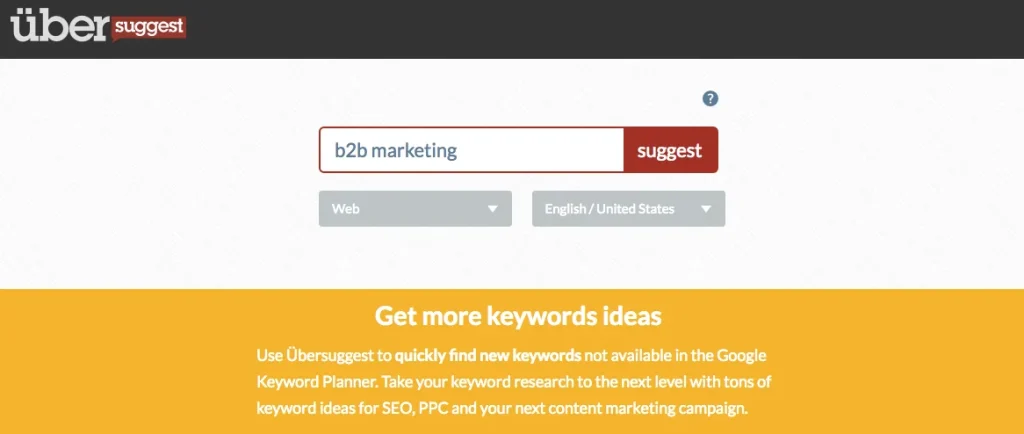
In the high-stakes world of B2B marketing, content isn’t just king—it’s your most strategic salesperson. Yet, creating great content is only half the battle. If it isn’t discovered by the right person at the right stage of their months-long decision journey, its value evaporates. The bridge between your solution and your ideal business customer is built with high-intent keywords: the precise terms and phrases decision-makers use when they’re actively researching, comparing, and selecting partners.
Traditional keyword research, often volume-obsessed, fails in the B2B arena. Ranking for “project management” might bring traffic, but it’s likely from students or casual readers, not from a VP of Operations evaluating enterprise software. The real opportunity lies in identifying the long-tail, specific, and commercial-intent queries that signal a buyer is moving down the funnel. This is where Ubersuggest transforms from a simple suggestion tool into a critical intelligence asset for your business.
This guide will walk you through a strategic framework for using Ubersuggest to conduct B2B keyword research that directly fuels your sales pipeline. We’ll move beyond basic search volume to uncover the terms that attract qualified leads, shorten sales cycles, and deliver a measurable return on your content investment.
B2B vs B2C Keyword Research: A Strategic Breakdown

While both disciplines aim to connect content with searcher intent, B2B and B2C keyword research are fundamentally different games requiring distinct playbooks. Understanding these differences is critical to avoiding wasted effort and aligning your SEO strategy with your business goals.
| Aspect | B2B Keyword Research | B2C Keyword Research |
|---|---|---|
| Primary Goal | Generate qualified leads, nurture long-term relationships, support sales cycles. | Drive direct sales, encourage impulse buys, build brand awareness. |
| Target Audience | Multiple stakeholders (users, managers, executives) with different concerns. | Individual consumer making a personal choice. |
| Intent & Funnel | Complex, research-heavy journey mapped to TOFU, MOFU, BOFU keywords. | Shorter, often emotion-driven journey focused on features, benefits, and price. |
| Keyword Characteristics | Lower search volume, higher specificity, longer phrases, focused on solutions and integration. | Higher search volume, broader terms, focused on products, reviews, and deals. |
| Sales Cycle & Value | Long (months to years), high customer lifetime value (LTV). | Short (minutes to days), lower average order value. |
The Core Distinctions in Practice
1. Audience Complexity: Committee vs. Consumer
A B2C purchase, like buying running shoes, typically involves one person. Your keywords target their desires: “best cushioned running shoes for marathons” or “Nike Pegasus 39 reviews.”
A B2B purchase, like selecting a new CRM, involves a buying committee. You must target keywords for the end-user (“easy CRM data entry”), the IT manager (“CRM security features SOC 2”), and the financial decision-maker (“CRM ROI case studies”). Your keyword strategy must speak to all these personas simultaneously.
2. The Sales Cycle: Marathon vs. Sprint
The B2B journey is a marathon. A searcher might start with a top-of-funnel (TOFU) problem-awareness query like “lead generation strategies.” Weeks later, they move to middle-of-funnel (MOFU) comparison searches like “Marketo vs. HubSpot for SaaS.” Finally, they reach bottom-of-funnel (BOFU) intent with “HubSpot enterprise pricing” or “B2B marketing automation implementation services.”
Your keyword list must mirror this journey. Relying only on high-volume TOFU terms will fill your top funnel but leave your sales team starving for ready-to-talk leads.
3. Intent Mapping: Solution-Seeking vs. Product-Buying
B2B intent is often informational and commercial mixed together. A search for “how to calculate customer churn rate” (informational) is directly tied to the eventual need for a solution like “churn reduction software” (commercial). Your content and keyword targeting should connect these dots.
B2C intent can be more direct. “Buy blue winter coat” has clear commercial intent. The connection between problem and purchase is immediate.
4. Volume vs. Value: The High-Value Long-Tail
In B2C, a keyword with 50,000 monthly searches is a prime target. In B2B, a keyword with just 50 searches per month can be a goldmine if it perfectly describes your niche solution. For example, “enterprise data warehouse automation tools” will have fraction of the volume of “data tools,” but nearly 100% of its searchers are your ideal, high-value prospects. Ubersuggest helps you find these high-value, low-competition gems that larger competitors might overlook.
Why B2B Keyword Research is Uniquely Challenging (and Rewarding)
The very factors that make B2B keyword research complex—longer cycles, committee buying, niche terms—are what make it so defensible and profitable. Successfully ranking for the right B2B keywords builds a moat around your business. It’s harder for competitors to quickly overtake you when you own a cluster of deep, intent-driven content that speaks directly to a niche audience’s core challenges.
How To Find High-Intent B2B Keywords That Actually Convert

Finding keywords that generate traffic is straightforward. Finding keywords that generate qualified sales conversations requires a strategic, multi-layered approach. High-intent B2B keywords are those used by buyers who have moved beyond general awareness and are actively evaluating solutions. Your goal is to build a keyword portfolio that intercepts these buyers at every stage of their decision-making process.
Step 1: Ground Your Research in Reality – Talk to Sales and Customers
Do not start in a keyword tool. Start with human conversations. Your sales and customer success teams are sitting on a goldmine of commercial intent language that no algorithm can fully predict.
-
Actionable Process: Schedule brief interviews with 3-5 sales reps and 2-3 happy customers. Ask specific questions:
-
To Sales: “What are the top three questions every prospect asks before a demo?” “What are the exact pain points they describe in discovery calls?” “What keywords or phrases do they use when they’re ready to buy?”
-
To Customers: “What did you search for when you first realized you had this problem?” “What terms did you use when comparing vendors?” “What was the final concern you had before signing with us?”
-
-
Outcome: You will collect a list of seed phrases like “integrates with our legacy ERP,” “compliance reporting automation,” or “total cost of ownership vs. ROI.” These are your foundational, high-intent keywords. Plug these directly into Ubersuggest.
Step 2: Use Ubersuggest to Expand and Validate
With your seed phrases from real conversations, you now use Ubersuggest to discover volume, difficulty, and related terms.
-
Enter a Seed Keyword: Start with a customer phrase like “marketing automation for enterprise.”
-
Analyze Keyword Ideas: Navigate to the “Keyword Ideas” section. Ubersuggest will generate a list of related terms. Here, you are not just looking for volume; you are classifying intent:
-
TOFU (Awareness): “what is marketing automation” – High volume, low commercial intent. Useful for top-funnel educational content.
-
MOFU (Consideration): “marketing automation platform comparison” – Clear commercial and comparison intent. Perfect for product pages and benchmark content.
-
BOFU (Decision): “Marketeto enterprise pricing” or “HubSpot for large teams implementation” – High purchase intent. Critical for bottom-funnel content and solution pages.
-
-
Leverage “Questions”: Click on the “Questions” tab. This is a powerhouse for B2B. It shows actual queries like “How to choose a marketing automation platform for B2B?” or “What is the ROI of marketing automation software?” These questions are ready-made blog titles or FAQ sections that match precise buyer intent.
Step 3: Conduct Competitor Gap Analysis
Your competitors are already ranking for terms your ideal customers search for. Use Ubersuggest to reverse-engineer their success and find gaps.
-
Enter a Competitor URL: In Ubersuggest, go to “Competitor Analysis” and input the domain of a key competitor.
-
Identify Their Top Pages: Review the “Top Pages” report to see which of their content pieces get the most organic traffic. A deep-dive “guide” or “comparison” page ranking well is a clear signal of high-intent traffic.
-
Find Keyword Gaps: Look at the specific keywords they rank for. Ask yourself: Can we create a more comprehensive, up-to-date, or visually engaging resource on this topic? Can we answer the question behind the keyword more effectively? This is where you find opportunities to create 10x better content targeting the same high-intent audience.
Step 4: Prioritize Intent and Strategic Value Over Raw Volume
This is the core mindset shift. In B2B, a keyword with 200 searches per month that converts at 5% is infinitely more valuable than a keyword with 10,000 searches that converts at 0.1%.
-
Use Ubersuggest Filters: When reviewing your keyword list, filter and prioritize using these criteria:
-
Commercial Modifiers: Look for keywords containing “vs,” “alternative to,” “best for [industry],” “review,” “pricing,” “cost,” “implementation,” “integration with [X].”
-
Low-to-Medium Difficulty (SD): Target keywords with a Keyword Difficulty (SD) score you can realistically compete for. For newer sites, this might be 0-40. The goal is to secure conversions first, then climb the difficulty ladder.
-
Cost-Per-Click (CPC) as a Proxy for Value: A high CPC (e.g., $50+) indicates that advertisers are willing to pay for that click, signaling high commercial value. These terms are worth targeting organically.
-
Step 5: Organize Keywords into Topic Clusters for Authority
A scattered list of keywords creates a scattered website. To build authority and guide users, you must organize your findings into a topic cluster model.
-
Identify Pillar Topics: These are your broad, core service categories (e.g., “B2B Marketing Automation Software”).
-
Group Supporting Keywords: Use Ubersuggest’s data to group your collected keywords into thematic clusters that support the pillar.
-
Pillar Page Target: “B2B Marketing Automation Software”
-
Cluster 1 (Integration): “marketing automation salesforce integration,” “hubspot crm connector”
-
Cluster 2 (Use Case): “lead nurturing for complex sales cycles,” “marketing automation for SaaS companies”
-
Cluster 3 (Comparison): “marketo vs. pardot comparison,” “best marketing automation for enterprise”
-
-
Strategic Outcome: This structure tells search engines you are a comprehensive authority on the topic. Internally, it creates a logical journey for a visitor, moving them from a cluster article (e.g., solving an integration problem) directly to your main pillar solution page.
By following this process—from human insight to tool-based expansion, competitive analysis, intent filtering, and strategic organization—you move beyond guesswork. You build a keyword universe deliberately engineered to attract, nurture, and convert your highest-value B2B prospects.
Read More: Google Ads’ New “Sponsored” Label: What It Means for Advertisers
B2B Keyword Types You Should Actually Focus On

In B2B marketing, not all keywords hold equal value. The goal is to filter out broad, top-of-funnel “fluff” and concentrate your efforts on terms that signal a searcher is on a direct path to becoming a customer. These four keyword types consistently deliver high-quality leads and shorter sales cycles.
1. Comparison Keywords
These are the crown jewels of B2B intent. When a professional searches “HubSpot vs. Salesforce CRM” or “SOC 2 vs. ISO 27001 compliance,” they are unequivocally in the evaluation phase. They have identified potential solutions and are actively comparing features, pricing, and suitability.
-
Why They Convert: The searcher is solution-aware and has a shortlist. Your content can directly influence their decision by providing a clear, authoritative, and unbiased comparison.
-
Content Strategy: Create detailed, side-by-side comparison pages, blog posts, or even interactive tools. Be honest about strengths and weaknesses, including your own. This builds immense trust. Use data sheets, case study snippets, and clear calls-to-action (CTAs) for a demo or trial tailored to the comparison winner.
2. Integration Keywords
In the modern B2B tech stack, no tool operates in a vacuum. Keywords like “Slack integration with Jira” or “ERP that integrates with Shopify” reveal a critical buying factor: technical compatibility.
-
Why They Convert: These searches are made by users or IT managers who have existing systems and need a new solution to work seamlessly within that ecosystem. It signals they are beyond the theoretical stage and are vetting practical implementation.
-
Content Strategy: Develop dedicated integration pages, documentation, and use-case videos. Highlight how your product connects with other major platforms in your industry. This content often serves bottom-of-funnel (BOFU) buyers who are making a final checklist before purchase.
3. Use-Case Specific Keywords
Moving from generic to specific is where intent sharpens. While “project management software” is broad, “project management software for marketing agencies” is better, and “project management software for remote creative teams with client portals” is best.
-
Why They Convert: These keywords demonstrate a deep understanding of the searcher’s niche, role, and specific workflow challenges. They filter out unqualified traffic and attract a perfect-fit audience.
-
Content Strategy: Craft content that speaks directly to a vertical or a specific role. Create “Ultimate Guide for [Industry]” blog posts, host webinars targeting “[Your Product] for [Specific Use Case],” and feature customer stories from that exact niche. This positions you as a specialist, not a generalist.
4. Pain-Point Phrases
These keywords are often framed as questions or problem statements: “how to reduce SaaS churn rate,” “why is my sales pipeline stagnant,” or “challenges of inventory management for ecommerce.”
-
Why They Convert: While they start at the top of the funnel (TOFU), they attract an audience acutely aware of their problem—the first step toward seeking a paid solution. By providing a valuable answer, you establish yourself as a trusted advisor early in their journey.
-
Content Strategy: Create in-depth problem-solving content. This includes tutorial blogs, diagnostic checklists, and framework-based ebooks. The key is to educate first and then naturally introduce your product as the logical solution, guiding them from pain point to resolution.
| Keyword Type | Example Searches | Funnel Stage | Content Format & Goal |
|---|---|---|---|
| Comparison | “Zendesk vs. Freshdesk,” “AWS vs. Google Cloud pricing” | Middle to Bottom (MOFU/BOFU) | Head-to-head comparison charts, “X vs. Y” blog posts. Goal: Influence final decision. |
| Integration | “Does QuickBooks integrate with NetSuite?” “CRM with Microsoft Teams integration” | Bottom (BOFU) | Integration documentation, technical how-to videos, API guides. Goal: Overcome final technical objection. |
| Use-Case Specific | “Email marketing for B2B SaaS,” “HR software for small businesses under 50 employees” | Middle (MOFU) | Industry-specific case studies, niche webinars, vertical-specific landing pages. Goal: Demonstrate perfect product-fit. |
| Pain-Point Phrases | “How to improve team productivity remotely,” “measuring marketing ROI challenges” | Top to Middle (TOFU/MOFU) | How-to guides, problem-explainer videos, diagnostic tools. Goal: Build authority & capture leads early. |
What to Do After You Have Your Keywords?

A keyword list in a spreadsheet is a cost center. An activated keyword strategy is a revenue driver. Here is your execution roadmap to turn research into results.
Phase 1: Foundational On-Page & Technical SEO
This is non-negotiable housekeeping to ensure search engines and users understand your content.
-
Strategic Page Optimization: Assign primary keywords to specific pages (pillar pages, service pages, blog posts). Integrate them naturally into:
-
Title Tags & Meta Descriptions: Craft compelling titles with the primary keyword near the front. Write meta descriptions that include the keyword and act as a value-driven ad.
-
Headings (H1, H2, H3): Structure your content logically using headings that incorporate keyword variations.
-
Body Content & Semantic Richness: Use keywords naturally within the first 100 words. Employ related terms, synonyms, and context that search engines use to understand topic depth.
-
-
Implement Schema Markup: Use structured data (like FAQSchema, HowToSchema, or ProductSchema) to give search engines explicit clues about your content. This can earn rich snippets in search results (those enhanced listings with stars, FAQs, or step-by-step guides), which significantly increase click-through rates.
Phase 2: Build Topic Clusters & Content Hubs
This is where you build authority and guide the user journey.
-
Create Your Pillar Page: Develop a comprehensive, cornerstone piece of content targeting a broad pillar topic (e.g., “The Complete Guide to B2B Lead Generation”).
-
Develop Cluster Content: Create individual blog posts or articles targeting each of the long-tail, specific keywords you grouped around that pillar (e.g., “lead scoring models,” “best lead generation tools for SaaS,” “how to qualify a B2B lead”).
-
Interlink Strategically: Hyperlink each cluster content piece to the main pillar page, and link from the pillar page to each cluster piece. This creates a thematic “hub” that signals authority to Google and keeps users engaged on your site, moving them logically toward conversion points.
Phase 3: Leverage Keywords Beyond Traditional SEO
Modern search extends beyond the classic blue-link results page.
-
Optimize for AI and Voice (LLMO – Large Language Model Optimization): AI tools like ChatGPT pull information from the web. Create clear, concise, and authoritative answers to specific questions within your content. Structure data with bullet points and definitive statements to increase the chance of being cited as a source in AI-generated answers.
-
Fuel Content Repurposing: Your keyword list is a content ideas engine.
-
Turn a “how-to” keyword into a short-form video tutorial for YouTube or LinkedIn.
-
Transform a list of “pain-point” questions into a webinar agenda.
-
Convert a “comparison” keyword analysis into an infographic or a slide deck for social media.
-
-
Inform Paid Campaigns: Use your validated list of high-intent, commercial keywords to create tightly themed ad groups in Google Ads or LinkedIn Campaigns. Your organic research has already identified what converts—apply that intelligence to your paid strategy for a higher ROI.
By moving methodically through these phases, you transition from having a static list to operating a dynamic, multi-channel content engine that attracts, engages, and converts your ideal B2B buyer at every touchpoint.
FAQs
Q1: Is Ubersuggest sufficient for B2B keyword research, or do I need more expensive tools like Ahrefs or Semrush?
Ubersuggest is an excellent and cost-effective starting point, especially for small to mid-sized B2B teams. It effectively handles core tasks: generating keyword ideas, showing search volume/trends, analyzing difficulty, and performing basic competitor research. For most, it is sufficient. However, enterprise B2B companies with complex, global niches may benefit from the more extensive backlink databases, granular historical data, and advanced competitor tracking features of premium tools like Ahrefs or Semrush. You can start with Ubersuggest and scale up as your needs grow.
Q2: How long does it typically take to see SEO results from targeting new B2B keywords?
Manage expectations: B2B SEO is a long-term strategy. For new pages targeting low to medium-competition keywords, you may see initial ranking movements in 2-4 months. For more competitive, high-intent keywords and to achieve meaningful, consistent traffic that converts into leads, a 6-12 month timeframe is standard. Success depends on content quality, existing domain authority, and how effectively you build your topic cluster and secure relevant backlinks.
Q3: What’s a good number of keywords to target initially for a new B2B service page or content hub?
Avoid targeting too many at once. Focus on quality:
-
For a core service or pillar page: Target 1 primary keyword (e.g., “B2B workflow automation software”) and 2-3 closely related secondary keywords (e.g., “automate business processes,” “workflow software for enterprises”).
-
For a new content hub: Start with 1 pillar topic and 3-5 supporting cluster articles. It’s better to deeply own a small, relevant topic area than to spread yourself too thin across many unrelated keywords.
Q4: How do I differentiate my content when targeting the same high-intent keywords as my larger competitors?
You compete on depth, specificity, and user experience. If a competitor writes a “guide,” you create the “ultimate guide” with more data, templates, or case studies. Leverage your unique expertise:
-
Add Original Data: Conduct surveys or analyze your industry data.
-
Improve Formatting: Use better visuals, interactive tools, or clearer step-by-step instructions.
-
Increase Specificity: Target a narrower segment (e.g., “for startups in fintech” instead of “for startups”).
-
Update Relentlessly: Ensure your content is the most current and comprehensive answer available.
Q5: How often should I revisit and update my B2B keyword strategy?
Perform a light review quarterly and a comprehensive audit annually. Market needs, competitor landscapes, and search behavior (especially with AI integration) evolve. Quarterly, check keyword rankings and search trend changes. Annually, re-interview sales/customers, re-run competitor analyses, and prune keywords that are no longer relevant to your business goals.
Conclusion
Effective B2B keyword research is not a one-time project of hunting for high-volume terms; it is an ongoing strategic process of aligning your content with the specific, evolving language of your buyers. As we’ve explored, this requires a fundamental shift in mindset—from pursuing raw traffic to capturing qualified intent.
The methodology outlined here provides a clear path. Start with the qualitative insights from your sales team and customers to ground your efforts in reality. Use a tool like Ubersuggest not as an oracle, but as an engine to expand, validate, and analyze those insights at scale. Ruthlessly prioritize comparison, integration, use-case specific, and pain-point keywords that signal a buyer’s journey from awareness to decision. Finally, activate this research through a structured system of on-page optimization, topic clusters, and content repurposing that builds authority and guides prospects seamlessly toward conversion.
Remember, in the complex, high-value world of B2B, the goal of SEO is to make your sales team’s job easier. By consistently creating and optimizing content for the keywords that matter most at every stage of the funnel, you do more than improve rankings—you build a predictable pipeline of educated, ready-to-engage leads. Begin by having that first conversation with your sales team, inputting their insights into Ubersuggest, and building your first targeted topic cluster. The long-term growth of your business will be built on this foundation of strategic visibility.
Read More: What Is LLMs.txt? & Do You Need One?


