

Imagine it’s 2026. Your marketing dashboard is flooded with data from immersive metaverse engagements, AI-personalized content streams, and interactive shoppable videos. The channels have multiplied, and customer journeys have become non-linear. In this complex landscape, a critical question cuts through the noise: “Is our marketing investment actually driving profitable growth?” The ability to answer this question with clarity and confidence will separate the industry leaders from those left behind.
Digital marketing ROI (Return on Investment) has always been important, but in 2026, it will be non-negotiable. As economic scrutiny intensifies and competition for consumer attention reaches new heights, marketing is under pressure to prove its value with precision. It’s no longer just about clicks, likes, or even leads—it’s about attributing revenue, profit, and long-term customer value directly to marketing activities. This guide will provide you with the frameworks, metrics, and strategic mindset needed to not just measure, but truly understand and maximize your digital marketing ROI in the evolving landscape of 2026, ensuring every dollar spent is an investment toward sustainable business success.
Understanding ROI in Digital Marketing

At its core, Return on Investment (ROI) is the definitive measure of profitability. In digital marketing, it quantifies the financial return generated from your marketing campaigns relative to their cost. It translates marketing efforts—often seen as creative and intangible—into the universal language of business: revenue and profit.
The Fundamental ROI Formula
The basic calculation for marketing ROI is straightforward:
ROI (%) = [(Revenue Attributable to Marketing – Cost of Marketing) / Cost of Marketing] x 100
For simpler, ratio-based analysis:
ROI (Ratio) = Net Revenue / Marketing Cost
Example: If a campaign costs $1,000 and generates $6,000 in revenue, the net profit is $5,000.
-
ROI (%) = ($5,000 / $1,000) x 100 = 500%
-
ROI (Ratio) = $5,000 / $1,000 = 5:1 (meaning you earn $5 for every $1 spent)
This formula provides a powerful snapshot, but its accuracy hinges on one crucial factor: correctly attributing revenue to the specific marketing campaign. This is where advanced tracking and attribution modeling become essential.
What Constitutes a “Good” ROI?
There’s no single universal benchmark, as a good ROI is highly contextual. However, general guidelines exist:
-
A 5:1 Ratio (500% ROI) is widely considered strong and healthy.
-
A 2:1 Ratio (200% ROI) is often viewed as a lower threshold, where profitability may be slim after accounting for all business overheads.
-
A 10:1 Ratio (1000% ROI) is typically outstanding.
The context depends on your industry margins, business goals, and campaign type. For example, a high-margin luxury brand might achieve a lower ratio but higher profit in dollars, while a low-margin, high-volume retailer needs a higher ratio to be sustainable. As noted by marketing strategists, a campaign with a seemingly low direct ROI might be vital for building top-of-funnel awareness that makes other, sales-focused campaigns significantly more effective.
Ultimately, understanding ROI is the first step toward data-driven decision-making. It moves the conversation from “Did people like our campaign?” to “Did our campaign contribute meaningfully to our company’s financial goals?” This foundation is critical as we explore the essential metrics and best practices for 2026.
Why You Need to Measure Digital Marketing ROI
In the data-saturated marketing environment of 2026, measuring ROI transitions from a best practice to a core survival skill. The “spray and pray” method of budget allocation is obsolete. With economic pressures, fragmented customer journeys across multiple digital touchpoints, and rising acquisition costs, intuition alone is a recipe for wasted spend. Systematic ROI measurement is the discipline that transforms marketing from a cost center into a verifiable growth engine.
Here’s why dedicating resources to this measurement is non-negotiable for modern businesses:
1. Justify and Secure Marketing Budgets with Confidence
Financial scrutiny is intensifying. When executive teams or stakeholders question marketing expenditures, vague claims about “brand awareness” or “engagement” are insufficient. Concrete ROI data is your most powerful advocacy tool. Demonstrating that for every $1 invested, $5 or $10 in revenue is returned provides an unambiguous, financially-grounded argument for maintaining or increasing your budget. It shifts the conversation from cost to investment, proving marketing’s direct contribution to the bottom line.
2. Enable Real-Time Optimization and Agile Decision-Making
Modern digital campaigns generate data in real-time. Without ROI measurement, you’re flying blind. By establishing which channels, creatives, and audience segments drive the highest return, you can pivot resources dynamically. This means cutting underperforming campaigns weeks—not months—earlier and doubling down on high-converting opportunities instantly. In 2026, this agility is powered by AI-driven analytics that can predict ROI trends, allowing for proactive optimization before a campaign underperforms.
3. Align Marketing with Overarching Business Objectives
Marketing activities must ladder up to business goals: revenue growth, market share expansion, or customer lifetime value increase. ROI is the key performance indicator (KPI) that creates this alignment. It ensures that every campaign is designed with a measurable business outcome in mind, fostering greater collaboration between marketing, sales, and finance departments. This alignment is crucial for executing an account-based marketing (ABM) strategy or launching products where specific revenue targets are paramount.
4. Understand Long-Term Value Beyond Immediate Sales
A purchase today is valuable, but a loyal customer who makes repeated purchases over years is far more valuable. Advanced ROI measurement incorporates Customer Lifetime Value (CLV). This reveals whether your acquisition costs are justified over the long term. For instance, a campaign with a modest 3:1 immediate ROI might be exceptional if it acquires customers with a high CLV. Without this long-term lens, you risk optimizing for cheap, one-time buyers while neglecting more valuable, loyal segments.
5. Perform Informed Competitive Analysis and Market Positioning
By calculating your own ROI and estimating competitors’ (through public data and market analysis), you gain a strategic view of the competitive landscape. You can identify which channels or strategies your rivals are likely investing in based on their performance. This intelligence allows you to exploit gaps in their approach, differentiate your messaging, and allocate your budget to areas where you can achieve a superior return, securing a competitive advantage.
Essential Metrics for Measuring Digital Marketing ROI
While the final ROI calculation is paramount, it is the result of a constellation of interconnected metrics. Relying on a single number is risky; a holistic dashboard provides the diagnostic power to understand why your ROI is what it is. For 2026, focus on this blend of financial, efficiency, and long-term value metrics.
Financial & Efficiency Core Metrics
These metrics directly feed into your ROI calculation and measure the efficiency of your spending.
-
Customer Acquisition Cost (CAC): The total average cost to acquire a single new paying customer. This includes all marketing and sales spend over a given period.
-
Formula: Total Marketing & Sales Costs / Number of New Customers Acquired.
-
2026 Context: With privacy regulations deprecating traditional tracking, calculating CAC may require more sophisticated modeling (like marketing mix modeling) to accurately attribute spend.
-
-
Cost Per Lead (CPL): The average cost to generate a qualified lead (a potential customer who has shown intent).
-
Formula: Total Campaign Cost / Number of Qualified Leads Generated.
-
Why it Matters: It measures the top-of-funnel efficiency. A skyrocketing CPL can signal audience fatigue or increased competition in your channels.
-
-
Marketing Percentage of CAC (M%CAC): This reveals what portion of your total acquisition cost is attributable to marketing (vs. sales salaries, technology, etc.).
-
Formula: (Total Marketing Cost / Total CAC) x 100.
-
Strategic Insight: A rising M%CAC might indicate that marketing is carrying too much of the load, or that sales-assisted conversions are becoming more costly.
-
Conversion & Performance Metrics
These metrics measure the effectiveness of your messaging, user experience, and conversion pathways.
-
Conversion Rate (CVR): The percentage of users who complete a desired action (purchase, sign-up, download) out of the total number who visited a page or saw an ad.
-
Formula: (Number of Conversions / Total Visitors) x 100.
-
Advanced Use: Segment CVR by channel, device, or audience cohort. A low CVR on a high-traffic channel is a major ROI leak.
-
-
Click-Through Rate (CTR): The percentage of people who click on your ad or link after seeing it.
-
Formula: (Number of Clicks / Number of Impressions) x 100.
-
2026 Context: In feed-based environments (social, native advertising) and with the rise of AI-powered ad buying, a strong CTR is foundational. It’s a direct signal of creative relevance and targeting accuracy.
-
-
Average Order Value (AOV): The average amount spent each time a customer places an order.
-
Formula: Total Revenue / Number of Orders.
-
ROI Impact: Increasing your AOV is one of the most powerful ways to boost ROI without increasing traffic or leads. Tactics like upselling, cross-selling, and bundling directly improve AOV.
-
Long-Term Value & Health Metrics
These metrics ensure you are not sacrificing future profitability for short-term gains.
-
Customer Lifetime Value (CLV or LTV): The total predicted net profit attributed to the entire future relationship with a customer.
-
Simplified Formula: (Average Purchase Value x Purchase Frequency per Year) x Customer Lifespan in Years.
-
The Critical Ratio: CLV:CAC. A ratio of 3:1 or higher is generally considered healthy. It indicates you are earning three times the cost of acquisition over the customer’s lifetime. This is the ultimate guardrail for sustainable growth.
-
-
Customer Retention Rate (CRR): The percentage of customers you retain over a specific period.
-
Formula: ((# Customers at End of Period – # New Customers During Period) / # Customers at Start of Period) x 100.
-
Why it’s Essential for 2026: Acquiring a new customer can be 5-25x more expensive than retaining an existing one. Retention marketing directly protects your marketing ROI by extending customer lifespan and increasing CLV.
-
-
Marketing Originated Customer %: The percentage of new customers who interacted with a marketing touchpoint before their first purchase.
-
Formula: (Number of New Customers with a Marketing Attribution / Total New Customers) x 100.
-
Strategic Insight: This metric demonstrates marketing’s contribution to the sales pipeline. A low percentage may indicate a brand awareness problem or a disconnect between marketing channels and the sales process.
-
-
Return on Ad Spend (ROAS): A channel-specific metric crucial for paid campaigns (Google Ads, Meta Ads).
-
Formula: (Revenue Attributable to Ads / Cost of Ads).
-
Key Distinction: ROAS measures gross revenue per dollar spent, while ROI measures net profit. A ROAS of 4:1 might look good, but if your product margins are thin, your net ROI could be minimal. Always analyze ROAS in conjunction with profit margins.
-
To visualize how these metrics interrelate and flow toward the ultimate goal of maximizing ROI, consider the following strategic framework:
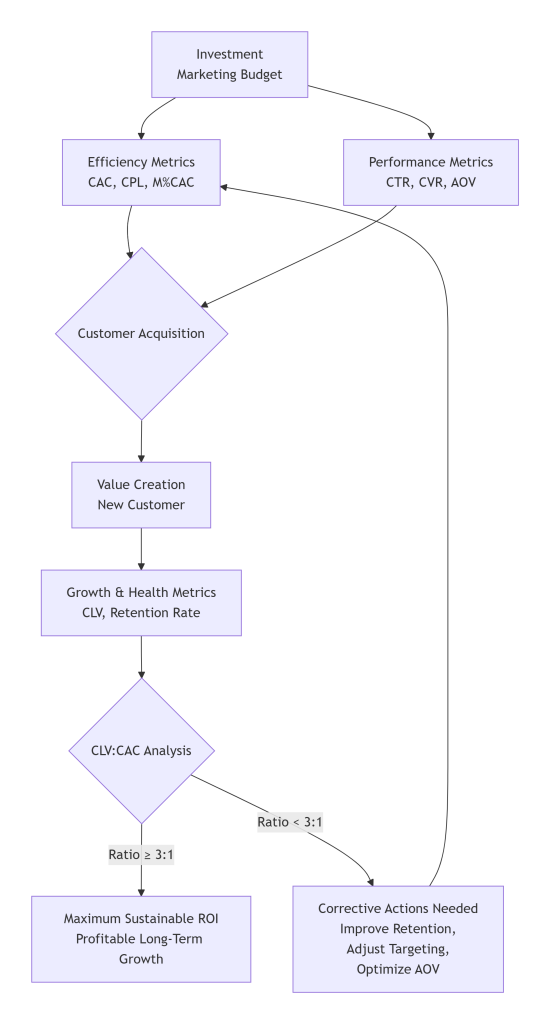
Implementing This in 2026: Success will depend on integrating data from CRM, ad platforms, and analytics into a unified dashboard. With the decline of third-party cookies, leveraging first-party data and advanced attribution models (like data-driven attribution) will be critical to accurately calculating these metrics and, by extension, your true marketing ROI.
Best Practices for Effectively Measuring ROI
Accurately measuring ROI in 2026 requires more than just pulling numbers from a platform dashboard. It demands a strategic framework that accounts for data complexity, cross-channel journeys, and long-term value. Implementing these best practices will transform your measurement from a backward-looking report into a forward-looking strategic asset.
1. Implement a Multi-Touch Attribution Model
The era of last-click attribution is obsolete. It unfairly credits the final touchpoint (like a retargeting ad) while ignoring the crucial role of top-funnel activities (like a blog post or brand video). For 2026, you must adopt a multi-touch attribution (MTA) model that distributes credit across all touchpoints in the customer journey.
-
Recommended Model: Data-Driven Attribution (DDA), which uses machine learning to analyze your unique conversion paths and assign fractional credit to each touchpoint based on its actual influence. While reliant on significant data, it’s the most accurate.
-
Practical Alternative: If DDA isn’t accessible, a position-based model (e.g., 40% credit to first touch, 40% to last touch, 20% distributed to middle touches) is a far better approximation than last-click alone.
2. Define and Track Full-Funnel Metrics
ROI is the ultimate bottom-funnel metric, but you cannot manage what you don’t measure upstream. Establish Key Performance Indicators (KPIs) for every stage of the funnel to diagnose why ROI shifts.
-
Top of Funnel (Awareness): Track Brand Search Volume, Video Completion Rates, and Social Share of Voice. A dip here often foreshadows a future ROI decline.
-
Middle of Funnel (Consideration): Monitor Cost Per Lead (CPL), Time on Page, and Content Download Rates. These indicate the quality of engagement.
-
Bottom of Funnel (Conversion): Measure Conversion Rate, Customer Acquisition Cost (CAC), and ROI itself.
This funnel view allows you to invest in improving leading indicators, thereby protecting your lagging ROI metric.
3. Integrate First-Party Data into a Single Source of Truth
With the deprecation of third-party cookies and tightening privacy regulations, reliance on fragmented platform data is a major risk. Build a unified customer data foundation.
-
Centralize Data: Use a Customer Data Platform (CDP) or a robust CRM to stitch together data from your website, email platform, paid ads, and offline sales. This creates a holistic view of each customer’s journey and lifetime value.
-
Leverage Server-Side Tracking: Implement server-side tracking via Google Tag Manager or a dedicated data layer to capture user interactions more reliably than browser-based tags, which are being blocked more frequently.
4. Calculate ROI Based on Profit, Not Just Revenue
A common and costly mistake is calculating ROI using gross revenue. This can make an unprofitable campaign appear successful.
-
The Correct Formula: ROI = (Gross Profit from Marketing – Marketing Cost) / Marketing Cost
-
Action: Incorporate your average profit margin into your ROI calculations. A campaign driving high-volume, low-margin sales may have a worse true ROI than a campaign driving lower-volume, high-margin sales. This profit-centric focus ensures marketing efforts align with business health.
5. Establish Realistic Time Horizons for Different Strategies
Not all marketing investments pay off on the same timeline. Evaluate ROI within an appropriate window to avoid killing a potentially winning strategy prematurely.
-
Short-Term (1-3 months): Performance Marketing (e.g., PPC, retargeting, conversion-focused social ads). Expect to see ROI quickly.
-
Mid-Term (3-12 months): Content Marketing & SEO. These build organic authority and compound over time. Judge them on lead quality and trends, not immediate ROI.
-
Long-Term (12+ months): Brand Marketing (e.g., awareness videos, sponsorships, PR). Measure through indirect metrics like branded search lift, reduced CAC over time, and higher conversion rates on other channels, as direct ROI attribution is challenging.
6. Conduct Regular Incrementality Testing
The most advanced practice is to answer the question: “What would have happened if we hadn’t run this campaign?” Incrementality testing measures the true causal lift of your marketing.
-
Method: Use geo-based holdout tests (running campaigns in some regions but not in similar control regions) or audience-based holdout tests (using platform tools to withhold ads from a statistically significant user group).
-
Outcome: This reveals whether your campaigns are driving new sales or simply capturing users who would have converted anyway. It is the definitive way to prove marketing’s true ROI and optimize budget allocation.
Exploring the ROI of Different Types of Marketing Strategies

The potential ROI of a marketing strategy is intrinsically linked to its inherent strengths, cost structure, and time to value. A sophisticated 2026 marketing plan leverages a portfolio of strategies, each playing a distinct role in the customer journey and contributing to overall ROI in different ways.
Search Engine Optimization (SEO)
-
ROI Profile: High Potential, Long-Term, Compound Growth. SEO is a long-term asset-building strategy.
-
Cost Structure: Primarily involves personnel, tool, and content creation costs. No direct “per-click” fee.
-
Time to Value: Typically 6-12 months to see significant traction, but traffic compounds over years.
-
Key ROI Drivers: Ranking for high-intent commercial keywords, creating comprehensive “top-of-funnel” content that builds authority, and technical SEO that improves crawl efficiency.
-
2026 Consideration: With AI-generated content flooding the web, Experience, Expertise, Authoritativeness, and Trustworthiness (E-E-A-T) will be the critical ROI differentiator. Content demonstrating real user experience and deep expertise will rank better and convert at higher rates.
Pay-Per-Click Advertising (PPC) & Performance Max
-
ROI Profile: Fast, Measurable, Scalable, but Costs Can Escalate.
-
Cost Structure: Direct ad spend (CPC/CPM). Efficiency is measured by ROAS and CPA.
-
Time to Value: Immediate. Traffic and conversions can start within hours of launch.
-
Key ROI Drivers: Keyword/match type precision, ad copy and landing page relevance, and smart bidding strategies (like Target ROAS) that use AI to optimize for value. Performance Max campaigns, which automate placement across Google’s inventory, require high-quality asset feeds and conversion data to drive positive ROI.
-
2026 Consideration: Automation and AI are central. Marketers must shift from manual control to influencing AI outcomes through superior first-party data, audience signals, and creative assets.
Content & Inbound Marketing
-
ROI Profile: Moderate to High, Educational, Builds Trust.
-
Cost Structure: Personnel and production costs for blogs, guides, videos, podcasts.
-
Time to Value: Mid to long-term. Builds sustainable lead generation engine.
-
Key ROI Drivers: Aligning content topics with your audience’s pain points and buying journey stages. Effective content repurposing across formats (blog -> video -> social snippets) maximizes ROI from a single asset. Lead magnet quality directly impacts CPL.
-
ROI Measurement: Don’t measure by direct revenue alone. Track lead generation rates, MQL (Marketing Qualified Lead) volume, and the influence content has on assisted conversions in your attribution reports.
Email Marketing
-
ROI Profile: Consistently Highest ROI of Any Channel, Direct & Owned.
-
Cost Structure: Low platform and personnel costs relative to its output.
-
Time to Value: Fast for promotional campaigns; ongoing for nurture sequences.
-
Key ROI Drivers: List segmentation and personalization are non-negotiable. Dynamic content based on user behavior (browse abandonment, past purchases) dramatically lifts ROI. Automated lifecycle campaigns (welcome series, re-engagement flows) deliver continuous value.
-
2026 Consideration: As privacy changes limit tracking, the deep first-party data relationship of email becomes even more valuable. Investing in list growth and engagement is a direct investment in a high-ROI asset.
Social Media Marketing (Organic & Paid)
-
ROI Profile: Dual-Purpose: Brand (Organic) & Performance (Paid).
-
Cost Structure: Organic: personnel/content cost. Paid: ad spend.
-
Time to Value: Paid offers fast results; organic builds long-term community.
-
Key ROI Drivers:
-
Organic: Audience engagement and community building. ROI manifests as higher conversion rates from this warm audience on other channels and reduced cost to reach them with paid ads.
-
Paid: Advanced targeting and platform-native creative (short-form video, Stories). Sophisticated use of lookalike audiences based on your best customers (first-party data) is key.
-
-
2026 Consideration: Attribution on social platforms (especially Meta) is less reliable post-iOS changes. Incrementality testing and focusing on lower-funnel conversion objectives (rather than vanity likes) are essential for accurate ROI assessment.
The Strategic Takeaway for 2026
The highest overall marketing ROI is not achieved by picking one “best” channel. It is achieved by building an integrated marketing engine where strategies support each other. For example:
-
SEO content captures high-intent search and fuels the top of the funnel.
-
Retargeting (PPC/Social) nurtures those visitors toward a first purchase.
-
Email marketing onboarding sequences turn new buyers into repeat customers, maximizing CLV.
-
Social media organic content builds the brand that makes all other channels more effective.
Your budget should be allocated not just to the channel with the highest immediate ROAS, but to the portfolio mix that maximizes the combined, long-term ROI of your entire marketing system.
3 Common Challenges in Measuring Digital Marketing ROI
Even with the right tools and intentions, accurately measuring ROI is fraught with obstacles that can distort your view of performance. In 2026, these challenges are amplified by complex customer journeys, evolving technology, and privacy shifts. Recognizing these hurdles is the first step to overcoming them.
1. Data Silos and Fragmented Attribution
The modern customer journey is rarely linear. A prospect might discover your brand through an organic social post, research via a blog article a week later, click a retargeting ad, and finally convert after receiving an abandoned cart email. Each of these touchpoints is typically recorded in a separate platform (Meta Ads, Google Analytics, your Email Service Provider, CRM), creating data silos.
-
The Problem: When data is isolated, you get a fragmented, channel-centric view. The social platform claims the “view-through” conversion, the blog claims an “assisted” conversion, and the email claims the “last-click.” This leads to overcounting conversions and misattributing value, making it impossible to know which channels or content truly drove the decision. You may cut a top-funnel channel that was essential to nurturing the sale, thereby damaging future ROI.
-
The 2026 Dimension: The decline of third-party cookies and iOS privacy updates (like App Tracking Transparency) have broken many of the traditional tracks that connected user behavior across sites and apps. This makes cross-device and cross-platform tracking even more challenging, pushing marketers toward more probabilistic models and first-party data integration.
2. Measuring the Impact of Top-Funnel and Brand-Building Activities
Not all marketing efforts are designed to trigger an immediate “Buy Now” click. Content marketing, brand awareness videos, and public relations are long-term investments designed to build trust, authority, and mental availability. Their direct impact on sales is delayed and diffuse.
-
The Problem: If you judge a beautifully crafted brand documentary or an insightful industry report solely by its 30-day direct ROI, it will almost certainly appear to be a failure. This “last-click” mindset leads to underfunding brand-building, starving the top of the funnel and ultimately making performance marketing more expensive and less effective over time.
-
The 2026 Dimension: In an era of AI-generated content saturation, authentic brand building that fosters human connection is more valuable, yet harder to justify with traditional metrics. The challenge is to identify and track proxy metrics that indicate future ROI, such as increases in branded search volume, improvements in direct traffic, lower cost per click on branded terms, or higher conversion rates for audiences exposed to brand campaigns.
3. Accounting for External Factors and Full Business Impact
Marketing does not operate in a vacuum. Your ROI is influenced by numerous external variables that are not reflected in your campaign analytics.
-
The Problem: A sudden spike in sales might be credited to a new PPC campaign, when in reality, it was driven by a competitor’s supply chain failure or a viral mention by an influencer you didn’t pay. Conversely, a decline in ROI might be blamed on a new ad creative, when the real cause is an economic downturn or a poor website experience caused by a recent IT update.
-
The 2026 Dimension: The increasing use of generative AI in marketing (for copy, images, and video) introduces a new variable: creative fatigue and authenticity. AI can produce vast volumes of content, but monitoring its impact on audience perception and quality of engagement becomes a new layer of measurement complexity. Furthermore, true ROI must account for overhead costs (software, salaries, agency fees) often excluded from simple ROAS calculations, and the long-term value of a customer (CLV), not just the first sale.
Ways To Improve Your ROI

Improving ROI is not a single tactic but a strategic discipline that spans data infrastructure, marketing execution, and financial analysis. Move beyond basic optimizations to implement these systematic improvements.
Foundation: Fix Your Measurement Framework
-
Implement a Unified Analytics & Attribution Model: Before you can improve, you must measure correctly. Break down data silos by implementing a cross-channel attribution model (like data-driven or position-based) within a unified platform like Google Analytics 4 (configured with first-party data emphasis) or a dedicated Customer Data Platform (CDP). This creates a single source of truth for the customer journey.
-
Conduct Incrementality Testing: Move beyond attribution to understand causality. Use geo-based tests or platform-built holdout groups (like Facebook’s Conversion Lift) to answer: “What happened because of our ads?” This reveals the true additive value of your campaigns, preventing you from over-investing in channels that simply capture existing demand.
Optimization: Enhance Marketing Effectiveness
-
Ruthlessly Focus on Customer Lifetime Value (CLV): Shift from optimizing for single-sale conversions to optimizing for valuable customer relationships.
-
Action: Calculate your average CLV and the CLV:CAC ratio. Set a goal to improve this ratio.
-
Tactics: Create post-purchase email nurture sequences, implement a loyalty program, and develop premium content for existing customers. Personalization powered by your first-party data is key here. Acquiring customers who have a high potential CLV justifies a higher initial CAC.
-
-
Systematically Improve Conversion Rate (CVR): A higher CVR improves the efficiency of all your marketing spend. This is a continuous process, not a one-time project.
-
Action: Institute a regular A/B testing program on key landing pages, ad copy, and email subject lines.
-
Tactics: Focus on value proposition clarity, reducing friction in forms (use progressive profiling), and building trust with testimonials, security badges, and clear return policies. Use session recording and heatmap tools (like Hotjar) to identify where users hesitate or drop off.
-
-
Increase Average Order Value (AOV): Boosting AOV is one of the most effective ways to increase revenue without increasing traffic costs.
-
Tactics: Implement strategic product bundling, “frequently bought together” suggestions, and tiered pricing models. Offer free shipping thresholds that are just above your current AOV. During checkout, suggest a last-minute, high-margin add-on product.
-
-
Strategic Budget Reallocation Based on Full-Funnel Value: Regularly review channel performance not in isolation, but based on their role in the full journey.
-
Action: Protect budget for top-funnel brand and content activities that build awareness, even if their direct ROI is unproven. Measure them by their impact on mid-funnel metrics (lead quality) and the performance of bottom-funnel retargeting campaigns.
-
Tactic: Use a portfolio approach. Allocate a percentage of budget to experimental new channels (e.g., emerging social platforms), a larger portion to proven performance drivers, and a steadfast portion to long-term brand building.
-
Analysis: Refine for Profitability
-
Calculate ROI Based on Profit Margins: The ultimate refinement is to move from revenue-based ROAS to profit-based ROI.
-
Action: Integrate your product or service profit margin data into your marketing dashboards. A campaign selling low-margin products needs a much higher ROAS to be profitable than one selling high-margin products.
-
Result: This may lead you to re-target audiences toward higher-margin offerings or adjust bids based on product profitability, ensuring your marketing spend is directly tied to net profit contribution.
-
-
Negotiate and Optimize Fixed Costs: ROI is “Return” over “Investment.” Scrutinize the “Investment” side.
-
Action: Regularly audit fixed marketing costs: software subscriptions, agency retainers, and freelance rates. Can tools be consolidated? Can retainers be renegotiated based on performance? Even a 10-15% reduction in fixed costs directly improves your net ROI across all activities.
-
By addressing the foundational challenges and executing this layered improvement strategy—from accurate measurement to tactical optimization and financial refinement—you build a marketing engine that doesn’t just report ROI, but systematically enhances it quarter after quarter. This disciplined approach turns marketing into a predictable driver of profitable growth.
Maximize Your Digital Marketing Budget With Pro Real Tech
Navigating the complexities of digital marketing ROI on your own can be a daunting and resource-intensive task. This is where a strategic partnership with a full-service digital agency like Pro Real Tech becomes your most powerful lever for efficiency and growth. As your premier digital partner, Pro Real Tech specializes in translating your marketing budget into measurable business outcomes through an integrated, expert-led approach.
Pro Real Tech operates as your comprehensive digital hub, offering the exact services required to execute the ROI-focused strategies outlined in this guide. Their core specialties—digital marketing, web design & development, graphic design, and video production & editing—are not isolated offerings. Instead, they are woven together to create seamless, high-impact campaigns. Imagine a world where your brand’s visual identity (crafted by their graphic design team) is perfectly embodied in a user-friendly, high-converting website (built by their developers), and then promoted through precisely targeted and creatively compelling video and digital marketing campaigns. This synergy eliminates the friction and miscommunication that often occurs when working with multiple vendors, ensuring every dollar spent works in concert toward a common goal: maximizing your return on investment.
Our proven process is designed for success. It begins with strategic project research, where they conduct market and competitor analysis to build a tailored plan. We evaluate and refine these strategies through precision analysis, ensuring optimal impact before a single ad is launched or a line of code is written. Finally, we focus on implementing plans with cutting-edge technology to deliver the best possible results. For businesses seeking predictable outcomes and simplified management, Pro Real Tech offers seamless subscription packages, providing ongoing support and optimization to ensure your marketing engine doesn’t just start strong but continues to improve over time. With a dedicated team of innovators and a track record of client satisfaction, they are built to help your business succeed in the digital world.
Stop letting your marketing budget evaporate in disconnected efforts and unclear metrics. Partner with Pro Real Tech to transform your spending into a strategic investment. Explore our portfolio and begin crafting your digital success story. Let’s elevate your brand and achieve your growth goals together!
Frequently Asked Questions About Digital Marketing ROI
Q1: What is considered a “good” ROI for digital marketing?
There’s no universal number, as a good ROI is highly contextual to your industry margins and business goals. Generally, a ratio of 5:1 (earning $5 for every $1 spent) is considered strong. A lower ratio, like 2:1, may be close to breaking even after overheads, while a 10:1 ratio is outstanding. The key is to benchmark against your own costs and profit margins, and to understand that top-funnel brand activities might have a lower direct ROI but are essential for driving long-term, sustainable growth.
Q2: What’s the most common mistake businesses make when calculating ROI?
The most significant error is calculating ROI based on gross revenue instead of profit. This can make an unprofitable campaign appear successful. Always use net profit (revenue minus the cost of goods sold) in your calculation. Another major mistake is relying on “last-click” attribution, which ignores all the other marketing touchpoints (like a blog article or social media video) that nurtured the lead before the final click.
Q3: How can I measure the ROI of “brand-building” activities like content or social media that don’t drive immediate sales?
For long-term strategies, you need to track leading indicators and proxy metrics that correlate with future revenue. Key metrics include increases in direct website traffic and branded search volume, improved email list growth rates, lower cost-per-click on your branded search terms, and higher conversion rates on other channels from warmed audiences. Over time, these activities should contribute to a reduction in overall Customer Acquisition Cost (CAC).
Q4: With so many metrics available, which ones should I focus on for a clear picture of ROI?
Focus on a balanced dashboard that covers efficiency, conversion, and long-term value:
-
Financial Efficiency: Customer Acquisition Cost (CAC), Cost Per Lead (CPL).
-
Conversion Performance: Conversion Rate (CVR), Average Order Value (AOV).
-
Long-Term Health: Customer Lifetime Value (CLV) and the critical CLV:CAC Ratio (aim for 3:1 or higher). This ratio is the ultimate test of sustainable marketing ROI.
Q5: My marketing channels all claim the same conversion. How do I know which one is actually effective?
This is the core challenge of attribution. To solve it, move beyond the default “last-click” view in your analytics. Implement a multi-touch attribution model (like position-based or data-driven) in a platform like Google Analytics 4 to see how channels work together. For the highest accuracy, conduct incrementality testing (e.g., using geo-holdouts or platform tools) to measure what conversions happened because of your ad, not just with your ad.
Q6: How can I quickly improve my current marketing ROI?
Start with these high-impact actions:
-
Fix Your Tracking: Ensure conversion tracking is accurately implemented.
-
Run A/B Tests: Systematically test landing pages, ad copy, and email subject lines to improve your conversion rate.
-
Increase Average Order Value: Implement bundling, upsells, or free shipping thresholds.
-
Audit Your Spend: Pause consistently underperforming campaigns and reallocate that budget to your best-performing channels or audiences.
-
Improve Retargeting: Create specific campaigns for users who abandoned carts or visited key product pages.
Read More: How To Implement Retargeting Without Violating New Privacy Regulations


