


Search is changing from a process of entering a short keyword, scanning a list of links, and opening several websites into a more conversational experience. People can now ask AI-powered search systems detailed questions, refine those questions with follow-ups, request comparisons, and continue researching without restarting the entire search process.
Google’s AI Overviews and AI Mode, as well as AI-powered platforms such as ChatGPT, increasingly support this type of interaction. Google, for example, allows users to move from an AI Overview into AI Mode while carrying the context of the original search into the next question. ChatGPT Search similarly combines natural-language questions with web results and citations, allowing users to research topics through conversational prompts.
This shift creates an important challenge for marketers: content can no longer be planned only around individual keywords. It needs to support the entire conversation a potential customer may have with an AI search system.
Consider a buyer researching customer relationship management software. Their journey might begin with:
“What is the best CRM for healthcare organizations?”
The next question could be:
“What features should I look for?”
Then:
“Which options integrate with our existing systems?”
And eventually:
“How much does implementation usually cost?”
These are different questions, but they belong to the same research journey. If your website has one page answering the first question and unrelated pages addressing the others, an AI system may not consistently connect your content across the conversation.
That is why modern content strategy needs to account for AI search behaviors. Instead of producing isolated articles for isolated keywords, businesses should understand the questions buyers ask, the order in which those questions arise, and how their content can provide useful answers throughout that journey.
The goal is not simply to create longer content. It is to create connected, useful, well-structured content that gives AI systems clear information to understand, extract, and potentially cite.
Understanding AI Visibility in Answer Engines
AI visibility refers to how frequently and prominently a brand’s information appears within AI-generated answers, recommendations, summaries, and citations.
This differs from traditional SEO. In conventional search, the primary objective is often to earn strong organic rankings for relevant queries. In an AI-powered search experience, the system may synthesize information from several sources and provide the user with a direct answer rather than simply presenting ten blue links.
Google describes AI Overviews as AI-generated snapshots that provide key information and links to supporting sources. Users can then continue the interaction through AI Mode and ask follow-up questions without losing the context of the original search.
ChatGPT Search works similarly in an important respect: it can search the web, use current information, and provide links to relevant sources within its answers.
This means visibility is no longer limited to the question, “Does my page rank?”
Marketers also need to consider questions such as:
- Does an AI system understand what our company offers?
- Is our content relevant to the questions our target audience asks?
- Can AI systems easily identify specific answers within our pages?
- Are our claims supported by credible information?
- Does our website cover multiple stages of the buyer’s research process?
- Is our brand represented consistently across relevant sources?
- Can our content contribute useful information to follow-up and comparison queries?
Why Answer Engine Optimization (AEO) Matters
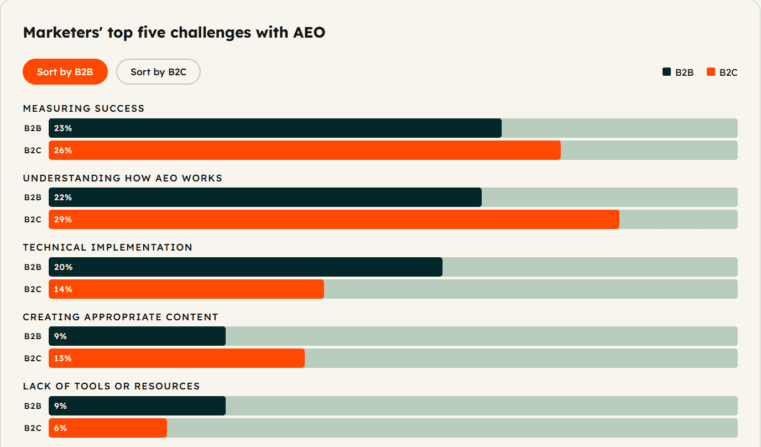
(Source)
Answer Engine Optimization, or AEO, is the practice of creating and structuring content so that answer-focused systems can understand, retrieve, and potentially cite it when responding to users.
AEO should not be treated as a replacement for SEO. Instead, it extends traditional search optimization into an environment where users increasingly receive synthesized answers.
A strong AEO strategy therefore focuses on more than inserting keywords. It emphasizes clarity, relevance, factual accuracy, structure, context, and comprehensive coverage of user questions.
For example, instead of creating a page that only targets “CRM software for healthcare,” a stronger content strategy could address:
- What healthcare CRM software is
- Who needs it
- Which features matter most
- How healthcare CRM systems handle patient-related workflows
- Integration considerations
- Security and compliance considerations
- Pricing factors
- Implementation requirements
- Comparisons between different solutions
- Common mistakes when selecting a CRM
- Questions to ask vendors before purchasing
This creates a broader information ecosystem around the subject.
Importantly, there is no guaranteed formula for getting cited by an AI system. Search engines and AI platforms use their own systems for selecting and presenting information, and even platforms that provide citations caution that search results can sometimes be incomplete, outdated, or incorrect.
The practical objective, therefore, is not to “game” an AI answer. It is to make your content so clear, useful, relevant, and well-supported that it can serve as a reliable source when these systems assemble answers.
The Shift From Single Queries To Multi-Turn Conversations
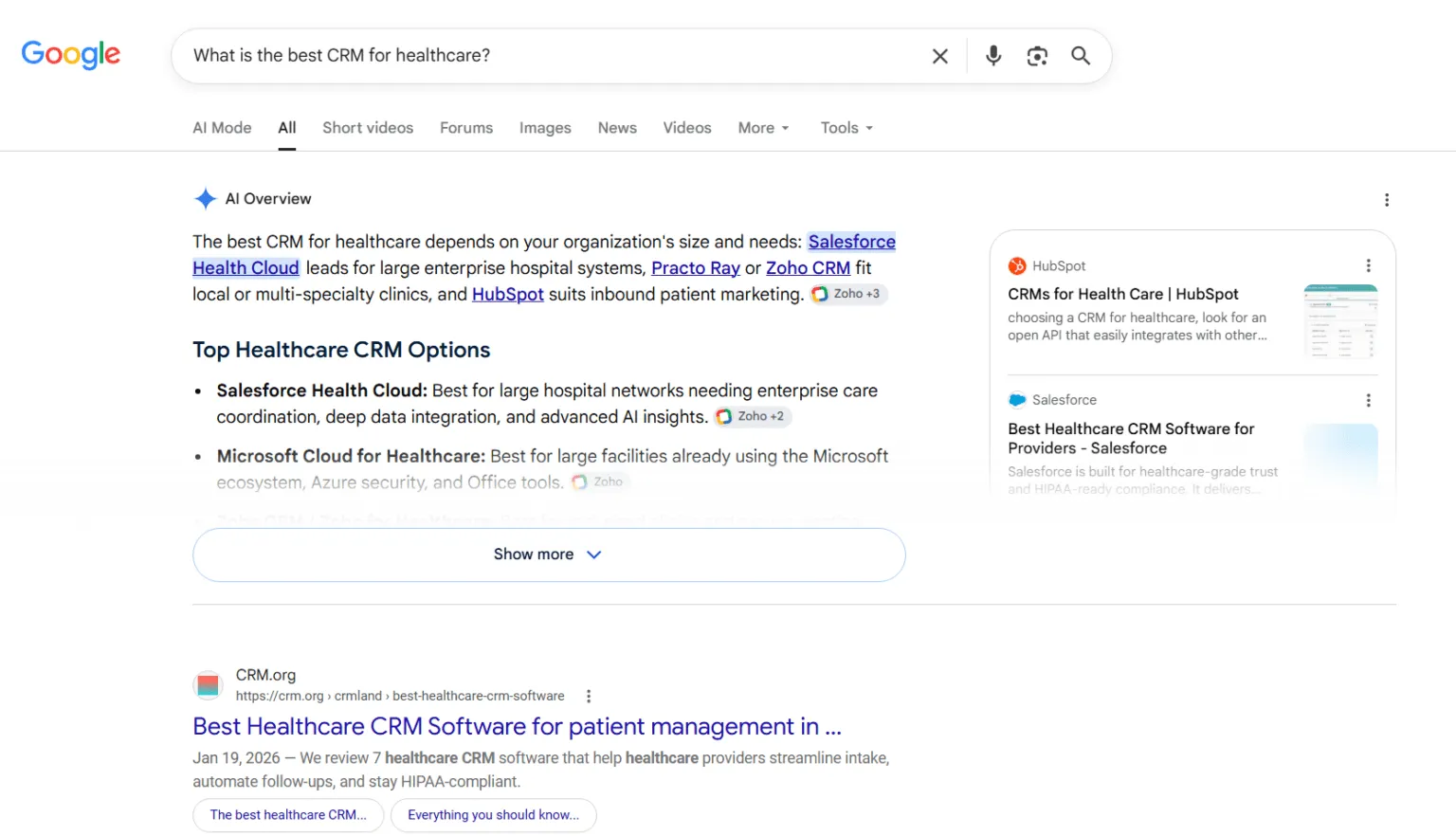
Traditional search behavior was often relatively linear.
A person had a question, entered a keyword or short phrase into a search engine, reviewed the results, clicked a page, and either found the answer or performed another search.
AI search makes the process more conversational.
A buyer may begin with a broad question and then progressively narrow the topic:
Initial question:
“What is the best project management software for agencies?”
Follow-up:
“What features should an agency look for?”
Clarifier:
“Does it support client approvals and team collaboration?”
Comparison:
“How does it compare with other agency project management tools?”
Commercial question:
“What does it typically cost?”
Implementation question:
“How difficult is it to migrate existing projects?”
The important point is that these questions are not independent.
Each answer can influence the next question.
Google’s current AI search experience explicitly supports this behavior. Users can move from an AI Overview into AI Mode, where the context of the original search carries forward into a deeper conversational exchange.
This changes how marketers should think about content.
A page optimized only for the initial query may perform well for that particular topic but fail to support the buyer’s subsequent questions. Meanwhile, a competitor with a connected content ecosystem may provide information relevant to several stages of the same research journey.
AI Search Is About Context, Not Just Keywords
Keyword research remains useful, but keywords alone do not fully represent conversational search behavior.
A buyer may use several different phrases to investigate the same underlying problem. More importantly, their intent changes as they move through the conversation.
For example:
| Buyer stage | Possible AI search question | Content need |
|---|---|---|
| Awareness | “What is project management software?” | Educational explanation |
| Exploration | “What features should agencies look for?” | Feature and use-case content |
| Evaluation | “Which project management tools are best for agencies?” | Comparison content |
| Validation | “What are the drawbacks of these tools?” | Pros, cons and alternatives |
| Purchase | “How much does agency project management software cost?” | Pricing and commercial information |
| Implementation | “How long does migration usually take?” | Implementation guidance |
A traditional keyword strategy might treat these as separate opportunities. An AI-search strategy recognizes that they can form one continuous buyer conversation.
This distinction matters because AI systems can synthesize information across multiple sources when generating an answer. ChatGPT Search, for example, can conduct web searches based on natural-language questions and provide cited sources in its responses.
Your content therefore needs to make relationships between topics clear.
Internal links, descriptive headings, concise answers, structured sections, comparison tables, FAQs, examples, and supporting evidence can all help users—and potentially search systems—understand how different pieces of information relate to one another.
Why Your Current Content Strategy Falls Short
Many content strategies were built around a simple model:
One keyword → one search intent → one page.
That model can still have value for traditional SEO, but it becomes limiting when customers use AI search to conduct extended research.
Imagine a company selling enterprise CRM software. Its content library contains:
- “Best CRM for Healthcare”
- “CRM Features”
- “CRM Pricing”
- “CRM Comparison”
- “CRM Implementation Guide”
At first glance, this looks like comprehensive topical coverage.
But if each page was created independently, the content may still be fragmented.
The “Best CRM for Healthcare” article may not explain pricing. The pricing page may not explain implementation. The implementation guide may not connect clearly to the healthcare use case. The comparison article may discuss competitors without linking back to the relevant product features.
The result is a collection of pages rather than a connected information system.
Siloed Content Creates Conversational Gaps
AI search users do not necessarily stop after receiving one answer.
They ask:
“What is it?” → “How does it work?” → “Which one is best?” → “How much does it cost?” → “What are the alternatives?” → “How do I implement it?”
If your content answers only one or two of those questions, your brand has fewer opportunities to contribute to the overall research journey.
This does not mean every page needs to answer every possible question. Instead, your content strategy should ensure that important questions are covered somewhere within a connected content ecosystem.
For example, an educational article could answer the basic question and link to a detailed comparison guide. The comparison guide could point readers toward pricing information. The pricing page could link to an implementation guide and relevant product documentation.
This creates a logical pathway between related information.
More Content Does Not Automatically Solve the Problem
A common reaction to AI search is to publish more articles.
But producing hundreds of pages around slightly different keyword variations can make the content ecosystem harder to manage without necessarily improving its usefulness.
The problem is not simply content volume. It is content coverage and connectivity.
A stronger approach asks:
- Which questions does our audience ask first?
- What follow-up questions naturally come next?
- Which questions are already answered?
- Which questions are missing?
- Which answers are spread across disconnected pages?
- Which commercial questions are difficult to find?
- Where are competitors providing information that we do not?
- Can a reader move logically from one piece of content to the next?
The original research behind this approach emphasizes the same distinction: businesses need to move away from treating every keyword as an isolated target and instead anticipate the sequence of questions buyers may ask. The source specifically recommends auditing existing content for unanswered questions, fragmented information, and disconnected topics.
Traditional SEO and AI Search Should Work Together
It would also be a mistake to conclude that traditional SEO is no longer important.
AI search systems still depend heavily on web content and information sources. Google continues to provide links to supporting webpages within AI Overviews, while ChatGPT Search provides links and citations to web sources.
Technical SEO, crawlability, useful content, authoritative sources, internal linking, structured information, and strong user experience therefore remain important.
The difference is that marketers now need to think beyond ranking for individual queries.
The stronger question is:
Can our content provide useful, connected answers throughout the conversation our target customer is having?
That shift—from isolated keywords to connected conversations—is the foundation of an effective content strategy for AI search.
The Importance of Planning for Conversational Queries
Planning content around conversational queries is becoming essential because the way people research information is changing. Instead of treating every search as an independent event, businesses need to understand the sequence of questions that naturally develops during a buyer’s research process.
AI search platforms are designed to support this behavior. Google AI Mode, for example, allows users to ask follow-up questions and continue exploring a subject in greater depth. Its system can also break a complex question into multiple subtopics, search for information across those areas, and combine the findings into a response.
This means a buyer may no longer need to perform five separate searches to evaluate a product or service. They can conduct much of the research through one evolving conversation.
For marketers, that creates a different content-planning challenge.
Your goal should not simply be to answer the first question. Your content strategy should anticipate what the buyer is likely to ask next.
For example, someone evaluating project management software might move through a sequence like this:
- What is project management software?
- What features should a growing agency look for?
- Which tools support client collaboration?
- How much do these platforms cost?
- Which options integrate with our existing tools?
- What are the advantages and disadvantages of each?
- How difficult is implementation?
- Which solution is best for our specific situation?
Each question represents a different information need, but they all belong to the same decision-making journey.
A content strategy built around conversational search connects those needs instead of treating them as unrelated keywords.
Plan Around Questions, Not Just Keywords
Keyword research remains valuable, but it should be the starting point rather than the entire content strategy.
A keyword such as “project management software” tells you what someone may be searching for. It does not necessarily tell you what they will ask after receiving the initial answer.
Conversational planning adds that missing layer.
Ask:
- What problem causes the buyer to begin searching?
- What information do they need before considering solutions?
- What questions will they ask about features?
- What objections might arise?
- What alternatives will they compare?
- What pricing information will they need?
- What proof will they look for?
- What implementation concerns might delay the purchase?
- What final questions could determine their decision?
This produces a buyer conversation map rather than a conventional keyword list.
The distinction is important because AI search can transform a complex research process into a continuous interaction. Google specifically describes AI Mode as an experience where users can ask questions that might previously have required multiple searches and then continue with follow-up questions.
Create Content That Can Support the Next Question
A useful AI-search strategy anticipates the next logical question.
Suppose you publish an article answering:
“What is CRM software?”
That page should provide a clear definition, but it can also anticipate related questions such as:
- Who needs CRM software?
- What features does a CRM provide?
- How does CRM software improve sales?
- How much does CRM software cost?
- What should businesses consider before choosing a CRM?
You do not necessarily need to answer every question in exhaustive detail on one page. Instead, provide enough context to satisfy the immediate intent and connect readers to deeper resources where appropriate.
This creates a connected content ecosystem.
A well-structured content system might look like:
Educational guide → Feature guide → Comparison page → Pricing resource → Implementation guide → Product/service page
Internal links help establish those relationships for users and search engines. More importantly, they create a logical information architecture in which each page has a defined role within the broader buyer journey.
Comprehensive Does Not Mean Excessively Long
Planning for conversational search does not mean turning every article into a 5,000-word guide.
The objective is completeness of intent, not maximum word count.
A 1,500-word article that clearly answers the important questions may be more useful than a 4,000-word article filled with repetitive explanations.
Focus on:
- Direct answers
- Clear definitions
- Relevant examples
- Useful comparisons
- Concise explanations
- Supporting evidence
- Tables and lists where appropriate
- Logical internal links
- Clearly defined sections
The source material behind this strategy makes the same distinction: the objective is not simply to write longer pages, but to create smarter content that anticipates the buyer’s conversation.
Make Conversational Planning Part of the Editorial Process
Conversational planning should happen before content production, not after an article has already been published.
Before assigning a new topic to a writer, identify:
Primary question: What does the user want to know?
Follow-up questions: What will they probably ask next?
Decision questions: What information will help them compare or evaluate options?
Objection questions: What could prevent them from taking action?
Action questions: What do they need to know before purchasing, contacting a company, or implementing a solution?
This process turns a content calendar into a buyer-journey framework.
It also prevents businesses from repeatedly publishing articles that target nearly identical search intent while leaving important commercial or implementation questions unanswered.
Your Step-By-Step Plan For Content Strategy for AI Search

You do not need to abandon your existing content library to adapt to AI search. In many cases, the better approach is to audit, connect, restructure, and expand what you already have.
The following four-step process provides a practical framework.
Step 1: Map The Buyer Conversation Sequence
Start by identifying the questions your ideal customer is likely to ask in order.
Do not simply create a list of every question associated with your industry. Instead, reconstruct the buyer’s likely research journey.
For a B2B SaaS product, the sequence might look like:
| Stage | Buyer question | Content opportunity |
|---|---|---|
| Awareness | What does this type of software do? | Educational guide |
| Understanding | How does it work? | Explainer |
| Evaluation | What features matter most? | Feature guide |
| Commercial research | How much does it cost? | Pricing guide |
| Comparison | Which solutions are best? | Comparison article |
| Validation | What are the pros and cons? | Review/alternative content |
| Integration | Does it work with our existing tools? | Integration guide |
| Implementation | How long does setup take? | Implementation guide |
| Decision | Which option is right for our business? | Product/service page |
This sequence becomes the foundation for your AI search content strategy.
Interviewing sales and customer-service teams can be particularly useful here. They hear real customer questions every day, including objections and questions that may never appear in conventional keyword research.
You can also analyze:
- Sales-call transcripts
- Customer support tickets
- Website search queries
- Live-chat conversations
- Product reviews
- Community discussions
- Search Console queries
- Existing FAQ questions
- Competitor comparison searches
The objective is to understand how your audience thinks through a decision, not simply what phrases they type into Google.
Step 2: Audit Your Current Content Against The Sequence
Once you have your conversation map, compare it against your existing content.
For every buyer question, determine whether your website:
- Answers it completely
- Answers it partially
- Answers it on another page
- Answers it poorly
- Has multiple competing pages answering it
- Does not answer it at all
This audit often reveals a surprising problem: businesses may have plenty of content but still lack coverage of critical questions.
For example, a company may have several articles explaining product features but no useful content about:
- Pricing
- Alternatives
- Integrations
- Implementation
- Limitations
- Use cases
- Security
- Switching from competitors
Those missing areas can become conversational gaps.
You should also identify fragmented information.
If the answer to one buyer question is on one page, the supporting evidence is on another, and the relevant comparison is buried somewhere else, users may struggle to understand the complete picture.
Create an audit table such as:
| Buyer question | Existing URL | Coverage | Action |
|---|---|---|---|
| What does the product do? | Product page | Strong | Keep |
| What features matter? | Blog post | Partial | Expand |
| How much does it cost? | Pricing page | Strong | Improve context |
| How does it compare? | None | Missing | Create |
| Does it integrate with X? | Help article | Fragmented | Consolidate/link |
| How long does implementation take? | None | Missing | Create |
This gives your content team a practical roadmap rather than another generic list of keywords.
Step 3: Restructure Content To Anticipate The Full Conversation
After identifying the gaps, restructure your highest-value pages.
Start with pages that already receive organic traffic, generate leads, target commercially important topics, or sit close to the purchase decision.
Use headings that correspond to real questions.
For example:
H2: What Is CRM Software?
H2: How Does CRM Software Work?
H2: What Features Should You Look For?
H2: How Much Does CRM Software Cost?
H2: How Does CRM Software Compare With Alternatives?
H2: What Should You Consider Before Choosing a CRM?
This structure makes the page easier for readers to navigate and makes individual answers easier to identify.
Google’s AI Mode can break complex questions into subtopics and search multiple sources before generating a response, making clear topical organization particularly valuable for content that covers complex subjects.
Use Structured Information Where It Helps
Different information types benefit from different formats.
Use:
- Bullets for criteria, benefits, or considerations
- Tables for comparisons
- Step-by-step lists for processes
- FAQs for specific questions
- Definitions for technical concepts
- Examples for practical understanding
- Statistics and evidence when making factual claims
- Internal links for deeper supporting information
The goal is to make important information easy to locate and understand.
Avoid hiding the primary answer underneath long introductions or repetitive marketing language. If a user asks a specific question, give them a clear answer first and then provide context.
Step 4: Implement Across Your Entire Content Strategy
The biggest mistake is treating AI search optimization as a one-page project.
The same conversational approach should influence your:
- Blog articles
- Product pages
- Service pages
- Comparison pages
- Buying guides
- Case studies
- Research reports
- FAQs
- Help documentation
- Industry pages
- Glossaries
- Video content
- Supporting resources
Every new piece should have a purpose within the broader information ecosystem.
Before publishing, ask:
What question does this page answer, and what question will the reader probably ask next?
Then make sure the next answer exists somewhere and is easy to reach.
This approach turns your website from a collection of isolated articles into a connected knowledge base.
It also supports traditional SEO. AI search does not eliminate the need for discoverable, crawlable, useful web content. Google’s AI experiences continue to use web information and provide supporting links, while ChatGPT Search similarly provides sources and citations for web-based answers.
Building Your Competitive Advantage
AI search creates a new dimension of competition: being visible when customers ask AI systems which companies, products, services, or solutions they should consider.
That makes AI visibility more than an SEO metric. It can become part of your broader brand-discovery strategy.
The competitive advantage comes from building an information footprint that consistently demonstrates expertise across the questions your market cares about.
A competitor might have one highly ranked article about a topic. Your brand could potentially have a stronger presence if it provides useful resources covering the entire decision journey:
Problem → Education → Evaluation → Comparison → Validation → Purchase → Implementation
The more completely your content addresses those stages, the more opportunities you create for your brand to be discovered during different moments of research.
Build Topic Depth Instead of Content Volume
Publishing more content is not necessarily the competitive advantage.
Owning a topic comprehensively is.
If your website consistently answers the important questions surrounding a subject, you can establish stronger topical coverage than a competitor that publishes dozens of disconnected articles.
For example, a cybersecurity company could create content covering:
- What cybersecurity risk means
- Common threats
- Risk assessment
- Security frameworks
- Compliance considerations
- Vendor selection
- Security tools
- Implementation
- Costs
- Comparisons
- Common mistakes
- Long-term monitoring
The result is a connected knowledge ecosystem rather than a collection of isolated keyword targets.
Strengthen Your Brand’s Information Consistency
AI systems need reliable information to produce useful answers. Businesses should therefore make sure important facts about their company, products, services, expertise, and positioning are consistent across their digital presence.
Review:
- Company descriptions
- Product names
- Service descriptions
- Pricing information
- Author information
- Expertise claims
- Customer examples
- Industry specializations
- Contact information
- Third-party profiles
Consistency helps reduce ambiguity and makes it easier for users—and potentially AI systems—to understand what your brand represents.
At the same time, businesses should avoid assuming that any single optimization guarantees AI citations. AI search systems can produce incorrect or incomplete results, and even official guidance recommends checking cited sources and important information independently.
Measure AI Visibility as a Separate Layer
Traditional SEO reporting might focus on:
- Rankings
- Organic traffic
- Click-through rate
- Backlinks
- Conversions
For AI search, add another layer of measurement.
Track:
- Whether your brand appears in AI answers
- Which prompts trigger brand mentions
- Which pages are cited
- Which competitors are mentioned instead
- Which topics generate visibility
- Whether visibility occurs at awareness or commercial stages
- How frequently your brand appears across related prompts
- Whether cited pages accurately represent your brand
Because AI responses can vary by query, platform, context, and time, treat AI visibility as an evolving measurement rather than a fixed ranking position.
Start Before the Market Becomes Crowded
AI search is developing rapidly. Google says AI Mode has expanded its ability to handle follow-up questions, complex searches, and multiple information sources, while its 2026 updates indicate an increasingly agentic direction for Search.
That makes early investment in high-quality, comprehensive content strategically valuable.
The competitive opportunity is not to produce content specifically designed to manipulate AI systems. It is to become one of the most useful and authoritative sources for the questions your customers repeatedly ask.
Brands that build this foundation now can create a durable content advantage across both traditional search and AI-powered discovery.
Moving Forward With AI Search Content Strategy
The move from traditional single-query searches to multi-turn AI conversations is changing how brands need to approach content. Buyers can now ask follow-up questions, request clarification, compare alternatives, and dig deeper into a topic within the same search journey. Your content strategy should be designed to support that entire conversation—not just answer one query. This is more than a small SEO adjustment; it is a strategic shift that can influence how visible and competitive your brand remains across AI-powered search and discovery.
Pro Real Tech helps brands adapt their content strategies to evolving AI search behaviors and improve visibility across answer engines. Whether you need to restructure existing content or develop an AI-focused strategy from the ground up, our team can help identify conversational search opportunities, uncover content gaps, and build a connected content ecosystem around your customers’ decision-making journey. Our AI SEO and AI search optimization services are designed to help your brand remain discoverable across the different stages of the buyer journey.
Ready to strengthen your AI search presence? Contact Pro Real Tech today to build a content strategy designed for conversational search, improve your brand’s visibility, and turn AI-driven discovery into meaningful business results.
Frequently Asked Questions (FAQs) About AI Search Behavior
What Exactly Is AI Search Behavior?
AI search behavior describes how people interact with AI-powered search and answer systems to research information. Instead of submitting one isolated query, users can ask an initial question and then continue with follow-ups, clarifications, comparisons, and more specific requests.
For example, a user might ask, “What is the best accounting software for small businesses?” followed by “Which one is easiest to use?” and then “Which has the best invoicing features?”
Each question builds on the previous interaction. Google’s AI Mode explicitly supports this type of follow-up conversation.
How Does AI Search Optimization Differ From Traditional SEO?
Traditional SEO primarily focuses on helping webpages become discoverable and rank for relevant searches. AI search optimization adds another objective: making information clear, useful, well-structured, and suitable for inclusion or citation within AI-generated answers.
The two approaches overlap considerably. Technical SEO, quality content, internal linking, authoritative information, and strong user experience remain important.
The key difference is that AI search often synthesizes information into an answer instead of simply displaying a ranked list of webpages.
Why Is Planning Content Around AI Search Behavior Important?
Planning around AI search behavior helps businesses address the complete buyer conversation rather than one isolated query.
When content anticipates follow-up questions about features, pricing, alternatives, integrations, limitations, and implementation, the brand has more opportunities to provide useful information throughout the research journey.
This is particularly important as AI search experiences increasingly support multi-turn interactions.
What Is an Example of Multi-Turn AI Search Behavior?
A buyer researching project management software might ask:
Question 1: “What is the best project management software for agencies?”
Question 2: “Which features are most important for client work?”
Question 3: “Which options integrate with Slack?”
Question 4: “How much do they cost?”
Question 5: “Which one is best for a 20-person agency?”
The questions become increasingly specific as the buyer learns more.
That is the fundamental difference between a single search and a conversational research journey.
How Should I Structure Content for Conversational AI Search Queries?
Start with the primary question and organize the page around the questions that naturally follow it.
Use:
- Descriptive headings
- Direct answers
- Short, focused sections
- Lists and tables
- Relevant examples
- Supporting evidence
- FAQs where appropriate
- Internal links to deeper resources
Avoid creating artificial content solely to satisfy perceived AI patterns. The priority should always be helpful information that directly satisfies the user’s intent.
What Is the Connection Between AI Visibility Strategy and Market Share?
AI visibility can influence how customers discover and evaluate brands.
When an AI system recommends, cites, or references a company during a research process, that brand may receive exposure at a moment when the customer is actively looking for a solution.
If competitors consistently appear in these conversations while your brand does not, they may gain a discovery advantage.
Therefore, AI visibility can be viewed as an additional layer of digital market presence—not as a direct replacement for traditional market-share measurement.
What Content Formats Perform Best in AI Answers?
There is no universal content format that guarantees inclusion in AI-generated answers.
However, different formats are useful for different search intents.
Comparison content is useful when users are evaluating alternatives. List-based content works well for recommendations and grouped options. How-to guides are useful for procedural questions. FAQs can address specific queries, while product and service pages provide direct commercial information.
The most important factor is not the format alone. It is whether the content provides clear, relevant, trustworthy information that directly addresses the question.
Can Existing Content Be Optimized, or Should I Start From Scratch?
You usually do not need to start from scratch.
Existing content can often be improved by:
- Mapping it against your buyer conversation.
- Identifying unanswered questions.
- Adding missing information.
- Improving headings and organization.
- Adding useful tables or lists.
- Connecting related pages with internal links.
- Removing outdated or repetitive information.
- Adding current evidence and examples.
Prioritize pages that already have organic visibility, backlinks, conversions, or strong topical relevance.
Should I Still Focus on Traditional SEO If Optimizing for AI?
Yes.
Traditional SEO and AI search optimization should work together.
AI search still relies on information available across the web. Google’s AI Mode describes its responses as being supported by web content, while ChatGPT Search provides links and citations to sources used in responses.
Continue investing in technical SEO, useful content, internal linking, crawlability, authority, user experience, and search intent while adding conversational planning to your strategy.
What’s the Best Way to Optimize Content for AI Search?
Start by understanding the buyer’s complete conversation.
Map the questions → audit existing content → identify gaps → restructure important pages → connect related resources → measure AI visibility → continuously update.
Focus on answering real questions clearly rather than trying to reverse-engineer an AI system.
The strongest AI-search strategy is ultimately a strong content strategy built around customer needs. Create comprehensive resources, organize information logically, support important claims, connect related topics, and make your expertise easy to understand.
AI search will continue to evolve, so your strategy should evolve with it. The businesses best positioned for this shift will be those that treat AI visibility not as a one-time optimization project, but as an ongoing extension of their search, content, and brand strategy.
Read More: Why You Need to Invest in Digital PR for AI Visibility


