

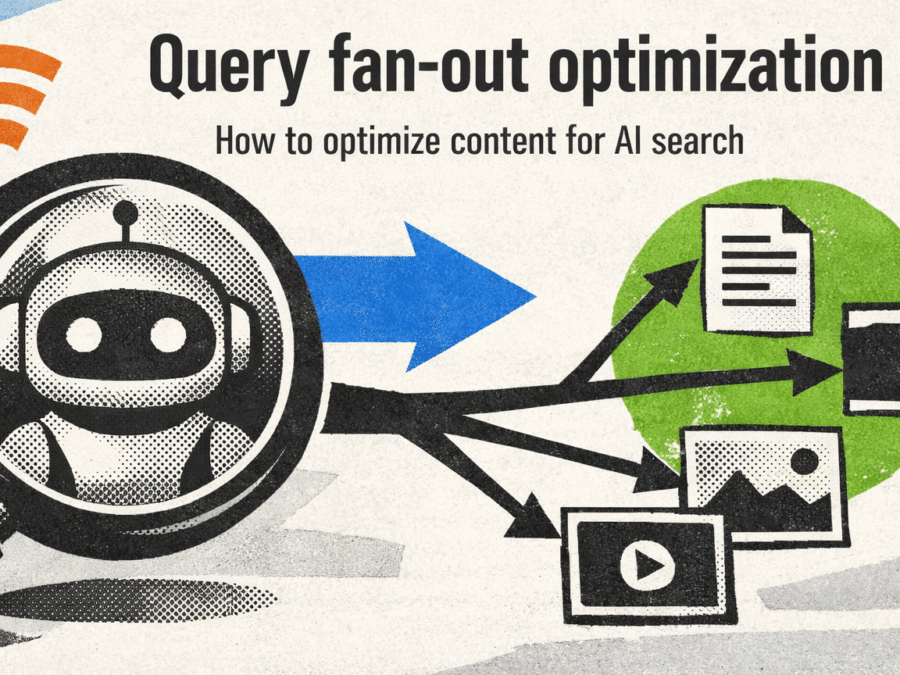
Search is changing from a system that primarily matches a user’s query with individual web pages into one that can interpret a broader question, explore several related information needs, and synthesize findings into a single response. AI-powered search experiences are a major reason for this shift. Instead of relying exclusively on the exact words entered by a user, these systems can break a complex request into multiple related searches or sub-questions, retrieve information for different aspects of the request, and combine the findings into an answer. This process is commonly referred to as query fan-out.
For businesses, the important change is that visibility is no longer only about creating a page that answers one primary keyword. A user may ask an AI search engine a single question, while the underlying retrieval process explores questions about comparisons, features, costs, use cases, limitations, alternatives, or other contextual details. If your content addresses only the headline topic but leaves those supporting questions unanswered, another source may be retrieved for those individual aspects instead.
This does not mean traditional SEO or keyword research has become irrelevant. Keywords still provide valuable evidence about what people search for. Query fan-out adds another layer: understanding the broader information landscape surrounding a topic and making sure your content can provide useful answers across multiple related intents. The result is a content strategy focused less on repeating a target phrase and more on building complete, well-organized topical coverage.
What Is Query Fan-Out?
Query fan-out is the process of expanding one user query into multiple related sub-queries so an AI-powered search system can gather information from different angles before producing a final answer. The original query acts as the central point, while the related searches branch outward to investigate the different pieces of information needed to satisfy the user’s intent.
For example, imagine someone searches:
“What is the best project management software for a small remote team?”
A conventional keyword-focused approach might concentrate on the phrase best project management software for a small remote team. But an AI search system may need to investigate several related dimensions before it can produce a useful recommendation, such as:
- Which project management tools are suitable for small teams?
- Which platforms support remote collaboration?
- What collaboration and communication features do they offer?
- How much do they cost for a small team?
- Which tools are easiest to learn and implement?
- Which platforms integrate with commonly used business applications?
- What are the limitations of each option?
- Which solutions are appropriate for different team sizes or workflows?
The exact number and wording of these sub-queries can vary by system and query complexity. There is no universal fixed number of fan-out searches. Research and industry observations show that AI systems can generate several related searches for relatively simple questions and substantially more for complex research tasks.
The important concept is query decomposition. The AI is not necessarily looking for one webpage that contains the exact wording of the original question. Instead, it can retrieve information relevant to different parts of the user’s underlying intent and then synthesize those findings.
Query fan-out is therefore better understood as a retrieval and information-discovery behavior, not simply another keyword variation.
How Query Fan-Out Works: A Real Example
Consider a user asking:
“What’s the best time to visit Japan?”
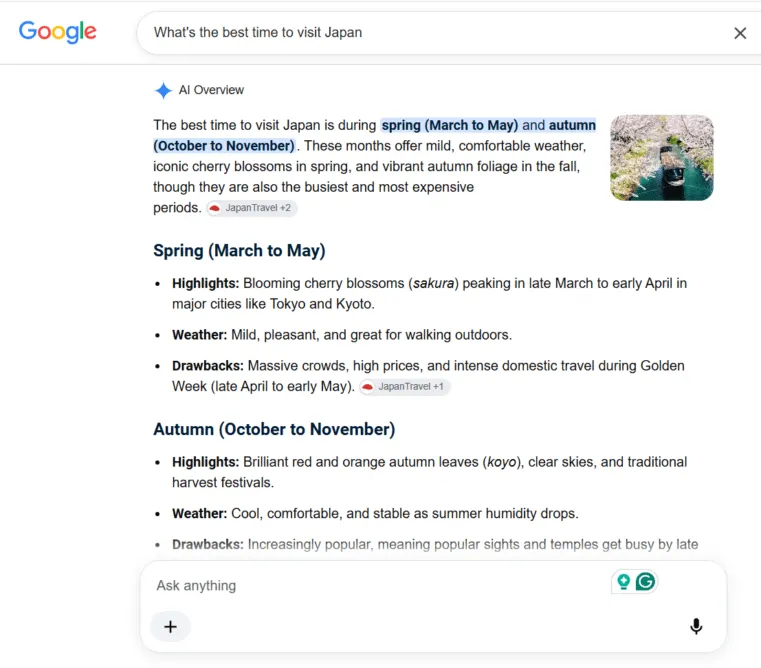
At first glance, this appears to be a straightforward travel question. However, a genuinely useful answer needs more context. “Best” depends on what the traveler values, and the answer can change considerably depending on the season.
A fan-out approach may explore several dimensions, including:
- Spring: weather, attractions, seasonal highlights and potential disadvantages
- Summer: temperatures, festivals, rainfall and travel considerations
- Autumn: foliage, weather, crowds and costs
- Winter: skiing, cold-weather conditions, seasonal attractions and drawbacks
- General considerations: peak travel periods, budget, regional differences and traveler preferences
The important point is that the AI does not have to wait for the user to ask every follow-up question individually. It can anticipate the supporting information required to make the original answer more useful. A recent real-world analysis of this type of query demonstrated this structured decomposition across seasons and dimensions rather than treating the question as a single flat keyword.
The process can be simplified into four stages:
1. Understand the original question:
The system identifies the main topic, intent, context and constraints contained in the user’s request.
2. Break the question into related information needs:
The system determines which supporting questions could help answer the original request comprehensively.
3. Retrieve information:
The resulting searches can be executed across relevant sources and information systems. Different sub-queries may retrieve different pages or sources.
4. Synthesize the answer:
The AI evaluates the retrieved information and combines relevant findings into a coherent response. In AI search environments, the final answer may cite multiple sources because different sources can provide the strongest evidence for different parts of the response.
This explains why a page can be relevant to an AI-generated answer even when it does not rank for, or directly target, the exact question a user typed. The page may provide particularly useful information for one of the related sub-queries generated during retrieval.
Why Businesses Need Query Fan-Out in Their Content Strategy
Query fan-out changes the way businesses should think about content coverage. If an AI system explores multiple dimensions of a user’s question, a page that addresses only one narrow aspect may have fewer opportunities to become a useful source.
For instance, suppose a company publishes an article targeting “best CRM software for small businesses.” If the article only lists a few products, it may fail to answer important supporting questions about pricing, integrations, implementation, scalability, reporting, customer support and industry-specific requirements. Those gaps create opportunities for competing sources to provide the missing information.
A more comprehensive resource can address the primary question while also covering the related decision-making factors. This gives the content a stronger chance of being relevant to multiple information needs within the broader topic.
Why Businesses Need Query Fan-Out in Their Content Strategy
The rise of query fan-out makes topical completeness and information depth increasingly important for businesses competing in AI-assisted search.
1. AI Search Evaluates More Than a Single Keyword
Traditional SEO often starts with a target keyword and builds a page around its search intent. That remains useful, but AI search can investigate several related intents behind the same user request.
A business therefore needs to consider not only:
“What keyword do I want this page to rank for?”
but also:
“What related questions would someone need answered to make this topic genuinely useful?”
That shift moves content planning from isolated keyword targeting toward broader intent and topic coverage.
2. Content Gaps Can Reduce AI Visibility
A content gap is not necessarily the absence of an entire article. It can be a missing section, explanation, comparison, example or supporting detail within an otherwise strong resource.
For example, an article about a software product may explain its features but fail to address:
- pricing considerations,
- integrations,
- security,
- implementation,
- limitations,
- alternatives,
- industry use cases, or
- suitability for different business sizes.
If these subjects become relevant sub-queries during AI retrieval, other sources may satisfy those information needs instead. Comprehensive content can therefore create more opportunities for a business to be considered across the broader topic.
3. It Supports More Complete Answers to Customer Questions
Customers rarely think in keywords. They think in problems, decisions and outcomes.
Someone searching for “best running shoes” may actually want to know which shoes work for their running surface, budget, foot type, distance, comfort preferences and training goals. Similarly, someone searching for a marketing agency may care about experience, pricing, services, industries served, process, results and alternatives.
Query fan-out reflects this broader decision-making process. Businesses that anticipate these information needs can create content that answers the questions customers are likely to have before, during and after their initial search.
4. It Creates More Opportunities for AI Citations and Mentions
AI-generated answers can draw information from multiple sources rather than relying on one page for everything. Consequently, businesses need content that is easy for retrieval systems to understand and extract.
Clear definitions, descriptive headings, concise answers, supporting evidence, logical organization and strong topical coverage can make individual sections more useful as information sources. Recent guidance on query fan-out optimization emphasizes creating comprehensive content that addresses multiple related questions while keeping the information clearly structured.
This does not guarantee that a page will be cited by an AI platform. AI visibility depends on many factors, including the query, retrieval system, source quality, relevance, authority and the information available at the time. Query fan-out optimization should therefore be viewed as a way to improve the relevance and retrievability of your content, not as a guaranteed ranking formula.
5. It Can Strengthen Traditional SEO, Too
Optimizing for query fan-out does not require abandoning traditional SEO. In many cases, the practices overlap.
Content that thoroughly addresses related questions can:
- satisfy more user intents,
- naturally incorporate relevant terminology,
- create useful internal linking opportunities,
- improve topical coverage,
- provide better context for search engines,
- answer long-tail questions, and
- improve the overall usefulness of a page.
That means a well-executed query fan-out strategy can complement conventional organic search efforts rather than replace them.
6. It Helps Businesses Compete on Topic Depth Rather Than Domain Size Alone
Large brands often have advantages in authority, backlinks and brand recognition. Smaller businesses cannot always compete on those factors immediately. However, they can compete by producing highly useful, focused resources that answer the questions their target customers actually need answered.
A small business that thoroughly explains a specialized topic, addresses its major sub-questions and demonstrates genuine expertise can create a valuable resource even when larger competitors have more general content.
This makes query fan-out particularly relevant for businesses operating in specialized industries. Instead of trying to publish dozens of shallow pages targeting every possible keyword variation, a company can build authoritative resources around important customer problems and cover the meaningful questions surrounding them.
7. It Encourages a More Customer-Centered Content Strategy
Perhaps the biggest strategic benefit is that query fan-out encourages businesses to stop thinking exclusively about search volume and start thinking about information needs.
A successful content strategy should ask:
- What is the customer ultimately trying to accomplish?
- What questions will they have before making a decision?
- What comparisons will they need?
- What objections or concerns might prevent them from taking action?
- What information would they search for next?
- Which details are essential for evaluating different solutions?
These questions lead to content that is useful beyond a single search phrase.
In an AI-driven search environment, that matters because the system may explore those same dimensions when determining which sources can help answer the user’s original request.
Ultimately, query fan-out is not a reason to abandon SEO—it is a reason to expand how you define search intent. Instead of creating content that answers only the visible query, businesses should build resources capable of answering the connected questions behind it. The goal is not to predict every hidden query an AI system might generate, but to provide accurate, comprehensive and well-structured information that genuinely satisfies the topic’s broader user intent.
How to Optimize Your Content for Query Fan-Out
Optimizing for query fan-out does not mean trying to predict every hidden search an AI system might generate. Instead, it means creating content that comprehensively answers the main topic and the logically connected questions surrounding it. Google now explicitly describes query fan-out as a set of related queries generated to retrieve additional information needed to answer a user’s original question. Its guidance also emphasizes that foundational SEO practices continue to apply to generative AI search.
The practical objective is to make your content relevant, comprehensive, easy to understand, technically accessible, and useful across multiple related intents. The following steps can help you build content that is better aligned with this retrieval behavior.
1. Identify Core Topics and Search Intent
Start with a clearly defined core topic, rather than beginning with a long list of disconnected keywords. Your core topic should be specific enough to establish a clear subject but broad enough to generate meaningful supporting questions.
For example, suppose your core topic is:
“Email marketing for small businesses.”
A traditional keyword approach might focus on phrases such as:
- email marketing for small businesses
- small business email marketing
- email marketing software
- email marketing tips
A query fan-out approach goes further by asking what the user is ultimately trying to accomplish. Related information needs could include:
- How does email marketing help a small business?
- How do you build an email list?
- Which email campaigns should a small business send?
- How often should businesses send emails?
- What email marketing metrics should be monitored?
- How much does email marketing cost?
- What tools make email marketing easier?
- How can small businesses improve email deliverability?
This distinction matters because AI search can expand an initial query into related searches covering definitions, follow-up questions, comparisons, constraints, and other aspects of the user’s intent.
Therefore, your first job is not to collect every keyword variation. It is to determine the central problem or decision behind the search.
A useful framework is to identify whether the primary intent is:
- Informational: The user wants to understand something.
- Commercial: The user is evaluating products, services, or solutions.
- Transactional: The user is ready to take an action or make a purchase.
- Navigational: The user is trying to find a particular website, company, product, or resource.
Then consider the secondary intents that naturally surround the primary one. A page can often address informational, evaluative, and contextual questions together when those questions belong to the same topic.
The key is relevance. Do not add unrelated questions simply to make a page longer. Every supporting topic should help the reader understand the core subject or accomplish the goal behind the original query.
2. Research the Sub-Questions in Your Query Fan-Out Strategy
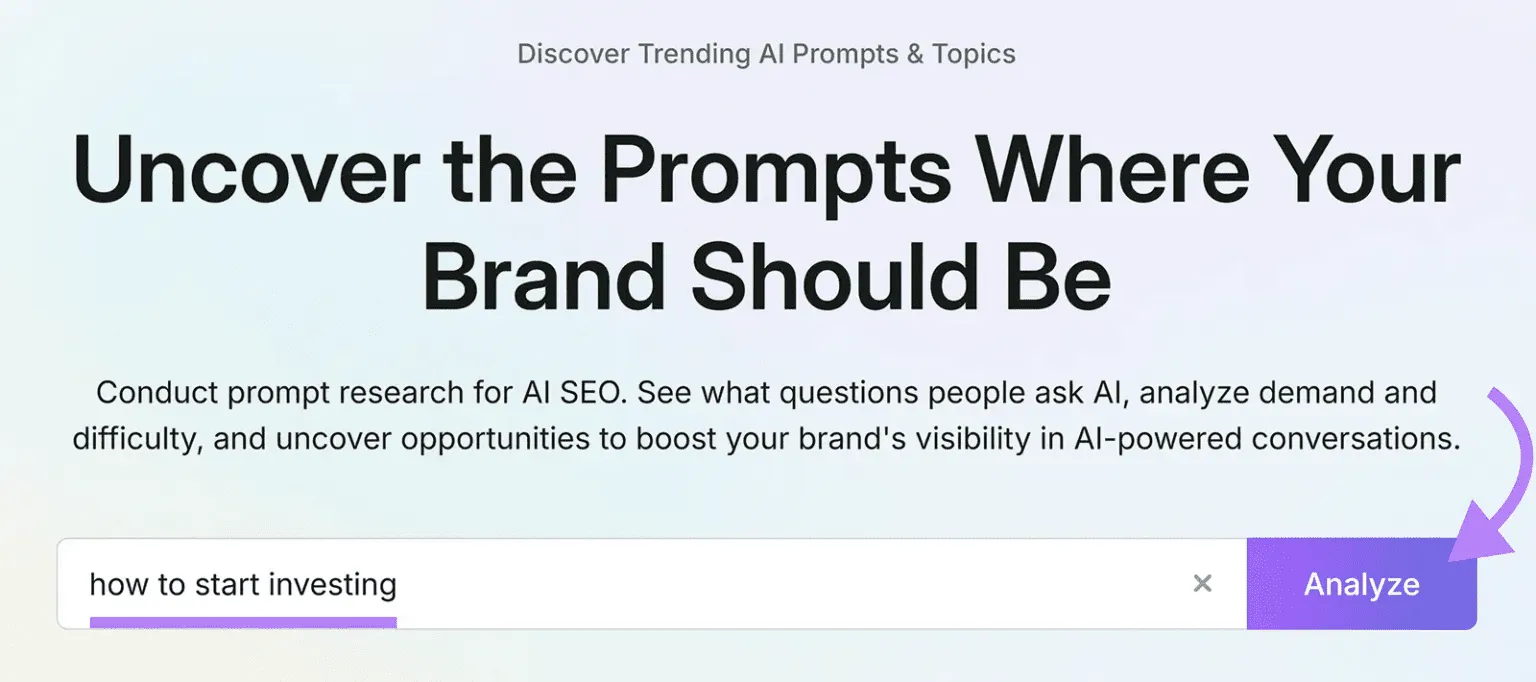
(Source)
Once you have identified the core topic and search intent, map the questions that could logically branch from it.
You cannot see every query generated internally by an AI search system, and there is no universal list of fan-out queries for a particular keyword. Instead, you should build a reasonable approximation of the information needs surrounding your topic.
Start with conventional research:
- Google autocomplete suggestions
- “People also ask” questions
- Related searches
- Existing search-result headings
- Competitor content gaps
- Customer support questions
- Sales-team questions
- Community discussions
- Search Console queries
- Keyword research tools
- Questions appearing in AI search experiences
Then expand your research beyond simple keyword variations.
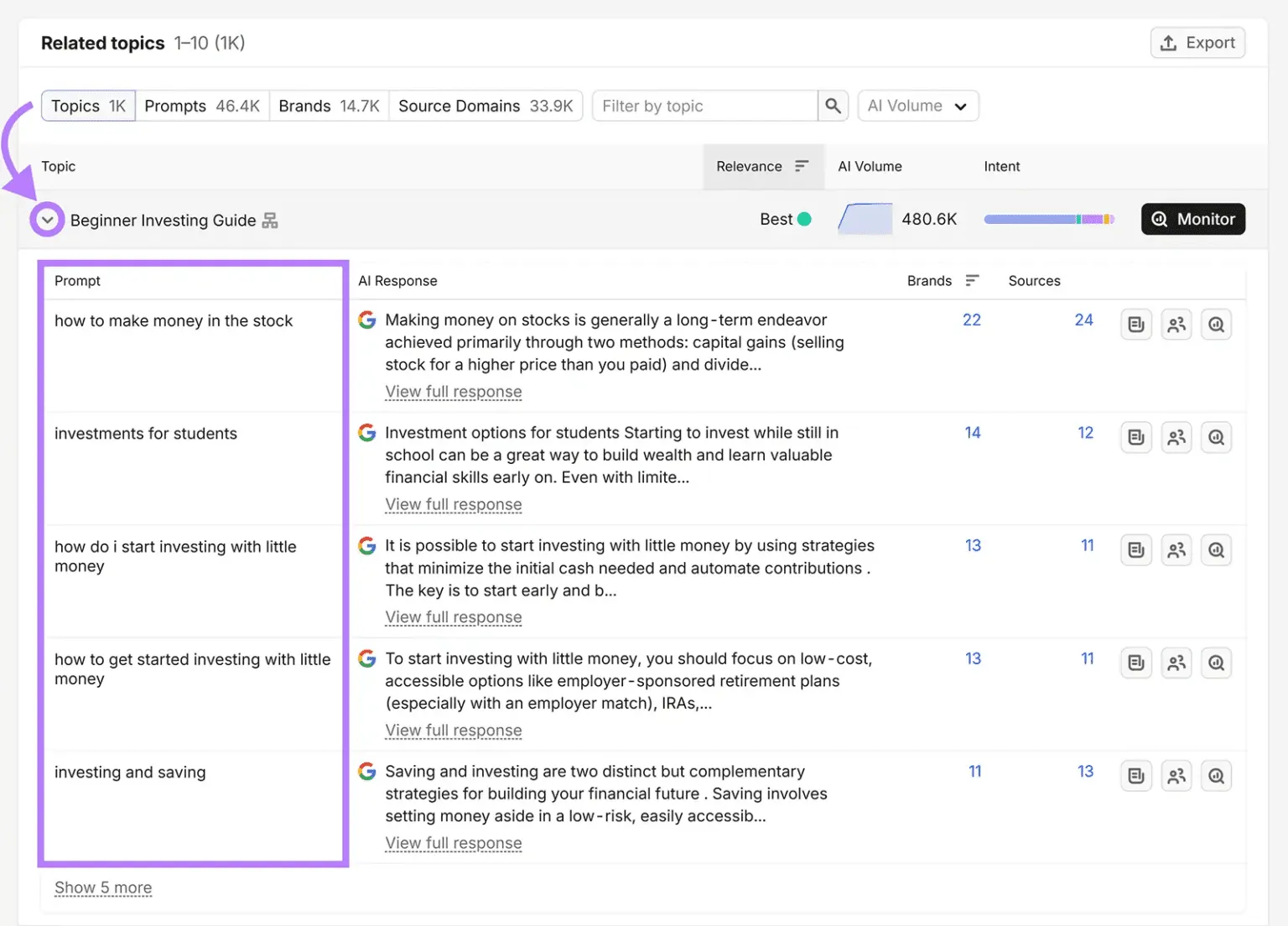
(Source)
Think about the topic through several angles:
Equivalent questions:
Different ways of asking essentially the same thing.
Follow-up questions:
What would a user naturally want to know after receiving the initial answer?
General questions:
What broader concept helps explain the topic?
Specific questions:
What happens when the user adds a particular audience, industry, budget, location, or use case?
Clarification questions:
What ambiguities could cause users to interpret the topic differently?
Comparison questions:
What alternatives, competitors, approaches, or options might the user evaluate?
Implication questions:
What are the consequences, benefits, risks, limitations, or next steps associated with the topic?
For example, if your core topic is “CRM software for small businesses,” your research should not stop at “best CRM software.” You might also investigate implementation difficulty, pricing, integrations, automation, reporting, scalability, security, customer support, and which features matter most to different business types.
Recent research into query fan-out emphasizes mapping topics across multiple sub-query patterns rather than treating the process as a simple exercise in finding more keyword variations.
Most importantly, do not create one thin page for every possible sub-question simply because you found a keyword variation. If several questions belong naturally to the same user journey, they can often be answered within one comprehensive resource. Query fan-out optimization is primarily about making a page useful across related queries, not multiplying URLs.
3. Create Comprehensive, Well-Structured Content
After mapping your core topic and sub-questions, build content that provides meaningful answers to the most important ones.
Comprehensive does not mean unnecessarily long.
A 5,000-word article filled with repetition is not automatically better than a focused 2,000-word resource. The goal is semantic completeness: covering the important concepts, relationships, questions, examples, limitations, and practical considerations that belong to the topic.
A strong structure might look like this:
Core topic → definition → how it works → why it matters → major considerations → examples → practical guidance → limitations → related questions
Each section should make sense on its own while contributing to the overall explanation.
Use descriptive headings
Headings should clearly communicate what the following section answers.
Instead of:
“Important Considerations”
use:
“How Much Does Email Marketing Cost for a Small Business?”
The second heading provides a much stronger signal about the section’s subject and gives readers an immediate understanding of what they will find there.
Clear headings also create useful retrieval anchors. Research on query fan-out optimization emphasizes headings, content chunking, lists, tables, and other structured formats because they help associate particular sections with specific sub-queries.
Answer important questions directly
When a section addresses a question, provide the core answer early.
For example:
Email segmentation means dividing subscribers into groups based on characteristics or behavior so businesses can send more relevant messages.
Then explain the details, examples, limitations, and best practices afterward.
This answer-first approach helps both users and systems understand what a section is about without forcing them to interpret several paragraphs before reaching the main point.
Cover multiple relevant intents
A strong resource may need to address more than one stage of the user’s decision-making process.
For example, an article about website redesign might explain:
- what a redesign is,
- when a redesign is necessary,
- how much it can cost,
- what the process involves,
- common mistakes,
- SEO considerations,
- how to choose an agency,
- and how to measure the results.
This creates a resource that can remain useful as the user’s information needs expand.
Demonstrate expertise and accuracy
Comprehensive content also needs to be trustworthy. Query expansion can expose your content to different retrieval contexts, so unsupported claims, contradictions, outdated information, and overly broad statements can weaken its usefulness.
Use:
- Reliable sources where appropriate
- Current statistics
- Specific examples
- Clear definitions
- First-hand expertise where available
- Transparent limitations
- Accurate dates and terminology
Avoid writing claims such as “Google always does X” when the underlying system is dynamic or the evidence does not support an absolute statement.
Google’s current guidance makes an important point here: generative AI search is still part of Search, meaning established SEO fundamentals—including creating helpful, reliable content—remain relevant.
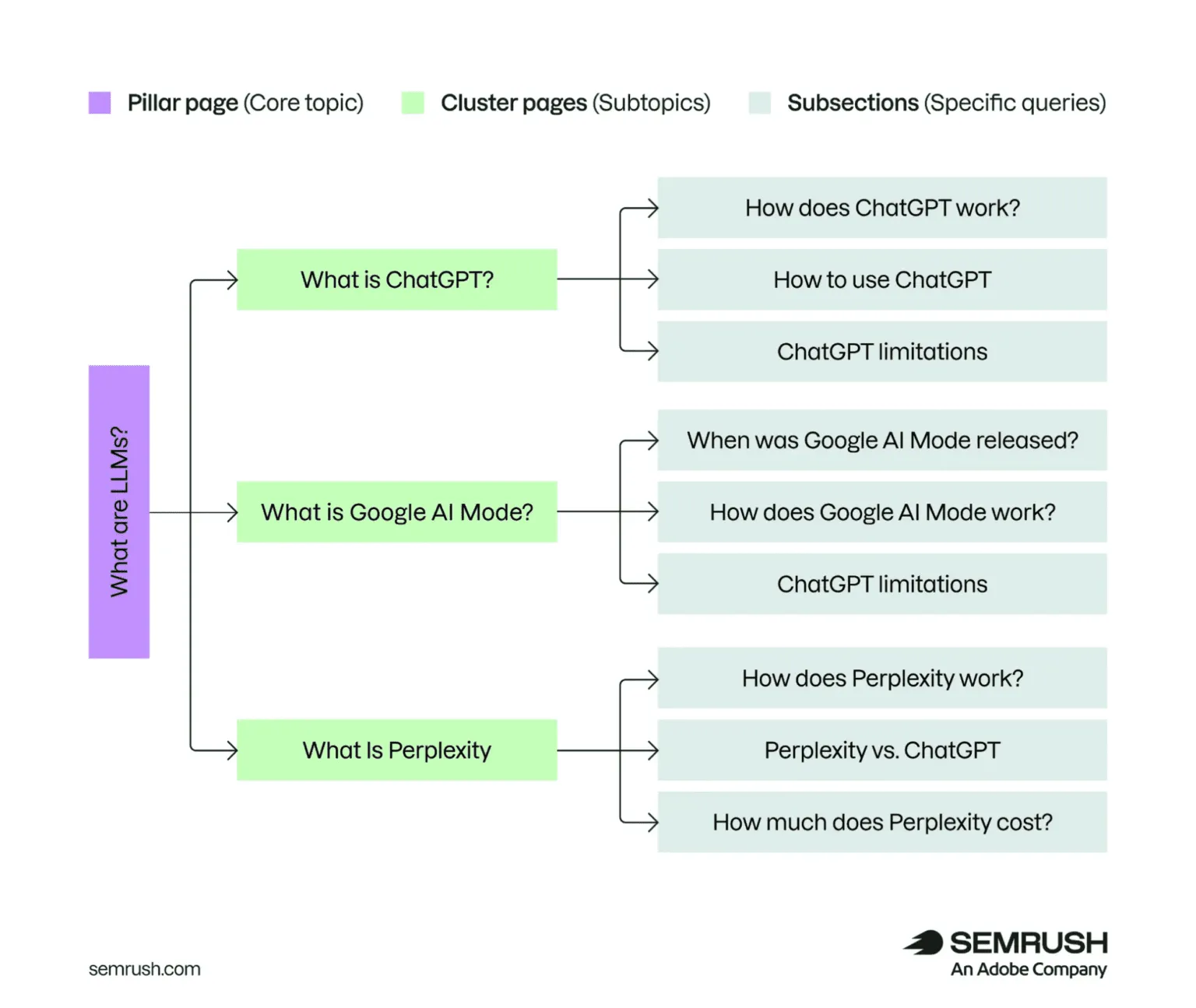
4. Organize Content into Topic Clusters
Query fan-out optimization does not eliminate the value of topic clusters. Instead, it changes how you should think about the relationship between your pillar content and supporting pages.
(Source)
A topic cluster typically contains:
- A broad pillar page
- More focused supporting pages
- Relevant internal links connecting related resources
For example:
Pillar:
Complete Guide to Local SEO
Supporting pages:
- Google Business Profile optimization
- Local citation management
- Local link building
- Local SEO reviews
- Local keyword research
- Local schema markup
This architecture can help search engines and users understand how your content relates across a broader subject.
However, avoid making supporting pages so narrow that they provide little independent value. A page should be useful enough to answer its own central question rather than existing solely to target one keyword variation.
The same principle applies within individual articles. A page should have a clear central topic while containing enough relevant supporting information to address the important sub-questions associated with that topic.
Recent analysis of query fan-out optimization describes this as a shift toward semantic completeness: related information can be grouped into a comprehensive resource while still maintaining a broader site architecture and internal linking structure.
Internal links should therefore remain useful, but they should primarily serve navigation, context, and user experience. Do not treat internal linking as a guaranteed way to make AI systems retrieve every page on your site.
5. Write for Natural Language Processing
Writing for natural language processing does not mean filling your article with AI-related terminology or attempting to manipulate a language model.
It means making the meaning of your content easy to understand.
AI systems need to identify entities, concepts, relationships, attributes, and context. Clear writing helps reduce ambiguity.
For example:
Corexta is an all-in-one business management platform that combines project management, HR, finance, client management, and other business functions in one system.
This sentence clearly establishes:
- Entity: Corexta
- Category: business management platform
- Functions: project management, HR, finance, client management
- Relationship: these functions are combined within one system
That is much clearer than repeatedly using a keyword without explaining what the entity actually does.
Use natural terminology
Use the words that genuinely belong to the topic.
If you are writing about HVAC maintenance, relevant concepts might include:
- air filters,
- refrigerant,
- coils,
- airflow,
- thermostat,
- ductwork,
- preventive maintenance,
- efficiency,
- indoor air quality.
You do not need to repeat “HVAC maintenance” in every paragraph. Discussing the concepts that naturally surround the subject provides richer semantic context.
Make relationships explicit
Do not assume the reader—or a retrieval system—will infer every relationship.
Instead of:
“Reviews are important. Local businesses need them.”
write:
“Positive customer reviews can strengthen a local business’s reputation and provide prospective customers with evidence of service quality.”
The second version explains what reviews are related to, why they matter, and how they influence the customer decision process.
Avoid keyword stuffing
Query fan-out is not an argument for replacing traditional keyword stuffing with semantic stuffing.
Do not force dozens of related phrases into an article simply because a tool identifies them as related. Search systems increasingly rely on meaning and context rather than requiring exact-match repetition.
Your priority should be:
clarity → completeness → accuracy → natural terminology → user value
rather than:
keyword count → keyword density → phrase repetition
Current research on query fan-out similarly emphasizes semantic relevance and explicit relationships over repeated keywords.
6. Implement Schema Markup
Schema markup can help search engines understand the entities and content types represented on a page. It is therefore a useful technical component of a broader content strategy, but it should not be treated as a shortcut to query fan-out visibility.
Structured data provides machine-readable context about content. Depending on the page, relevant types can include:
ArticleBreadcrumbListOrganizationPersonProductLocalBusinessReviewEventFAQPage, where applicable under current search-feature guidelines
The important rule is that your structured data should accurately represent the content visible on the page and follow the applicable search-engine guidelines.
For example, if an article contains a clearly labeled FAQ section with genuine questions and answers, appropriate structured data may help search systems understand that content. But adding schema simply because you want to target AI search does not guarantee that the page will be cited, ranked, or displayed with a particular search enhancement.
Google’s current documentation specifically states that there is no special schema markup required for AI Overviews or AI Mode. Its guidance recommends maintaining foundational SEO practices and ensuring that pages are crawlable, indexable, and eligible to appear in Search.
That distinction is important.
Use schema to clarify your content—not to manipulate AI retrieval.
A strong implementation should therefore combine structured data with:
- Clear HTML headings
- Descriptive page titles
- Logical content hierarchy
- Crawlable content
- Accurate entity information
- Helpful internal links
- High-quality, original information
- Appropriate author and organization details
Schema is most valuable when it reinforces information that is already clearly expressed on the page.
Putting the Six Steps Together
A practical query fan-out workflow can be summarized as:
1. Start with one core topic.
Define exactly what the page is about and identify its primary search intent.
2. Map the information landscape.
Identify the questions, comparisons, definitions, constraints, follow-ups, and related concepts surrounding the topic.
3. Consolidate related needs into useful content.
Answer the important sub-questions within the same resource when they belong naturally together.
4. Structure the information clearly.
Use descriptive H2s and H3s, short sections, lists, tables, examples, and direct answers where appropriate.
5. Strengthen semantic clarity.
Name important entities, explain their relationships, use natural terminology, and avoid unnecessary keyword repetition.
6. Support the content technically.
Use appropriate schema markup, crawlable HTML, strong internal linking, and other foundational SEO practices.
The overall principle is simple: do not try to guess the exact hidden queries an AI system will generate. Build content that remains useful when the original query expands. Google’s own documentation confirms that AI Overviews and AI Mode can use query fan-out to issue related searches across subtopics and sources, while its broader guidance continues to emphasize established SEO fundamentals.
That makes query fan-out optimization less about chasing a new ranking trick and more about producing complete, clearly structured, trustworthy content that can satisfy a broader set of related information needs.
Measuring Your Query Fan-Out Optimization Success
Query fan-out optimization should not be measured by a single ranking position or by counting how many times a keyword appears on a page. Because AI-powered search can break a complex question into multiple related information needs, success needs to be evaluated across visibility, coverage, engagement, traffic, and business outcomes.
This is especially important in 2026 because AI search measurement is becoming more sophisticated. Google has introduced dedicated Search Console reporting for visibility in generative AI features such as AI Overviews and AI Mode, although the new reporting is being rolled out gradually.
Track Your Visibility Across Related Queries
Begin by creating a list of important primary queries and their associated sub-questions. Then monitor whether your content appears for those topics across traditional search and AI-powered search experiences.
For traditional SEO, monitor:
- Organic impressions
- Organic clicks
- Average position
- Ranking keywords
- Long-tail query visibility
- Pages receiving search traffic
- Click-through rates
For AI search, where data is available, monitor:
- AI-generated answer appearances
- Brand mentions
- Citations or source links
- Visibility across important prompts
- Competitor mentions
- Referral traffic from AI platforms
- Conversions associated with AI-referred visitors
Do not expect AI visibility to behave exactly like conventional keyword rankings. AI responses can vary based on the wording of the prompt, user context, model behavior, location, freshness, and the sources retrieved. Recent research and industry measurement frameworks therefore recommend treating AI visibility more like a portfolio of observed prompts and outcomes than a single rank-tracking number.
Measure Sub-Topic Coverage
One of the most useful measurements for a query fan-out strategy is how comprehensively your site covers the information surrounding an important topic.
Suppose your primary topic is “commercial solar panels.” Your content coverage might include:
- How commercial solar panels work
- Commercial solar installation costs
- ROI and payback periods
- Tax incentives
- Maintenance requirements
- Energy production
- Panel types
- Battery storage
- Commercial installation process
- Common limitations
- Financing options
You can create a simple content coverage matrix and mark each important sub-question as:
Covered → Partially covered → Not covered
This gives your content team a practical way to identify gaps rather than relying exclusively on keyword volume.
Monitor AI Citations and Brand Mentions
A citation tells you that your content was selected as a source. A brand mention tells you that your business was included in the answer or recommendation.
Both can be useful, but they are not identical.
A page might be cited because it provides a specific statistic, definition, comparison, or technical explanation. Meanwhile, your brand may be mentioned because an AI system considers your business relevant to the user’s broader question.
This distinction matters when evaluating commercial outcomes. Current AI-search measurement research increasingly separates access, visibility, referrals, demand, and revenue rather than treating citation count as the final KPI.
Measure Engagement and Conversion Quality
Traffic from AI-powered search should ultimately be evaluated according to what those visitors do.
Track metrics such as:
- Engagement rate
- Time spent on important pages
- Pages per session
- Lead form submissions
- Demo requests
- Phone calls
- Newsletter registrations
- Product trials
- Purchases
- Revenue
- Assisted conversions
Google has noted that visitors arriving from AI search experiences can be highly engaged, reinforcing the importance of evaluating the quality and value of visits, not merely their volume.
For example, suppose updating a comprehensive guide results in fewer total organic visits but a substantial increase in qualified leads. That can be a positive outcome even though the traffic graph alone looks unimpressive.
Compare Performance Before and After Optimization
When updating existing content for query fan-out, establish a baseline before making changes.
Record:
- Current organic traffic
- Existing keyword visibility
- Important ranking queries
- Search impressions and clicks
- Existing conversions
- AI visibility, where measurable
- Competitor visibility
- The sub-topics currently covered
After publishing the changes, compare performance over a meaningful period.
Avoid declaring success or failure after only a few days. Search engines need time to recrawl and reevaluate content, while AI-search visibility can fluctuate because retrieval and model behavior are not deterministic.
Also remember that correlation does not automatically prove causation. Algorithm updates, competitor changes, seasonality, link acquisition, technical changes, and changes in search demand can all affect performance at the same time. Controlled SEO testing and appropriate comparison groups can make conclusions more reliable.
Focus on Business Outcomes, Not Vanity Metrics
The ultimate question is not:
“Did our article appear in an AI answer?”
It is:
“Did our content help the business become more discoverable, trusted, and useful to potential customers?”
A practical measurement framework can therefore move through five levels:
Access → Visibility → Engagement → Demand → Revenue
This reflects the increasingly complex customer journey in AI search. A prospect might encounter a company in an AI-generated recommendation, search for the company separately, read third-party reviews, return through organic search, and eventually become a customer. Traditional last-click attribution may not capture the entire journey.
Query fan-out optimization is successful when your content becomes useful across these connected stages—not simply when one page ranks for one keyword.
Adapting Your Content Strategy for Query Fan-Out
Query fan-out is changing how customers discover, research, and evaluate brands in AI-powered search. As search engines increasingly break complex queries into related questions, businesses need content that addresses broader search intent and provides comprehensive, trustworthy information. Adapting your content strategy now can help strengthen your brand’s visibility across emerging AI search experiences and traditional search results. The key is not simply adopting query fan-out optimization, but building a content strategy that is flexible enough to keep pace with how people search and make decisions.
Contact Pro Real Tech to discover how to optimize your content for query fan-out, strengthen your AI search visibility, and build a strategy designed for long-term digital growth.
Frequently Asked Questions (FAQs) About Query Fan-Out
How Is Query Fan-Out Different From Traditional Keyword Research?
Traditional keyword research primarily investigates what people search for, including search volume, competition, keyword variations, and intent.
Query fan-out focuses on what can happen after a user submits a query: an AI search system may expand the original request into multiple related searches to gather information for different aspects of the answer.
For content marketers, the difference is practical. Keyword research might identify “best CRM for small business” as the primary keyword. A query fan-out approach would also consider related questions about pricing, integrations, implementation, features, scalability, alternatives, security, and use cases.
Keyword research remains valuable. Query fan-out adds another layer of intent and topic analysis rather than replacing keyword research.
Do I Need to Change My Entire Content Strategy for Query Fan-Out Optimization?
No.
You generally do not need to abandon your existing SEO strategy. Google’s guidance for AI search explicitly continues to emphasize established fundamentals such as helpful, original content, crawlability, indexability, and a good page experience.
Instead, improve your existing strategy by asking broader questions during content planning:
- What is the primary user intent?
- What follow-up questions naturally arise?
- Which related concepts should be explained?
- Which important questions are missing from existing content?
- Can one resource answer several closely related information needs?
The goal is to make your existing content more comprehensive and useful, not to rebuild your entire website around a new algorithmic trick.
Which AI Platforms Use Query Fan-Out?
Query decomposition and multi-query retrieval are associated with modern AI-powered search systems, but implementation details vary by platform and can change over time.
Google has explicitly documented query fan-out in connection with AI Overviews and AI Mode, explaining that these experiences can issue multiple related searches to find information across subtopics.
Research has also examined fan-out behavior across platforms including ChatGPT, Gemini, and Perplexity, finding that these systems can generate multiple retrieval queries from an original user prompt.
However, marketers should avoid assuming that every platform uses the exact same fan-out process. The number, formulation, sequencing, and retrieval mechanisms can differ between systems and may change as products evolve.
How Many Sub-Questions Should I Plan for in My Query Fan-Out Strategy?
There is no universal ideal number.
The number of sub-questions should depend on the complexity of the topic and the user’s intent.
A straightforward informational query may require only a few supporting questions. A complex commercial query could involve dozens of considerations.
Instead of setting an arbitrary target such as “10 sub-questions per article,” prioritize the questions that materially contribute to the user’s goal.
For each potential sub-question, ask:
Does answering this help the reader understand, compare, evaluate, or act on the core topic?
If yes, include it where appropriate. If not, leave it out.
Quality and relevance matter more than hitting a predetermined number.
Does Query Fan-Out Optimization Improve Traditional SEO?
It can, but there is no automatic ranking benefit simply because you use the term “query fan-out.”
Many practices associated with query fan-out optimization overlap with established SEO best practices:
- Understanding search intent
- Covering relevant subtopics
- Answering user questions
- Creating useful internal links
- Structuring content clearly
- Demonstrating expertise
- Keeping information accurate and current
- Improving page experience
Google has stated that the same foundational principles that support traditional Search also apply to its AI search experiences.
Comprehensive content can also capture additional long-tail searches and provide stronger topical coverage. However, content should never be expanded merely for the sake of length. Google’s guidance continues to emphasize original, satisfying content created for people.
How Long Does It Take to See Results From Query Fan-Out Optimization?
There is no fixed timeline.
Results depend on factors such as:
- Website authority
- Existing rankings
- Content quality
- Competition
- Crawl and indexing speed
- Frequency of search-engine updates
- Number and quality of content improvements
- Search demand
- AI platform behavior
For traditional SEO, meaningful changes often require weeks or months rather than days. AI visibility can sometimes change more quickly, but it can also fluctuate substantially.
The best approach is to establish a baseline, make a clearly defined improvement, and monitor the results over an appropriate period rather than expecting an immediate increase in visibility.
Can Small Businesses Compete Using a Query Fan-Out Strategy?
Yes.
Query fan-out does not require a business to publish hundreds of pages or compete for every broad keyword.
A small business can focus on a narrower subject where it has genuine expertise and build unusually useful content around the questions its customers actually ask.
For example, a local commercial HVAC company could create a comprehensive resource covering:
- Commercial HVAC maintenance
- Maintenance schedules
- Common warning signs
- Seasonal maintenance
- Energy efficiency
- Repair versus replacement
- Maintenance costs
- Equipment-specific considerations
- Questions to ask an HVAC contractor
This approach can help a smaller company demonstrate topical expertise without trying to compete with enormous websites across unrelated subjects.
The key is depth within a relevant niche, not content volume for its own sake.
Should I Optimize Every Page for Query Fan-Out?
No.
Not every page needs to become a comprehensive topical resource.
A short product page, contact page, service page, pricing page, or transactional landing page may have a very specific purpose. Adding numerous unrelated questions can actually make the page less focused.
Prioritize query fan-out optimization for pages where users are likely to have complex or multi-dimensional information needs, such as:
- Ultimate guides
- Comparisons
- Buying guides
- Industry resources
- How-to content
- Research articles
- Service education pages
- Product explainers
- High-value informational landing pages
For other pages, focus on their specific search intent and conversion goal.
How Does Schema Markup Help With Query Fan-Out Optimization?
Schema markup can provide search engines with structured information about the entities and content represented on a page.
For example, appropriate structured data can help clarify that a page contains an article, product, organization, local business, event, or other supported content type.
However, schema markup does not guarantee inclusion in an AI-generated answer.
Google’s current guidance recommends that structured data accurately match visible page content and follow its structured-data guidelines. It also states that there is no special schema markup required specifically for AI Overviews or AI Mode.
Therefore, use schema as a supporting technical practice—not as a substitute for comprehensive content.
Your priority should remain:
Useful content + clear structure + accurate information + technical accessibility + appropriate structured data.
What’s the First Step in Implementing a Query Fan-Out Strategy?
Start with your most important customer question or business topic.
Do not begin by trying to optimize hundreds of pages.
Choose one high-value topic and identify:
- The primary search intent
- The user’s underlying goal
- The most important related questions
- Common comparisons and alternatives
- Important limitations or objections
- Supporting entities and concepts
- Existing content gaps
- Which page or pages should address those needs
Then build or update the content so that it provides clear, trustworthy answers to the most relevant questions.
After publication, establish a measurement baseline and monitor both traditional search performance and AI-search visibility where reliable data is available. In 2026, dedicated generative-AI visibility reporting is beginning to become available within Search Console, while broader AI-search measurement is increasingly focused on visibility, citations, referrals, demand, and revenue rather than rankings alone.
The most effective query fan-out strategy is therefore not about trying to reverse-engineer every internal AI query. It is about understanding the full information journey behind a user’s question and creating content that can satisfy that journey with accurate, useful, well-structured information.
Read More: Choosing the Best Restoration SEO Company for Small Business


