


AI search is changing what it means for a business to be visible online. Being mentioned by an AI system is no longer the same as being positioned as a business customers should choose. A company may be easy for AI to identify, yet still be absent when a customer asks, “Who is the best option?” That distinction is at the center of the Q2 2026 Business Visibility Index. The latest analysis moves beyond basic discoverability and examines whether businesses are actually being recommended when users ask AI for a trusted choice.
The results reveal a substantial recommendation gap. Across the 372-business panel, AI could identify roughly 86% of businesses when their names were supplied, but recommended only about one in five when asked to identify the best businesses in a category. In other words, being known is relatively common; being selected is considerably harder.
The findings also challenge a familiar assumption in digital marketing: that stronger traditional SEO automatically translates into stronger AI visibility. The study found only weak relationships between AI recommendations and metrics such as Domain Rating, referring domains, backlinks, and organic traffic. This suggests that businesses need to think beyond conventional search rankings and build the third-party authority signals that AI systems appear to rely on when deciding whom to recommend.
The Q2 study is also a continuation of an earlier March investigation. Looking at both waves together makes the shift particularly important. The first wave focused on whether AI could find businesses and their owners. The second asked the more commercially meaningful question: once AI knows you exist, will it actually recommend you?
The Two-Volume Picture
Read the two volumes together and the investigation becomes much more revealing. The March study established a baseline around AI visibility, while the summer study examined what happens after basic discoverability is no longer the main obstacle.
Volume 1 (March)
The first volume asked a relatively straightforward question: Can AI find local businesses and the people behind them?
The answer was generally yes for businesses, although owners were substantially less visible. The March analysis found that companies averaged a visibility score of 37 out of 100, compared with approximately 28 for their owners. Nearly 47% of owners were classified as effectively invisible under that study’s blended measurement.
The first wave also suggested a relationship between AI visibility and business performance. Businesses visible to AI on both the company and owner sides had median year-over-year traffic growth of about 3%, while businesses invisible on both sides experienced a much sharper median decline of 28.1%. The analysis also found that basic technical infrastructure was generally not the major differentiator. Earned, third-party coverage was more closely associated with visibility.
That created an important starting point: the problem wasn’t necessarily whether a business had a website or basic SEO infrastructure. It was whether credible information about that business existed across sources AI could find and interpret.
Volume 2 (Summer)
The second volume changed the question.
Instead of simply asking whether AI could identify a business when given its name, the analysis asked whether AI would independently recommend that business when prompted to identify the best option in its category.
That produced a much different picture.
AI could identify approximately 86% of the businesses when asked about them directly. Yet only around 20% were recommended when AI was asked which businesses were best. The result is a roughly 67-percentage-point difference between being known and being recommended.
This distinction matters because a recommendation occurs much closer to the point of customer decision-making. A user asking, “What does this company do?” is still researching. A user asking, “Which company should I hire?” is much closer to taking action.
The second volume therefore suggests that AI visibility has at least two different layers:
- Recognition: AI can identify or describe your business.
- Recommendation: AI considers your business credible enough to put forward as an option.
The first is becoming increasingly common. The second remains difficult to earn.
Volume 1 in Brief, for Readers Who Missed It
The March research established several findings that remain important for understanding the Q2 results.
First, AI generally recognized companies more readily than their owners. Second, businesses with stronger AI presence showed different traffic patterns from businesses that were largely invisible. Third, technical fundamentals were not enough to explain the difference. The more meaningful distinction was the presence of credible, third-party information about the business.
However, the second volume also makes an important methodological clarification: the original 47% owner-invisibility figure should not be directly compared with the new 9% owner-recommendation rate. The earlier measurement combined different aspects of visibility, while the Q2 study separates being looked up from being recommended.
That distinction is important because it prevents an apparently dramatic change from being mistaken for a real decline. The two waves are measuring related concepts, but not exactly the same owner-level outcome.
What We Corrected From Volume 1
The Q2 analysis also revisited the earlier dataset and corrected several findings.
One correction involved the previously reported performance of the “Visible” tier. Rather than showing traffic growth, that group actually experienced an approximately 14% decline. Another correction reversed an earlier conclusion about owner visibility by company size: the original claim that mid-sized businesses had stronger owner visibility than small businesses was found to run in the opposite direction.
A third number changed after businesses that did not properly belong in the sample were removed. The “Both Visible” group was restated from approximately +2.5% to +3.0% year-over-year traffic growth. These corrections do not represent a change in the underlying business landscape; they represent a cleaner and more accurate interpretation of the original data.
Publishing corrections is especially important in a longitudinal study. If the goal is to compare AI visibility over multiple waves, the underlying sample and calculations have to remain consistent. Correcting earlier errors makes later comparisons more meaningful rather than less credible.
Why the Panel Is 372, Not 400
The original panel contained 400 businesses, but a later review found that 28 did not actually belong in the intended categories. Those businesses were removed, leaving a final panel of 372 businesses for the ongoing study.
Most of the exclusions occurred in Restoration. The category term had pulled in organizations such as auto-body businesses, museums, a botanical garden, a naval museum, and nonprofits that did not represent property-restoration companies. Four additional businesses in Home Services were also found to be outside the intended category, including organizations associated with telecommunications, aviation, and government.
The final panel consists of:
| Vertical | Businesses |
|---|---|
| Medical | 80 |
| Legal | 80 |
| Franchise | 80 |
| Home Services | 76 |
| Restoration | 56 |
| Total | 372 |
The smaller Restoration sample is therefore intentional rather than an oversight. Removing irrelevant businesses creates a more focused comparison between actual businesses operating within the five target verticals.
The Recommendation Gap
The central finding of the Q2 analysis is the difference between being known and being recommended.
When AI was given a business name and asked about that company, it could produce a meaningful response for approximately 86% of businesses. But when the name was withheld and AI was instead asked to recommend the best businesses within a category, only about one in five appeared in the recommendations.
That distinction changes how businesses should think about AI search.
A company does not necessarily need more information simply telling AI that it exists. It needs enough credible evidence for AI to conclude that the company is worthy of being suggested to someone else.
The Gap by Vertical
The difference appears across every vertical in the study:
| Vertical | AI Knows the Business | AI Recommends the Business |
|---|---|---|
| Medical | 95% | 26% |
| Home Services | 89% | 22% |
| Restoration | 98% | 21% |
| Franchise | 88% | 14% |
| Legal | 65% | 14% |
Medical businesses had the highest recommendation rate at 26%, but even there, approximately three-quarters of businesses that AI knew were not recommended. Restoration had the highest recognition rate at 98%, yet only 21% were recommended.
Legal presents an especially interesting case. AI recognized only 65% of the firms in the panel and recommended just 14%. The analysis suggests that AI often recognizes individual attorneys more readily than the firms they represent, creating a company-level visibility problem alongside the recommendation problem.
The broader lesson is consistent across all five verticals: high recognition does not guarantee recommendation.
The Owner Opportunity
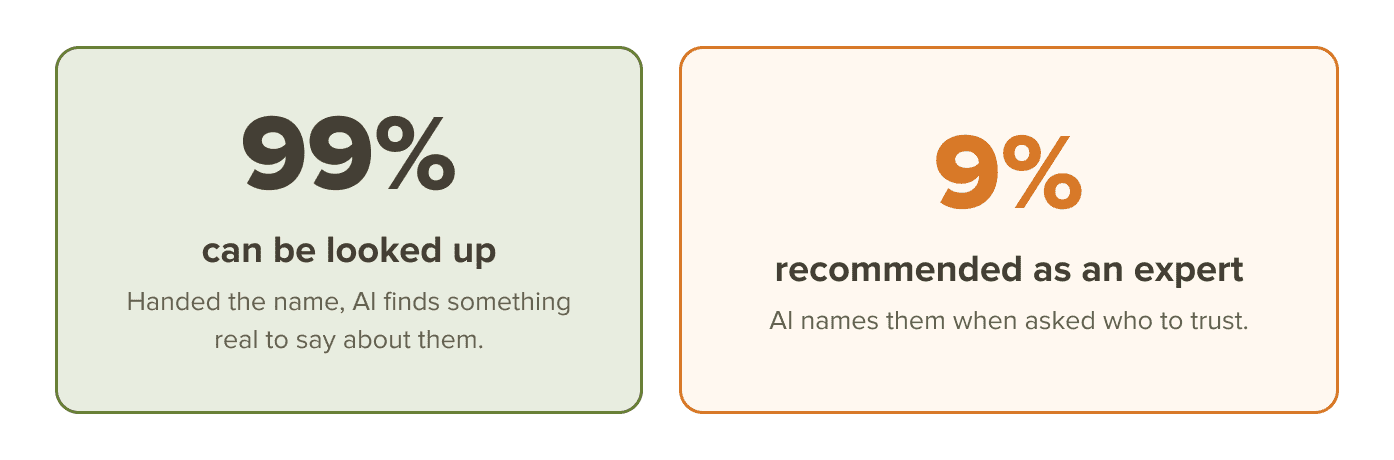
The same pattern becomes even more pronounced when the analysis shifts from businesses to owners.
AI could produce an answer when asked to identify the owner for approximately 99% of the businesses in the panel. Yet owners were recommended as experts only about 9% of the time.
That creates a potentially valuable opening for business owners.
A customer may not only ask an AI system, “Which company should I hire?” They may also ask, “Who is an expert in this field?” or “Who should I trust for this problem?” If an owner has credible third-party recognition, professional credentials, media coverage, interviews, expert contributions, and other authoritative references, those signals can help establish the person as more than simply the individual behind a company.
The gap varies dramatically by industry. Medical owners had an 18% recommendation rate and legal owners 16%. By contrast, restoration owners were at 4%, home-services owners at 3%, and franchise owners at only 1%.
That means personal authority may be particularly underdeveloped in industries where customers traditionally choose a company rather than an individual professional.
Where the Slot Is Already Real, and Where It’s Wide Open
The data suggests that owner-level recommendation is already an established concept in some industries.
Legal and medical professionals operate within ecosystems containing professional directories, credentials, rankings, licensing information, and expert profiles. These environments give AI more structured evidence from which to identify individuals as credible experts.
The opportunity appears much wider in home services, restoration, and franchise businesses. In these sectors, AI may readily recognize the company or brand but have far less authoritative information about the person who owns or operates the local business.
That creates an important distinction:
Company authority can get you into the conversation. Personal authority can give AI a reason to name you as the expert behind the business.
Why the Owner Number Swings, and Why That’s the Opening
Owner visibility also behaves differently from company visibility.
In repeated tests performed several hours apart without meaningful changes to the underlying information, company-level scores remained relatively stable. Owner-level scores, however, could change dramatically. The analysis found that owner visibility was roughly 25 times more volatile than company visibility in its same-day reliability testing.
At first glance, that volatility might appear to make owner visibility less useful. But it can also indicate that AI has insufficient, consistent evidence about many business owners.
When an AI system has abundant reliable information from multiple authoritative sources, its answer is more likely to remain consistent. When information is thin, fragmented, or ambiguous, the system has fewer strong signals to rely on.
This is why earned authority matters.
A business owner does not necessarily need hundreds of mentions across the web. A smaller number of credible placements can be more meaningful if they come from sources that are relevant to the owner’s industry and reputation. Professional directories, respected trade publications, interviews, podcasts, expert contributions, credible local coverage, and industry organizations can all help create a clearer identity around the person.
The objective is not simply to make the owner findable. It is to make the owner’s expertise supported by enough independent evidence that an AI system has a reason to recommend them.
What AI Actually Decides to Cite
The recommendation gap raises an obvious question: If traditional SEO metrics do not fully explain AI recommendations, what information is AI actually using?
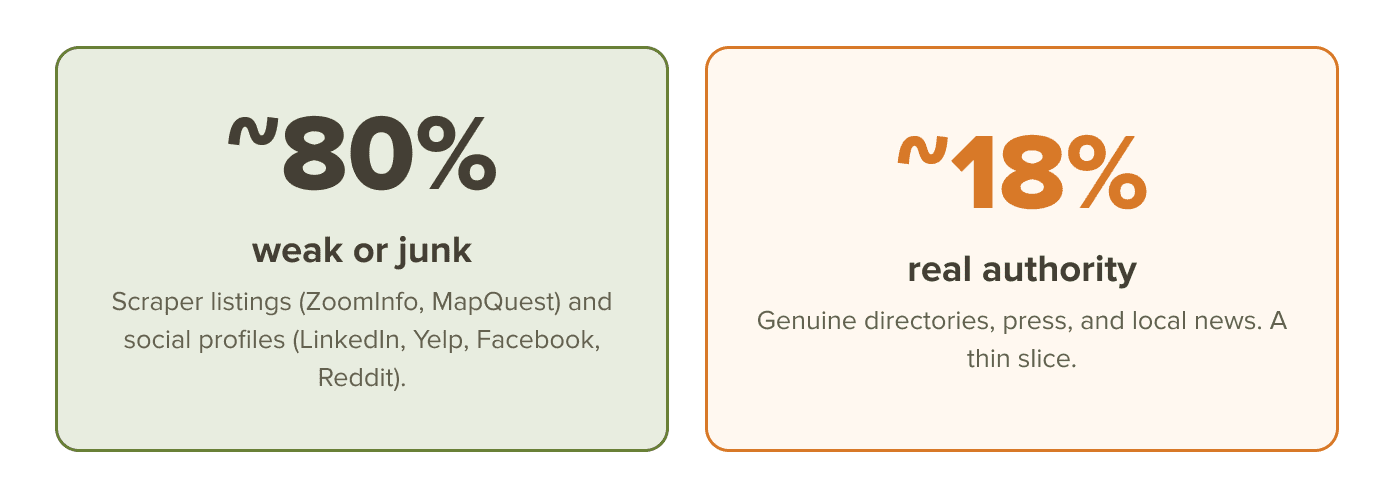
The Q2 analysis points toward the sources appearing around a business, particularly authoritative third-party sources relevant to its industry.
Across the two study waves, AI began citing substantially more sources per response. However, the quality mix did not improve proportionally. Approximately 81% of sources were classified as weak in the first wave, compared with about 78% in the second. In other words, AI was producing more citations, but that did not necessarily mean it was relying on higher-quality sources.
Social and community platforms also became increasingly common in the citation mix. LinkedIn appeared for approximately 99% of businesses, Yelp for 91%, Facebook for 69%, and Reddit for 41%. This indicates that AI can draw from a broad ecosystem of publicly available information, rather than relying exclusively on conventional editorial websites.
But frequency of citation is not the same as authority.
The Sources That Actually Carry Authority, by Vertical
The sources most likely to provide meaningful authority differ according to the industry:
| Vertical | Important Authority Sources |
|---|---|
| Legal | Super Lawyers, Avvo, Best Lawyers, Justia |
| Medical | Healthgrades, Zocdoc, Castle Connolly |
| Home Services | BBB, Angi, HomeAdvisor, Houzz |
| Restoration | BBB, Angi, HomeAdvisor, Houzz |
| Franchise | YouTube, Bizjournals, Entrepreneur |
This is one of the most practical findings in the study. There is no single universal “AI authority website” that every business should pursue. The sources that matter depend heavily on the vertical.
For a law firm, recognition from established legal directories may provide a stronger contextual signal than simply accumulating more backlinks. For a medical practice, credible healthcare directories and professional profiles can provide structured evidence about qualifications and expertise. For home services and restoration, review platforms, business organizations, and industry-specific directories can provide the third-party context AI needs to distinguish one provider from another.
Franchises present a different challenge. AI may know the larger franchise brand quite well while having comparatively little information about the individual local owner. Building credible local and professional coverage around the owner can therefore become an important part of establishing authority.
The key principle is relevance plus credibility. A business does not need to appear everywhere. It needs to appear consistently in the places that carry meaning within its particular industry.
There is also an important limitation to the source comparison. Earlier citation records were capped at ten sources per business, so precise domain-by-domain changes between the two waves should be treated as directional rather than definitive. The more reliable finding is that the overall mix remained heavily weighted toward weaker sources despite the increase in citation volume.
That leads to a more useful way of thinking about AI visibility: the goal is not to manufacture more mentions; it is to build a credible web of evidence around the business and the people behind it.
Why SEO Doesn’t Buy the Recommendation
Traditional SEO still matters. Search visibility, crawlability, relevant content, backlinks, and strong technical foundations can help a business get discovered. But the Q2 2026 findings suggest that SEO performance and AI recommendation are not interchangeable outcomes.
The clearest evidence comes from comparing businesses that AI recommended with those it did not, using the metrics SEO professionals commonly monitor. The median Domain Rating was 22 for recommended businesses versus 15 for businesses that were not recommended. That is a meaningful difference, but it is nowhere near enough to explain the recommendation gap by itself.
The same pattern becomes clearer with other conventional metrics. Median referring domains were approximately 109 for recommended businesses compared with 82 for non-recommended businesses, while median organic traffic was approximately 3,100 versus 2,600. These differences indicate that recommended businesses can have somewhat stronger SEO profiles, but they do not establish a simple rule such as “more authority equals AI recommendation.”
Recommended vs. Not Recommended, on the Metrics SEO Optimizes (Medians)
| SEO metric | AI-recommended businesses | Not recommended |
|---|---|---|
| Domain Rating | 22 | 15 |
| Referring domains | 109 | 82 |
| Organic traffic | 3,100 | 2,600 |
The correlations were even weaker than the median differences might suggest. Domain Rating had only a modest relationship with AI recommendation, while referring domains and organic traffic showed very weak relationships. In practical terms, SEO strength may help establish a baseline of credibility, but it does not appear to determine whether AI will put a business on its recommendation list.
That distinction matters because search engines and generative AI systems are solving somewhat different problems.
Traditional SEO is largely concerned with helping a page become discoverable, relevant, crawlable, and competitive for particular searches. An AI recommendation requires another layer of judgment: the system must determine which businesses appear sufficiently credible, relevant, and appropriate to mention as an answer to a user’s question.
A business can therefore have:
- A technically strong website
- Good organic rankings
- A substantial backlink profile
- Consistent organic traffic
- Strong on-page content
…and still fail to become a recommended option.
This does not mean businesses should abandon SEO. Instead, SEO should be treated as one part of a larger authority strategy. A business needs the information that search engines can crawl, but it also needs independent evidence from sources that establish reputation, expertise, identity, and relevance.
The Q2 findings essentially separate two objectives:
SEO helps make your business discoverable. Authority helps give AI reasons to recommend it.
The Five Verticals
The study examined five business categories: Medical, Home Services, Restoration, Franchise, and Legal. Each produced a different relationship between recognition, recommendation, and owner visibility.
Medical
Medical businesses had the strongest overall recommendation performance among the five categories. AI recognized 95% of the medical businesses in the panel and recommended 26% when asked for the best options. Owner recommendation was also relatively strong at 18%.
That makes sense within a sector where professional credentials, healthcare directories, physician profiles, institutional affiliations, and other structured information can provide strong evidence about both businesses and individual practitioners.
However, even in the strongest-performing category, most businesses AI knew were not recommended. Medical businesses therefore demonstrate the central finding particularly well: high recognition does not automatically translate into selection.
Home Services
Home Services had an 89% recognition rate, while only 22% of businesses were recommended. Owner recommendations fell to just 3%.
This creates a particularly interesting opportunity for local service companies. AI generally knows these businesses exist, but it has far less confidence in identifying the individual owners as recognized experts.
Third-party business profiles, customer reviews, industry directories, local coverage, professional associations, and authoritative mentions can therefore become important pieces of the authority picture.
Restoration
Restoration produced the highest business recognition rate at 98%, but only 21% of businesses were recommended. Owner recommendation was just 4%.
The result is a near-perfect example of the recommendation gap. AI can identify almost all of the businesses in this category, yet only about one in five makes the transition from “known” to “recommended.”
For restoration companies, the opportunity is not necessarily to create more pages describing services. It may be more valuable to strengthen the external evidence surrounding the company, its expertise, its reputation, and the people responsible for the business.
Franchise
Franchise businesses had an 88% recognition rate, but only 14% were recommended. Owner recommendation was the lowest of all five verticals at approximately 1%.
This highlights a potential identity problem. A franchise brand can be highly recognizable while the local business owner remains largely invisible as an authority.
For these businesses, building authority around the individual operator—not simply the parent brand—could represent a significant opportunity. Local news coverage, business publications, professional profiles, interviews, community involvement, and credible industry references can help connect the owner with the expertise associated with the business.
Legal
Legal businesses showed the lowest recognition rate of the five categories at 65%, with only 14% recommended. Yet owner recommendation reached 16%, second only to Medical.
This creates an unusual pattern: AI may have difficulty consistently recognizing the firm itself while being comparatively more willing to identify individual attorneys as experts.
The legal category also illustrates why industry-specific authority matters. Legal professionals operate within a mature ecosystem of professional directories, rankings, attorney profiles, publications, and credential information. These sources can create strong signals around individual expertise even when firm-level visibility is inconsistent.
Taken together, the five verticals show that there is no universal AI visibility formula. The authority signals that matter most depend on how information about each profession is created, published, and trusted online.
What Changed Since Volume 1
The biggest change between the two volumes was the question being asked.
The first volume focused primarily on visibility: could AI find the business and recognize the owner? The second volume moved closer to the customer decision by asking whether AI would actually recommend the business.
That change exposed a much larger gap than basic visibility measurements suggested.
The March analysis found that business visibility was substantially stronger than owner visibility. The summer analysis showed that even when AI could identify a business, recommendation remained relatively rare. Approximately 86% of businesses were known to AI, while only about 20% were recommended.
The research also became more rigorous by correcting the original dataset. The panel was reduced from 400 to 372 businesses after 28 businesses were identified as outside the intended categories. This was particularly important in Restoration, where several organizations had been included despite not being property-restoration companies.
Several earlier conclusions were also corrected. For example, an earlier reported traffic-growth figure for the “Visible” group was revised to an approximately 14% decline, and the previous interpretation of owner visibility by company size was reversed after rechecking the underlying data.
Another important development was the examination of citation behavior. AI responses increasingly included sources, but the additional citations did not automatically translate into higher-quality authority. The second volume therefore reinforced an important point: more citations do not necessarily mean better evidence.
The investigation also found considerable volatility in owner-level visibility. Company-level results were comparatively stable, while owner-level results could change substantially between repeated tests. That suggests that AI systems may have less consistent evidence from which to construct a reliable picture of individual business owners.
So the evolution from Volume 1 to Volume 2 is not simply a story of changing percentages. It is a shift from asking “Does AI know you?” to asking “Does AI trust you enough to recommend you?”
What This Means If You Run One of These Businesses
The most important takeaway is that being present in AI search is not the same as being competitive in AI recommendations.
If you operate a medical practice, law firm, home-services company, restoration business, or franchise, the first step is still to make sure AI can accurately understand your business. Your name, services, location, ownership, credentials, and other essential information should be consistent across your website and important third-party sources.
But that is only the foundation.
The next question should be: What independent evidence exists that makes my business worth recommending?
That means looking beyond traditional SEO metrics and evaluating your broader authority footprint.
Build authority outside your own website
Your website tells AI what you say about yourself. Third-party sources can provide evidence that other organizations, professionals, customers, and publications recognize your business.
Depending on your industry, that could include reputable directories, professional associations, trade publications, local media, interviews, expert contributions, awards, credible reviews, and other authoritative references.
Strengthen the owner’s digital identity
The owner opportunity is especially significant in Home Services, Restoration, and Franchise businesses, where owner recommendation rates were only 3%, 4%, and 1%, respectively.
If you are the face of the company, make your expertise easier to verify. Maintain consistent professional information, demonstrate genuine subject-matter expertise, contribute to relevant publications or industry discussions, and establish connections between your name, role, business, location, and area of expertise.
Stop measuring AI visibility with SEO metrics alone
Domain Rating, backlinks, rankings, and organic traffic remain useful performance indicators. But they should not be treated as direct proxies for AI recommendation.
A better measurement framework includes questions such as:
- Does AI correctly identify my company?
- Does it correctly understand what we do?
- Does it identify the right location?
- Does it recognize the owner or key experts?
- Does it recommend the business for relevant category searches?
- Which competitors does it recommend instead?
- Which sources does AI cite when making those recommendations?
- Are those sources present in my own authority profile?
This shifts the objective from simply ranking to building a recognizable and defensible reputation across the web.
Ultimately, the Q2 findings point to a two-stage challenge. First, a business needs to become known. Then it needs to become trusted enough to recommend. Those are related goals, but they are not the same goal—and businesses that treat them as identical may miss one of the biggest opportunities in AI-driven discovery.
In Plain English: Two Games, and You Have to Play Both
The simplest way to understand the Q2 2026 findings is to think of digital visibility as two different games.
The first is the traditional search game: can customers find your website through Google, and can you attract organic traffic from people searching for your products or services?
The second is the AI recommendation game: when someone asks an AI system which businesses they should consider, does your company appear in the answer?
These two outcomes overlap, but the data suggests they should not be treated as the same thing. A business can perform reasonably well in traditional search and still be missing from AI recommendations. Conversely, a business can experience declining Google traffic while becoming increasingly visible when customers ask AI systems for recommendations.
1. Your Google Traffic Is Probably Slipping, But You’re Not Alone, and a Few Businesses Are Booming
The traffic data in the study reflects a broader period of change in search behavior. Traditional search is no longer the only place customers go when they need an answer, comparison, or recommendation. AI-generated answers, AI search interfaces, and other zero-click experiences can increasingly satisfy part of the user’s information need without requiring a visit to a traditional search result.
That makes organic traffic harder to interpret than it once was.
The Q2 analysis found that the businesses in the panel were not moving in one uniform direction. Some were growing, while others experienced substantial declines. The median year-over-year traffic performance differed significantly between groups, reinforcing the idea that a decline in Google traffic does not necessarily mean a business has suddenly become less relevant or less authoritative.
This is particularly important for businesses watching their analytics and wondering why established SEO efforts are producing less traffic than before.
A portion of the answer may simply be that the search journey is changing.
A customer who previously searched Google, clicked a business website, read an article, and then contacted the company may now ask an AI system a series of questions instead:
Which companies provide this service?
Which ones are best rated?
What should I look for?
Which option is best for my situation?
If the AI system answers those questions directly, fewer users may need to click through to individual websites during the research stage.
That does not make SEO irrelevant. It makes the definition of visibility broader.
Businesses still need strong websites, useful content, technical accessibility, relevant search presence, and traditional organic visibility. But they also need to understand what happens when the customer doesn’t click.
And there is another important point: not every business is losing equally.
The data includes businesses experiencing growth alongside businesses experiencing steep declines. That means the market is not simply moving from “old search” to “AI search” in a way that affects everyone identically. Some businesses are successfully maintaining or expanding their visibility while others are losing ground.
The strategic question is therefore not simply, “How do I stop my Google traffic from falling?”
It is:
“Where are my customers discovering businesses now, and is my brand visible in those environments?”
2. Whether AI Recommends You Is a Completely Separate Question
A business can be well known to AI and still not be recommended.
That is the most important distinction in the entire Q2 analysis.
Approximately 86% of the businesses in the panel could be identified by AI, but only around 20% were recommended when AI was asked to identify the best businesses in their category.
Think of it this way:
Known: “Yes, I know this company exists.”
Recommended: “Yes, this is one of the businesses I would suggest to someone looking for this service.”
Those statements require different levels of confidence.
Recognition can come from a business website, directories, social profiles, reviews, and other public information. Recommendation requires AI to make a comparative judgment about which businesses deserve to be included in the answer.
That is why simply increasing the amount of content on your website may not solve the problem.
If AI already knows your company exists, another 20 service pages may do little to change whether it recommends you. The missing ingredient could instead be independent authority—credible evidence from sources outside your own website that supports your expertise, reputation, relevance, and standing in your market.
This also explains why traditional SEO metrics do not tell the entire story.
Recommended businesses had somewhat stronger median SEO metrics than non-recommended businesses, but the relationships were not strong enough to conclude that higher Domain Rating, more referring domains, or greater organic traffic directly produces AI recommendations.
The practical lesson is straightforward:
Keep doing SEO, but don’t expect SEO alone to purchase a recommendation.
Build the website and search visibility you need to be found. Then build the broader authority ecosystem that gives AI credible reasons to choose you.
What We’re Still Digging Into
The Q2 findings answer some important questions, but they also create several new ones.
One major area for further investigation is why AI recommends one business instead of another when both appear similarly authoritative through conventional SEO measurements.
The data shows that traditional metrics such as Domain Rating, referring domains, and organic traffic do not strongly explain recommendations. That suggests other variables may be involved, including source quality, topical relevance, brand mentions, review patterns, professional recognition, entity consistency, and the context in which a business appears across the web.
Another area is owner-level recommendation.
Business recognition was relatively stable, while owner recommendation was much more volatile. Repeated tests conducted hours apart could produce significantly different owner-level outcomes. That raises questions about how much information AI systems require before they consistently associate an individual with expertise.
The study also leaves room to investigate how recommendations differ between AI platforms and models. Different systems can have different retrieval processes, source preferences, training data, and approaches to generating answers. A recommendation appearing in one AI environment should therefore not automatically be assumed to appear everywhere else.
There is also a broader question around time.
AI recommendation systems are evolving quickly. A source that carries significant influence today may have a different role months from now. New search interfaces, retrieval systems, model updates, and changing user behavior could alter how businesses become visible.
For that reason, the Business Visibility Index is better understood as an ongoing measurement rather than a final formula.
The objective is not to declare that one particular tactic “wins AI.” It is to identify patterns, test them repeatedly, correct errors, and determine which signals consistently distinguish businesses that are merely recognized from those that are actually recommended.
How We Measured This, in Plain Language
The Q2 study examined a final panel of 372 businesses across five verticals:
- Medical
- Legal
- Franchise
- Home Services
- Restoration
The original panel contained 400 businesses, but 28 were removed after a review found that they did not properly fit the intended categories. The final sample was therefore 372 businesses rather than 400.
The research looked at two different questions.
The first was essentially:
“Does AI know this business?”
The business name was supplied, and the system was evaluated on whether it could correctly identify and describe the company.
The second question was more demanding:
“If someone asked for the best businesses in this category, would AI recommend this company?”
The business name was not simply handed to the model as the answer. Instead, recommendation prompts were used to see which businesses appeared naturally in the generated recommendations.
The same basic distinction was applied to business owners. Researchers examined whether AI could identify the owner and whether it would recommend that person as an expert.
This distinction is critical because recognition and recommendation were measured separately. A business being identifiable does not count as proof that AI considers it one of the best options.
The analysis also compared AI outcomes with conventional SEO and website-performance metrics, including measures such as Domain Rating, referring domains, and organic traffic. These comparisons were used to determine whether conventional SEO strength could explain differences in AI recommendation rates.
Citation analysis was also used to understand the kinds of sources appearing in AI responses. Rather than assuming that every citation has equal value, sources were evaluated according to their apparent authority and relevance.
The study should therefore be viewed as a snapshot and comparative analysis, not a universal ranking system for every business or every AI platform.
Disclosures, in Brief
The Q2 2026 analysis is observational. It identifies patterns between business characteristics, online authority, search performance, and AI recommendations, but it does not prove that one specific factor causes an AI system to recommend a business.
The final panel contains 372 businesses after category-quality corrections. The Restoration category is smaller than the others because a number of businesses initially included in the dataset were later determined not to belong in the intended category.
Some figures from the earlier volume were also corrected after the underlying data and classifications were reviewed. These corrections are important when comparing the March and summer findings, because the purpose of the second volume is to build a cleaner longitudinal dataset rather than preserve numbers that were later found to be inaccurate.
AI responses are also inherently variable. Models can change their answers based on prompt wording, timing, available information, model updates, retrieval behavior, and other factors. This is particularly relevant to owner-level recommendations, which demonstrated substantially greater volatility than company-level recognition.
Finally, the findings should not be interpreted as evidence that SEO no longer matters. Traditional search remains an important discovery channel. The more defensible conclusion is that SEO is only one component of modern digital visibility.
The emerging challenge is broader: a business needs to be discoverable in search, understandable to AI, supported by credible third-party information, and authoritative enough to earn a recommendation when the customer asks, “Who should I choose?”
That is the real gap between being known and being recommended.
Read More: AI Search Still Runs on SEO: Why Technical Foundations Matter More Than Ever


