


AI-powered search is changing how people discover, compare, and evaluate businesses. Instead of simply returning a list of links, platforms such as ChatGPT, Google AI Overviews, Gemini, and Perplexity can synthesize information from multiple sources and present a direct answer. That means your brand’s visibility increasingly depends on what the broader web says about your business—not just what appears on your own website.
This is where digital PR for AI visibility becomes strategically important. Digital PR helps businesses earn mentions, coverage, reviews, expert references, and other third-party signals that AI systems can use when determining which brands are relevant and trustworthy. Recent research and industry analysis indicate that AI search frequently relies on external sources to understand and validate brands, making earned media an important part of a modern AI visibility strategy.
Traditional SEO still matters, but optimizing your website alone is no longer enough. If you want AI systems to recognize your business as a credible answer within your industry, you need to build a strong reputation beyond your own domain.
What Is Digital PR for AI Visibility?
Digital PR for AI visibility is the practice of using earned media and strategic online publicity to increase the number and quality of third-party sources that mention, describe, or reference your brand.
Traditional digital PR often focuses on goals such as backlinks, referral traffic, brand awareness, and media coverage. For AI search, the objective expands. You want credible external sources to establish consistent connections between your brand, expertise, products, services, and industry.
This distinction matters because AI search systems do not rely exclusively on your website when generating answers. They can draw information from news publications, industry websites, review platforms, forums, research, directories, social platforms, and other authoritative sources.
A strong digital PR strategy can therefore help you:
- Earn mentions from authoritative third-party websites.
- Build recognition around specific products, services, or areas of expertise.
- Strengthen associations between your brand and important industry topics.
- Provide independent evidence that supports claims made on your website.
- Increase the number of external sources AI systems can use to understand your business.
- Improve the likelihood of being mentioned or cited in AI-generated answers.
Importantly, a backlink is not the only valuable outcome. An unlinked brand mention can still contribute to your digital footprint, while earned coverage can provide context that helps AI systems understand what your company does and why it is relevant.
Digital PR should therefore be viewed as an external authority-building layer that complements your website, technical SEO, content strategy, and broader AI search optimization efforts.
Why AI Search Looks Beyond Your Website
Your website is your primary source of information about your company, but it is also a self-published source. AI systems have an incentive to compare information across multiple sources rather than simply accepting every claim a business makes about itself.
For example, your website might state that your company is an expert provider of a particular service. That establishes what you say about yourself. If reputable publications, industry websites, review platforms, and other independent sources describe your company in similar terms, those external references provide additional evidence.
This creates an important distinction between owned authority and earned authority.
AI search can use external sources to corroborate facts, identify industry relationships, understand reputation, and determine which brands are relevant to a particular query. Recent digital PR research specifically highlights the importance of third-party sources in helping AI platforms understand and validate brands.
The sources AI systems use can also vary significantly between platforms. Research from Meltwater, for example, found different citation patterns across major AI systems, with sources such as YouTube, Reddit, NIH, Wikipedia, Statista, Forbes, and LinkedIn appearing prominently in its 2026 analysis.
That means there is no single external website that guarantees AI visibility. Instead, businesses need a diversified presence across credible and contextually relevant sources.
There is another reason to look beyond citation counts: being cited does not necessarily mean your brand is mentioned. A 2026 analysis found substantial differences between citations and explicit brand mentions, reinforcing the need to measure both outcomes separately.
For example, an AI answer might cite an article containing information about your company without actually naming your brand in the response. Your content contributed to the answer, but the user may not associate that information with your business. Digital PR can help close this gap by earning coverage where your brand is clearly and contextually identified.
How Digital PR Strengthens AI Brand Mentions
Digital PR strengthens AI brand mentions by expanding the network of independent sources that describe your company and its expertise. The goal is not simply to generate as many mentions as possible. Relevance, credibility, consistency, and source quality matter.
1. Earn Coverage on Authoritative Websites
A mention from a respected publication or industry-specific website can provide stronger contextual evidence than a large volume of low-quality placements.
Focus your PR efforts on publications and platforms that are relevant to your industry and audience. A technology company, for example, benefits more from meaningful coverage in reputable technology and business publications than from unrelated websites with little topical authority.
2. Build Consistent Brand Associations
AI systems need to understand what your business represents.
If different third-party sources consistently associate your company with the same services, expertise, products, or industry categories, those repeated signals can strengthen your digital entity.
Your messaging should therefore remain consistent across:
- Company descriptions
- Founder and executive profiles
- Expert commentary
- Press coverage
- Industry interviews
- Product reviews
- Case studies
- Business directories
- Professional profiles
Consistency helps reduce ambiguity and makes it easier for AI systems to connect your brand with the topics you want to own.
3. Create Original Data and Research
Original research gives journalists and publishers a reason to reference your business.
Surveys, industry studies, proprietary statistics, market reports, benchmark data, and expert analysis can all create opportunities for earned coverage. When independent publications reference your research, your brand becomes associated with the subject matter rather than simply appearing in promotional coverage.
This type of coverage can also create a broader network of citations and references that AI systems may encounter when researching a topic.
4. Position Experts as Reliable Sources
Digital PR should not only promote your company. It should also establish the expertise of the people behind it.
Offer founders, executives, subject-matter experts, and specialists for interviews, expert commentary, podcasts, industry articles, and journalist requests. These appearances can create repeated associations between a recognizable person, your company, and a specific area of expertise.
Over time, that external evidence can contribute to stronger brand recognition in AI-generated answers.
5. Target the Sources That Influence Your Industry
Not every publication has equal value for every query.
AI systems can rely on different sources depending on the subject, industry, and platform. Research into AI visibility has shown that source preferences vary between AI ecosystems, making diversification important.
Instead of asking only, “Where can we get a backlink?”, ask:
“Which third-party sources are already being used when AI answers questions about our industry?”
Those sources should become priority targets for your digital PR strategy.
6. Measure Mentions, Citations, and Share of Voice
Digital PR for AI visibility needs measurement beyond traditional media metrics.
Track whether your brand appears in AI-generated answers, which platforms mention it, which external sources are cited alongside it, and which competitors receive stronger visibility. Tools and research frameworks increasingly separate brand mentions from citations because these represent different forms of visibility.
The goal is not simply to accumulate media placements. It is to build an external information environment in which AI systems repeatedly encounter your brand in credible, relevant contexts.
As AI search becomes more prominent, digital PR is evolving from a traditional awareness and link-building activity into an important component of AI visibility and brand authority. Your website tells AI systems what your business says about itself. Digital PR helps establish what the wider web says about you.
The strongest strategy combines both: authoritative owned content supported by credible third-party evidence. That combination gives AI systems more context, more corroboration, and more reasons to recognize your brand when users ask relevant questions.
Original Research Creates Citation-Worthy Authority
Original research can give your brand something that generic content cannot: information worth citing. When you publish proprietary surveys, industry benchmarks, original datasets, market analyses, or expert studies, other websites have a reason to reference your work. Those third-party references can expand your brand’s presence across the web and create additional sources that AI-powered search systems can encounter when researching a topic.
The strongest research is not created simply to promote a company. It answers a question that customers, journalists, publishers, or industry professionals genuinely care about. For example, a software company could publish an annual report analyzing productivity trends, while an agency could survey businesses about changing customer behavior.
Promote the research through digital PR rather than leaving it on your website. Pitch relevant findings to journalists, contribute statistics to industry articles, and provide experts who can explain the results. When reputable sources reference your data, your brand becomes connected to the subject matter in an independent context.
This can be particularly valuable for AI visibility because AI search systems can use external sources when developing answers. Research cited by authoritative publications gives your brand additional opportunities to appear within the information ecosystem surrounding important industry questions.
The objective is therefore bigger than earning backlinks. Original research can turn your brand into a source of information that other websites repeatedly reference.
Comparison and “Best of” Content Can Influence AI Search Visibility
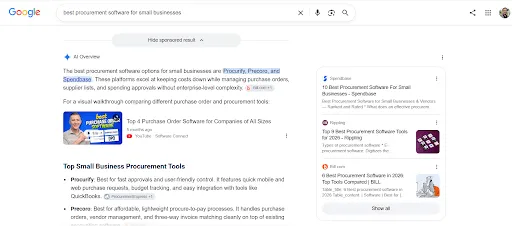
Comparison and “best of” content can play an important role in how brands are discovered during commercial research. Users frequently ask AI tools questions such as “What are the best project management platforms?”, “Which accounting software is best for small businesses?” or “What is the best agency for local SEO?”
(Source)
These queries require AI systems to evaluate multiple options and identify relevant brands. The information used to make those comparisons can come from product pages, review websites, editorial publications, directories, expert articles, and other third-party sources.
That makes comparison-focused digital PR valuable. Rather than concentrating exclusively on promotional announcements, businesses can seek legitimate inclusion in industry roundups, product comparisons, buyer’s guides, and editorial “best of” articles.
However, the objective should not be to manufacture positive rankings. Low-quality or obviously paid placements can weaken credibility. A stronger approach is to provide genuinely useful information that helps publishers evaluate your company based on meaningful criteria such as features, pricing, customer experience, specialization, performance, or use cases.
You should also monitor how your competitors are represented. If competing brands consistently appear in authoritative comparison articles while your company is absent, that represents a visibility gap.
The goal is to build enough credible third-party coverage that when customers ask AI systems to compare solutions, your brand has a stronger information footprint to draw from.
Expert Commentary Builds Trust Around Your Brand
Your company’s expertise should not exist only on your own website. Digital PR gives subject-matter experts opportunities to demonstrate knowledge through independent publications, interviews, podcasts, industry discussions, and journalist commentary.

(Source)
When an expert from your company contributes useful insight to a relevant story, the resulting coverage can establish associations between the individual, the organization, and a particular subject. Repeated exposure across credible sources can help strengthen the broader reputation of both the expert and the brand.
For example, a cybersecurity company’s security specialist could provide commentary on a new threat. A financial services executive could explain an emerging market trend. A healthcare organization could have qualified professionals contribute expert perspectives to appropriate industry publications.
The key is to lead with expertise rather than promotion. Journalists generally need useful explanations, evidence, context, and informed opinions—not advertisements disguised as commentary.
Create a clear expert profile for each spokesperson, including their areas of expertise, professional experience, credentials where appropriate, and topics they can discuss. Then proactively look for opportunities where their knowledge can add value.
Over time, consistent expert commentary can produce a network of third-party references connecting your people and organization with the topics you want to be known for. That broader reputation can support AI visibility because AI systems can encounter your expertise outside your own website.
Review Platforms Help Validate Brand Reputation
Reviews provide another important layer of third-party validation. While reviews are especially influential in local and transactional searches, they can also contribute to the broader online understanding of a brand.
A business can describe its products and services on its own website, but customer reviews provide independent perspectives about actual experiences. Review platforms, industry directories, marketplaces, and other trusted third-party profiles can therefore add context that owned content cannot provide on its own.
For AI visibility, the important factor is not simply having the highest possible review count. Consistency, authenticity, relevance, and reputation matter.
Make sure your business information is accurate and consistent across important review platforms. Encourage genuine customers to share honest experiences, respond professionally to feedback, and address legitimate complaints rather than attempting to manipulate ratings.
You should also pay attention to what customers repeatedly mention. If reviews consistently associate your business with a particular strength—such as fast service, specialized expertise, product quality, or customer support—that language can become part of the broader online narrative surrounding your brand.
Review platforms should therefore be treated as part of your digital reputation infrastructure, not merely as places to collect stars.
When original research, editorial comparisons, expert commentary, and authentic customer reviews work together, they create a much stronger external presence than website optimization alone. Each source contributes a different type of evidence: research demonstrates knowledge, comparisons establish market relevance, expert commentary demonstrates expertise, and reviews provide customer validation. Together, these signals can help create the credible and consistent brand footprint that supports visibility across AI-powered search experiences.
Consistent Brand Information Supports Entity Clarity
AI search systems need to understand who your brand is, what it offers, and what topics it is associated with. This is where consistent brand information becomes important. When your company name, description, services, leadership information, and industry associations remain consistent across your website and reputable third-party sources, AI systems have clearer signals for connecting those references to the same entity.
Digital PR can strengthen this entity clarity by creating consistent references across news publications, industry websites, review platforms, directories, interviews, and other relevant sources. For example, if your company is repeatedly described as a specialist in a particular service across authoritative publications, those repeated associations can reinforce how AI systems understand your brand.
Consistency does not mean copying identical descriptions everywhere. Instead, your core facts should remain accurate and aligned while the surrounding editorial context can vary.
Pay particular attention to:
- Your official business name and variations
- Products and services you provide
- Industry and areas of specialization
- Founder and executive information
- Locations and markets served
- Proprietary products, methodologies, or research
- Expert topics associated with your brand
- Links between your brand and relevant organizations or profiles
This matters because AI visibility is not simply about appearing somewhere online. A brand needs to be recognized and described accurately. Research into AI visibility increasingly emphasizes entity clarity and external references as important components of how AI systems understand brands.
Backlinks Still Matter in an AI Search Environment
The growth of AI search does not make backlinks irrelevant. Quality backlinks continue to support traditional SEO by helping search engines discover pages, evaluate authority, and understand relationships between websites. They can also make valuable content easier for AI systems to find and assess.
However, backlinks should no longer be treated as the only objective of digital PR.
AI visibility involves several different signals. A brand mention can strengthen the association between your company and a particular topic, while a backlink can provide a direct path to a page containing supporting information. A strong earned-media placement can provide both.
Current research suggests that brand mentions and backlinks perform different jobs rather than one simply replacing the other.
This means your PR strategy should prioritize quality over raw link volume. One relevant mention in a respected industry publication may be more strategically useful than dozens of unrelated links.
When evaluating a PR opportunity, consider:
- Source quality: Is the publication credible?
- Topical relevance: Does it cover your industry or audience?
- Context: Is your brand mentioned naturally and accurately?
- Link value: Does the coverage link to a useful page where appropriate?
- Entity value: Does the article clearly connect your brand with the expertise you want to establish?
- AI visibility: Is the source one that AI platforms commonly use or cite?
The strongest digital PR campaigns therefore pursue earned authority, meaningful brand mentions, and useful backlinks together rather than treating link acquisition as the entire goal.
How To Build a Practical AI Visibility Strategy With Digital PR
A practical AI visibility strategy should connect traditional digital PR with the way customers now discover information through AI-powered search.
Start by establishing a baseline. Search your most important informational, commercial, and branded queries across relevant AI platforms. Record whether your company is mentioned, whether your website or third-party pages are cited, which competitors appear, and which sources are repeatedly used.
Tools that track AI visibility can help separate metrics such as brand mentions, citations, cited pages, and AI share of voice.
Next, identify the information gaps preventing stronger visibility.
For example, you may discover that:
- Competitors appear in industry roundups while your brand does not.
- Review platforms frequently mention competitors but rarely mention you.
- Publishers discuss your category without referencing your expertise.
- Your brand is cited but rarely named in AI responses.
- Different websites describe your company inconsistently.
- Your own content is useful but lacks third-party validation.
Then build your PR activities around those gaps.
1. Identify Your Priority Topics
Choose the products, services, problems, and questions for which you want your brand to become known.
2. Research the Sources AI Systems Use
Look at which publications, review platforms, directories, communities, and industry websites appear in AI answers for your target topics. Semrush’s 2026 research similarly recommends identifying sources that AI platforms already favor and prioritizing opportunities to earn coverage there.
3. Develop Something Worth Covering
Create original research, proprietary data, expert commentary, useful case studies, industry insights, or genuinely newsworthy announcements.
4. Build Expert Visibility
Position knowledgeable people from your organization as sources for journalists, publications, podcasts, interviews, and industry discussions.
5. Earn Relevant Third-Party Mentions
Focus on authoritative publications and platforms that are genuinely relevant to your audience and subject matter.
6. Strengthen Review and Reputation Signals
Maintain accurate business profiles and encourage genuine customers to provide honest feedback on relevant review platforms.
7. Support PR Coverage With Strong Owned Content
When publishers link to your website, send them to a page that clearly explains the subject, provides evidence, and offers useful information. A PR campaign cannot compensate for weak destination content.
8. Measure AI Visibility Over Time
Track brand mentions, citations, cited domains, cited pages, competitors, and the accuracy of AI-generated descriptions. Mentions and citations should be measured separately because they represent different visibility outcomes.
Finally, repeat the process. AI visibility is not a one-time optimization project. As AI platforms change their retrieval systems and source preferences, the publications and topics influencing your visibility can change as well.
How Do I Prepare My Brand for AI Search?
Preparing your brand for AI search requires more than optimizing your website. Digital PR for AI visibility helps establish your business across the trusted sources that customers and AI platforms use to research and evaluate brands. Earned media coverage, authentic reviews, expert commentary, comparison content, quality backlinks, and consistent business information can all strengthen your brand’s credibility and third-party presence.
As AI-powered search becomes a bigger part of the customer journey, businesses need to build visibility beyond their own websites. A strategic digital PR approach can help your brand become easier to discover, understand, validate, and mention across AI search experiences. Pro Real Tech helps businesses strengthen their digital presence through strategic content, reputation building, search optimization, and AI-focused visibility strategies. If you want to build a stronger and more credible presence in AI search, contact Pro Real Tech today.
Frequently Asked Questions (FAQs) About Digital PR for AI Visibility
WHAT IS DIGITAL PR FOR AI VISIBILITY?
Digital PR for AI visibility is the process of earning credible third-party mentions, citations, expert coverage, reviews, and media references that help AI search systems understand and validate your brand. It extends traditional digital PR beyond backlinks and referral traffic to include brand recognition and AI-generated search visibility.
HOW DOES DIGITAL PR FOR AI SEARCH WORK?
Digital PR creates an external evidence layer around your brand. When reputable websites, publications, review platforms, and industry sources consistently discuss your company and expertise, AI systems have more independent information available when generating answers. The objective is to build relevant, credible coverage rather than simply increase the number of links.
WHY DOES AI SEARCH VISIBILITY MATTER?
AI search visibility matters because customers increasingly use AI-powered platforms to research products, services, businesses, and solutions. A company can have strong traditional search rankings but still be overlooked when customers ask AI systems for recommendations or comparisons. AI visibility helps ensure your brand has a chance to be included and accurately represented in these answers.
WHAT ARE AI BRAND MENTIONS?
AI brand mentions are instances where an AI-generated response explicitly names your business, product, service, or other brand entity. They indicate that the AI system has associated your brand with a particular query or topic.
Mentions and citations are not identical. A brand can be mentioned without its website being cited, and a website can be cited without the brand being explicitly mentioned. Recent research demonstrates why businesses should monitor both metrics separately.
WHAT ARE AI CITATIONS?
AI citations are references or source links that an AI search system provides to support information in its generated response. The cited source may be your website or a third-party publication containing information relevant to your brand or topic.
A citation does not automatically mean your brand will be named. One recent Semrush analysis found that a substantial share of AI citations did not result in explicit brand mentions, highlighting the difference between being a source and receiving brand recognition.
HOW CAN EARNED MEDIA FOR AI VISIBILITY HELP A BUSINESS?
Earned media can increase the number of credible third-party sources discussing your brand. It can also strengthen associations between your company and specific products, services, expertise, or industry topics.
Coverage can come from news publications, trade media, industry websites, expert interviews, podcasts, research reports, comparison articles, and other relevant sources. The strongest opportunities are those that provide genuine editorial value rather than promotional exposure alone.
WHAT SHOULD A DIGITAL PR STRATEGY INCLUDE?
A digital PR strategy designed for AI visibility should include:
- Original research and proprietary data
- Expert commentary and thought leadership
- Relevant media outreach
- Industry publications and editorial coverage
- Comparison and “best of” opportunities
- Review and reputation management
- Consistent brand information
- High-quality backlinks where appropriate
- Monitoring of AI mentions and citations
- Competitor and source analysis
The strategy should connect these activities to specific business topics and visibility goals rather than pursuing media coverage without a clear purpose.
DO REVIEWS AFFECT BRAND VISIBILITY IN AI SEARCH?
Reviews can contribute to the broader third-party information ecosystem surrounding a brand, particularly for local, consumer, and transactional searches. Review platforms provide independent information about customer experiences, products, and services.
However, reviews should be genuine and relevant. Businesses should focus on maintaining accurate profiles, delivering strong customer experiences, responding appropriately to feedback, and encouraging authentic reviews rather than attempting to manipulate ratings.
IS AI SEARCH OPTIMIZATION DIFFERENT FROM SEO?
AI search optimization overlaps with SEO but has a broader focus. Traditional SEO concentrates heavily on helping pages rank and earn organic traffic. AI visibility also considers whether AI systems can understand your brand, associate it with relevant topics, select your content as a source, and accurately mention your business.
That means SEO fundamentals—such as useful content, crawlability, internal linking, technical accessibility, and authoritative backlinks—still matter. But AI visibility adds greater emphasis on entity clarity, third-party validation, brand mentions, citations, and source diversity.
HOW CAN BUSINESSES IMPROVE AI VISIBILITY STRATEGY RESULTS?
Start by measuring your current visibility before changing your strategy. Identify the queries where competitors appear but your brand does not, examine the sources AI platforms cite, and determine which topics you want your business to own.
Then use digital PR to fill those gaps through original research, expert commentary, authoritative media coverage, relevant comparison content, and genuine reviews. Keep your brand information consistent across owned and third-party sources, while continuing to invest in strong website content and quality backlinks.
Most importantly, measure progress regularly. Track where your brand is mentioned, which sources are cited, what topics AI associates with your company, and whether those descriptions are accurate. This turns digital PR from a publicity exercise into a measurable component of your broader AI visibility strategy.


