


The Google Search Engine Results Page (SERP) is no longer a static list of ten blue links. It has evolved into a dynamic, interactive canvas where information is synthesized, summarized, and served in increasingly intuitive formats. Just when SEO professionals and content creators adapt to one change, the next evolution arrives, reshaping the rules of visibility and engagement.
Enter a significant shift in this landscape: the integration of a more structured, AI-guided exploration of topics directly within the search results. This move represents a fundamental change in how users discover and navigate information online. Instead of merely presenting sources, Google is beginning to curate and connect them into a coherent, top-down narrative.
This article will demystify this transformative development. We’ll explore what this new “guided” search experience is, how it fundamentally alters the user journey, and, most critically, what practical steps you must take to future-proof your SEO strategy in this new environment. The race for visibility is now a race for comprehension and authority within a guided framework.
Google Web Guide: A New Search Experience
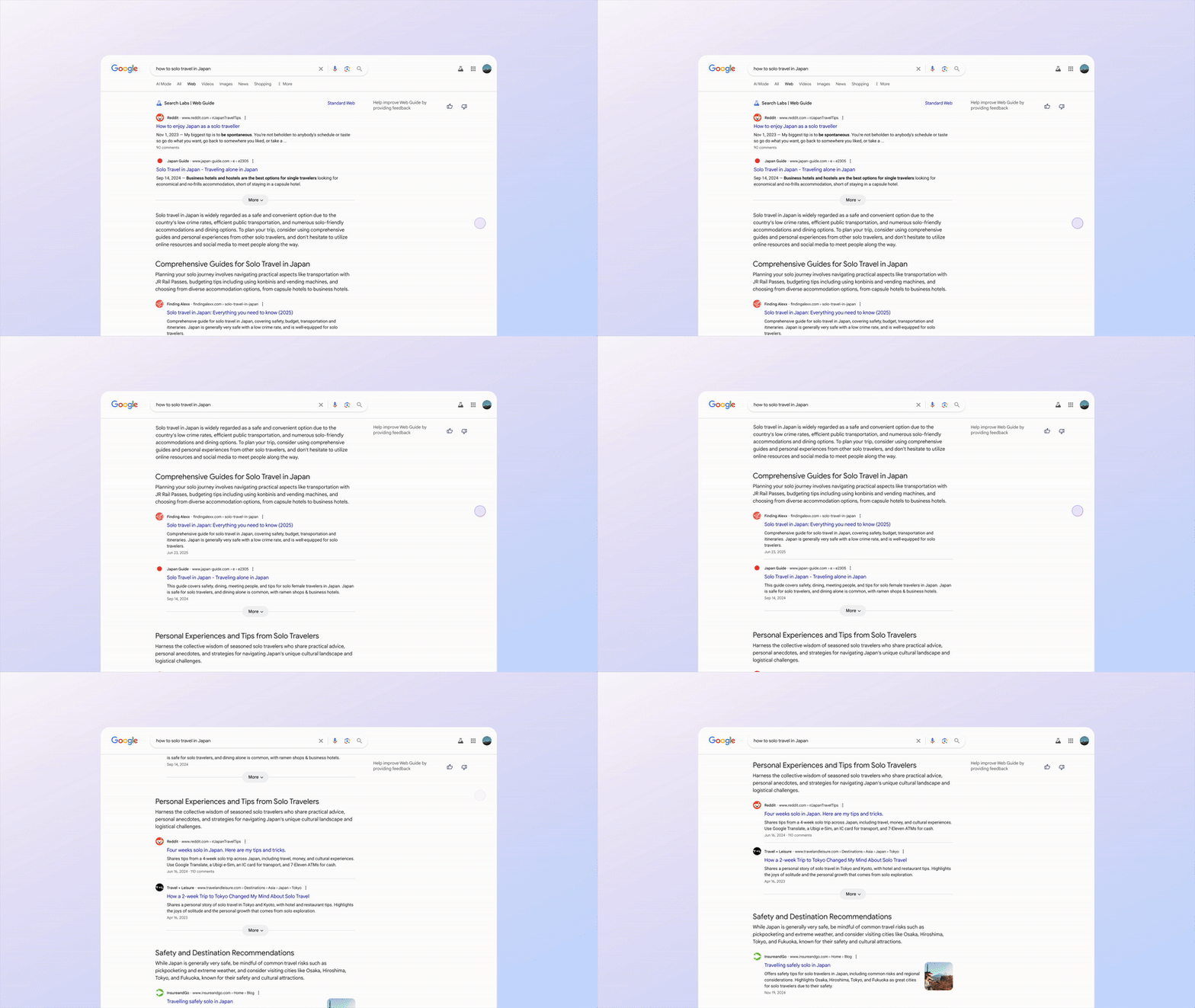
At its core, this new feature represents a shift from a search engine to an exploration guide. Traditional SERPs present a ranked list of individual destinations (websites) for a user to visit and piece together understanding themselves. The new guided experience, powered by advanced AI and language models, aims to synthesize that understanding upfront and then provide structured pathways for deeper learning.
Think of it as the difference between being given a list of book chapters from different volumes (traditional SERPs) and being handed a masterfully written summary report with clear footnotes and references to the original, most authoritative sources (the new guided experience). The user’s journey starts with a comprehensive overview and then branches out based on their specific interests.
Key Mechanics of the Guided Experience:
-
AI-Powered Synthesis: For complex, informational queries, Google generates a high-level overview that directly answers the user’s core question, pulling from a variety of sources.
-
Structured Topic Pathways: Instead of just links, users are presented with organized subtopics or key questions related to their main search. This creates a “choose-your-own-adventure” path down the information funnel.
-
Embedded Source Attribution: Within the generated overview and along each pathway, specific websites are cited as sources for particular points. This shifts the value from merely being the #1 ranked link to being the authoritative source for a specific, valuable piece of information within the larger narrative.
-
Contextual Deep Dives: The guide allows users to expand on specific points or subtopics interactively, revealing more detailed information and relevant sources without requiring a new search or page load.
Example in Practice:
A user searches for “beginners guide to sustainable gardening.”
-
Traditional SERP: Shows a list of blog posts, guides, and videos from various websites. The user clicks, reads, backs out, and repeats to gather a full picture.
-
New Guided Experience: Presents a clear, structured overview of sustainable gardening principles right at the top. It is broken into sections like “Soil Preparation,” “Water Conservation,” and “Natural Pest Control.” Each section has a brief explanation and an option to “Explore further,” which reveals key tips and directly links to the most relevant articles from authoritative gardening sites for that specific subtopic.
This transformation signifies a profound change: the unit of search value is moving from the webpage to the individual, expert-level insight within that page. Your content isn’t just competing for a ranking position; it’s competing to be the definitive source for a specific piece of information that a smart, guided system will recommend to users seeking to understand a topic holistically.
What This Means for Your SEO Strategy
The introduction of a guided, AI-powered search experience fundamentally redefines the goals and tactics of a successful SEO strategy. It moves the focus from simply capturing clicks to establishing recognized authority within a knowledge ecosystem. This shift has immediate and profound implications for how you measure and achieve visibility.
The Impact on Visibility
The most immediate and concerning impact for many businesses is the potential for traffic compression. When a synthesized answer is provided directly on the SERP, satisfying the user’s initial query, the need to click through to a website is reduced. This phenomenon, often called “zero-click search,” is amplified in this guided environment. Key changes include:
-
Shrinking Traditional Organic Real Estate: The space dedicated to the classic “blue links” is compressed by the guided overview, interactive panels, and source citings. Ranking on the first page is no longer guaranteed to drive traffic if your content is not integrated into the guided narrative.
-
The “Source-Citing” Paradigm: Your website may appear not as a standalone result, but as a footnote or reference for a specific point within the guide. While this still represents visibility, it transforms the user journey and the attribution of value.
-
Increased Competition for Topic Authority: You are no longer competing solely with direct competitors for a keyword. You are competing with all entities Google’s AI deems authoritative on any sub-topic within your niche. A university, a government agency, a non-profit, or a highly detailed forum post could be cited as a source instead of your commercial page.
-
Volatility in Performance Metrics: Traditional ranking positions become less stable and less indicative of performance. A page might see significant fluctuations in traffic not because its ranking changed, but because Google’s guide began or ceased to reference it for a key insight.
The Potential Upside
While disruptive, this evolution is not a doomsday scenario. It creates significant opportunities for strategic publishers who adapt. The guided environment rewards depth, clarity, and genuine expertise in new ways.
-
Authority is Amplified: Being selected as a source within the guide is a powerful trust signal. It positions your brand as a verified expert on a specific topic, directly from the search results. This can drive highly qualified, intent-rich traffic from users who are already primed with context and seeking deeper detail.
-
The Long-Tail Becomes Crucial: The guide’s structure naturally branches into nuanced subtopics. This creates massive opportunity for content that answers very specific questions, as each subtopic point needs a credible source. Comprehensive coverage of a subject is rewarded more than ever.
-
Leveling the Playing Field: You do not necessarily need the most domain authority to be featured. A single, exceptionally well-researched, clear, and perfectly structured article on a specific point can be cited as the best source for that information, outshining larger but more generic sites.
-
Sustainable Traffic from Guided Exploration: Users who engage with the guide are on a learning journey. If you become a trusted source for one part of that journey, they are more likely to click through to explore related content on your site via internal links, building a more engaged and loyal audience.
The game has changed from “winning the rank” to “winning the citation.” Your SEO strategy must now prioritize becoming the indisputably best answer to a specific, valuable piece of the user’s broader question. The following section will outline the concrete steps to build this kind of authoritative presence.
How to Strengthen Your SEO Strategy in the Google Web Guide Environment
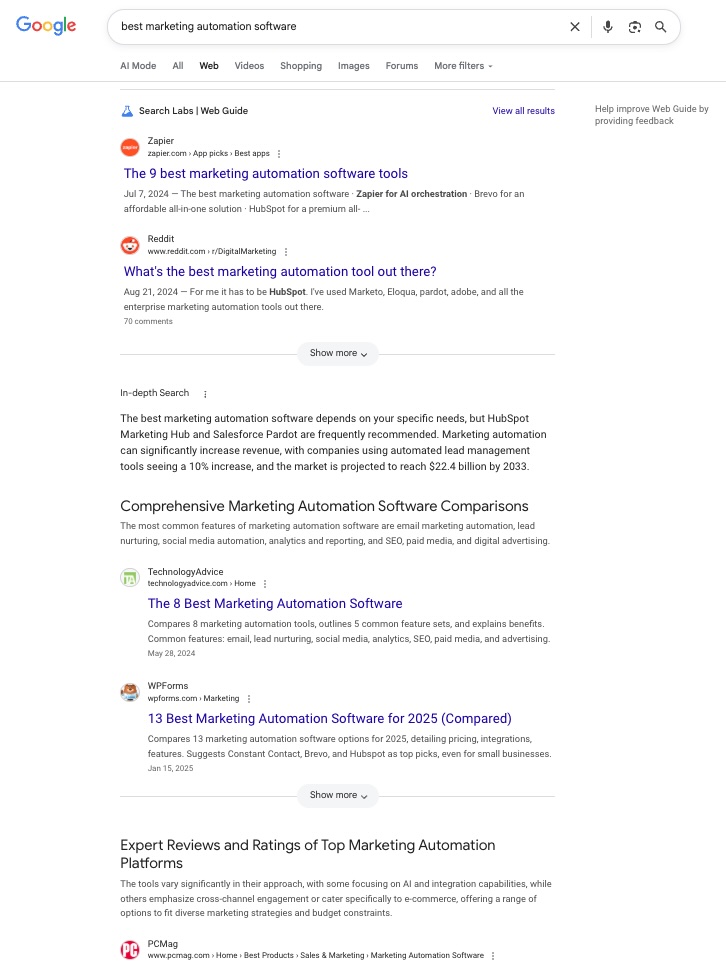
To thrive in a search ecosystem that prioritizes guided exploration and source citation, your SEO strategy must evolve from keyword targeting to topic authority architecture. The goal is to structure your website’s information in a way that is inherently compatible with how AI-driven systems discover, understand, and reference expert sources. Here are three foundational pillars to build upon.
1. Focus on Structured Content
In a guided SERP, clarity and scannability are currency. Your content must be organized not just for human readers, but for the AI models that seek to extract and validate specific pieces of information.
-
Employ Definitive Hierarchies: Use clear, descriptive header tags (H1, H2, H3) to create a logical content skeleton. Each header should signal a distinct subtopic or answer a specific question, making it easy for systems to parse the document’s structure.
-
Front-Load Key Information: Adopt the “inverted pyramid” style. State the core answer or most important information at the beginning of sections. This directly aligns with the guide’s goal of providing concise, upfront summaries.
-
Implement Schema Markup: Go beyond basic Article or FAQ schema. Use more specific types like
HowTo,Course,ProblemSolution, orQAPageto give search engines explicit, structured data about your content’s purpose and components. This metadata acts as a direct translation of your content’s value for AI systems. -
Prioritize Context and Completeness: For any key claim or piece of advice, provide the “why” and the “how.” Authoritative sources don’t just state facts; they explain context, cite studies (with internal or external links), and acknowledge nuances. This depth is what the guide will seek to reference.
2. Build Topic Clusters
The guided experience organizes information around core topics and related subtopics. Your website should mirror this architecture through a topic cluster model, moving away from isolated blog posts to interconnected knowledge hubs.
-
Define Your Core Pillars: Identify 5-10 broad, foundational topics central to your business (e.g., “Sustainable Gardening,” “Financial Planning for Retirement,” “B2B SaaS Marketing”).
-
Create a Comprehensive “Pillar Page”: For each core topic, develop a substantial, high-level page that provides a complete overview. This page should be the definitive guide on your site for that topic, structured with clear sections for each major subtopic.
-
Develop “Cluster Content”: Create detailed, individual pieces of content (blog posts, guides, videos) that each deeply cover one specific subtopic or question related to the core pillar (e.g., “Composting for Beginners,” “Understanding Roth IRA Contributions,” “Measuring SaaS Customer LTV”).
-
Hyperlink with Purpose: Every piece of cluster content must link back to the main pillar page (using relevant anchor text like “part of our complete guide to…”), and the pillar page should link out to each cluster piece. This creates a dense, thematic network that screams “authority on this entire subject” to search engine crawlers.
3. Strengthen Internal Links
Internal linking is the connective tissue that turns a collection of pages into a cohesive knowledge base. In the guided environment, a robust internal link architecture does two critical things: it demonstrates the relationship between concepts to AI, and it captures user engagement by facilitating the “guided” journey on your own site.
-
Link for Context, Not Just Navigation: Move beyond just menu links. Embed contextual hyperlinks within your content body that connect related ideas. When you mention a concept covered in more detail elsewhere on your site, link to it. This mimics the guide’s behavior of offering pathways for deeper exploration.
-
Use Descriptive Anchor Text: The clickable link text should precisely describe what the user will find on the target page (e.g., “learn the five steps to build a raised garden bed” instead of “click here”). This trains search engines on the semantic relationship between pages.
-
Audit and Optimize Orphaned Pages: Identify high-quality content that has few or no internal links pointing to it. These “orphaned pages” are isolated from your site’s topical network and are less likely to be discovered and valued by crawlers. Integrate them into your topic clusters through strategic internal links.
-
Create Pathways for Engagement: Design your content to naturally guide a reader to the next logical step. A blog post on a problem should link to your solution page. A guide comparing options should link to a product or service page. By doing this, you retain users within your own “guided experience,” increasing session duration and signaling content relevance.
By focusing on these three interdependent strategies, you architect your website to be the ideal source for a sophisticated, topic-hungry search engine. You make it easy for AI to understand your expertise, easy for it to find the best answers within your content, and rewarding for users to engage with your site as their primary guide.
How The Web Guide Shapes the Future of Search
The emergence of guided search experiences is not merely another feature update; it is a clear signal of the fundamental direction in which Google—and the entire concept of search—is evolving. It represents a move towards a more proactive, conversational, and semantically intelligent information ecosystem. Understanding this trajectory is essential for long-term digital strategy.
1. From Search Queries to Search Conversations
The future of search is conversational. The guided framework, with its branching subtopics and interactive exploration, mimics a dialogue. Users start with a broad question, and the system asks (implicitly or explicitly), “What part of that would you like to explore next?” This anticipates the continued rise of natural language processing, where success will depend on anticipating the full spectrum of user intent and related questions within a session, not just optimizing for a single keyword.
2. The Rise of the “Verifiable Web”
Trust and verification will become the supreme ranking factors. When an AI system synthesizes information for billions of users, the integrity of its sources is paramount. This will massively elevate the importance of Expertise, Authoritativeness, and Trustworthiness (E-E-A-T), not as a guideline but as a technical requirement. Expect a greater emphasis on:
-
Author bylines and credentials being scrutinized and weighted.
-
Citations to primary sources, data, and studies within your content becoming critical for topical authority.
-
Site reputation signals (e.g., backlinks from institutional sites, mentions in credible media) becoming even more powerful.
3. The Devaluation of “Content for Content’s Sake”
Thin, derivative, or purely keyword-stuffed content will become functionally invisible. The guided environment requires unique, substantive insights to reference. The future rewards depth over breadth, originality over aggregation, and utility over volume. Content will need to demonstrate a clear “point of view” or “unique value” that a language model cannot simply reconstruct from other public sources.
4. Websites as “Knowledge Bases” for AI
Your website will increasingly be treated as a database of vetted information for AI systems to draw upon. This reframes the purpose of publishing. The goal is not just to attract human visitors, but to become a trusted data source for the AI that serves them. This necessitates a technical and editorial focus on clean data structure, unambiguous semantics, and comprehensive topic coverage that we outlined in the previous section.
5. A Shift in Success Metrics
Traditional SEO KPIs like keyword rankings and even organic traffic will provide an incomplete picture. New metrics will gain prominence:
-
Citation Rate: How often is your content sourced in AI-generated overviews?
-
Topic Ownership: For how many subtopics within your niche are you the cited expert?
-
Engagement Depth: Do users who arrive from guided results explore more of your site (signaling you successfully fulfilled their deeper intent)?
-
Branded Search Lift: Does being cited as an authority increase searches for your brand name?
The guided search experience is a stepping stone toward a future where search engines act less like librarians pointing to books and more like expert tutors who have read every book, synthesized the knowledge, and can provide a personalized lecture while crediting their references. For businesses and creators, the imperative is clear: adapt to become an essential reference in that tutorial, or risk fading into the background of the next era of information discovery.
Get Your Business Search-Ready
Google’s search landscape is evolving fast, and Web Guide is just the starting point. To stay visible, businesses need SEO strategies that adapt to new formats, user behaviors, and search expectations.
Pro Real Tech helps brands build resilient SEO strategies that keep them ahead as Google continues to change. Our solutions include:
-
AI-Driven SEO
-
Content Writing
-
Copywriting
-
Content Marketing
Now is the perfect time to refresh your content and prepare for the next era of search. Contact us today.
Frequently Asked Questions About Google Web Guide
WHAT IS GOOGLE WEB GUIDE AND WHY IS IT IMPORTANT?
Google’s guided search experience represents a fundamental shift in how search results are presented. It leverages advanced AI to provide synthesized overviews of complex topics directly on the results page, organizing information into structured pathways with direct citations to source websites. It’s important because it changes the user journey from “clicking through links to find an answer” to “exploring a pre-organized guide of information.” For SEO, this means the goal is evolving from merely ranking highly to becoming a cited authority within these guides.
HOW DOES WEB GUIDE DIFFER FROM OTHER GOOGLE SEARCH FEATURES?
While features like Featured Snippets answer a single question, or Knowledge Panels provide facts about an entity, the guided experience is more comprehensive and interactive. It’s less about a quick fact and more about structuring an entire learning journey for a broad topic. Unlike the traditional “10 blue links,” it creates a top-down narrative, connecting subtopics and sources into a cohesive exploration path, fundamentally altering information discovery.
WHY DOES WEB GUIDE MATTER NOW?
This shift matters now because it marks a critical point in the integration of generative AI and large language models into core search. It’s a direct response to users’ desires for quicker, more comprehensive understanding without manually piecing together information from multiple sites. For businesses, ignoring this trend means risking irrelevance as the primary interface for information discovery transforms.
WILL GOOGLE RANKING CHANGES BECOME MORE COMMON?
Yes, volatility and frequent changes are becoming the new norm. The incorporation of AI and machine learning models means Google’s systems can learn and adjust more rapidly than ever before. Updates are becoming more continuous and nuanced, rather than occasional, major “named” events. Agility and a focus on core quality principles, rather than chasing short-term tactics, are essential for resilience.
HOW DOES THIS RELATE TO GOOGLE UPDATES OVERALL?
This guided experience is the culmination of years of algorithm updates focused on E-E-A-T (Experience, Expertise, Authoritativeness, Trustworthiness), helpful content, and user intent. It’s not a separate change but the logical outcome of those efforts. Updates like Helpful Content, Product Reviews, and Core Updates have all been refining Google’s ability to identify the most reliable, expert sources—exactly the kind of content it needs to power trustworthy AI-generated guides.
SHOULD BUSINESSES EXPECT MORE SERP CHANGES?
Absolutely. The SERP will continue to evolve from a simple list into an increasingly dynamic, interactive, and AI-assisted interface. Businesses should expect more immersive formats, more personalized results based on user context, and a continued de-emphasis of the traditional organic list. The focus must remain on adapting to the underlying principle: serving user intent with supreme authority and clarity, regardless of how the results page looks.
HOW DO GOOGLE ALGORITHM CHANGES AFFECT THE WAY BUSINESSES MEASURE SUCCESS?
Traditional metrics like keyword position are becoming less reliable. Success measurement must evolve to include:
-
Visibility in New Formats: Are you appearing as a source in guides, answers, or other AI-powered features?
-
Topic Authority: Are you gaining visibility for a wider range of subtopics within your niche?
-
Engagement Quality: Are users from search engaging more deeply (e.g., longer time on page, lower bounce rate) because your content perfectly satisfies their refined intent?
-
Branded Search Growth: Is your brand recognition increasing as a byproduct of being cited as an expert?
The key is to measure outcomes—like lead generation, sales, and audience growth—rather than fixating on intermediate ranking metrics that are losing their direct correlation to traffic.
Read More: 12 Biggest SEO Trends in 2026 (+ Data-Backed Strategies To Get Ahead)


