

A business can have hundreds of online reviews and still look less active than a competitor with far fewer reviews. The difference is often not the total number of reviews, but how consistently new reviews are being added.
That ongoing pace is known as review velocity. It measures how many new customer reviews a business receives during a specific period, such as a week, month, or quarter. Instead of looking only at the historical size of a review profile, review velocity focuses on what is happening now.
This distinction matters because online reputation is not static. Customers use recent reviews to understand whether a business is still delivering a consistent experience, while search platforms need current business information to provide relevant results. Google, for example, says that local rankings are influenced by relevance, distance, and prominence, with review quantity and positive ratings among the factors associated with prominence.
Review velocity should therefore be viewed as part of a broader reputation strategy rather than as a standalone ranking trick. A steady flow of authentic reviews can keep a business’s reputation current, reveal recurring customer feedback, and provide more recent evidence of customer experiences.
It is also becoming relevant to the way people discover businesses through AI-powered search. Google’s AI search experiences can surface local businesses with information such as ratings and reviews, while Google says keeping Business Profile information up to date can help businesses appear in AI features. However, there is an important distinction: there is currently no official Google statement establishing a specific “review velocity” ranking factor for AI Overviews or AI Mode.
The practical goal, then, is not to manufacture a certain number of reviews every month. It is to create a repeatable, compliant process that naturally encourages genuine customers to share their experiences.
What Is Review Velocity?
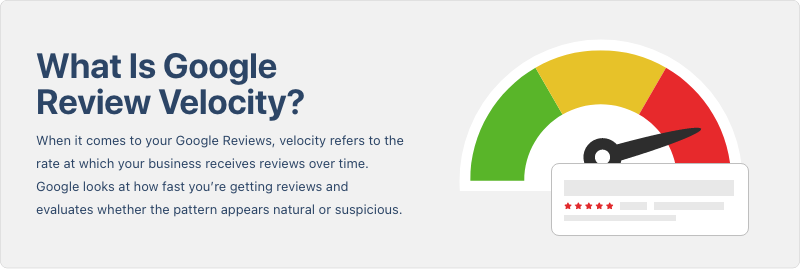
Review velocity is the rate at which a business receives new reviews over a defined period. It is usually expressed as reviews per week or reviews per month.
The basic calculation is simple:
Review Velocity = Number of New Reviews ÷ Measurement Period
For example, suppose a business receives 30 new reviews over three months:
30 ÷ 3 = 10 new reviews per month
Its monthly review velocity would therefore be 10 reviews per month.
This metric is different from both review volume and review recency.
| Metric | What it measures | Example |
|---|---|---|
| Review volume | Total accumulated reviews | 500 reviews |
| Review velocity | Rate of new reviews | 10 reviews/month |
| Review recency | How recently customers posted reviews | 3 reviews in the last 14 days |
These metrics work together, but they answer different questions.
A business with 500 reviews has substantial historical review volume. However, if its most recent review was several months ago, that profile does not communicate the same level of ongoing customer activity as a business that consistently receives new reviews.
Consider two hypothetical businesses:
- Business A: 500 total reviews, but only 2 new reviews in the past three months.
- Business B: 150 total reviews and 30 new reviews during the same three-month period.
Business A has greater review volume, while Business B has greater review velocity. Neither metric should be treated as an automatic ranking determinant, but the comparison illustrates why looking only at the lifetime review count can provide an incomplete picture of a business’s current reputation.
Review Velocity Is a Flow Metric
One useful way to understand review velocity is to think of reviews as a flow rather than a stock.
Total reviews are cumulative. Once a legitimate review is published, it can remain part of the business’s public history for a long time.
Review velocity measures the incoming flow of new reviews.
That makes it particularly useful for reputation monitoring. A business can track whether its review acquisition is:
- Increasing over time
- Remaining relatively consistent
- Declining
- Experiencing unexplained gaps
- Changing after a new review-request process is introduced
For example, a business could track monthly results like this:
| Month | New Reviews | Monthly Velocity |
|---|---|---|
| January | 8 | 8 |
| February | 11 | 11 |
| March | 13 | 13 |
| April | 9 | 9 |
This does not establish a Google ranking score. Instead, it gives the business an operational metric that can be monitored alongside average rating, total reviews, response activity, customer satisfaction, and conversion performance.
Review Velocity and Review Recency Are Closely Related
Velocity and recency are connected, but they are not interchangeable.
A business can have a high historical review velocity but poor current recency. For example, it might have received 100 reviews during a successful six-month period and then stop receiving reviews for several months.
Conversely, a business with a smaller overall review profile can have strong recent activity because customers are continuing to post reviews.
This is why businesses should avoid focusing exclusively on a target such as “get 100 reviews.” A more sustainable objective is to create a process that continually gives genuine customers an opportunity to provide feedback.
There Is No Universal “Ideal” Review Velocity
There is no single review-per-month number that is appropriate for every business.
A national retailer, a neighborhood restaurant, a medical practice, a B2B software company, and a high-value construction company naturally have very different transaction frequencies and customer volumes.
Instead of copying a competitor’s raw review count, businesses should consider:
- Number of customers or completed transactions
- Typical purchase frequency
- Average customer lifetime
- Industry norms
- Location and market size
- Number of business locations
- Existing review volume
- Historical review patterns
- The platforms customers actually use
A sustainable review strategy should reflect the underlying customer activity. A sudden, unexplained surge in reviews may create compliance or platform-policy problems rather than producing a long-term reputation benefit.
What Review Velocity Could Mean for AI Search

AI-powered search has changed how people can discover businesses. Instead of entering a short keyword and reviewing ten blue links, users can increasingly ask conversational questions such as:
- “Which restaurants near me are good for a family dinner?”
- “What is a reliable roofing company in my area?”
- “Which dentist has strong recent patient feedback?”
- “Which local businesses have consistently positive reviews?”
AI search systems can combine information from multiple sources to construct an answer or recommendation. That makes current, consistent, and trustworthy business information increasingly important.
Google’s current documentation says that generative AI responses can include local businesses and that maintaining accurate Business Profile information can help businesses become visible in AI responses as well as conventional Search results. Google has also demonstrated AI Mode experiences that show local businesses with ratings, reviews, opening hours, and other business information.
However, it is important not to overstate the role of review velocity.
Review Velocity Is Not a Confirmed AI Ranking Factor
There is currently no official evidence establishing a formula such as:
“Businesses receiving X reviews per month will rank higher in AI search.”
AI systems do not publicly provide a universal review-velocity threshold that guarantees recommendation visibility.
The more defensible interpretation is that ongoing review activity can contribute to the freshness and depth of the public information available about a business.
Recent reviews can tell prospective customers what people are experiencing now. They may mention current services, staff interactions, product quality, wait times, facilities, pricing expectations, or other details that older reviews cannot communicate as effectively.
For AI-powered systems that synthesize information from current web sources and business data, that broader body of recent information can potentially be useful.
Fresh Reviews Can Strengthen the Current Reputation Picture
Imagine two businesses with similar ratings:
- Business A has a 4.7-star average based largely on reviews accumulated several years ago.
- Business B has a 4.6-star average and continues to receive detailed reviews every month.
The second business has a more active stream of recent customer experiences. That does not automatically make it more authoritative or guarantee that an AI system will recommend it. But it gives users—and potentially systems assembling current business information—more recent evidence to evaluate.
This distinction becomes particularly important in industries where circumstances change frequently.
For example, recent reviews may reveal changes in:
- Service quality
- Customer support
- Product availability
- Business hours
- Staff experience
- Location conditions
- Delivery performance
- Appointment availability
- New services or facilities
Review Content Can Be More Useful Than Review Count Alone
Review velocity should not become a race for volume.
Ten detailed, authentic reviews that describe real customer experiences can provide more useful context than a large number of vague reviews containing little information.
For reputation and AI visibility, businesses should therefore pay attention to what customers are actually saying, not simply how quickly reviews accumulate.
A healthy review profile can naturally develop useful language around:
- Specific products or services
- Customer service
- Location
- Staff
- Quality
- Delivery
- Expertise
- Problem resolution
- Customer outcomes
Businesses should never attempt to script or manufacture those statements. The objective is to make it easy for real customers to describe their experiences in their own words.
Reviews Are Only One Part of AI Visibility
AI search visibility also depends on the broader information ecosystem surrounding a business.
That can include:
- Accurate Google Business Profile information
- A clearly identifiable business entity
- Consistent business details across important websites
- A useful and crawlable official website
- Relevant service and location information
- Third-party mentions
- Authoritative references
- Customer reviews and ratings
- Up-to-date business information
Google’s current guidance for AI features emphasizes fundamental SEO practices rather than a special AI-specific ranking formula. It also recommends keeping Business Profile information up to date.
For that reason, review velocity should be treated as one component of a broader reputation and business-information strategy, not as a shortcut to AI recommendations.
How to Build Sustainable Review Velocity in 5 Steps

Sustainable review velocity comes from creating a reliable review-request process, not from launching occasional campaigns to generate a large batch of reviews.
The objective is simple: make it easy for genuine customers to leave honest feedback after a legitimate interaction with the business.
1. Identify the Right Moment
The timing of a review request can strongly influence whether a customer actually responds.
The best moment depends on the business model and the customer journey.
For a restaurant, it may be shortly after the customer’s visit. For an ecommerce business, it could be after the customer has received and used the product. For a service business, the appropriate moment may be after the project, appointment, consultation, or support issue has been completed.
The key principle is to connect the request to a genuine customer interaction.
Businesses should avoid selectively asking only customers who they believe will provide positive reviews. A consistent process should give eligible customers an opportunity to share honest feedback regardless of whether the business expects a positive or negative response.
This is important both for credibility and compliance.
A practical workflow might look like:
Customer interaction → Service completed → Appropriate follow-up period → Review request → Customer chooses whether to respond
The exact delay should depend on the type of product or service. A customer may need several days to evaluate a product, while a restaurant customer may be able to provide useful feedback immediately after a visit.
2. Choose the Right Channel
Once the timing is established, make the request through a channel customers already use.
Common options include:
- SMS
- Post-purchase messages
- Customer portals
- Receipts
- Printed cards
- In-person requests
- QR codes
There is no universally best channel. The appropriate choice depends on the customer relationship and how the business normally communicates.
For businesses that regularly communicate with customers by SMS, a text message can create a convenient path to the review page. For B2B companies and professional services, email may be more natural because customers already use it for project communication and follow-ups.
Google itself allows businesses to share a review-request link or QR code to make it easier for customers to leave reviews.
The important principle is convenience. If a customer must search for the business manually, navigate through several pages, or remember the business name before finding the review form, more friction is introduced into the process.
3. Keep the Request Simple
A review request does not need to be a long marketing message.
A simple request can explain:
- Why the business is contacting the customer
- That honest feedback is welcome
- Where the customer can leave a review
For example:
“Thanks for choosing us. We’d appreciate your honest feedback about your experience.”
Then provide the appropriate review link.
The request should not tell customers what rating to give or provide language designed to produce a particular sentiment.
Simplicity also makes the process easier to automate. Once a business has identified the appropriate customer event, the review request can become a normal part of its post-purchase or post-service workflow.
4. Automate the Trigger, Not the Review
Automation can help businesses maintain consistent review velocity, particularly when customer volume makes manual requests impractical.
The distinction is important:
Automate the request process—not the customer opinion.
A CRM, point-of-sale system, ecommerce platform, appointment system, or customer-management tool can trigger a review request after a predefined event.
For example:
Appointment completed → CRM updates customer status → Review-request message sent
Or:
Order delivered → Waiting period passes → Review-request email sent
Automation can reduce the risk of employees forgetting to ask customers and can create a consistent process across locations.
But automation should never be used to create fake reviews, generate artificial customer identities, or manufacture review content. The review itself must come from the customer’s genuine experience.
5. Build a Multi-Platform Presence
Google is important for many local businesses, but it should not necessarily be the only place where customers can provide feedback.
Depending on the industry, customers may also use:
- Industry-specific review websites
- Professional directories
- Marketplace platforms
- Specialized service platforms
- Other relevant third-party websites
The right platforms depend on where customers actually research businesses in that industry.
A multi-platform strategy can also provide a broader picture of customer sentiment. For example, a hotel may have one set of customers reviewing it on travel platforms, while a contractor may receive feedback on local directories or industry-specific services.
However, businesses should not attempt to create artificial review activity across every platform simply to increase their numbers. Focus on platforms that are genuinely relevant to the business and its customers.
Make Review Velocity Part of an Ongoing Process
The strongest review strategy is not a one-month campaign. It is a repeatable operational process.
Businesses can monitor:
- New reviews per month
- New reviews per location
- Average rating
- Review recency
- Response rate
- Common customer themes
- Review-request conversion rate
- Platform distribution
- Periods with unusually low activity
The goal is not to force a particular review volume. It is to identify whether genuine customer feedback is being captured consistently.
A sudden drop in review activity can also be useful operational information. It may indicate that a review-request workflow stopped working, a customer communication channel changed, or customers are encountering friction when attempting to leave feedback.
Likewise, an unusual spike should be investigated rather than automatically celebrated. Businesses should be able to explain where reviews came from and confirm that the process complies with applicable laws and platform policies.
Ultimately, sustainable review velocity is about consistency, authenticity, convenience, and compliance. A business that routinely creates opportunities for real customers to provide honest feedback can build a fresher and more informative reputation profile without relying on artificial review-generation tactics.
FTC Compliance: What You Can and Can’t Do
Building review velocity does not mean trying to generate as many reviews as possible. Businesses need to balance consistent review requests with consumer-protection laws and the policies of the platforms where reviews are published.
In the United States, the Federal Trade Commission’s Consumer Reviews and Testimonials Rule took effect on October 21, 2024. The rule addresses deceptive practices involving consumer reviews and testimonials and gives the FTC additional enforcement tools for certain violations.
For businesses trying to build a sustainable flow of customer feedback, the safest approach is straightforward: ask real customers for honest reviews, make the process convenient, and do not attempt to control what they say.
What You Can Do
Businesses can generally ask customers to leave reviews about their genuine experiences.
You can:
- Ask customers for honest feedback after a legitimate purchase or service.
- Send customers a direct link to the appropriate review platform.
- Use email, SMS, QR codes, receipts, or other normal customer communication channels to request feedback.
- Automate review-request messages based on legitimate customer transactions.
- Ask customers to describe their experience in their own words.
- Respond professionally to both positive and negative reviews.
- Invite customers to update a review if their experience changes after an issue has been resolved, provided the process does not involve prohibited incentives or manipulation.
- Use customer feedback internally to identify service problems and improve the customer experience.
Google specifically permits businesses to solicit reviews when the reviews represent genuine customer experiences, provided the business does not offer incentives or attempt to influence the rating or content.
What You Can’t Do
The FTC rule prohibits several deceptive review practices, including creating, purchasing, or disseminating fake or false reviews when the business knew or should have known they were fake or false. It also prohibits compensation or incentives that are conditioned on a review expressing a particular sentiment, whether positive or negative.
That means businesses should not:
- Buy five-star reviews.
- Pay people to post reviews about experiences they never had.
- Create fake customer accounts.
- Write reviews and publish them as if they came from customers.
- Use AI to manufacture fake customer experiences and publish them as genuine reviews.
- Offer a discount only if a customer leaves a positive review.
- Offer a reward for changing or removing a negative review.
- Ask only known satisfied customers to leave reviews while deliberately preventing dissatisfied customers from providing feedback.
- Threaten customers to prevent legitimate negative reviews.
- Misrepresent a review collection website as an independent source when the business controls it.
Google’s Maps policies independently prohibit fake engagement, paid or incentivized reviews, selectively soliciting positive reviews, and attempts to manipulate ratings. Google also says unusual volumes or patterns of reviews that indicate rating manipulation can violate its policies.
Can You Offer Incentives for Reviews?
This area requires particular care because FTC requirements and individual platform policies are not identical.
The FTC’s rule does not categorically prohibit every incentive for a review if the incentive is not conditioned on a particular sentiment. However, disclosure requirements and other FTC Act obligations can still apply. More importantly, Google’s policies prohibit incentives such as payments, discounts, free goods, or services in exchange for reviews on Google Maps.
Therefore, a strategy that may be permissible under one legal framework can still violate the rules of a particular review platform.
For businesses operating across multiple locations or jurisdictions, review-generation processes should be reviewed against the applicable laws and the policies of each platform being used.
Don’t Confuse Review Velocity With Review Manipulation
A consistent stream of reviews is not inherently suspicious. A business that serves customers regularly may naturally receive reviews regularly.
The problem begins when a business attempts to manufacture the appearance of organic customer activity.
The goal should therefore be sustainable review velocity based on genuine customer interactions—not a predetermined number of reviews at any cost.
Review Velocity Remains a Competitive Metric
Review velocity is increasingly relevant to reputation management because customers want current evidence of a business’s performance, not just a large archive of historical reviews. As search experiences become more conversational and AI-powered, businesses have an additional reason to keep their public information, customer feedback, and reputation signals current.
However, review velocity should not be treated as a guaranteed ranking factor or as a shortcut to AI recommendations. There is no published formula showing that a particular rate of incoming reviews automatically improves visibility. Its practical value lies in maintaining a steady stream of authentic customer feedback that keeps a business’s reputation profile current and informative.
Pro Real Tech helps businesses build sustainable review-generation and review-response processes across relevant platforms, including Google, Yelp, and Facebook. Its reputation management services can help businesses establish consistent workflows for requesting authentic customer feedback, monitoring reviews, and responding to customer experiences.
If your business is struggling with inconsistent review activity or wants a more structured reputation-management process, contact Pro Real Tech to develop a review strategy built around genuine customer experiences, platform compliance, and long-term reputation growth.
Frequently Asked Questions About Review Velocity
What Is Review Velocity?
Review velocity is the rate at which a business receives new reviews during a particular period.
For example, if a business receives 20 new reviews over two months, its average review velocity is 10 reviews per month.
It is different from total review count. Total review count tells you how many reviews a business has accumulated, while review velocity tells you how quickly new reviews are being added.
Review velocity can be useful for monitoring the health of a review-generation process, but there is no universal number of reviews per month that every business should target.
Is Review Velocity More Important Than Total Review Count?
Neither metric should be treated as universally more important.
Total review count provides a measure of the accumulated volume of customer feedback. Review velocity shows whether new feedback is continuing to arrive.
A business with hundreds of reviews may have strong historical review volume but little recent activity. Another business may have fewer total reviews but a steady stream of new customer feedback.
Customers can consider both when evaluating a business. For businesses, tracking both metrics provides a more complete view of reputation activity.
Other factors also matter, including average rating, review content, recency, customer experience, business information, and the relevance of the review platform to the industry.
What Happens If I Stop Getting New Reviews?
A temporary slowdown does not automatically mean that a business will lose its search visibility or rankings.
However, a prolonged lack of new reviews can make the public reputation profile less current. Customers may encounter older feedback without much recent evidence of how the business is performing today.
A decline in review activity can also signal an operational problem. For example, the business may have stopped sending review requests, changed its customer communication process, introduced unnecessary friction, or experienced a decline in customer interactions.
Rather than trying to maintain an arbitrary review quota, businesses should investigate significant changes in review activity and make it easier for genuine customers to provide feedback.
Does Review Velocity Affect AI Search Recommendations?
There is no publicly documented universal AI-search rule stating that a specific review velocity directly improves a business’s chances of being recommended.
AI-powered search can use business information, ratings, reviews, and other sources when generating responses or presenting local businesses. Google has also introduced experiences where business information and customer reviews can be incorporated into AI-powered interactions.
That makes recent and accurate business information potentially useful for visibility, but it would be inaccurate to claim that receiving a certain number of reviews per month guarantees AI recommendations.
A better strategy is to maintain accurate business information, encourage authentic customer feedback, monitor reviews across relevant platforms, and maintain a strong overall online presence.
Can I Get Reviews Too Fast?
There is no universal number of reviews that Google or the FTC defines as “too fast.”
The more important question is why the reviews are appearing and whether they represent genuine customer experiences.
A business with a large number of real customers may naturally receive many reviews within a short period. That is different from creating an artificial surge through paid reviews, fake accounts, incentives, coordinated activity, or other forms of rating manipulation.
Google says unusual volumes or patterns of review contributions can be considered rating manipulation when they indicate an effort to manipulate a business’s rating.
If review activity suddenly increases, businesses should be able to trace the activity back to legitimate customers and a legitimate customer-review process.
Is It Legal to Ask Customers for Reviews?
Generally, asking genuine customers for honest reviews is allowed, but the exact requirements depend on the applicable law, jurisdiction, and review platform.
The FTC’s rules focus on deceptive practices such as fake reviews, misleading testimonials, sentiment-conditioned incentives, and certain forms of review suppression.
Google also allows merchants to encourage genuine reviews as long as they do not offer incentives or attempt to influence the rating or content of the review.
The safest approach is to ask customers for honest feedback, rather than asking them specifically for five stars or a positive review.
Does Responding to Reviews Help With Review Velocity’s Ranking Impact?
Responding to reviews does not increase review velocity, because velocity measures the rate at which new reviews are received.
A response is an interaction with an existing review; it is not a new customer review.
However, responding to reviews can be valuable for reputation management and customer communication. A thoughtful response can show prospective customers that the business pays attention to feedback and takes customer concerns seriously.
Businesses should therefore treat review responses and review acquisition as two separate activities:
Review acquisition → builds the flow of new customer feedback
Review responses → demonstrate how the business engages with existing feedback
Neither should be confused with a guaranteed search-ranking mechanism.
Why Do Recent Reviews Matter?
Recent reviews provide customers with more current information about a business.
A review written several years ago may describe a business under completely different circumstances. Products, employees, processes, locations, pricing, service standards, and customer experiences can all change.
Recent reviews can therefore help prospective customers understand whether the business continues to deliver the type of experience described in its older reviews.
They can also provide more current context around the business’s reputation. This is particularly useful when customers are comparing businesses and want evidence that a high rating reflects recent experiences rather than only historical performance.
Should I Ask for Reviews on Platforms Other Than Google?
Yes, when those platforms are genuinely relevant to your customers and industry.
Google may be important for local discovery, but it is not the only source customers use to evaluate businesses. Depending on the industry, relevant platforms can include social networks, specialist directories, marketplaces, travel websites, professional platforms, and industry-specific review sites.
A multi-platform strategy can diversify the sources of customer feedback and give prospective customers more opportunities to evaluate the business.
However, businesses should not simply duplicate review requests everywhere. Prioritize platforms where:
- Your customers actively look for businesses like yours.
- Reviews influence purchasing decisions.
- Your competitors are already being evaluated.
- Your business has an appropriate presence.
- The platform’s review policies can be followed.
The goal is not to maximize the number of platforms. It is to establish a credible and sustainable reputation across the channels that matter to your customers.
Read More: Review Management Software vs. Reputation Management Services: Which Do You Need?


