


B2B marketing works best when you understand who is involved in a purchase and what drives their decisions. A broad audience description is not enough. A marketing team needs to know what a buyer wants, what problems they face, what risks they worry about, and what could stop them from choosing a solution.
That is where B2B buyer personas become useful.
A strong persona gives marketing and sales teams a practical view of the people involved in buying. It goes beyond basic details such as job title, company size, or industry. It explains the reasons behind a person’s actions and the factors that influence their decisions. The goal is to make messaging, content, qualification, and sales conversations more relevant.
Modern B2B buying also makes persona development more important. Many purchases involve several stakeholders. One person may identify the problem, another may check the technical requirements, another may control the budget, and an executive may give final approval. Each person can have different goals and concerns.
For that reason, effective B2B personas should reflect how buying decisions actually happen. They should be based on real customer evidence rather than assumptions.
What Is a B2B Buyer Persona
A B2B buyer persona is a research-based representation of a person who influences, evaluates, approves, implements, or uses a business product or service.
It helps a company understand the person behind a business purchase. Instead of asking only, “Who is our target customer?” a useful persona asks:
- What problem is this person trying to solve?
- Why does solving it matter to them?
- What outcomes do they need?
- What risks are they trying to avoid?
- What objections could delay the purchase?
- What information do they need before moving forward?
- How much influence do they have over the final decision?
This makes a persona more than a customer profile. It becomes a practical framework for understanding decision-making behavior.
For example, imagine a company selling cybersecurity software. Its target buyer might be a security leader. But that person’s concerns may include more than the product’s features. They may care about reducing security risks, meeting compliance requirements, making implementation easier, and proving the value of the investment to senior leadership.
A finance leader in the same buying process may look at the purchase differently. They may focus on cost, expected return, contract terms, and financial risk.
Both people belong to the same potential customer account. Yet they need different information.
That is why a useful B2B persona focuses on motivation, concerns, behavior, goals, and influence, rather than creating a simple demographic description.
What a B2B buyer persona should tell you
A practical persona should help your team answer four basic questions:
1. Why do they care?
Understand the business or personal outcomes that make the problem important.
2. What are they afraid of?
Identify risks such as implementation problems, wasted budget, poor adoption, security issues, or choosing the wrong vendor.
3. How do they define success?
Connect your solution to the metrics or outcomes the stakeholder is responsible for.
4. How do they influence the purchase?
Determine whether the person is a user, influencer, champion, evaluator, budget owner, approver, or potential blocker.
This information gives marketers a stronger foundation for creating content and campaigns that match real buying needs.
ICP vs. Buyer Persona: A Critical Distinction in B2B Marketing
An ideal customer profile (ICP) and a B2B buyer persona work together, but they answer different questions.
An ICP describes the type of company that is most likely to become a valuable customer. A buyer persona describes the people inside those companies and how they approach a purchase.
Think of it this way:
ICP = Which companies should we target?
Buyer persona = Which people inside those companies should we understand and engage?
An ICP may include factors such as:
- Industry
- Company size
- Annual revenue
- Geographic market
- Business model
- Growth stage
- Technology stack
- Existing business challenges
A buyer persona focuses on the individual stakeholder. It may include:
- Job responsibilities
- Goals and KPIs
- Pain points
- Motivations
- Fears and risks
- Common objections
- Preferred information
- Buying behavior
- Decision-making authority
- Influence within the buying group
For example, a SaaS company could define its ICP as mid-market B2B companies with 200–1,000 employees that have a growing sales organization and use several sales technologies.
That tells the company where its best-fit accounts are.
The buyer personas then explain who matters inside those accounts. The company might need separate personas for a VP of Sales, sales operations manager, IT leader, and CFO.
The distinction matters because confusing the two can create several problems. Teams may target the right type of company but use generic messaging that does not address the needs of its stakeholders. This can lead to weaker lead quality, poor alignment between sales and marketing, and longer sales cycles.
Use the ICP and persona together
The strongest B2B strategy does not choose between an ICP and buyer personas.
Use the ICP to identify where your company should focus.
Then use buyer personas to determine how to communicate with people inside those accounts.
For example:
ICP:
Technology companies with 500+ employees, complex sales operations, and a need to improve revenue visibility.
Revenue leader persona:
Wants better forecasting accuracy and predictable growth. Cares about revenue performance and executive reporting.
RevOps persona:
Wants cleaner data, fewer manual processes, and better system integration. Cares about operational efficiency and data quality.
CFO persona:
Wants financial justification and controlled spending. Cares about ROI, payback period, and risk.
The same account can contain all three stakeholders. Your ICP helps you find the account. Your personas help you communicate with each person.
Why Modern B2B Personas Must Reflect Buying Committees
The idea of a single B2B decision-maker is often too simple for today’s buying environment.
Many business purchases involve a buying committee, or a group of stakeholders who participate in researching, evaluating, approving, or implementing a purchase. Recent B2B research and industry analysis commonly describes buying groups involving multiple stakeholders, often spanning business, technical, financial, and executive roles.
These people do not necessarily want the same thing.
Consider a company evaluating a new business software platform:
- Champion: Wants the project approved and believes the solution can solve an important problem.
- End user: Wants the product to be easy to use and useful in daily work.
- Technical evaluator: Checks integrations, security, architecture, and technical requirements.
- Economic buyer: Looks at the financial value and whether the investment makes sense.
- Executive sponsor: Wants the purchase to support broader business goals.
- Procurement or legal: Reviews commercial terms, contracts, and organizational requirements.
One person may support the purchase while another can delay or stop it.
This is why a persona strategy that focuses only on the person who fills out a form can leave major gaps. A deal may appear promising because a champion is engaged, but the purchase can still stall when another stakeholder raises an unanswered concern.
Different stakeholders need different messages
A buying committee also changes how marketers should create content.
A technical evaluator may want:
- Integration details
- Security information
- Technical documentation
- Implementation requirements
- Product architecture
An executive may instead want:
- Business impact
- Expected ROI
- Strategic value
- Risk reduction
- Competitive advantage
An end user may care about:
- Ease of use
- Workflow improvements
- Training
- Adoption
- Day-to-day productivity
Using one generic message for all three stakeholders makes the buyer do the work of translating your value proposition for everyone else.
A better approach is to create role-based messaging. Each persona should have content and proof that address its specific concerns while keeping the overall brand promise consistent.
Build personas around roles, not stereotypes
A common mistake is creating personas from assumptions such as:
“Our buyer is a 40-year-old marketing director who likes industry podcasts.”
Details like these can provide context, but they do not explain why the person buys.
A stronger persona focuses on the stakeholder’s role in the decision.
Ask:
- What business problem are they responsible for?
- What happens if the problem remains unsolved?
- Which results make them look successful?
- What could make them reject a solution?
- Who do they need to convince?
- Who can challenge their recommendation?
- What evidence would make them feel confident?
- What role do they play before, during, and after the purchase?
This approach makes the persona useful to both marketing and sales.
It also reflects the reality that B2B buying is rarely a simple linear path. Different stakeholders can enter the process at different times, research different information, and have different priorities. Research on B2B customer journeys similarly recognizes that multiple buying and usage members can follow intertwined paths across different touchpoints.
The goal is committee alignment
The purpose of modern B2B personas is not simply to create more persona documents.
The goal is to help the company understand what each stakeholder needs to move the purchase forward.
When personas reflect the buying committee, marketing can create content for different concerns, sales can prepare for objections, and teams can identify gaps in stakeholder coverage.
In the end, an effective B2B persona should help answer one practical question:
“What does this person need to believe, understand, or prove before they can support the purchase?”
That question turns buyer personas from static profiles into useful tools for real B2B decision-making.
What Goes Into a High-Impact B2B Buyer Persona
A useful B2B buyer persona should help your marketing and sales teams understand why a person buys, what they need to achieve, how they behave, and how much influence they have. It should not read like a fictional character profile filled with unnecessary personal details.
The best personas focus on information that can change your go-to-market decisions. Research should reveal the stakeholder’s responsibilities, goals, pain points, concerns, buying behavior, and role within the purchasing process.
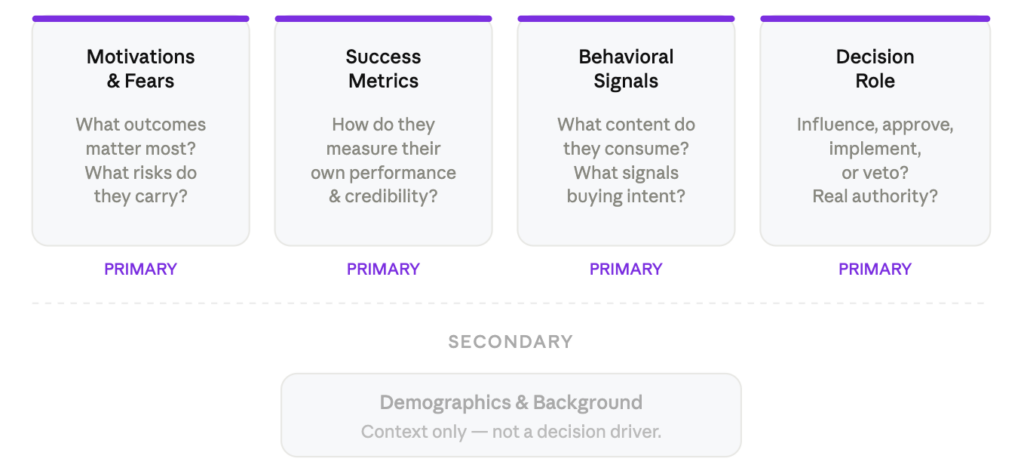
Four areas deserve particular attention.
Motivations and Fears
Start by understanding what pushes the buyer toward change and what makes them hesitate.
Motivations are the outcomes the stakeholder wants. They may want to reduce costs, improve productivity, increase revenue, reduce manual work, improve customer experience, or lower operational risk.
Fears are the perceived risks connected to making the wrong decision. A buyer may worry about wasting budget, choosing an unreliable vendor, disrupting existing workflows, failing to get internal approval, or struggling with implementation.
These factors are important because two people can experience the same business problem but respond to it differently.
For example, a marketing leader may want a new platform because the current system limits campaign performance. An IT leader may be more concerned about security and integration. A CFO may focus on the financial return.
A strong persona captures these differences instead of treating everyone at the account as having the same priorities.
It is also useful to identify buying triggers. A trigger is an event that makes a problem urgent enough to investigate a solution. It could be rapid company growth, a leadership change, a new regulation, a technology replacement, declining performance, or a major business initiative.
Success Metrics
Knowing what a buyer wants is only part of the picture. You also need to understand how they measure success.
Ask what numbers, outcomes, or business results the person is responsible for improving.
Depending on the role, this might include:
- Revenue growth
- Customer acquisition cost
- Conversion rate
- Time saved
- Operating costs
- Productivity
- Customer retention
- Forecast accuracy
- System adoption
- Return on investment
- Implementation time
These metrics make your messaging more relevant.
Instead of saying that your product has “powerful automation,” you can connect automation to an outcome the persona actually cares about. For example, you might explain how automation can reduce repetitive work and give a team more time for revenue-generating activities.
This also helps sales teams build a stronger business case. If the persona is measured on cost reduction, the sales conversation should show financial impact. If the person is measured on adoption, the conversation should explain usability, training, and implementation.
Behavioral Signals
Behavioral signals show what buyers actually do, rather than what you assume they do.
Look at the actions that happen before, during, and after a buying process. Useful signals can include:
- Pages or topics repeatedly viewed
- Content downloaded
- Product or feature searches
- Webinar or event attendance
- Demo requests
- Questions asked during sales calls
- Trial activity
- Email engagement
- Requests for pricing or security information
- Involvement of additional stakeholders
- Changes in engagement over time
These signals can help reveal what stage a buyer is in and what information they may need next.
For instance, someone reading introductory educational content may still be learning about the problem. Someone comparing solutions, reviewing implementation details, and requesting security documentation may be much closer to a vendor evaluation.
However, behavioral data should not be treated as proof by itself. Combine it with customer interviews, CRM information, sales conversations, and other evidence. A research-based persona is stronger when multiple data sources point to the same pattern.
Role in Decision-Making
Every persona should explain the person’s role in the buying process.
A stakeholder could be:
- Champion: Actively supports your solution and helps build internal support.
- Economic buyer: Controls or approves the budget.
- Technical evaluator: Assesses technical requirements, security, integrations, or feasibility.
- End user: Will use the product or service in daily work.
- Executive sponsor: Connects the purchase to strategic business priorities.
- Blocker: Can delay, challenge, or prevent the purchase.
One person can have more than one role. The important point is to understand their influence and what they need before supporting the decision.
This matters because B2B purchases often involve several people and departments. Research shows that buying groups can include stakeholders with different goals, and modern B2B buying journeys are often nonlinear rather than a simple person-by-person funnel.
A high-impact persona should therefore answer one practical question:
What does this stakeholder need to see, understand, or prove before they can support the purchase?
How to Create B2B Buyer Personas Using Real Data
The biggest mistake in persona development is starting with assumptions.
A team may sit in a meeting and describe its “typical buyer” based on what it believes customers want. The result may look polished, but it does not necessarily reflect how real customers behave.
Instead, build personas from real customer evidence.
1. Start With Your Existing Customer Data
Your CRM is a useful starting point because it contains information about actual opportunities and customers.
Review both successful and unsuccessful deals. Look for patterns such as:
- Who started the conversation?
- Which job roles became involved?
- Who attended meetings?
- Which stakeholders had approval authority?
- What objections appeared?
- Which deals moved quickly?
- Where did opportunities stall?
- Why were deals won or lost?
- Which customer characteristics appear repeatedly?
Do not study only closed-won deals. Lost and stalled opportunities can reveal important objections and gaps in your messaging.
2. Interview Customers and Prospects
Quantitative data can show you what happened. Interviews can help explain why it happened.
Speak with customers across different account types and buying outcomes. Include successful customers, recent customers, lost opportunities, and, where possible, accounts that stopped using the product.
Ask open questions instead of leading customers toward the answers you expect.
Useful questions include:
- What caused you to look for a solution?
- What problem were you trying to solve?
- What alternatives did you consider?
- Who else was involved?
- What concerns did your team have?
- What almost stopped you from buying?
- Which information helped you make the decision?
- How did you compare vendors?
- What made you choose the final solution?
- How do you measure whether the purchase was successful?
Standardized interviews can help marketers collect persona information consistently across different job roles and identify recurring patterns.
3. Analyze Sales Conversations
Sales calls contain valuable buyer language.
Review call recordings, notes, emails, and questions from prospects. Look for repeated phrases around:
- Problems
- Goals
- Objections
- Desired outcomes
- Competitors
- Implementation
- Pricing
- Risk
- Internal approval
The exact words customers use can improve your messaging. A persona should reflect how buyers describe their problems, not only how your company describes its product.
4. Combine Qualitative and Quantitative Evidence
No single data source tells the whole story.
Customer interviews provide context. CRM data shows account and opportunity patterns. Website and product analytics show behavior. Sales conversations reveal objections and decision criteria.
Bring these sources together and look for repeated patterns.
For example, suppose interviews show that operations leaders complain about manual reporting. CRM data shows that companies with this problem convert at a higher rate. Product data shows that successful customers frequently use your reporting automation features.
Together, these signals provide stronger evidence than any one source alone.
5. Group People by Meaningful Patterns
Do not create a new persona for every job title.
Instead, group stakeholders when they share similar:
- Goals
- Responsibilities
- Pain points
- Buying triggers
- Success metrics
- Objections
- Decision-making behavior
A VP of Operations at one company may have a different title from a Director of Operations at another company but perform a similar role in the buying process.
The objective is to create actionable role-based personas, not a long list of profiles that nobody uses.
6. Validate Before You Finalize
Before turning research into a finished persona, compare your findings against real accounts.
Ask:
- Does this persona appear in our best customers?
- Does the role actually influence purchases?
- Do the stated pain points appear in customer conversations?
- Do the buying triggers match real opportunities?
- Do the objections match lost or stalled deals?
- Can sales representatives recognize this persona?
If your research does not support an assumption, remove it.
A persona becomes valuable when teams can trust it.
Using B2B Buyer Personas to Drive Revenue Outcomes
Creating personas is not the end goal. The real value comes from using them to improve revenue-generating activities.
A persona should influence what marketing creates, who sales contacts, what messages prospects receive, and how the company supports the buying process.
Improve Targeted Messaging
Different stakeholders need different reasons to care.
Instead of one broad value proposition, adapt the message around each persona’s priorities.
For example:
| Persona | Main concern | Useful message |
|---|---|---|
| Executive | Business impact | Show strategic value and expected return |
| Finance | Financial risk | Explain costs, savings, and ROI |
| Technical evaluator | Feasibility | Explain integrations, security, and implementation |
| End user | Usability | Show workflow improvements and ease of adoption |
| Champion | Internal approval | Provide proof and resources they can share internally |
This does not mean creating completely different brand messages. The core value should remain consistent while the emphasis changes for each stakeholder.
Create More Relevant Content
Personas can guide your content strategy.
An early-stage buyer may need educational content that helps define the problem. A technical evaluator may need documentation and security information. An executive may want case studies, business outcomes, and ROI evidence.
Modern B2B buying is not linear, so buyers may revisit information at different points. Helpful content should support the tasks the buying group needs to complete rather than assuming every stakeholder follows the same path.
Help Sales Prioritize Opportunities
Sales teams can use personas to understand who they are speaking with and what matters to that person.
This can improve:
- Prospect qualification
- Discovery questions
- Outreach personalization
- Objection handling
- Demo preparation
- Stakeholder mapping
- Follow-up content
- Deal strategy
It also helps sales identify missing stakeholders. If an opportunity has a strong champion but no clear economic buyer or technical evaluator, the team may need to expand its engagement within the account.
Connect Personas to Revenue Metrics
Persona work should eventually connect to measurable business outcomes.
Track whether persona-based changes improve metrics such as:
- Qualified pipeline
- Conversion rates
- Sales cycle length
- Win rate
- Deal size
- Customer acquisition cost
- Content-assisted pipeline
- Expansion or retention
This turns personas from a marketing document into a revenue tool.
The Feedback Loop That Keeps B2B Personas Accurate
A buyer persona should never be considered permanently finished.
Markets change. Products change. Buying committees change. Job responsibilities change. New technologies can also change how buyers research and evaluate vendors.
That means persona research needs a continuous feedback loop.
Collect New Evidence
Continue gathering information from:
- Sales calls
- Customer interviews
- Win/loss reviews
- CRM data
- Customer success teams
- Product usage
- Website behavior
- Support conversations
- Marketing campaign performance
The goal is to identify changes in buyer behavior before outdated assumptions spread across your marketing and sales programs.
Compare Assumptions With Reality
Create a regular review process.
For each persona, ask:
Are the goals still accurate?
Has the stakeholder’s definition of success changed?
Are the pain points still relevant?
Is the same problem still driving demand?
Have buying triggers changed?
Are different business events causing customers to search for solutions?
Has the buying committee changed?
Are new departments or stakeholders becoming involved?
Are objections different?
Have new concerns about price, security, implementation, or AI emerged?
Does the role still have the same influence?
Organizational changes can move budget and decision-making authority.
Update the Persona and Activate the Changes
Once new evidence appears, update the persona itself and then update the systems that depend on it.
That could mean changing:
- Website messaging
- Campaign targeting
- Content plans
- Sales enablement materials
- Email sequences
- Lead qualification criteria
- Account-based marketing programs
- CRM fields
- Sales playbooks
This closes the loop between research and execution.
The best persona process is therefore not:
Research → Create persona → File it away
It is:
Research → Build → Activate → Measure → Gather feedback → Update → Activate again
That approach keeps buyer personas connected to real customer behavior and makes them more useful as market conditions change.
Buyer Personas Are Decision Systems, Not Profiles
Buyer personas should be more than a marketing asset that sits in a presentation or shared folder. They should serve as a strategic system that turns customer insights into clear actions and measurable results. When personas are built from real data, structured around the full buying committee, and updated through ongoing feedback, they can give teams a stronger competitive advantage. They help marketers qualify prospects more effectively, keep messaging consistent across channels, support sales teams with better insights, and improve overall revenue efficiency.
Pro Real Tech helps organizations put buyer personas into practice across demand generation, sales enablement, and analytics as a trusted Digital B2B Marketing Agency.


