

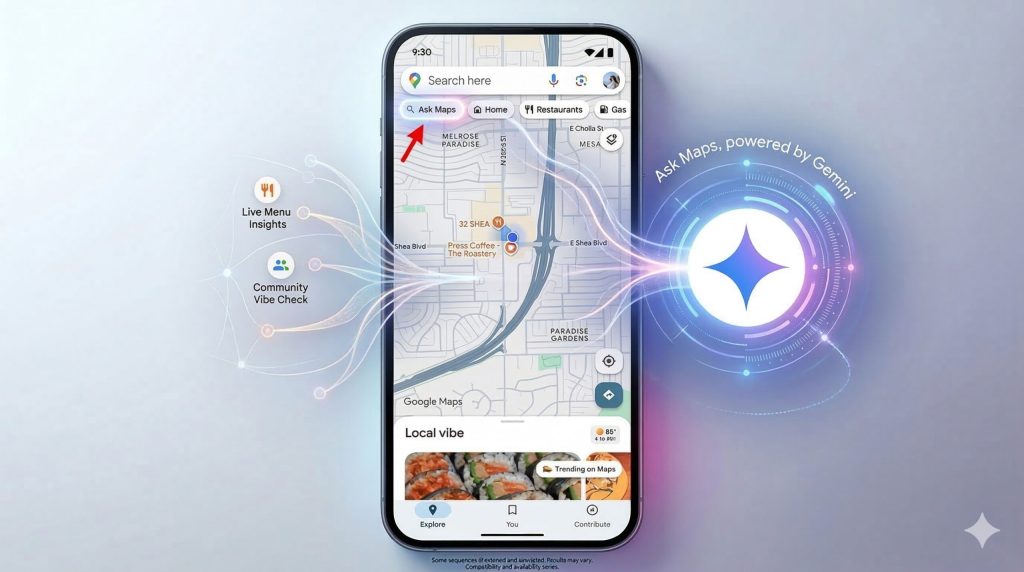
Local search is shifting from a list of links and map pins toward a more conversational experience. Instead of typing short phrases such as “best Italian restaurant near me” or “dentist in Austin,” people can increasingly describe what they actually need in natural language and expect Google Maps to help narrow down the options.
That is where Google Ask Maps comes in. Introduced in March 2026, Ask Maps brings Gemini into Google Maps to answer complex, real-world questions and provide personalized recommendations. Rather than simply displaying places that match a keyword, it can interpret several requirements at once and present relevant options on a customized map. Google says the experience draws on information from more than 300 million places and contributions from more than 500 million people.
For local businesses, this changes what it means to be discoverable. A strong position in a traditional local search result is still valuable, but businesses increasingly need accurate, complete, and useful information across their digital presence so AI-powered systems can understand what they offer and when they are relevant.
The opportunity is significant: Google Ask Maps can put businesses in front of customers who are asking highly specific, high-intent questions. But it also means local businesses have less control over the discovery journey because customers may receive recommendations without ever visiting a business website.
What Is “Google Ask Maps” and How Does It Work?
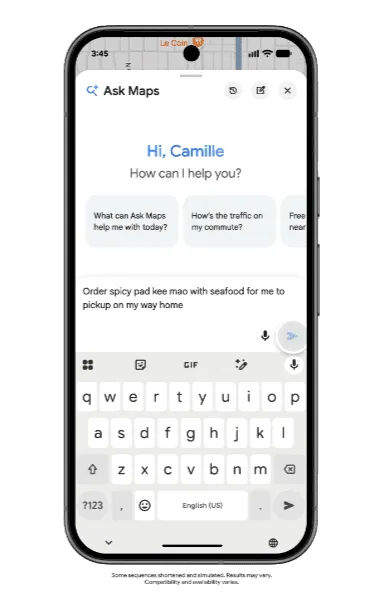
Google Ask Maps is a conversational AI experience built into Google Maps and powered by Gemini. Instead of requiring users to search through individual listings, reviews, photos, and websites themselves, it allows them to describe a situation or request and receive a synthesized response with relevant places displayed on a map.
For example, a user might ask:
“Where can I find a quiet restaurant with vegetarian options that has a table for four tonight?”
That is much more complicated than a conventional search such as “vegetarian restaurant near me.” The request contains several conditions—location, atmosphere, dietary preference, party size, and timing.
Ask Maps is designed to handle this type of conversational query. Google explains that the feature combines Gemini’s capabilities with information in Maps to answer questions about real-world places. It can use information such as reviews and other place details to help users evaluate their options.
The experience can also be personalized. Google says recommendations may take into account things such as places a user has previously searched for or saved in Maps. This means two people asking similar questions could potentially receive different recommendations depending on their context and preferences.
Most importantly for businesses, Ask Maps isn’t limited to providing information. It is designed to help users act on a recommendation. Depending on the business and available functionality, users can save a place, share it, get directions, or make a restaurant reservation without leaving the Maps experience.
And the feature is continuing to expand. In 2026, Google added capabilities in markets including India, such as Hindi-language support, real-time transit information, and Personal Intelligence. Google has also expanded Ask Maps into areas such as food ordering, hotel and event discovery, making Maps increasingly useful as an interface between local customers and businesses.
Why this matters for local businesses
The key difference is that Ask Maps isn’t simply matching a user’s words against a business name or category. It is attempting to understand the user’s underlying need and determine which places are appropriate.
That creates a new visibility layer for local businesses.
A business might not be the obvious result for a broad search such as “restaurants near me,” but it could become relevant when someone asks for a restaurant with a particular atmosphere, dietary option, amenity, service, or other combination of characteristics.
This makes the quality of the information associated with a business increasingly important. If important services, attributes, hours, or other details are missing or inaccurate, an AI system has less reliable information with which to determine whether the business fits a particular request.
At the same time, businesses should be careful about assuming that Google has published a simple “Ask Maps ranking formula.” It has not. Google has explained what information and capabilities power the experience, but there is no publicly documented checklist that guarantees inclusion in an Ask Maps recommendation.
The New Local Search Journey: Search to Transaction
Traditional local search generally follows a relatively straightforward path:
Search → Map results → Business profile → Website/call/visit
A customer searches for something, reviews a handful of listings, chooses a business, and then takes the next step.
Ask Maps can compress several of those stages into a single conversational experience:
Question → AI recommendations → Evaluation → Action
That distinction matters.
Instead of searching separately for “best coffee shop,” checking reviews, looking at photos, confirming opening hours, and then deciding where to go, a customer can ask a more complete question from the beginning. Ask Maps can interpret the request, surface relevant places, and help the person move toward an action. Google specifically describes the experience as making it easier to turn plans into actions such as reservations, saving places, sharing recommendations, and navigation.
This creates what can be thought of as a search-to-transaction journey inside Maps.
For local businesses, that means the Google Business Profile and other place information can become even more important. The customer may make a decision based on information presented within Maps without ever going through the business’s homepage.
Consider a home services company. A traditional searcher might type:
“plumber near me.”
An Ask Maps user could instead ask:
“Who can fix a leaking water heater near me today and has good reviews for emergency service?”
The second query communicates considerably more intent. The business needs to be understood not simply as a “plumber,” but as a business that provides the relevant service, serves the relevant area, handles the appropriate type of job, and has credible evidence of customer satisfaction.
That is why the emerging local-search environment rewards specificity and trustworthy business information.
It also means the customer journey can become shorter. When Maps can answer questions, summarize relevant information, compare options, and facilitate actions, fewer customers may need to open multiple websites before deciding what to do.
For businesses, this presents both an opportunity and a risk. The opportunity is getting recommended at precisely the moment someone has a relevant need. The risk is that the business may have fewer opportunities to control the customer’s first interaction with its brand on its own website.
How Google Ask Maps Impacts Local Businesses: The Opportunities
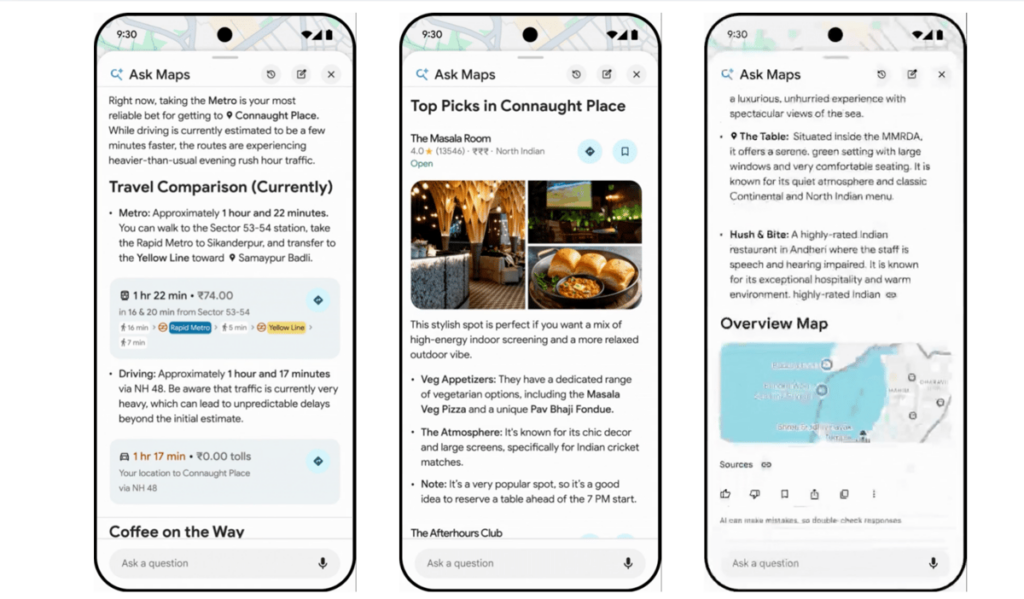
1. Increased Visibility in Conversational Queries
One of the biggest opportunities is exposure to more specific, conversational searches.
Traditional local search often revolves around relatively short queries:
- “best dentist near me”
- “Italian restaurant downtown”
- “HVAC repair near me”
- “coffee shop open now”
Ask Maps allows users to express much richer requirements. Google gives examples involving combinations such as location, atmosphere, timing, party size, and preferences.
This creates opportunities for businesses that clearly communicate their niche and capabilities.
For example, a restaurant that accurately identifies its cuisine, dietary options, atmosphere, seating, hours, and other relevant characteristics has more useful information available when a customer makes a highly specific request.
Importantly, conversational discovery can potentially expose businesses beyond a simple “top three” mindset. The goal is no longer only to think about which generic keyword a business ranks for. Local marketers should also consider which customer needs the business can satisfy and whether its online information clearly demonstrates that fit.
That shifts local optimization from keyword matching toward contextual relevance.
2. Better Targeting of High-Intent Customers
Not every local search represents the same level of buying intent.
Someone searching for “things to do in Chicago” could simply be researching. Someone asking, “What family-friendly attraction can we visit this afternoon that is close to our hotel?” has a much more immediate need.
Ask Maps is particularly relevant to these high-intent, multi-condition searches because users can communicate exactly what they want.
For businesses, appearing in this type of recommendation can be valuable because the customer has already supplied several criteria before seeing the business.
Imagine someone asking:
“Find a highly rated dog groomer near me that is open this evening and specializes in large dogs.”
A business that satisfies those conditions has an opportunity to appear in front of a customer who is much closer to taking action than someone performing a broad informational search.
The newer transactional capabilities make this even more significant. Ask Maps is evolving beyond discovery toward actions such as reservations and food ordering, although the specific actions available can depend on the business, market, and integrations.
For local businesses, the lesson is straightforward: don’t optimize only for generic visibility. Make it easy for Google and customers to understand exactly what you offer, who you serve, where you operate, and when you’re available.
3. More Prominent Review Role
Reviews have always been important in local search, but conversational AI makes their informational value particularly interesting.
Ask Maps can use information from the Maps community to help users understand places. Google says its Maps experience draws on reviews and contributions from its large community when providing recommendations and insights.
That means reviews aren’t merely social proof that a customer reads after discovering a business. They can also provide context about the actual customer experience.
A review saying that a restaurant is “quiet enough for business conversations” can be more useful for a user asking for a quiet restaurant than a generic five-star review that simply says “great food.”
Similarly, detailed customer feedback can reveal information about service quality, specific offerings, atmosphere, accessibility, or other characteristics that matter to prospective customers.
This makes review quality and relevance increasingly important alongside review volume and star rating.
Businesses should therefore focus on earning genuine feedback from customers rather than trying to manufacture reviews or manipulate sentiment. Google continues to invest in systems designed to detect fake reviews and other abusive contributions, reinforcing the importance of authentic customer feedback.
The broader takeaway is that local reputation is becoming more than a number. What customers actually say about your business can help communicate why your business is a good fit for a particular need.
And that is exactly the kind of context conversational local search is designed to understand.
The Challenges: How Google Ask Maps Affects Local Businesses Negatively
Google Ask Maps creates a new discovery opportunity, but it also changes the balance of power in local search. Customers can increasingly ask Google to interpret their needs, compare places, summarize information, and help them take action without visiting multiple business websites. Recent updates have pushed this even further, with Ask Maps expanding into areas such as food ordering, hotel discovery, events, and personalized recommendations.
For local businesses, the result is a more competitive environment in which being visible is important, but controlling the customer journey becomes harder. Four challenges deserve particular attention.
1. Reduced Direct Traffic to Business Websites
One of the biggest concerns is the possibility of fewer website visits from local-intent searches.
Traditionally, a customer might search for a local business, open its Google listing, visit its website, read the service information, and then make a decision. With conversational Maps experiences, more of that research can happen directly inside Google Maps.
For example, instead of searching for several restaurants individually, a customer could ask Google to find restaurants that meet specific requirements and then evaluate the recommendations directly in Maps. If the information available through Maps answers the customer’s questions, there may be less reason to click through to every business website.
This is part of a broader change in search behavior. Recent research into AI-generated search experiences has found that AI answers can be associated with fewer clicks to external websites. While that research concerns Google Search rather than proving a specific traffic impact from Ask Maps, it illustrates the broader zero-click direction of AI-powered discovery.
For local businesses, this doesn’t mean websites are becoming irrelevant. Quite the opposite: Google says it can use publicly available information from a business’s official website when compiling information for local listings.
The challenge is that the website may increasingly function as a source of business information and credibility even when it doesn’t receive the final click.
That changes what businesses should measure. Website sessions remain important, but local marketers should also pay attention to actions such as:
- Calls from the Business Profile
- Direction requests
- Booking or appointment actions
- Messages
- Profile interactions
- Search visibility
- Branded searches
- Actual leads and customers generated from local discovery
The goal is no longer simply to maximize website traffic. It is to make sure local discovery produces measurable business outcomes, even when the customer doesn’t visit the website.
2. Increased Competition and Less Differentiation
AI-powered recommendations can make competition more intense because businesses are being evaluated against competitors based on the customer’s specific request, rather than only a broad keyword.
A customer might ask:
“Find a quiet coffee shop that’s good for working, has Wi-Fi, and is open late.”
Now a coffee shop isn’t competing only for “coffee shop near me.” It may be competing for every business that could satisfy the combination of requirements.
This creates an important shift from keyword competition to contextual competition.
Businesses that previously differentiated themselves through their own websites, advertising, or branding may find that customers first encounter a condensed description, review summary, photos, or other information inside Maps.
There is also a practical limit to how many businesses a user is likely to seriously consider. If an AI system narrows a large local market into a small set of recommendations, businesses outside that consideration set may receive little attention—even if they perform well in conventional local search.
Google does not publish a formula showing exactly how Ask Maps chooses every recommendation. Businesses therefore shouldn’t assume that one particular optimization trick guarantees inclusion. Google’s established local-search guidance says local results are primarily influenced by relevance, distance, and prominence, while also emphasizing complete and accurate Business Profile information.
The strategic response is to make your business meaningfully relevant, not simply more optimized.
That means clearly communicating what makes your business useful for particular customers:
- Specialized services
- Specific products
- Service areas
- Amenities
- Accessibility features
- Dietary options
- Business hours
- Pricing information where appropriate
- Appointment availability
- Unique experiences or specialties
The more clearly your legitimate differentiators are represented online, the easier it is for customers—and potentially AI-powered discovery systems—to understand when your business is the right fit.
3. Greater Dependency on Accurate, Complete Business Data
AI local search makes inaccurate information more dangerous.
A traditional searcher may notice that a business’s website says one thing while an outdated directory listing says something else. An AI-powered experience, however, can draw information from multiple sources and use that information when constructing an answer.
Google explains that Business Profile information can come from the business owner, publicly available web content, licensed third-party data, user contributions, photos, reviews, and Google’s own interactions with a place.
That creates a potential data consistency problem.
Imagine that:
- Your Google Business Profile says you’re open until 8 p.m.
- Your website says 7 p.m.
- A directory lists an old address.
- Your service page doesn’t mention a service you recently added.
- Customers have uploaded photos showing outdated information.
Even if one source is correct, conflicting information can make your online identity less reliable.
Google already states that complete and accurate business information helps businesses appear for relevant local searches.
In an AI-assisted environment, the stakes become even higher because the system is expected to interpret information rather than simply display it.
For local businesses, this means treating business information as operational data, not something you set once and forget.
Regularly check:
- Business name
- Address
- Phone number
- Website
- Opening hours
- Holiday hours
- Primary and secondary categories
- Services
- Attributes
- Photos
- Menu or product information where applicable
- Booking links
- Service areas
- Business description
The objective isn’t to fill every field with keywords. It’s to ensure that the information accurately represents the business customers can actually visit or hire.
4. Review Sentiment Matters More Than Ever
Reviews have always influenced local reputation. But in an AI-driven discovery environment, the content and context of reviews can become just as important as the overall star rating.
Google’s Business Profile documentation confirms that local listings can include review scores, review counts, and reviews from users, while Google may also surface reviews from other local review sites in some circumstances.
Consider two businesses with similar four-star averages.
Business A has hundreds of short reviews saying:
“Great!”
Business B has a similar rating, but customers consistently describe the staff as knowledgeable, the location as accessible, the service as fast, and the business as particularly good for a certain type of customer.
For a conversational query, those details potentially provide much richer context.
This doesn’t mean businesses can—or should—try to manufacture particular phrases in their reviews. Authenticity matters. The objective is to consistently deliver a good customer experience and make it easy for genuine customers to share useful feedback.
Negative reviews also shouldn’t be ignored. A recurring complaint about slow service, confusing pricing, poor communication, or another operational issue can reveal a genuine weakness that affects future customers’ perceptions.
The challenge, therefore, isn’t simply:
“How many five-star reviews do we have?”
It’s increasingly:
“What does the overall customer feedback say about our business?”
The New Reality: How AI Local Search Changes Optimization
The emergence of Ask Maps doesn’t mean traditional local SEO is dead. Instead, it makes the underlying fundamentals more important while expanding the definition of what it means to be optimized.
Google says local visibility is primarily influenced by relevance, distance, and prominence, and recommends complete, accurate Business Profile information.
The practical difference is that businesses now need to think beyond ranking for a keyword and toward being understood as an entity that satisfies real customer needs.
Four areas deserve particular attention.
1. Google Business Profile Completeness
Your Google Business Profile should be treated as one of your most important local business assets.
Google explicitly recommends keeping business information complete and accurate because this helps it understand what a business does and match it with relevant local searches.
Start with the fundamentals:
- Use the correct business name.
- Select the most appropriate primary category.
- Add relevant secondary categories where applicable.
- Keep your address or service area accurate.
- Maintain current opening and holiday hours.
- Add the services you genuinely provide.
- Keep phone and website information current.
- Add useful, current photos.
- Maintain booking, ordering, or appointment links where relevant.
- Add products or menus when those features apply to your business.
Don’t treat completeness as an excuse for keyword stuffing. Your profile should describe the real business, not an imaginary version created to capture more searches.
This is particularly important because Google can combine information supplied by the business with information from other sources.
2. Review Quality and Sentiment
A strong review strategy is no longer simply about accumulating as many stars as possible.
Businesses should aim to create a steady stream of genuine, detailed customer feedback.
That starts with the customer experience. If customers consistently receive excellent service, make it easy for them to leave an honest review after their interaction.
Pay attention to recurring themes in feedback:
- What do customers praise?
- Which services receive the strongest feedback?
- What problems appear repeatedly?
- Do customers mention staff expertise?
- Are customers satisfied with communication?
- Are there complaints about waiting times?
- Do customers describe a particular product or service as especially valuable?
These patterns can tell you far more than a single aggregate rating.
Google also makes clear that review scores are calculated from the ratings published for a business, while reviews and ratings contribute to the information customers see in Search and Maps.
Don’t try to manipulate this process with fake reviews, incentivized reviews that violate platform policies, or manufactured feedback. Instead, use reviews as a feedback loop for improving the real customer experience.
3. Category and Service Accuracy
Category selection and service information help establish what your business actually is and what it provides.
Google’s local-search guidance describes relevance as how well a Business Profile matches what someone is searching for and recommends providing complete and detailed business information to help Google understand that match.
This becomes especially important when customers use detailed conversational queries.
A business should therefore review whether its profile accurately communicates:
Who are we?
What do we provide?
Who do we serve?
Where do we serve them?
When are we available?
For example, a generic “contractor” description provides less useful context than accurately identifying legitimate specialties such as bathroom remodeling, kitchen renovation, or commercial renovation—assuming those are genuinely offered.
The same principle applies to restaurants, healthcare practices, professional services, retail stores, and virtually every other local category.
However, accuracy comes first. Adding irrelevant categories or services simply because they have search demand can create misleading information and weaken the quality of the profile.
4. Entity Consistency Across the Web
Your business doesn’t exist online only inside Google Business Profile.
Google says it can compile local business information from your official website, third-party data, user contributions, and other sources.
That makes entity consistency increasingly important.
Your business should be represented consistently across relevant locations such as:
- Your website
- Google Business Profile
- Local directories
- Industry directories
- Social profiles
- Chamber or association pages
- Review platforms
- Local news or community websites
- Other legitimate business listings
Check the fundamentals: name, address, phone number, website, services, and other important business details.
But consistency doesn’t mean copying the exact same paragraph everywhere. It means ensuring that independent sources don’t contradict the basic facts about your business.
Your website should also provide clear supporting information. Create useful pages that explain your services, locations, specialties, products, FAQs, and customer needs in natural language.
The broader principle is simple:
Make your business easy for both people and machines to understand.
Ask Maps may change how customers discover local businesses, but it doesn’t eliminate the fundamentals. A clearly defined business, accurate information, genuine customer feedback, strong local relevance, and a consistent online presence give AI-powered local discovery better information to work with.
For local businesses, the future of optimization is therefore less about finding one secret ranking tactic and more about building a complete, trustworthy, machine-readable representation of the real-world business.
How Local Businesses Can Stay Discoverable in the Ask Maps Era
Google Ask Maps changes the way customers can discover local businesses, but it does not mean businesses need an entirely new form of SEO. The fundamentals still matter: Google says local results are primarily influenced by relevance, distance, and prominence, while complete and accurate Business Profile information helps Google understand which businesses are relevant to a search.
The difference is that conversational search can make the customer’s requirements much more detailed. Instead of optimizing only for “dentist near me” or “Italian restaurant,” businesses should make their online presence clear enough to communicate what they offer, who they serve, where they operate, and what customers experience.
Here are the practical steps local businesses should take.
1. Optimize Your Google Business Profile for AI
Your Google Business Profile is one of the most important sources of information Google uses to understand a local business. Google says Business Profiles can contain information supplied by the business as well as information gathered from public web content, third-party data, user contributions, reviews, photos, and Google’s own interactions with a place.
That makes accuracy and completeness essential.
Start by reviewing your:
- Business name
- Primary and relevant secondary categories
- Address or service area
- Phone number
- Website
- Opening and holiday hours
- Services
- Business description
- Photos and videos
- Products or menu information, where applicable
- Booking, ordering, or appointment links
- Relevant business attributes
Don’t try to turn the profile into a keyword-stuffed document. Instead, make every field accurately describe the business.
For example, a plumbing company shouldn’t simply describe itself as a “plumber.” If it genuinely provides emergency plumbing, water-heater repair, drain cleaning, and commercial plumbing, those services should be represented accurately in its profile and supporting online content.
This matters because Ask Maps allows users to ask detailed questions and receive recommendations based on their specific needs. Google describes Ask Maps as a conversational experience that can answer complex questions about places and provide personalized recommendations.
Think beyond “What keyword do I want to rank for?”
Instead ask:
“What information would Google need to know to determine that my business is the right answer to this customer’s question?”
2. Build Genuine, Positive Reviews
Reviews are another important part of local visibility. Google says reviews can help businesses stand out, provide useful information to potential customers, and appear alongside Business Profiles in Search and Maps. It also says more reviews and positive ratings can help local ranking through the prominence factor.
But the objective shouldn’t be to collect hundreds of generic five-star ratings.
Useful reviews contain context.
For example:
- “The emergency plumber arrived within an hour and fixed our water heater.”
- “Great quiet atmosphere for working, with reliable Wi-Fi.”
- “The dentist explained every step and was particularly good with nervous patients.”
These reviews tell prospective customers why the business was useful.
Google’s Maps interface already uses customer-review information to generate features such as Place Topics and review snippets. Place Topics are based on themes found in customer reviews, while review snippets can highlight commonly mentioned words and phrases.
That makes the substance of customer feedback valuable.
Businesses should therefore focus on delivering excellent experiences and making it easy for genuine customers to leave honest feedback. Google allows businesses to create a review link or QR code for this purpose, but explicitly prohibits offering incentives in exchange for reviews.
A good review strategy is:
Great experience → genuine customer feedback → stronger reputation → better customer confidence.
3. Maintain Consistent Business Information
Your business information should tell the same basic story everywhere customers and search systems encounter it.
Google explains that it can gather business information from sources including official websites, third-party data, and user contributions.
So check your information across:
- Google Business Profile
- Official website
- Major local directories
- Industry directories
- Social profiles
- Review platforms
- Local organization or chamber pages
- Other authoritative business listings
Pay particular attention to your name, address, phone number, website, hours, services, and business category.
For example, if your Google Business Profile lists your current address but an important directory still shows your previous location, customers may become confused and Google’s broader understanding of the business may contain conflicting information.
Consistency doesn’t mean every website needs identical wording. It means the important facts shouldn’t contradict each other.
This is especially important in conversational search because users aren’t necessarily asking Google to “find websites.” They are asking it to understand real-world places.
4. Create Content That Answers Specific Questions
Traditional local content often targets phrases such as:
“HVAC company in [city]”
or:
“Best restaurants near [neighborhood].”
Those pages can still be useful, but conversational search creates an opportunity to address the questions behind the search.
Think about what customers actually ask before choosing your business.
A roofing company might create content around:
- How much does roof repair typically cost?
- How do I know whether I need repair or replacement?
- Can you repair a roof after storm damage?
- How long does a roof inspection take?
- What should I do if my roof starts leaking during heavy rain?
A dental practice might answer:
- How long does a dental cleaning take?
- What should I expect during a root canal?
- Is emergency dental care available on weekends?
- How often should I get a dental checkup?
This type of content helps customers make decisions while giving Google clearer information about your expertise, services, and areas of relevance.
The key is specificity without artificial optimization. Write for real customer questions first. Use clear headings, straightforward explanations, accurate service information, and relevant location context where it genuinely helps.
Your website still matters even when the customer doesn’t click through. Google says information from a business’s official website can be used as one source when it compiles information for Business Profiles and local search.
5. Respond to Every Review, Positive and Negative
Review management should be an ongoing part of local marketing, not an occasional task.
Google specifically recommends replying to reviews to show customers that their feedback matters.
For positive reviews, a response can reinforce the relationship:
“Thank you for choosing us. We’re glad our team could help with your water-heater repair.”
For negative reviews, avoid becoming defensive or argumentative. A professional response should acknowledge the concern, provide appropriate context when necessary, and move the conversation toward resolution.
For example:
“We’re sorry your experience didn’t meet expectations. We’d like to understand what happened and see how we can address the issue. Please contact our team directly so we can look into it.”
There is another important reason to monitor reviews: customers can contribute information and photos to Maps, and Google uses customer feedback to surface themes about businesses.
You cannot completely control what customers say. What you can control is the experience you provide and how professionally you respond.
6. Strengthen Your Overall Local SEO Foundation
Ask Maps should be treated as an additional layer of local discovery—not a replacement for your existing local SEO strategy.
Google continues to describe local visibility through factors including relevance, distance, and prominence. Complete business information, reviews, links from other websites, and overall prominence can all contribute to local visibility.
That means businesses should continue investing in the fundamentals:
- Maintain an accurate Google Business Profile.
- Build legitimate local and industry citations.
- Earn relevant links and mentions.
- Publish useful location and service content.
- Improve website usability and mobile performance.
- Make contact information easy to find.
- Create dedicated pages for important services and locations where appropriate.
- Monitor rankings and conversions.
- Maintain a strong review-management process.
- Keep business information consistent across the web.
The goal isn’t to “optimize for Gemini” through a secret formula. Google does not publish a guaranteed Ask Maps ranking checklist. Instead, build a business presence that is accurate, relevant, authoritative, useful, and genuinely valuable to local customers.
That foundation is useful whether a customer finds you through traditional Google Search, the Local Pack, Google Maps, or a conversational Maps experience.
Preparing Your Business for AI Local Search
Google Ask Maps is changing how people discover, evaluate, and choose local businesses. As conversational search becomes a bigger part of the customer journey, businesses that adapt their local presence early can position themselves for greater visibility. Those that rely solely on traditional search tactics risk falling behind as customers increasingly use AI-powered experiences to find answers and recommendations.
The shift is straightforward: traditional local SEO focused heavily on helping your website rank for relevant searches. AI-powered local search requires a broader approach—making your business information complete, accurate, consistent, and trustworthy across the web so AI systems can confidently understand your business and identify when it is relevant to a customer’s needs.
If you’re looking to improve your visibility across both traditional search and emerging AI-powered local experiences, Pro Real Tech provides local SEO and Google Business Profile optimization services built for today’s evolving search landscape. Our team can help strengthen your online business information, build a healthier review profile, improve local relevance, and create a stronger foundation for AI-driven discovery.
Want to stay competitive as local search evolves? Contact Pro Real Tech today and prepare your business for the Ask Maps era.
Frequently Asked Questions (FAQs) About Google Ask Maps
What is Google Ask Maps and how is it different from regular Google Maps search?
Google Ask Maps is a conversational AI experience in Google Maps powered by Gemini. Instead of relying solely on traditional keyword searches and browsing individual listings, users can ask questions in natural language and receive answers and recommendations about places. Google says Ask Maps is designed to handle complex questions and provide personalized recommendations.
Traditional Maps search is generally more list- and query-oriented. Ask Maps adds a conversational layer that allows users to describe what they’re looking for in greater detail and ask follow-up questions.
How does Google Ask Maps decide which businesses to recommend?
Google has not published a complete ranking formula specifically for Ask Maps.
For traditional local results, Google says the primary factors are relevance, distance, and prominence. It also recommends complete and accurate Business Profile information to help Google understand the business and match it with relevant searches.
Because Ask Maps is conversational, the specific details in a user’s question can also affect which businesses are relevant to that request. Businesses should therefore focus on accurately representing their services, location, attributes, and customer experience rather than trying to manipulate a supposed AI ranking factor.
What happens to my website if customers get answers directly in Google Maps?
Your website may receive fewer clicks from some local discovery journeys because customers can get more information directly within Google Maps.
However, that doesn’t make your website unimportant. Google says it may use publicly available information from an official business website when compiling information for Business Profiles and local search.
Your website should therefore remain a reliable source of detailed information about your services, locations, expertise, products, FAQs, and business identity.
Does Google Ask Maps replace traditional local SEO?
No.
Ask Maps changes how customers can discover and evaluate businesses, but traditional local-search fundamentals remain important. Google still identifies relevance, distance, and prominence as the main factors for local results and recommends maintaining complete, accurate Business Profile information.
A strong local SEO foundation can therefore support visibility across multiple Google surfaces rather than becoming obsolete.
Why is review sentiment more important now than review quantity?
Review quantity still matters, and Google says the number of reviews and positive ratings can contribute to local prominence.
But detailed reviews provide context that a simple star count cannot.
Google’s Place Topics and review snippets can surface recurring themes and phrases from customer reviews.
So businesses should focus on genuine, useful customer feedback, not simply maximizing the number of reviews.
What should local businesses prioritize to appear in Google Ask Maps?
Start with the fundamentals:
- Keep your Google Business Profile complete and accurate.
- Choose appropriate categories.
- Clearly describe your genuine services and attributes.
- Maintain accurate hours, location, and contact information.
- Earn authentic customer reviews.
- Respond professionally to reviews.
- Keep important business information consistent across the web.
- Publish useful content that answers customer questions.
- Maintain a strong overall local SEO presence.
There is no publicly documented “Ask Maps hack” that guarantees a recommendation.
How does Ask Maps handle multi-variable queries?
One of the important differences is its conversational approach. Users can ask questions containing multiple requirements rather than searching for one simple phrase.
For example, a person could ask for a place that is nearby, suitable for a particular activity, open at a certain time, and offers a specific feature.
Google describes Ask Maps as being able to answer complex questions about places and provide personalized recommendations.
For businesses, this makes it more important to accurately communicate the legitimate characteristics that distinguish their business.
Will Ask Maps eventually have advertising like Google Search does?
Google Maps already has advertising products, so advertising in Maps is not new. However, businesses should not assume that paid placement will guarantee inclusion in an organic Ask Maps recommendation.
Google’s local-ranking guidance explicitly says businesses cannot request or pay for a better local ranking.
If Google changes how advertising works within conversational Maps experiences, businesses should evaluate those products separately from organic local optimization.
What should I do about my Google Business Profile right now?
Audit it.
Confirm that your business name, category, address, service area, phone number, website, hours, services, photos, attributes, and other relevant information are accurate.
Then review your customer feedback and look for recurring themes. Google says complete and accurate information makes businesses more likely to appear in relevant local searches.
You should also establish a process for requesting genuine reviews and responding to customer feedback. Google provides businesses with tools such as review links and QR codes for requesting reviews.
How does Ask Maps impact businesses that rank well in the traditional Local Pack?
A strong Local Pack presence remains valuable, but it shouldn’t be treated as a guarantee that a business will be recommended for every conversational query.
The important difference is query context.
A business might rank strongly for a broad search such as “restaurant near me,” while another business could be more relevant to a highly specific request based on cuisine, atmosphere, amenities, opening hours, or other requirements.
Therefore, businesses that already perform well locally shouldn’t stop optimizing. Instead, they should make their business information more complete, maintain their reputation, clearly communicate their services and differentiators, and continue strengthening their overall local SEO foundation.
The biggest shift isn’t from SEO to AI. It’s from optimizing for isolated keywords to making your business easy to understand in context. Google Ask Maps makes that distinction increasingly important because customers can now describe what they actually need—and expect Google to find the places that best fit those needs.
Read More: Known, But Not Recommended: Business Visibility Index Q2 2026


