

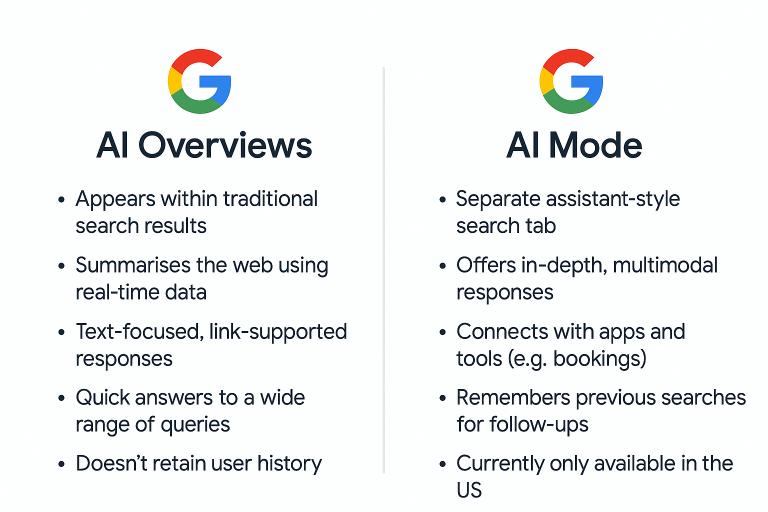
Google Search is moving beyond the traditional list of blue links toward AI-generated answers that synthesize information from multiple sources. Two of the most important experiences in this shift are Google AI Overviews and Google AI Mode. Although both use generative AI to help people find information, they serve different search behaviors and can select very different sources for the same query.
For brands, that distinction matters. Appearing in an AI-generated answer can put a business in front of potential customers before they ever visit a website. However, visibility in AI Overviews does not automatically mean equivalent visibility in AI Mode. An analysis of hundreds of thousands of Google AI responses found that AI Overviews and AI Mode reached highly similar conclusions but shared the same cited URLs only 13.7% of the time.
That means modern AI search visibility requires more than simply ranking well for conventional keywords. Brands need authoritative content, recognizable entities, trustworthy references, strong websites, and a strategy that accounts for how different AI search experiences discover and cite information.
The practical takeaway is simple: AI Overviews and AI Mode should be treated as related but distinct opportunities for brand discovery.
Quick Background: AI Overviews and AI Mode
Google AI Overviews
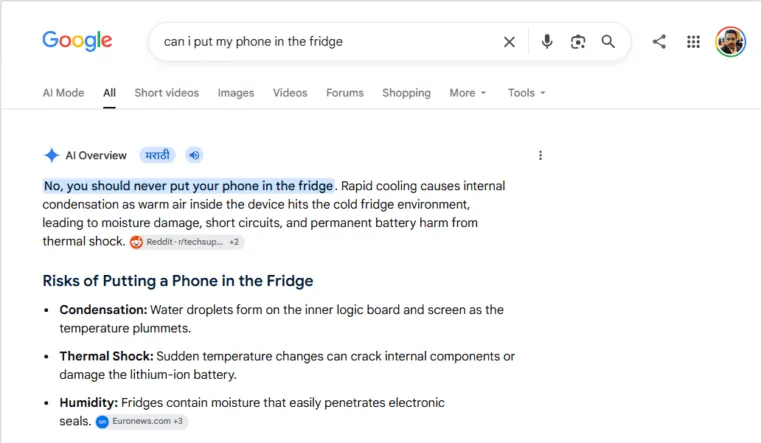
AI Overviews are AI-generated summaries that can appear within the traditional Google Search results. Instead of requiring users to open several pages and combine the information themselves, Google provides a synthesized response with links that allow users to investigate the underlying sources.
The experience is designed primarily for quick understanding. A user might search for a question such as “What should I look for when choosing accounting software?” and receive a concise AI-generated explanation followed by supporting links.
For brands, this creates a new form of search visibility. The objective is not simply to occupy position one in the traditional results. A brand may instead be selected as a source, mentioned as an entity, or included among the websites users can explore after reading the AI-generated answer.
Research analyzing 730,000 response pairs found that AI Overviews were considerably shorter than AI Mode responses and generally mentioned fewer brands or entities. The study also found that AI Overviews showed stronger preferences for certain formats, including video and core website pages.
Google AI Mode
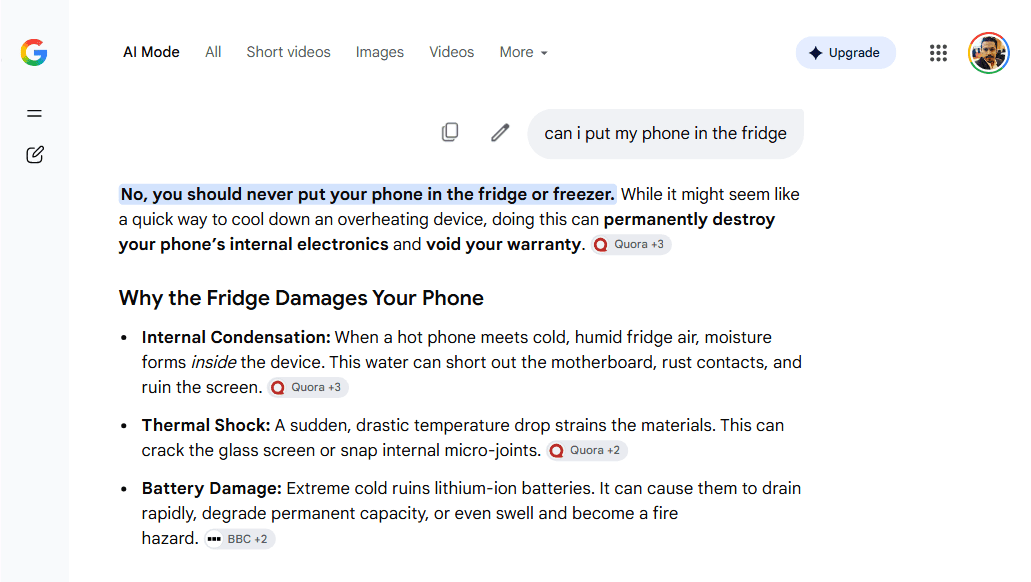
AI Mode is a more conversational, research-oriented Google Search experience. Instead of presenting one generated summary within the standard results page, it allows users to ask complex questions, continue with follow-up questions, and explore a topic through an ongoing interaction. Google says AI Mode uses query fan-out, meaning it can break a question into related subtopics and search across multiple sources before constructing the response.
This makes AI Mode particularly relevant for searches involving comparisons, recommendations, multi-step research, and deeper investigation.
AI Mode responses are also substantially longer than AI Overviews. Ahrefs’ analysis found that AI Mode responses were approximately four times longer on average and mentioned about 3.3 people or brand entities per response compared with 1.3 in AI Overviews.
For marketers, that creates both an opportunity and a challenge. There may be more opportunities for a brand to be mentioned, but there can also be more competitors and sources included in the same response.
The Critical Finding: AI Search Marketing Insights
One of the most important findings for marketers is that AI Overviews and AI Mode can agree on the answer while relying on different sources.
The large-scale analysis found approximately 86% semantic similarity between AI Overview and AI Mode responses. In other words, the systems frequently arrive at broadly similar conclusions. Yet the cited URLs overlapped only 13.7% of the time.
This distinction changes how brands should approach AI search marketing.
Imagine two experts answering the same customer question. Both might recommend similar solutions, but one could rely on an industry report while the other cites a university study, a specialist publication, or an authoritative reference site. The conclusion is similar, but the path used to establish credibility is different.
The same principle applies to Google’s AI search experiences.
A brand that appears prominently in an AI Overview may not receive the same exposure in AI Mode. Conversely, a company that is overlooked by an AI Overview may become relevant to an AI Mode response because the latter explores a broader set of sources.
The study also found that when a brand or entity appeared in an AI Overview, AI Mode included that entity 61% of the time while adding additional entities.
For businesses, the lesson is not to chase one AI feature. Instead, build a strong information ecosystem that gives multiple Google systems reasons to recognize your brand as relevant and trustworthy.
Brand Discovery Strategy: AI Search Visibility
AI search visibility is becoming a broader concept than traditional rankings. Your brand can be visible because its website is cited, because the company is mentioned directly, because authoritative sources discuss it, or because its content contributes information used to construct an AI answer.
The optimization strategy should therefore address both AI Overviews and AI Mode while recognizing their different characteristics.
Optimizing for AI Overviews
AI Overviews tend to reward content that can provide clear, authoritative answers to specific questions. That does not mean producing extremely short articles. Instead, your content should make important information easy for search systems to understand, verify, and connect with the user’s query.
Focus on:
- Answering important questions directly: Put the key answer near the relevant section rather than burying it under unnecessary introductions.
- Building topical authority: Cover related questions and subtopics so your website demonstrates genuine expertise in the subject.
- Strengthening website authority: High-quality backlinks, reputable mentions, and strong site signals can help establish credibility.
- Creating original, useful content: Add expertise, examples, data, first-hand observations, or analysis rather than simply rewriting information available elsewhere.
- Using multiple content formats: The research found that AI Overviews showed a stronger preference for video and core website pages than AI Mode.
- Maintaining technical SEO fundamentals: Crawling, indexing, page accessibility, structured information, internal linking, and overall site quality still matter because AI systems need to discover and interpret your content.
The goal is to make your brand a credible, easily understood source for the questions your target audience is asking.
It is also important not to assume that appearing in an AI Overview guarantees exclusivity. If your brand is included, AI Mode may also include your brand—but it can introduce additional competitors and entities into the longer response.
Optimizing for AI Mode
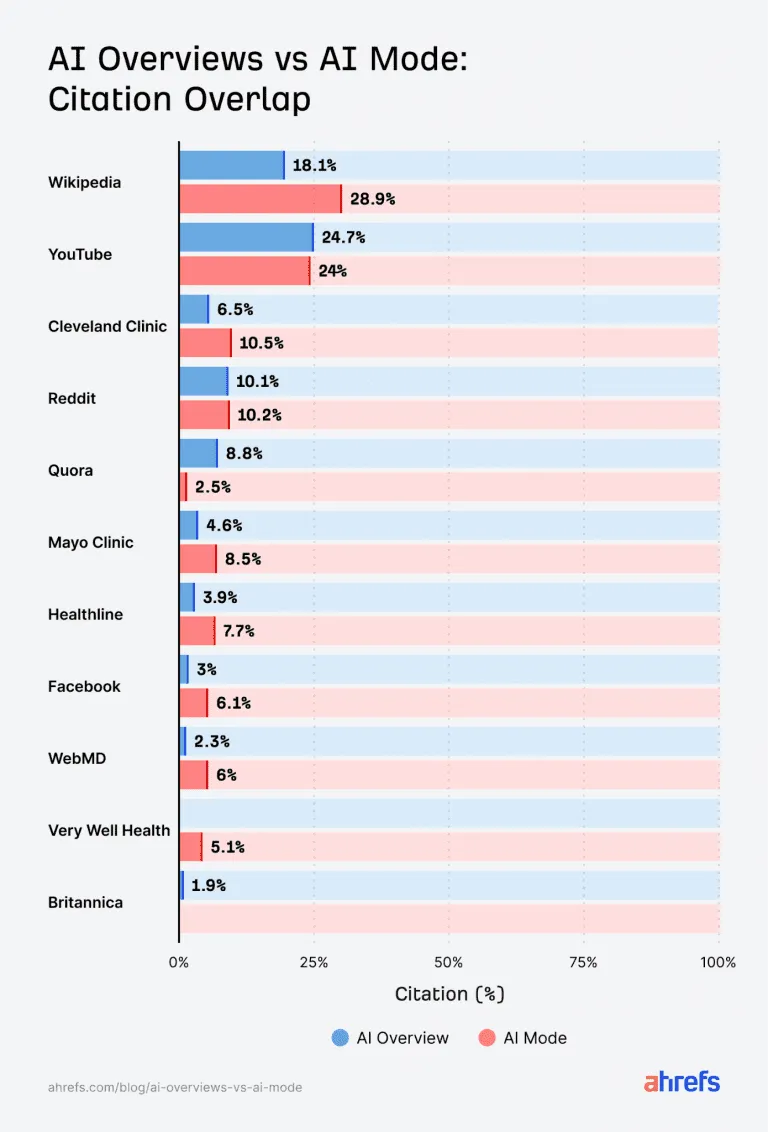
Image: Domain preferences of AI Mode and AI Overviews (Source)
AI Mode requires a somewhat broader content strategy because users can use it for deeper research and continue asking questions.
Instead of creating one page targeting one isolated keyword, consider building comprehensive topic coverage.
For example, a cybersecurity company shouldn’t only publish an article titled “What Is Endpoint Security?” A stronger AI-search-oriented content ecosystem might also cover:
- How endpoint security works
- Endpoint security vs. network security
- Common endpoint security threats
- Endpoint security for small businesses
- Endpoint protection best practices
- Endpoint security software comparisons
- Implementation challenges
- Compliance considerations
- Frequently asked questions
- Real-world use cases
This creates a connected body of information that can address different stages of a user’s research journey.
AI Mode’s citation patterns also make depth and source quality particularly important. The Ahrefs study found that Wikipedia appeared substantially more often in AI Mode citations than in AI Overviews, while Quora appeared about 3.5 times more frequently in AI Mode. Health websites were also cited much more frequently in AI Mode than in AI Overviews.
That does not mean every brand should attempt to copy Wikipedia or manufacture Quora mentions. Instead, it demonstrates that AI Mode draws from a broader range of detailed and reference-oriented sources.
A better approach is to:
- Create comprehensive articles that answer the main question and relevant follow-ups.
- Demonstrate first-hand expertise wherever possible.
- Support important claims with credible sources.
- Build authoritative mentions and links from relevant websites.
- Develop strong brand/entity recognition across your website and reputable third-party sources.
- Cover a topic from multiple perspectives, including comparisons, use cases, limitations, alternatives, and practical examples.
- Monitor AI Mode and AI Overviews independently instead of treating them as one visibility metric.
Google itself continues to evolve both experiences. Recent updates have focused on helping users discover relevant websites, deeper insights, and original content through AI Overviews and AI Mode. Google has also introduced features such as Preferred Sources to give users more ways to find high-quality and first-hand content.
Ultimately, the strongest strategy is not to “optimize for AI” through a separate set of tricks. Build a brand that is easy for search systems to understand, supported by credible evidence, consistently represented across the web, and genuinely useful to the people asking the questions. That foundation can support visibility across both AI Overviews and AI Mode, even though the two systems may choose different sources.
Platform Preferences: Understanding AI Search Citations
One of the biggest mistakes brands can make with AI search is assuming that every AI-generated result draws from the same websites. Google AI Overviews and AI Mode can answer the same question in similar ways while selecting different sources to support those answers.
A large analysis of 730,000 AI Overview and AI Mode response pairs found that the two experiences had about 86% semantic similarity, yet the same URLs appeared in only 13.7% of cases. This means a brand can be cited in an AI Overview without receiving the same citation in AI Mode.
The source preferences also show meaningful differences:
- AI Overviews show a stronger preference for video content and core website pages.
- AI Mode uses more encyclopedic and reference-style sources and includes more brand and entity mentions.
- Quora appeared substantially more often in AI Mode citations in the large-scale analysis.
- Wikipedia also appeared more frequently in AI Mode than in AI Overviews.
- Reddit showed comparatively similar citation levels between the two systems.
- Both experiences frequently use article-based content, reinforcing the importance of useful, well-structured written resources.
These differences do not mean brands should simply try to obtain mentions on Wikipedia, Quora, Reddit, or YouTube. The more useful lesson is that AI search evaluates information across a wider ecosystem than a brand’s own website.
For example, a company may publish an authoritative article on its own website, demonstrate expertise through video, earn coverage from respected industry publications, receive legitimate customer discussions on community platforms, and maintain consistent business information across the web. Together, these signals can create a stronger information footprint around the brand.
Google also explains that AI Mode can break a user’s question into multiple subtopics and search for information on those subtopics simultaneously. This “query fan-out” allows it to explore a broader collection of web content before generating an answer.
That makes source diversity and topical authority increasingly important. Instead of asking, “Which single website should I get cited on?”, brands should ask, “Does the wider web contain enough credible, consistent information to establish my brand as a relevant authority on this topic?”
Real Results: How Brands Can Appear in Google AI Overviews
There is no guaranteed method for forcing a website or brand into an AI Overview. Google determines when an AI Overview is useful and which sources should support the generated response. Google also states that AI responses can contain mistakes, which is why users should be able to investigate the underlying web sources.
For brands, the practical objective is therefore to increase the probability of being considered a useful, trustworthy source.
Several factors can contribute to that visibility.
Build strong topical authority
Create content that thoroughly addresses the questions your customers ask. Instead of publishing disconnected articles around individual keywords, build topic clusters covering definitions, comparisons, use cases, costs, benefits, limitations, alternatives, implementation questions, and frequently asked questions.
This gives search systems more context about what your business knows and the subjects for which it is relevant.
Strengthen your website’s authority
Quality backlinks and legitimate third-party references can help establish your website as an authoritative resource. However, the goal should not be to accumulate links indiscriminately.
A smaller number of relevant, editorially earned links from credible websites can be more valuable than large numbers of unrelated or low-quality links.
Give direct answers to important questions
AI-generated responses need information that can be understood and synthesized efficiently. Make important answers clear.
Use descriptive headings, concise explanations, definitions, supporting evidence, tables where appropriate, and logical internal linking. This benefits human readers while also making the information easier for search systems to interpret.
Demonstrate first-hand expertise
Generic content is unlikely to provide a strong competitive advantage when dozens of websites can say essentially the same thing.
Add original research, real examples, expert commentary, case studies, product experience, data, photographs, demonstrations, or other evidence that shows your business understands the subject beyond surface-level information.
Build recognition beyond your own website
AI search visibility is not exclusively an on-site SEO exercise. A brand can be discussed or referenced across news sites, industry publications, review platforms, social networks, video platforms, professional communities, and other authoritative sources.
The more consistent and credible those references are, the stronger the overall context surrounding the brand becomes.
One real-world case described in the source material illustrates the potential impact: a hyperbaric treatment center used a targeted link-building strategy to strengthen its authority and subsequently recorded 381 AI Overview appearances. That example demonstrates the potential connection between authority-building and AI search visibility, although it should not be interpreted as a guaranteed result for every business.
It is also important to recognize that visibility does not automatically equal website traffic. A 2026 study of Google Search behavior found that clicks to sources cited in AI Overviews were rare in its observed sample, occurring in roughly 1% of AI Overview visits.
That makes brand exposure, consideration, and citation presence important metrics alongside traditional organic clicks.
Strategic Takeaways for Your Brand to Optimize for AI Mode and AI Overviews
The most effective strategy is not to choose between AI Overviews and AI Mode. Instead, build a search strategy that supports visibility across both while recognizing their different behaviors.
1. Track AI Overviews and AI Mode separately
Do not use one AI visibility number to represent your entire performance.
Track important queries in both experiences and record:
- Whether your brand is mentioned
- Whether your website is cited
- Which page is cited
- Which competitors appear
- Which third-party sources are being cited
- How frequently your brand appears
- Whether your brand is associated with positive, neutral, or negative information
This makes it possible to identify gaps that conventional ranking reports cannot show.
2. Create content for both quick answers and deep research
AI Overviews often provide concise answers, while AI Mode is designed for deeper exploration and follow-up questions. Google describes AI Mode as its more powerful AI search experience, capable of breaking complex questions into subtopics and searching for relevant information across them.
Your content strategy should therefore include both:
Answer-focused content:
Clear definitions, FAQs, short explanations, comparisons, and direct answers.
Research-focused content:
Detailed guides, original research, case studies, expert analysis, comparisons, and comprehensive topic resources.
3. Invest in authority, not shortcuts
AI search optimization should not become a new name for keyword stuffing or artificial mention-building.
Focus on:
- Relevant backlinks
- Original research
- Expert contributions
- Industry publications
- Strong internal linking
- High-quality editorial content
- Consistent brand information
- Genuine customer experiences
- Helpful multimedia content
These activities strengthen your overall digital presence rather than attempting to manipulate one particular AI response.
4. Build a recognizable brand entity
AI systems need to understand who your company is, what it does, which products or services it offers, and how it relates to a particular topic.
Keep your business name, descriptions, products, services, authors, locations, and other important information consistent across your website and reputable third-party sources.
The objective is to make your brand more than a collection of pages. You want search systems to understand it as a recognizable entity within its industry.
5. Expand beyond your website
Because AI Mode can investigate multiple subtopics and sources, your brand’s external footprint matters.
Look for legitimate opportunities to earn visibility through:
- Industry publications
- Expert interviews
- Relevant news coverage
- YouTube and other video platforms
- Professional communities
- Customer reviews
- Partner websites
- Industry directories
- Original research and statistics
Do not pursue mentions simply for the sake of being mentioned. Relevance and credibility matter more than volume.
6. Prepare for more competition in AI Mode
AI Mode can mention more entities in a single response than AI Overviews. The large-scale study found an average of approximately 3.3 brand/person entities in AI Mode compared with 1.3 in AI Overviews.
So even if your brand earns a mention, you may be appearing alongside several competitors.
The goal is not merely to be mentioned. Your brand should have a clear reason to be included—such as expertise, relevance, distinctive information, strong reputation, or a useful product or service.
7. Do not assume one citation guarantees another
This is perhaps the most important strategic lesson.
The 13.7% URL overlap between AI Overviews and AI Mode demonstrates that the two experiences can select substantially different sources.
Therefore, measure and optimize them as related but distinct search surfaces.
A brand that consistently builds authority, produces genuinely useful content, and earns credible references across the web is better positioned to appear in both.
The Future of Brand Discovery
The future of brand discovery is no longer limited to traditional Google rankings. AI Overviews and AI Mode represent two distinct search experiences, each with different ways of interpreting queries, selecting sources, and presenting information. A brand may appear in one experience but remain absent from the other, even when both are responding to the same search. Understanding the difference between AI Overviews vs. AI Mode is therefore becoming an important part of modern AI search marketing.
Brands that want to remain visible in this changing search landscape need to build strategies that support both experiences. That means developing strong domain authority, earning relevant and high-quality backlinks, publishing comprehensive and genuinely useful content, strengthening brand recognition, and consistently monitoring where the brand appears across AI-powered search results. A broader approach to AI search optimization can create more opportunities for a brand to be discovered, cited, and considered throughout the customer journey.
If your business is ready to strengthen its presence in AI-powered search, Pro Real Tech can help. Our team combines AI SEO, strategic link building, content development, and search visibility strategies to help brands build stronger authority and increase their chances of earning meaningful visibility across emerging AI search experiences.
Ready to strengthen your brand’s AI search visibility? Contact Pro Real Tech today to discuss a customized AI search optimization and AI search marketing strategy for your business.
Frequently Asked Questions (FAQs) About AI Overviews vs. AI Mode
HOW CAN MY BRAND APPEAR IN GOOGLE AI OVERVIEWS?
There is no guaranteed way to make a brand appear in an AI Overview. The strongest approach is to build topical authority, publish accurate and useful content, strengthen your website’s authority, earn relevant backlinks, and establish credible brand references across the web.
Make sure your pages directly answer important customer questions and are technically accessible to search engines. Google determines when an AI Overview appears and which sources it uses, so optimization should focus on making your content genuinely useful and trustworthy rather than trying to force a citation.
WHICH PLATFORMS DO AI OVERVIEWS AND AI MODE PREFER FOR CITATIONS?
The two systems have different citation patterns. Large-scale research found that AI Overviews showed stronger use of video and core website pages, while AI Mode relied more heavily on encyclopedic sources such as Wikipedia and cited Quora more frequently. Reddit appeared at relatively similar rates in both systems.
These are observed tendencies, not fixed rules. Citation patterns can change depending on the query, topic, location, language, and Google’s evolving systems.
WHAT IS AI SEARCH VISIBILITY AND WHY DOES IT MATTER?
AI search visibility is the extent to which your brand, website, products, services, or expertise appear in AI-generated search experiences.
It matters because users can now receive answers without following the traditional path of clicking through multiple search results. Google says AI Overviews are designed to provide an AI-generated snapshot with links for users who want to explore further.
For brands, this means visibility can happen before a conventional website visit. Being recognized and mentioned in an AI answer can influence awareness and consideration even when the user does not immediately click through.
WHAT IS AI SEARCH MARKETING AND HOW SHOULD I APPROACH IT?
AI search marketing is the broader practice of increasing a brand’s visibility within AI-powered search and answer experiences.
A practical approach combines traditional SEO with:
- Topical authority
- High-quality content
- Brand/entity optimization
- Digital PR
- Relevant backlinks
- Original research
- Multimedia content
- Reputation management
- Third-party brand mentions
- AI visibility monitoring
Rather than optimizing for a single AI feature, build an authoritative digital presence that gives multiple search systems reliable information about your business.
IF MY BRAND APPEARS IN AI OVERVIEWS, WILL IT ALSO APPEAR IN AI MODE?
Not necessarily.
Research involving 730,000 response pairs found that when an entity appeared in an AI Overview, AI Mode included that entity about 61% of the time. However, AI Mode frequently added other entities as well.
So an AI Overview appearance is a positive signal, but it should not be treated as a guarantee of AI Mode visibility.
WHAT ROLE DO BRAND ENTITIES PLAY IN AI SEARCH CITATIONS?
Brand entities help AI systems connect information about a company across different sources.
For example, if your company’s name, products, leadership, services, expertise, and industry associations are consistently represented across authoritative sources, search systems have more context for understanding the brand.
This is especially relevant to AI Mode because it tends to mention more entities than AI Overviews. In the large-scale analysis, AI Mode averaged about 3.3 people or brand entities per response compared with 1.3 for AI Overviews.
The practical goal is to build consistent, credible brand recognition, not simply increase the number of times your company name appears online.
IS AI MODE MORE ACCURATE THAN AI OVERVIEW?
Not automatically.
AI Mode is designed for deeper research and can search across multiple subtopics, while AI Overviews provide a more concise AI-generated snapshot.
More detail does not necessarily mean greater accuracy. Both systems can make mistakes, and Google explicitly warns that AI-generated responses may contain errors.
For important decisions—especially medical, financial, legal, safety, or other high-stakes topics—users should inspect the cited sources and verify critical information independently.
HOW IS AI MODE DIFFERENT FROM AI OVERVIEWS?
The simplest distinction is depth and interaction.
AI Overviews appear within the regular Google Search results when Google determines that an AI-generated snapshot would be useful. They are primarily designed to help users understand a topic quickly.
AI Mode is a dedicated conversational search experience that supports follow-up questions, deeper research, and more complex queries. Google says it can break a question into multiple subtopics and search for information on them simultaneously.
For brands, this means AI Overviews can represent a concise discovery opportunity, while AI Mode can create a broader research environment in which several brands and sources may be considered.
CAN AI OVERVIEW PROVIDE INCORRECT ANSWERS?
Yes.
Google explicitly states that AI responses may include mistakes. Generative AI can misunderstand a question, synthesize information incorrectly, rely on incomplete sources, or produce an answer that sounds convincing but is not fully accurate.
That is why citations matter. Users should follow the links and check the original sources when accuracy is important.
Brands should apply the same principle to their own content: publish information that is accurate, clearly sourced where appropriate, regularly reviewed, and updated when facts change.
IS CHATGPT BETTER THAN GOOGLE?
There is no universal winner because ChatGPT and Google Search are designed around different experiences, and both continue to evolve.
Google’s advantage is its deep integration with web search, current search results, maps, shopping, businesses, and other Google services. Its AI search experiences can combine generated answers with links to web sources. AI Mode is specifically designed for conversational search and deeper exploration.
ChatGPT, meanwhile, is designed primarily as a conversational AI assistant and can also use web search and provide sources when web access is available.
For brands, the better question is not “Which platform is better?” but “Where are my customers researching, and how visible is my brand there?”
If Google Search is an important acquisition channel for your business, AI Overviews and AI Mode should now be part of your search visibility strategy. At the same time, brands should not limit their AI visibility efforts to Google alone. Customers increasingly use multiple AI and search platforms to research products, services, companies, and solutions.
Read More: How To Leverage Your Paid Ads Account for AI Visibility


