


Google reviews have become an important part of how customers evaluate local businesses. Before calling a service provider, visiting a restaurant, booking an appointment, or making a purchase, people often check a business’s Google rating and read recent customer feedback. That makes reviews valuable not only for reputation but also for local visibility and consumer trust.
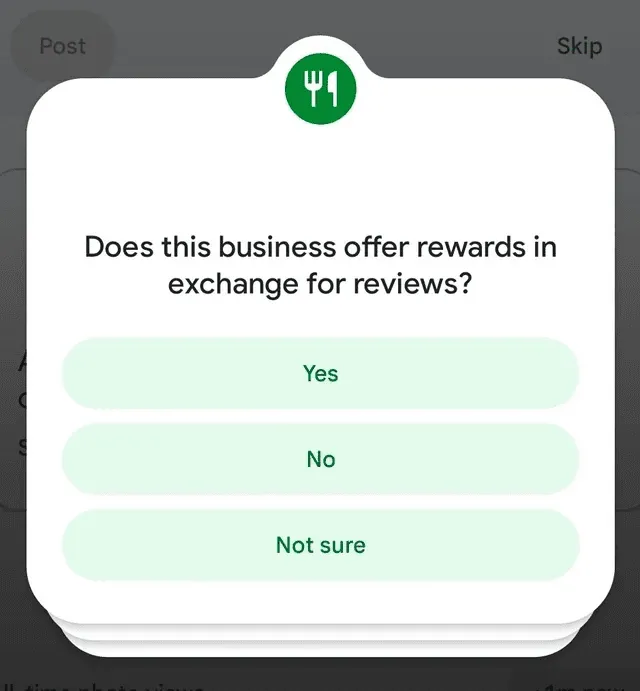
At the same time, Google is paying closer attention to whether reviews represent genuine customer experiences. A recent development has drawn attention to this issue: Google has been asking some users whether a business offered them a reward or incentive for leaving a review. The question is significant because incentives can influence what customers post and can undermine the authenticity of review content.
This does not mean that asking customers for reviews is prohibited. Businesses can still legitimately encourage customers to share their experiences. Google even provides businesses with tools to create a direct review link or QR code and recommends using channels such as receipts, thank-you emails, chat interactions, and in-store materials to make review requests easier.
The important distinction is how the review is requested. Asking a customer to honestly describe their experience is different from offering money, a discount, a free product, or another benefit in exchange for posting a review. Google classifies incentivized reviews as fake engagement and prohibits businesses from offering incentives for reviews, review changes, or the removal of negative reviews.
For businesses that depend on Google Business Profile visibility, this distinction matters. A review strategy that produces more reviews in the short term can create much bigger problems if those reviews are influenced by rewards or other forms of manipulation. Understanding Google’s current policy can help businesses build a review acquisition process that supports long-term reputation and local SEO without putting their Business Profile at unnecessary risk.
What Is Google Asking Customers About “Google Review Rewards”?
(Source)
The phrase “Google Review Rewards” does not refer to an official Google rewards program that businesses can use to pay customers for reviews. Rather, it describes the practice of businesses offering customers some type of benefit in connection with leaving a Google review.
The recent attention comes from Google asking users questions designed to identify whether reviews may have been influenced by incentives. The underlying concern is straightforward: Was the customer given something of value in exchange for posting, changing, or removing a review?
An incentive can take different forms. For example, a business might tell customers:
- “Leave us a Google review and receive 10% off your next purchase.”
- “Post a five-star review and receive a free item.”
- “Review our business and enter a prize drawing.”
- “Change your negative review to a positive one and we’ll give you a discount.”
- “Remove your negative Google review and receive a refund or complimentary service.”
These arrangements create a connection between the customer’s benefit and the review activity. Under Google’s current policy, that connection is prohibited. Google specifically identifies payments, discounts, free goods or services, and other benefits offered in exchange for reviews as examples of incentivized or biased reviews.
Why Is Google Asking About Review Incentives?
The goal is to protect the reliability of information that appears on Google Maps and Business Profiles. Reviews are supposed to represent genuine experiences and provide potential customers with an authentic picture of what it is like to interact with a business.
When customers receive something in return for reviewing a business, the incentive can affect whether they leave a review, what they say, or how they rate the business. This can make the review less representative of normal customer sentiment.
Google’s policy therefore treats incentivized reviews as a form of fake engagement, even when the person leaving the review is a real customer. The issue is not necessarily whether the customer actually visited or purchased from the business; it is whether the review was influenced by a prohibited benefit.
This is an important distinction for businesses. A genuine customer can still create a policy-violating review if the business offered an incentive specifically in exchange for that review.
Does Asking About Rewards Mean Google Is Banning Review Requests?
No. Businesses are still allowed to ask customers for honest feedback.
Google’s own guidance says businesses can encourage customers to leave reviews through a review link or QR code. Businesses can include those requests on receipts, thank-you emails, chat interactions, or printed materials.
The problem begins when the request attempts to influence the customer’s decision or rating through a reward.
A compliant request might say:
“We’d appreciate your honest feedback about your experience with our business.”
A problematic request would connect the review to a benefit:
“Leave us a Google review and receive 15% off your next purchase.”
The first request gives the customer freedom to decide whether and how to review the business. The second provides a financial incentive for posting content.
Businesses should also avoid asking only happy customers for positive reviews, discouraging negative feedback, pressuring customers to provide a particular rating, or requesting specific wording. Google’s policies prohibit merchants from selectively soliciting positive reviews or attempting to influence the rating or content of a review.
Are Businesses Allowed To Offer Rewards for Google Reviews Under Google’s Reviews Policy?
(Source)
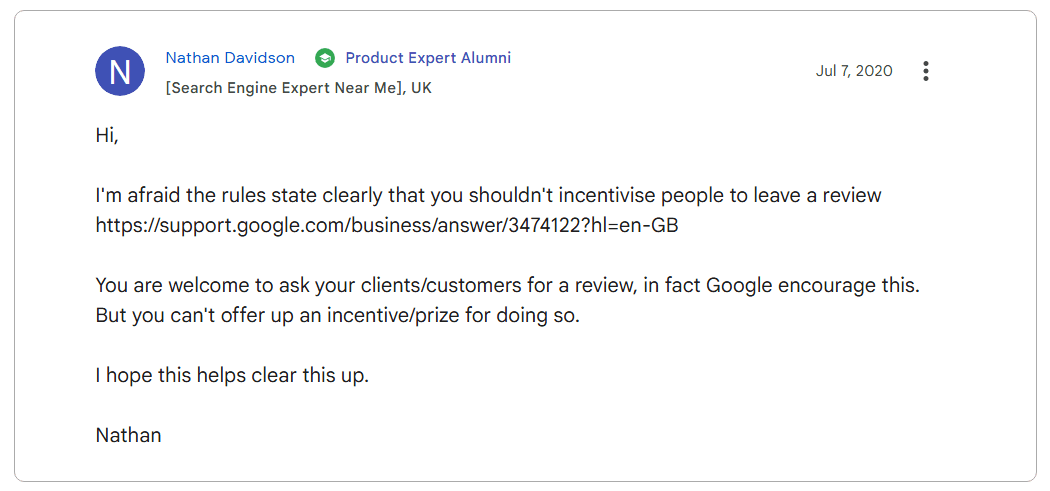
No. Businesses should not offer rewards in exchange for Google reviews. Google’s current policy explicitly prohibits incentives such as payments, discounts, free goods or services, or other benefits when they are offered in exchange for posting a review, changing a review, or removing a negative review.
This applies even if the business is confident that its customers are genuine and even if the business does not explicitly ask for a five-star rating.
For example, this is still problematic:
“Leave an honest review—good or bad—and get $5 off your next order.”
Although the business has not directly demanded a positive review, it is still offering a benefit in exchange for posting a review. Google’s policy identifies this type of incentivized activity as prohibited.
Similarly, a business should not run promotions such as:
- “Review us to get a discount.”
- “Leave a review to receive a free product.”
- “Write a Google review to enter our giveaway.”
- “Change your rating and receive a coupon.”
- “Delete your negative review and we’ll provide compensation.”
Google’s policy specifically includes incentives connected to posting, revising, or removing reviews, so businesses should not try to bypass the policy by rewarding customers for changing or deleting existing feedback.
What About a Reward That Isn’t Directly Tied to a Positive Review?
The safest approach is to avoid linking any customer benefit to a Google review.
For example, a business could legitimately run a general customer loyalty program where customers receive points for purchases. However, those points should not depend on whether the customer leaves a Google review or on what rating they give.
The key question is:
Would the customer receive the benefit regardless of whether they reviewed the business?
If the benefit is conditional on submitting, changing, or removing a review, the arrangement can fall within Google’s prohibited incentive rules. Google’s policy focuses on the connection between the benefit and the review activity rather than simply whether the customer is an actual customer.
Can Businesses Ask for Reviews Without Offering Rewards?
Yes. In fact, this is the recommended approach.
A business can ask customers to share an honest and unbiased review after a genuine interaction. Google provides a review link and QR-code feature specifically to make this process easier. Businesses can share the link through email, WhatsApp, Facebook posts, receipts, thank-you messages, or other appropriate customer communication channels.
A compliant review strategy should focus on making feedback easy, voluntary, and authentic rather than trying to manufacture a particular rating.
For example:
“Thanks for choosing our business. If you have a moment, we’d appreciate your honest feedback on Google.”
This approach does not promise a reward, demand a five-star rating, or tell the customer what to write.
What If a Business Already Offered Review Rewards?
Businesses that have previously used review incentives should not simply continue the campaign because the reviews came from real customers. They should review their process and remove any connection between rewards and Google reviews.
Google can remove reviews that violate its policies, and businesses found to have violated the Fake Engagement policy may face additional restrictions on their Business Profile. Potential restrictions can include temporarily preventing new reviews or ratings, temporarily unpublishing existing reviews, or displaying a warning to consumers that fake reviews were removed.
Google does not need to treat every customer review as suspicious merely because a business has a strong rating. The important issue is whether there is evidence or signals of prohibited activity.
For that reason, businesses should build their review strategy around real customer experiences rather than incentives, selective solicitation, rating manipulation, or artificial review generation.
The takeaway is simple: Google reviews are valuable, but businesses should earn them through customer experience—not purchase them through rewards. A consistent process for requesting honest feedback can generate legitimate reviews while protecting the credibility of the business’s Google Business Profile and supporting sustainable local search visibility.
What Counts as an Incentivized Review?
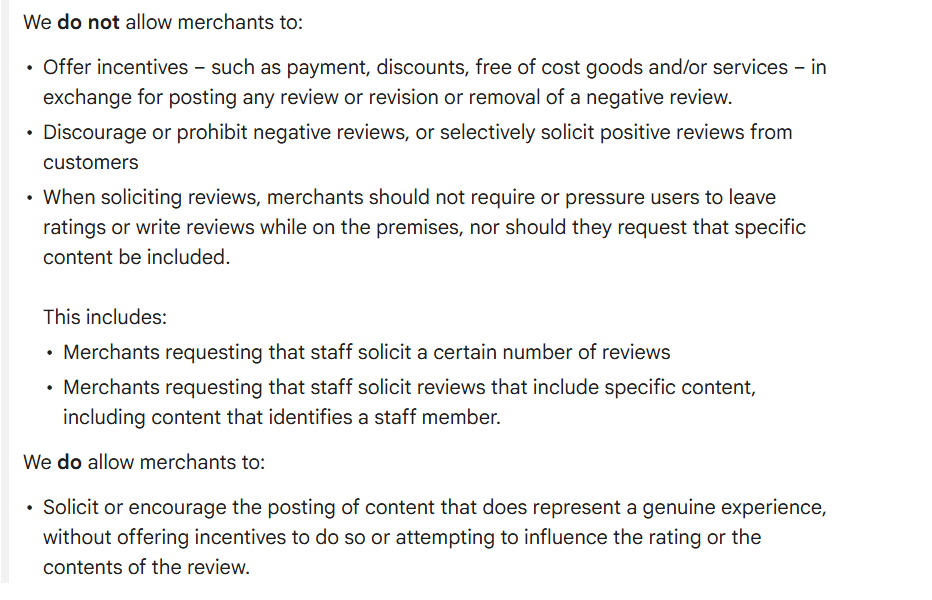
An incentivized review is a Google review or rating that has been influenced by a payment, discount, free product or service, gift, or another benefit offered to the person leaving the review. Google’s current Maps User-Generated Content Policy explicitly identifies reviews influenced by incentives as prohibited content because these arrangements can undermine the integrity of customer feedback and mislead people who rely on reviews when choosing a business.
(Source)
Importantly, an incentivized review does not have to be completely fabricated to violate Google’s policy. A customer may have genuinely purchased from or visited the business and still create a policy-violating review if the business offered something in exchange for posting, changing, or removing it.
Common examples include:
- Discounts for reviews: “Leave us a Google review and receive 10% off your next order.”
- Cash or gift cards: Paying customers a fixed amount for submitting a review.
- Free products or services: Giving away an item, upgrade, consultation, or service in exchange for feedback.
- Contest or giveaway entries: Automatically entering customers into a prize drawing when they post a Google review.
- Store credit or loyalty points: Awarding credits specifically because a customer submitted a review.
- Benefits for changing a review: Offering compensation if a customer changes a low rating to a higher rating.
- Benefits for deleting negative feedback: Offering a refund, discount, replacement, or other benefit in exchange for removing a negative review.
Google’s policy specifically prohibits offering incentives for posting a review, revising a review, or removing a negative review.
What About Asking for an Honest Review?
Simply asking customers to share their experience is different from incentivizing them.
Google allows businesses to encourage customers to leave reviews as long as the review represents a genuine experience and the business does not offer an incentive or attempt to manipulate its content or rating. Google also recommends using a review link or QR code to make it easier for customers to submit feedback.
For example, this is generally appropriate:
“Thank you for choosing us. We’d appreciate your honest feedback about your experience on Google.”
The customer is free to leave a review—or not—and is not promised anything for doing so.
By contrast:
“Leave a Google review and get $10 off your next purchase.”
creates a direct connection between the review and a financial benefit. That is the type of arrangement Google’s policy prohibits.
Businesses should also avoid review gating, where customers who appear satisfied are directed toward Google reviews while unhappy customers are discouraged from posting. Google says merchants should not discourage negative reviews or selectively solicit positive reviews.
The safest rule is simple: ask for genuine feedback, but never make a reward conditional on receiving, changing, or removing a Google review.
Are Incentivized Reviews Considered Fake Google Reviews?
They can be considered fake engagement under Google’s policies, even when the reviewer is a genuine customer. This distinction is important.
A “fake review” does not necessarily mean that the reviewer invented the entire customer experience. Google’s policy focuses more broadly on whether the review represents genuine, unbiased engagement and whether the content was influenced or manipulated. Google classifies incentivized reviews under its Fake Engagement policy.
Consider two scenarios.
Scenario 1: Genuine but incentivized
A customer visits a restaurant, has a real meal, and receives a $5 discount after posting a Google review.
The customer is real, the visit is real, and the experience is real. However, the review was influenced by an incentive. Under Google’s policy, the incentive makes the review prohibited.
Scenario 2: Completely fabricated
A business pays people who have never visited the location to create Google accounts and post positive reviews.
This involves an even more obvious form of fake engagement because the reviews do not represent genuine experiences.
Both situations undermine the reliability of Google’s review ecosystem, although the underlying conduct is different.
Google states that Maps contributions should reflect genuine experiences and that fake engagement is not allowed. Its policy specifically includes content posted because of incentives such as payment, discounts, or free goods and services.
Why Incentives Make Reviews Less Trustworthy
The problem with incentives is that they can influence whether someone reviews, what they say, or how they rate the business.
For example, a customer who would normally never leave a review might post one because the business offers a discount. Another customer might give a higher rating than they otherwise would because they want to receive a reward.
That creates a distorted picture of customer sentiment.
The same issue applies when a business offers something in exchange for changing or deleting a negative review. Google explicitly includes those practices within its prohibited incentive rules.
This is why businesses should not assume that saying “We only reward honest reviews” makes an incentive compliant. The issue is not simply whether the business demanded five stars. The underlying problem is that a benefit was offered in connection with the review itself.
Incentivized Reviews vs. Negative Reviews
Businesses should also understand that a negative review is not automatically a bad or prohibited review.
Google’s guidance says businesses should value honest and balanced reviews, and legitimate negative feedback can remain visible. Businesses should not report reviews simply because they dislike them; reviews are eligible for removal when they violate Google’s policies.
A healthy review profile can contain both positive and negative feedback. What matters is whether those reviews reflect authentic customer experiences.
What Could Happen if Your Business Commits Google Review Violations?
Violating Google’s review policies can affect more than individual reviews. Depending on the circumstances, Google may remove violating reviews and impose restrictions on the Business Profile.
Google currently lists several potential Business Profile restrictions for violations of its Fake Engagement policy.
1. Reviews May Be Removed
If Google identifies reviews that violate its policies, those reviews can be removed from Maps and Search. Google’s policy specifically states that incentivized or biased reviews are not allowed and will be removed.
This can quickly reduce the review count a business has spent months or years building.
For example, a company that accumulated dozens of reviews through a discount campaign could eventually lose some or all of those policy-violating reviews if Google identifies them.
2. New Reviews May Be Temporarily Blocked
Google can restrict a Business Profile from receiving new reviews or ratings for a set period when it determines that the profile has violated its Fake Engagement policy.
This can be particularly damaging for local businesses because reviews are an ongoing source of customer trust.
A business may have legitimate customers who want to leave feedback, but a posting restriction can temporarily prevent those customers from doing so.
3. Existing Reviews May Be Temporarily Unpublished
Google may also temporarily unpublish existing reviews or ratings associated with a Business Profile when it identifies policy violations.
That means the impact can extend beyond the specific reviews that triggered the problem.
4. Google May Display a Warning to Customers
One of the more visible consequences is a potential warning banner on the Business Profile informing consumers that fake reviews were removed.
Google’s current guidance says these consumer alerts can appear when suspicious review activity is detected or when a business violates its policies.
This can create a reputation problem that is potentially more damaging than simply losing a few reviews. A customer who sees a warning about removed fake reviews may become more cautious about doing business with that company.
5. Repeated Policy Violations Can Create Broader Account Risks
Google’s Business Profile policies also allow for account-level restrictions when there is a pattern of policy violations. In certain circumstances, access to a Business Profile can be restricted, and profiles associated with a restricted account can also be affected.
This is why businesses should not treat review incentives as a harmless marketing shortcut.
Can a Business Appeal a Restriction?
Yes. Google provides an appeal process for Business Profile restrictions. When an appeal is submitted, Google can review the profile and the additional context supplied by the business.
However, an appeal should not be viewed as a reason to continue risky review practices. The better approach is to identify the source of the violation, stop the prohibited activity, and establish a compliant review-generation process.
Why This Matters for Local SEO
Google reviews are closely connected to the way consumers discover and evaluate local businesses. They appear alongside Business Profiles in Google Search and Maps and can provide potential customers with information about a company’s products, services, and customer experience.
That makes review quality an important part of a broader local SEO and reputation strategy.
However, businesses should not confuse getting more reviews with getting better local SEO results. A large number of reviews obtained through prohibited methods can create more risk than value.
Reviews Influence Customer Trust
When someone searches for a local business, reviews can help them decide which company to contact.
A business with genuine, recent, detailed feedback can give prospective customers additional confidence. On the other hand, a profile affected by suspicious review activity or a Google warning can create the opposite reaction.
Review authenticity matters as much as review quantity.
Policy Compliance Protects Your Local Presence
Local SEO depends on maintaining a healthy Google Business Profile. If a business receives a restriction that temporarily prevents new reviews or causes existing reviews to be unpublished, its local search presence can become less persuasive to potential customers.
For businesses that rely heavily on Maps and local search leads, losing access to normal review activity can be a significant setback.
Review Velocity Should Come From Real Customers
Businesses sometimes become focused on achieving a specific number of new reviews every week or month. That can encourage employees or marketing teams to use aggressive tactics.
A better approach is to create a repeatable customer-feedback process:
- Deliver a strong customer experience.
- Ask customers for honest feedback after a genuine interaction.
- Provide a direct Google review link or QR code.
- Avoid offering rewards for reviews.
- Don’t pressure customers to leave a specific rating.
- Don’t selectively discourage negative feedback.
- Respond professionally to both positive and negative reviews.
- Monitor the profile for policy issues and suspicious activity.
Google itself recommends reminding customers to leave reviews, sharing a review link or QR code, responding to reviews, and valuing honest feedback.
Quality and Authenticity Matter More Than Short-Term Numbers
The appearance of Google’s questions about review rewards is another reason businesses should reconsider shortcut-based review strategies. While the prompt reported in 2026 does not by itself represent a new review policy, it is consistent with Google’s existing focus on detecting incentivized and manipulated engagement.
For local businesses, the long-term objective should therefore be broader than simply increasing the star rating. The goal is to build a credible review profile that accurately reflects customer experiences.
That means earning reviews through service quality, making it easy for customers to provide feedback, responding constructively to criticism, and keeping every part of the review process compliant with Google’s guidelines.
Ultimately, authentic reviews are a local SEO asset because they support both search visibility and customer confidence. Incentivized reviews may appear to offer a quick way to increase review volume, but the potential loss of reviews, posting restrictions, consumer warnings, and reputational damage can make that shortcut far more expensive than building genuine customer feedback over time.
How To Get More Google Reviews Without Breaking Policy
Getting more Google reviews does not require discounts, giveaways, gift cards, or other incentives. In fact, the safest approach is to build a repeatable process that makes it easy for genuine customers to share honest feedback after a real interaction with your business.
Google allows businesses to ask customers for reviews and provides tools such as review links and QR codes to simplify the process. The important limitation is that businesses should not manipulate the rating, selectively solicit only positive reviews, discourage negative feedback, or offer something of value in exchange for posting, changing, or removing a review.
1. Ask Customers at the Right Time
Timing can make a significant difference in whether customers respond to a review request.
Consider asking after:
- A successful purchase or completed service
- A customer has expressed satisfaction
- A problem has been resolved
- A project has been completed
- A repeat customer has had another positive interaction
- A delivery or appointment has been successfully completed
The request should remain voluntary. Instead of asking for a five-star review, ask for an honest review based on the customer’s actual experience.
For example:
“Thank you for choosing us. If you have a moment, we’d appreciate your honest feedback on Google.”
This approach encourages authentic participation without telling customers what rating or wording to use.
2. Make the Review Process Easy
Customers may be willing to leave feedback but abandon the process if they have to search for your business manually.
Use Google’s review link or QR-code functionality to send customers directly to the appropriate review page. You can include the link in customer emails, receipts, follow-up messages, invoices, or other legitimate communications.
The objective is to remove unnecessary friction—not to influence the content of the review.
3. Ask Your Customers Consistently
A review strategy works better when review requests are part of your normal customer journey rather than an occasional campaign.
For example, a home-service company could automatically send a review request after completing a job. A restaurant could include a review invitation in a post-visit message. A professional service provider could request feedback after delivering a completed project.
Consistency helps generate a natural flow of feedback instead of creating an artificial spike in reviews.
4. Ask for Honest Feedback, Not Positive Reviews
Avoid language such as:
- “Give us five stars.”
- “Leave a positive Google review.”
- “Only mention the good parts.”
- “Don’t post anything negative.”
Instead, encourage customers to describe their genuine experience.
This distinction matters because Google’s policies prohibit businesses from engaging in practices that manipulate review content or ratings.
5. Respond to the Reviews You Receive
Review generation should not be the end of your reputation strategy.
Responding professionally demonstrates that the business pays attention to customer feedback. Positive reviews can receive a brief, personalized thank-you, while negative reviews should be addressed calmly and constructively.
For businesses receiving a high volume of feedback, monitoring and response management can become difficult to handle manually. A structured reputation management process can help businesses monitor reviews, respond consistently, and identify recurring customer concerns.
6. Improve the Customer Experience Behind the Reviews
The most sustainable way to increase positive reviews is to give customers something worth talking about.
Look for recurring themes in your existing feedback:
- What do customers praise most?
- Where do complaints repeatedly occur?
- Which employees receive positive mentions?
- Are customers experiencing delays?
- Are expectations being communicated clearly?
- Is the post-purchase experience satisfactory?
Reviews can therefore become more than a reputation metric. They can provide useful customer feedback that helps improve the underlying business experience.
7. Never Buy Reviews or Create Artificial Review Activity
Avoid purchasing reviews, using review farms, asking people who have not used your business to review it, or creating multiple accounts to increase your rating.
These tactics can create serious policy and reputation risks because Google requires reviews to represent genuine experiences.
A smaller collection of authentic reviews is far more sustainable than a large review count built through questionable methods.
What To Do if You Currently Offer Review Incentives
If your business currently offers discounts, gift cards, free products, cash, loyalty points, or another benefit specifically for Google reviews, the first step is to stop connecting the reward to the review.
Do not assume the program is safe simply because the people leaving the reviews are genuine customers. Google’s policy focuses on whether the review was influenced by a prohibited incentive. Incentives can include benefits offered for posting a review as well as benefits connected to changing or removing a review.
Step 1: Stop the Incentive Campaign
Pause any campaign that says or implies:
“Leave a Google review and receive a reward.”
Also stop campaigns that offer benefits for:
- Increasing a star rating
- Editing a negative review
- Removing negative feedback
- Posting a particular type of review
- Writing a review within a certain timeframe in exchange for a benefit
The goal should be to completely separate customer rewards from Google review activity.
Step 2: Review How the Program Was Implemented
Look at your existing emails, SMS messages, receipts, employee scripts, QR-code cards, loyalty programs, and marketing materials.
Search for language that connects a reward to a review.
For example, determine whether employees were instructed to say:
“Leave us a review and we’ll give you a discount.”
or whether automated messages offered rewards for submitting feedback.
This audit can help identify where the problematic practice entered your customer journey.
Step 3: Identify Potentially Affected Reviews
Create an internal record of reviews that may have been generated through the incentive campaign.
Do not attempt to manipulate, rewrite, or delete customer reviews yourself simply to make the profile look cleaner. Instead, review the situation carefully against Google’s policies and consider professional guidance if a significant number of reviews may have been affected.
Step 4: Replace the Strategy With Policy-Compliant Requests
Once the incentive is removed, continue asking genuine customers for honest feedback.
For example:
“Thanks for choosing our business. We’d love to hear about your experience. You can share your honest feedback on Google here.”
There is no promise of a reward and no request for a specific rating.
Step 5: Train Your Employees
Employees can unintentionally violate review policies if they are measured only on the number of reviews they generate.
Give staff clear instructions:
- Ask for honest feedback.
- Never promise a reward for a Google review.
- Never request a specific star rating.
- Never pressure customers to change negative reviews.
- Never ask customers to remove negative reviews in exchange for compensation.
- Never create reviews for customers.
- Never submit reviews on behalf of customers.
This creates a much safer review-generation process.
Step 6: Monitor Your Google Business Profile
After changing your strategy, continue monitoring your profile for unusual review activity, disappearing reviews, customer complaints, or policy notifications.
If Google has already applied a restriction to your Business Profile, follow Google’s official appeal and remediation process rather than attempting to work around the restriction.
The objective is not simply to recover lost reviews. It is to establish a review-generation system that remains sustainable as Google’s policies and enforcement mechanisms evolve.
How Pro Real Tech Can Help
Managing Google reviews involves more than asking customers to leave feedback. Businesses also need to monitor their online reputation, maintain an accurate Google Business Profile, respond to customer feedback, and connect review management with their broader local SEO strategy.
Pro Real Tech provides online reputation management and local SEO services designed to help businesses strengthen their digital presence and manage customer feedback more strategically. Its online reputation management services include review monitoring, review acquisition, survey management, real-time alerts, listings management, and review responses.
Pro Real Tech also provides Google Business Profile management, helping businesses optimize and manage their profile to support local visibility and trust. Its local SEO services cover areas including Google Business Profile optimization, local keyword research, local citations, review management, local link building, reputation management, and performance monitoring.
This can be particularly useful for businesses that are trying to increase their review volume without relying on risky incentives. Instead of focusing only on the number of stars, a structured reputation strategy can help businesses:
- Monitor customer reviews across relevant platforms
- Create a consistent review-acquisition process
- Respond to customer feedback professionally
- Identify negative feedback quickly
- Strengthen Google Business Profile management
- Maintain accurate business listings
- Improve local search visibility
- Build greater customer trust
- Track reputation and local SEO performance
Pro Real Tech’s reputation management process also includes consultation, goal definition, online presence auditing, and competitor analysis, giving businesses a structured foundation for improving and protecting their online reputation.
For businesses concerned about Google review rewards, incentivized reviews, disappearing reviews, or broader reputation-management challenges, getting the process reviewed before continuing an existing campaign can help reduce unnecessary risk.
Ready to build a stronger and more policy-conscious review strategy? Contact Pro Real Tech today to discuss your online reputation and local SEO needs and create a sustainable approach to generating genuine customer feedback.
Frequently Asked Questions (FAQs)
Is Google Asking Customers About Businesses Offering Review Rewards?
Google has been reported to ask some users questions about whether businesses offered rewards or incentives for reviews. The question is relevant because Google’s existing policies prohibit incentivized reviews and other forms of fake engagement.
This should not be interpreted as Google banning businesses from asking customers for reviews. Businesses can still request honest feedback; they simply should not offer benefits in exchange for reviews or manipulate what customers say.
Can Businesses Offer Rewards for Google Reviews?
No. Businesses should not offer money, discounts, free products, services, gifts, or other benefits specifically in exchange for Google reviews.
The safest approach is to request honest feedback without attaching any financial or promotional benefit to the customer’s decision to review.
Is It Against Google Policy To Offer Review Incentives?
Yes. Google’s Fake Engagement policy prohibits incentives connected to posting reviews. The policy also addresses incentives offered for revising or removing reviews.
A customer being genuine does not make an incentivized review compliant. The problem is the influence created by the reward.
Are Incentivized Google Reviews Allowed?
No. Google does not allow businesses to incentivize customers to post reviews.
This includes arrangements involving discounts, free products or services, payments, gifts, or other benefits when those benefits are conditional on review activity.
What Does the Google Reviews Policy Say About Incentives?
Google’s policy prohibits fake engagement, including content posted because of an incentive offered by a business. Examples include payment, discounts, free products or services, and other benefits provided in exchange for reviews. The policy also addresses incentives for revising or removing negative reviews.
Businesses should therefore keep customer rewards and Google review requests completely separate.
What Is the Google Business Profile Review Policy?
Google’s review policies require reviews to represent genuine experiences and prohibit practices that manipulate ratings or review content.
Businesses can encourage customers to leave honest reviews, but they should not:
- Buy or manufacture reviews
- Offer incentives for reviews
- Pressure customers to provide particular ratings
- Selectively solicit positive reviews
- Discourage legitimate negative feedback
- Ask customers to change or remove negative reviews in exchange for a benefit
Google’s enforcement can apply to both individual reviews and Business Profiles.
Does the Google Maps Review Policy Allow Review Rewards?
No. Google’s Maps User-Generated Content Policy prohibits incentivized reviews. Offering something of value in exchange for a review can make the resulting content prohibited even when the reviewer is an actual customer.
Can Google Remove Incentivized Reviews?
Yes. Reviews that violate Google’s policies can be removed.
Depending on the circumstances, Google may also impose Business Profile restrictions related to fake engagement. These can include temporarily preventing new reviews or ratings, temporarily unpublishing existing reviews, or displaying a warning to consumers that fake reviews were removed.
Are Incentivized Reviews the Same as Fake Google Reviews?
They fall under Google’s broader concept of fake engagement, but an incentivized review does not necessarily mean the reviewer fabricated their customer experience.
For example, a real customer who received a discount for posting a review may have genuinely purchased from the business. However, the review can still violate Google’s policy because it was influenced by an incentive.
A completely fabricated review from someone who never used the business is a different form of prohibited activity.
How Can Businesses Get More Google Reviews Legitimately?
Businesses can increase genuine reviews by making it easy for real customers to provide honest feedback.
Effective approaches include:
- Ask after genuine customer interactions.
- Use Google’s review link or QR code.
- Include review requests in appropriate follow-up communications.
- Ask for honest feedback rather than five-star reviews.
- Make the request part of a consistent customer journey.
- Respond professionally to existing reviews.
- Use customer feedback to improve service quality.
- Never offer rewards in exchange for reviews.
- Never buy reviews or manufacture customer experiences.
- Monitor your Google Business Profile and broader online reputation.
Pro Real Tech’s reputation management services include review monitoring, review acquisition, survey management, real-time alerts, listings management, and review responses, while its local SEO services incorporate Google Business Profile optimization and review management.
Read More: How To Reduce Low-Quality Leads From Your Website


