

For years, marketers have predicted the death of outbound marketing. As inbound strategies like SEO, content marketing, social media and organic brand building became more effective, many businesses started believing that traditional outreach methods no longer worked. Buyers became harder to reach, ad fatigue increased, email inboxes became crowded and cold outreach developed a negative reputation.
But in 2026, the reality looks very different.
Outbound marketing is not dead. What actually died was the old version of outbound marketing — the mass-blast, generic, interruption-heavy approach that ignored buyer intent and personalization. Modern outbound marketing has evolved into a smarter, more targeted and data-driven system that works alongside inbound marketing instead of competing against it.
Today’s buyers spend more time researching independently before speaking with a company. Many B2B buyers complete a significant portion of their decision-making journey before ever booking a sales call. That behavior has changed how businesses approach lead generation and customer acquisition. Instead of relying only on waiting for customers to discover them organically, companies are combining inbound attraction with strategic outbound outreach to accelerate growth.
This shift is especially important in competitive industries where waiting for organic traffic alone may not generate enough pipeline. Businesses now use outbound marketing to create conversations, enter new markets, reach highly specific decision-makers and build awareness faster than inbound alone can accomplish.
The biggest misconception about outbound marketing is that it only means cold calling or spam emails. In reality, modern outbound includes a wide range of channels and tactics, including personalized email outreach, LinkedIn prospecting, account-based marketing, retargeting campaigns, paid advertising, event networking, sales enablement and intent-driven engagement strategies.
At the same time, inbound marketing remains essential because buyers still want to research solutions on their own terms. They search Google, read reviews, compare providers, watch videos, download resources and evaluate credibility before responding to outreach. That means businesses need both discoverability and proactive engagement.
In 2026, the companies seeing the strongest growth are not choosing between inbound and outbound marketing. They are building hybrid systems that combine trust-building content with targeted outreach and sales alignment.
Inbound vs. Outbound Marketing: What Is the Difference?
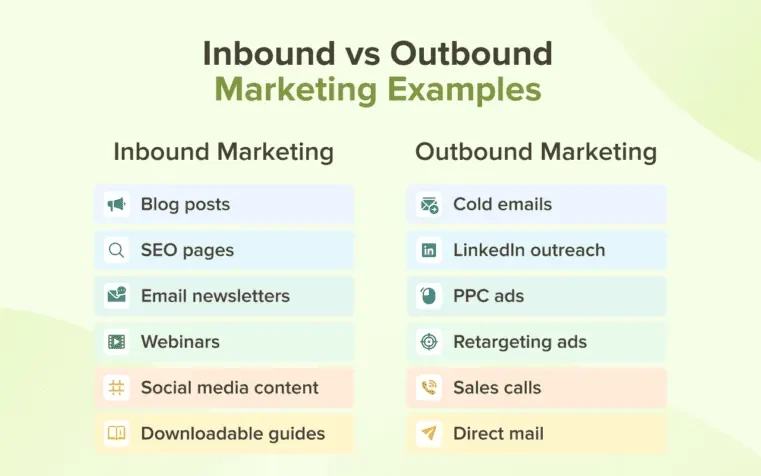
Inbound and outbound marketing are built around two different approaches to reaching potential customers.
Inbound marketing focuses on attracting people who are already searching for information, solutions or products. Instead of interrupting potential buyers, inbound strategies pull them toward a business through useful and relevant content. Common inbound tactics include SEO, blogs, webinars, email newsletters, organic social media, video content, lead magnets and educational resources.
The core idea behind inbound marketing is simple: provide value first and allow buyers to engage when they are ready.
Outbound marketing works differently. Instead of waiting for prospects to discover a business, outbound marketing proactively reaches out to potential customers. Businesses identify their ideal audience and initiate contact directly through channels such as cold email, cold calling, paid ads, direct messaging, display advertising, trade shows and account-based outreach campaigns.
Traditionally, outbound marketing was associated with interruption-based tactics. However, modern outbound has become far more personalized and relevant. Companies now use behavioral data, intent signals, firmographic targeting and AI-assisted personalization to make outreach more timely and useful.
The biggest practical difference between inbound and outbound marketing is who starts the conversation.
With inbound marketing, the customer initiates engagement by finding the business through search engines, social platforms or content. With outbound marketing, the business initiates the interaction by directly contacting the prospect.
Another important difference is timing.
Inbound marketing often produces long-term results. SEO content, educational resources and brand authority can continue generating leads for months or years after publication. However, inbound usually takes time to build momentum.
Outbound marketing typically generates faster visibility and pipeline opportunities because businesses can immediately target specific audiences and launch campaigns quickly. This is one reason many startups and B2B companies still rely heavily on outbound strategies when entering new markets or pursuing enterprise accounts.
That said, each approach has strengths and weaknesses.
Inbound marketing helps build trust, authority and sustainable organic growth. It supports buyers who prefer self-education and independent research. But inbound can be slower, highly competitive and dependent on consistent content production.
Outbound marketing offers speed, targeting precision and greater control over pipeline generation. Businesses can directly reach high-value prospects instead of waiting for them to discover the brand. However, outbound becomes ineffective when messaging is generic, poorly targeted or overly aggressive.
In 2026, the line between inbound and outbound marketing is becoming increasingly blurred. Many companies now combine both approaches into unified customer acquisition systems. For example, a prospect may first discover a company through content marketing, later see retargeting ads and eventually receive personalized outreach from a sales team.
This connected approach reflects how modern buyers actually behave across multiple channels before making decisions.
Why People Think Outbound Marketing Is Dead
The belief that outbound marketing is dead comes from years of poor execution.
For a long time, businesses relied on mass outreach strategies that prioritized quantity over relevance. Prospects received generic cold emails, repetitive sales calls and untargeted advertising campaigns that offered little personalization or value. As inboxes became saturated and consumers gained more control over digital experiences, people started ignoring low-quality outreach. Spam filters improved, privacy regulations became stricter and buyers became more resistant to interruption-based marketing.
At the same time, inbound marketing gained popularity because it aligned more naturally with modern buyer behavior. Consumers preferred researching solutions independently instead of immediately speaking with sales representatives. Businesses that invested in SEO, educational content and social proof often saw stronger long-term engagement and lower acquisition costs.
This created the impression that outbound marketing no longer worked.
But the problem was not outbound itself. The problem was outdated outreach methods.
Modern buyers do not respond to irrelevant mass messaging. They respond to relevance, timing and credibility. Generic cold emails sent to thousands of unqualified prospects rarely perform well today. On the other hand, highly targeted outreach supported by personalization, intent signals and multi-channel engagement can still generate strong results.
Another reason people assume outbound is dead is because the buyer journey has changed dramatically. Buyers now move across multiple touchpoints before making decisions. They may discover a brand through social content, research reviews independently, visit the website multiple times and only later engage with sales outreach. This makes attribution more complicated and causes some companies to underestimate outbound’s influence on pipeline generation.
In reality, outbound marketing still plays a critical role in accelerating awareness and creating opportunities that inbound alone may not generate quickly enough.
What Outbound Marketing Looks Like in 2026
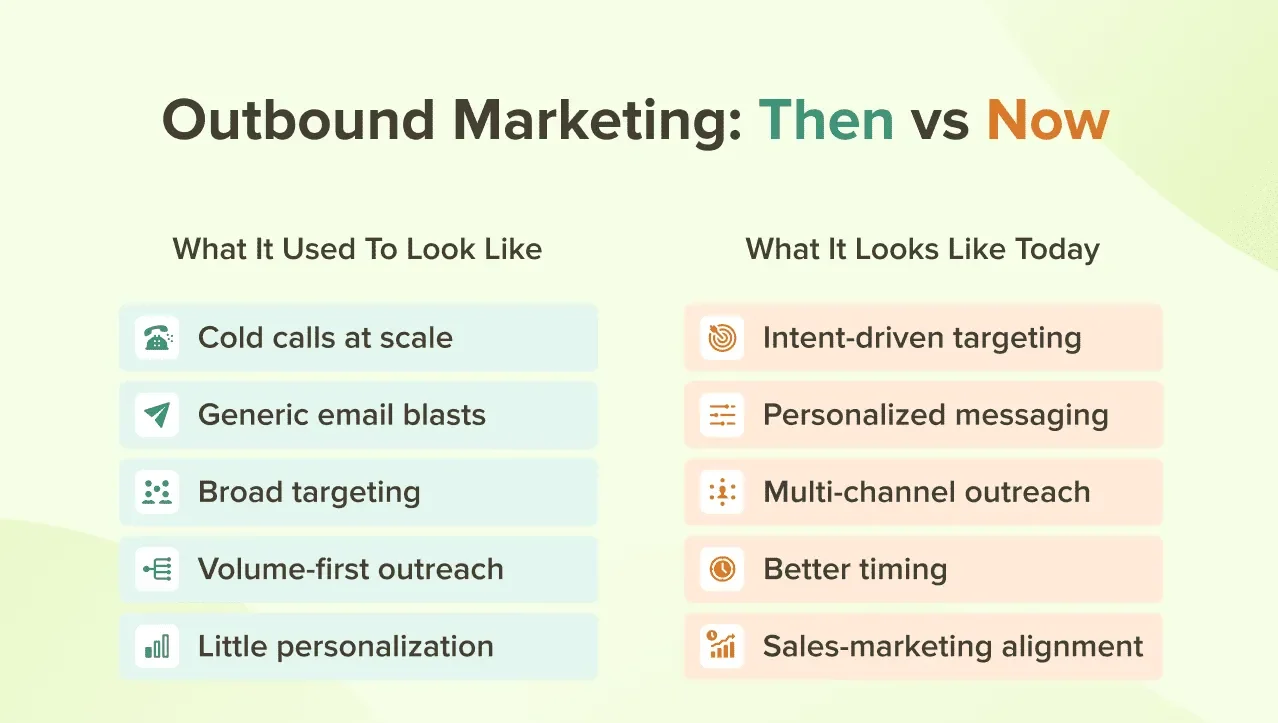
Outbound marketing in 2026 looks very different from the outdated “spray-and-pray” strategies of the past.
Today’s outbound is built around precision targeting, personalization, buyer intent data and multi-channel engagement. Instead of blasting the same message to thousands of contacts, businesses focus on reaching carefully selected prospects with messaging tailored to their needs, industry challenges and buying stage.
Cold email remains a major outbound channel, but successful campaigns now rely heavily on relevance and context. Teams personalize outreach using company-specific insights, behavioral data, industry trends and intent signals. AI tools also help marketers scale personalization without making messages feel robotic or generic.
LinkedIn has become another important outbound platform, especially in B2B industries. Sales teams use LinkedIn to build familiarity before outreach, engage with prospects through content and establish credibility before initiating conversations.
Outbound advertising has also evolved. Businesses now combine paid search, social ads, retargeting and account-based advertising to stay visible across the buyer journey. Instead of relying on a single touchpoint, companies create coordinated multi-channel experiences that reinforce brand familiarity over time.
Timing has become one of the most important factors in outbound success. Modern teams increasingly rely on intent-based selling, where outreach is triggered by signals such as website visits, content engagement, technology adoption, hiring activity or buying research behavior.
This shift allows businesses to contact prospects when they are more likely to be interested instead of reaching out randomly.
Outbound marketing in 2026 is also more closely connected to inbound marketing than ever before. Outreach works best when prospects already recognize the brand from content, social media, reviews or previous engagement. This is why many companies now combine content marketing, brand awareness campaigns and sales outreach into one integrated growth strategy.
The Modern Outbound Toolkit: What Actually Works
Outbound marketing in 2026 is no longer about pushing messages to as many people as possible. The most successful companies now treat outbound as a strategic growth system built around precision, relevance and timing. Businesses that continue using outdated mass outreach methods often struggle with low response rates, rising acquisition costs and declining engagement.
Modern outbound works because it focuses on understanding buyer behavior, identifying real intent and creating coordinated touchpoints that feel relevant instead of intrusive. Rather than operating as a disconnected sales activity, outbound marketing has become deeply integrated with brand awareness, content marketing, customer data and revenue strategy.
The companies generating consistent pipeline growth today are using outbound to create meaningful conversations with the right people at the right time.
1. Target the Right Prospects
The foundation of successful outbound marketing is targeting.
One of the biggest reasons traditional outbound campaigns failed was because businesses prioritized volume over fit. Sales teams often purchased large contact lists and sent the same message to everyone regardless of industry, company size, business challenges or buying readiness. That approach no longer works because modern buyers expect relevance from the very first interaction.
In 2026, successful outbound campaigns begin with a clearly defined ideal customer profile (ICP). Businesses identify the types of companies and decision-makers most likely to benefit from their solution. This includes analyzing factors such as industry, company size, revenue range, geographic market, business maturity, technology stack and common operational pain points.
But modern targeting goes even deeper than demographics or firmographics.
Companies now use behavioral and intent data to identify prospects that may already be researching solutions or showing signs of purchase interest. For example, businesses can monitor signals such as increased website activity, engagement with industry content, technology adoption patterns, hiring trends or interactions with specific topics across digital platforms.
This allows outreach teams to prioritize warmer opportunities instead of contacting random prospects without context.
Artificial intelligence is also transforming prospect research and segmentation. AI-powered tools help teams analyze customer data, identify high-converting audience segments and personalize outreach at scale. Instead of manually researching every lead, sales and marketing teams can now use automation to surface insights that improve targeting accuracy and message relevance.
Personalization has become another critical component of outbound success.
Modern buyers ignore generic messaging because they receive too much of it every day. Effective outbound communication now references the prospect’s industry challenges, company goals, recent business developments or specific operational needs. Personalized outreach demonstrates that the sender understands the prospect’s situation rather than simply sending a mass sales pitch.
However, personalization does not mean writing completely unique messages for every contact. Successful teams create scalable frameworks that balance efficiency with relevance. They personalize the most important elements while maintaining consistency across campaigns.
The result is outreach that feels informed, timely and useful instead of disruptive.
2. Build Familiarity Across Channels
One of the most important shifts in outbound marketing is the growing role of familiarity.
Modern buyers rarely respond positively to a completely unknown brand after a single interaction. In most cases, prospects need repeated exposure before they trust a company enough to engage. This is why modern outbound marketing is increasingly multi-channel and relationship-driven rather than focused on one-time contact attempts.
Today’s buyers move across multiple digital environments during the research process. They search Google, browse LinkedIn, read reviews, consume content, watch videos, attend webinars and compare competitors before making decisions. Because of this behavior, businesses now focus on creating consistent visibility across channels instead of relying on isolated outreach tactics.
For example, a prospect may first encounter a company through a LinkedIn post, later see a retargeting ad, visit the website to read a blog article and then receive a personalized email from a sales representative. Each interaction builds familiarity and reinforces credibility.
This connected approach is far more effective than relying only on cold outreach.
LinkedIn has become one of the most important outbound channels in 2026, particularly for B2B organizations. Sales teams use LinkedIn not just for direct messaging, but also for relationship-building and visibility. Engaging with industry conversations, sharing educational insights and participating in relevant discussions helps businesses establish authority before outreach even begins.
Email outreach also continues to play a major role, but the strategy behind it has evolved significantly. Successful outbound email campaigns now prioritize quality over quantity. Messaging is shorter, more relevant and focused on solving real problems instead of aggressively pushing sales offers.
Video outreach is also becoming more common. Personalized video introductions, product walkthroughs and short explanatory clips help humanize communication and increase engagement rates. Buyers often respond more positively when they can see and hear the person behind the outreach.
Retargeting campaigns further strengthen familiarity by keeping brands visible after prospects interact with websites or content. Even if a prospect does not respond immediately, consistent exposure across multiple touchpoints increases recognition and trust over time.
This is important because modern purchasing decisions are rarely immediate. Buyers often require multiple interactions before they are ready to engage seriously with a business.
The companies seeing the strongest outbound results understand that attention alone is not enough. Familiarity creates trust, and trust drives conversion.
3. Align Sales and Marketing
One of the most important factors behind successful outbound marketing in 2026 is alignment between sales and marketing teams.
For many years, sales and marketing operated separately in many organizations. Marketing teams focused on generating leads, while sales teams focused on closing deals. This disconnect often created inconsistent messaging, poor lead quality and fragmented customer experiences.
Modern outbound strategies require much closer collaboration.
Marketing teams now play a larger role in supporting outbound success by creating educational content, improving brand positioning, building awareness campaigns and generating audience insights. At the same time, sales teams provide direct feedback about customer objections, buying behavior and real-world conversations happening during outreach.
When both teams share data and goals, outbound campaigns become significantly more effective.
For example, marketing content can support outbound outreach by helping sales teams provide valuable resources during conversations. Instead of immediately pushing for a meeting, representatives can share relevant guides, case studies, research or industry insights that help prospects make informed decisions.
This creates a more consultative and trust-driven experience.
Sales and marketing alignment also improves targeting accuracy. Both teams can work together to identify high-value accounts, refine messaging and prioritize audiences with the strongest conversion potential.
In 2026, many businesses are also adopting revenue-focused models where both sales and marketing share accountability for pipeline generation and customer acquisition outcomes. Instead of measuring success separately, teams collaborate around shared growth objectives.
Technology plays a major role in enabling this alignment. CRM systems, automation platforms and analytics tools allow teams to track engagement across channels, monitor lead activity and coordinate outreach more effectively.
The result is a more unified customer journey where every interaction feels connected instead of fragmented.
Why a Hybrid Approach Is Essential for Growth in 2026
The debate between inbound and outbound marketing is becoming increasingly outdated because the most successful businesses now rely on both.
Inbound marketing remains essential for building trust, authority and long-term visibility. Buyers still want access to educational content, organic search results, customer reviews and independent research before making decisions. A strong inbound presence helps businesses establish credibility and attract prospects who are actively searching for solutions.
However, inbound alone is often not enough to sustain aggressive growth goals, especially in competitive industries.
Organic traffic takes time to build. SEO competition continues to increase, content saturation is growing and buyers are exposed to more information than ever before. Even companies with strong inbound programs may struggle to reach high-value prospects quickly enough through organic discovery alone.
This is where outbound marketing becomes essential.
Outbound allows businesses to proactively reach decision-makers, create opportunities faster and accelerate pipeline generation. Instead of waiting for prospects to discover the brand, companies can introduce themselves directly to highly targeted audiences.
But outbound works best when supported by inbound credibility.
Modern buyers often research companies immediately after receiving outreach. If they cannot find helpful content, strong messaging, customer proof or brand authority online, they are less likely to respond positively. This means outbound performance increasingly depends on inbound strength.
A hybrid strategy combines the strengths of both approaches.
Inbound builds awareness, trust and discoverability. Outbound creates momentum, targeted engagement and faster pipeline development. Together, they create a more complete and scalable growth system.
In 2026, businesses that integrate inbound and outbound marketing effectively are better positioned to adapt to changing buyer behavior, rising competition and longer sales cycles.
Key Takeaways: The Truth About Outbound Marketing in 2026
Outbound marketing is not dead in 2026. It has simply evolved.
The outdated tactics that relied on mass messaging, interruption and generic outreach are becoming less effective. But modern outbound marketing continues to deliver strong results when it is personalized, data-driven and strategically integrated with inbound marketing efforts.
Today’s buyers expect relevance, trust and consistency across channels. Businesses that succeed with outbound are focusing on targeted prospecting, multi-channel familiarity, sales and marketing alignment and intent-based engagement rather than high-volume outreach.
At the same time, inbound marketing remains essential for building authority and supporting modern buyer research behavior. This is why the strongest growth strategies no longer treat inbound and outbound as competing approaches.
The future belongs to hybrid marketing systems that combine proactive outreach with trust-building content and brand visibility.
In 2026, outbound marketing still matters — but only when it evolves alongside the way modern buyers make decisions.
Move Your Growth Strategy Forward With Pro Real Tech
Outbound marketing still matters in 2026, but success now depends on how well businesses adapt to modern buyer behavior. The most effective strategies focus on precision targeting, meaningful engagement and stronger alignment between outreach, content and sales efforts. Companies that continue relying on disconnected or outdated tactics often struggle to generate sustainable growth.
Pro Real Tech helps businesses create marketing systems built for today’s digital landscape. Our approach combines inbound and outbound strategies to support better visibility, stronger lead generation and more consistent customer engagement across channels.
Our services include:
- Outbound marketing
- Content marketing
- Pay-per-click (PPC) advertising
- Social media advertising
- Social media marketing
Whether your goal is to improve lead quality, strengthen brand positioning or build a more scalable digital marketing strategy, Pro Real Tech can help you develop a plan aligned with real business objectives and long-term growth. Contact us today to learn more.
Frequently Asked Questions About Outbound Marketing in 2026
WHAT IS OUTBOUND MARKETING?
Outbound marketing is a strategy where businesses proactively reach potential customers instead of waiting for them to discover the brand on their own. It involves initiating conversations through channels such as cold email, paid advertising, direct outreach, LinkedIn messaging, cold calling, display ads, event marketing and account-based campaigns.
In 2026, outbound marketing is far more targeted and personalized than it was in the past. Modern outbound strategies rely on audience research, intent signals, customer data and multi-channel engagement to create more relevant interactions. The goal is not simply to reach more people, but to connect with the right prospects at the right time.
WHAT IS THE DIFFERENCE BETWEEN INBOUND AND OUTBOUND MARKETING?
Inbound marketing focuses on attracting people who are already searching for information, products or solutions. It usually includes SEO, blogs, organic social media, webinars, email newsletters and educational content that helps prospects discover a business naturally.
Outbound marketing works differently because the business initiates the contact. Instead of waiting for customers to find the brand, companies proactively engage potential buyers through direct outreach and advertising efforts.
The biggest difference is how the conversation begins. In inbound marketing, the customer takes the first step. In outbound marketing, the business starts the interaction.
However, in 2026, successful companies rarely rely on only one approach. Most growth-focused businesses combine inbound trust-building with outbound outreach to create a stronger customer acquisition system.
HOW HAS BUYER BEHAVIOR CHANGED IN WAYS THAT AFFECT OUTREACH?
Modern buyers are more independent, informed and selective than they were in previous years. Most people now research solutions extensively before responding to a sales conversation. They compare providers, read reviews, visit websites, consume educational content and evaluate credibility across multiple channels before making decisions.
This shift has changed how outbound marketing works.
Generic mass outreach is far less effective because buyers expect relevance and personalization. They also expect businesses to understand their challenges and provide useful insights rather than simply pushing products or services.
Another major change is that buyers move across multiple touchpoints before converting. A prospect may discover a company through content marketing, later see paid ads, engage with LinkedIn posts and eventually respond to direct outreach. This means businesses need more connected and consistent marketing strategies.
HOW SHOULD TEAMS THINK ABOUT OUTBOUND VS. INBOUND MARKETING WHEN PLANNING CAMPAIGNS?
Teams should stop viewing inbound and outbound marketing as competing strategies. In 2026, the strongest campaigns are built around integration rather than separation.
Inbound marketing helps attract and educate audiences over time. It builds authority, organic visibility and trust. Outbound marketing helps businesses create momentum faster by proactively reaching decision-makers and generating conversations.
When planning campaigns, businesses should think about how both strategies can support the same customer journey. For example, outbound outreach can direct prospects toward educational content, case studies or webinars created by the inbound marketing team. At the same time, inbound content can improve outbound conversion rates by increasing brand familiarity and credibility.
The goal is to create a seamless experience where inbound and outbound efforts reinforce each other instead of operating independently.
WHY DOES TIMING MATTER SO MUCH IN MODERN OUTREACH?
Timing has become one of the most important factors in outbound marketing success because buyers respond differently depending on their current needs and level of interest.
Even highly personalized outreach may fail if it reaches prospects at the wrong moment. On the other hand, outreach delivered when a business is actively researching solutions or experiencing operational challenges can generate strong engagement.
Modern teams use intent data and behavioral signals to improve timing. These signals may include website visits, content downloads, hiring activity, technology changes, social engagement or increased research behavior around specific topics.
The goal is to reach prospects when they are more likely to be open to a conversation rather than relying on random outreach attempts.
WHEN SHOULD A BUSINESS INVEST IN AN OUTBOUND MARKETING STRATEGY?
A business should invest in outbound marketing when it needs more control over pipeline generation, faster growth opportunities or access to highly targeted audiences.
Outbound marketing can be especially valuable when entering new markets, launching new services, targeting enterprise accounts or shortening long sales cycles. It also helps businesses that cannot rely entirely on organic discovery because of competitive search environments or limited brand awareness.
Companies often benefit most from outbound marketing when they already have strong messaging, a clear understanding of their target audience and a sales process capable of converting qualified opportunities.
In many cases, outbound becomes even more effective when supported by strong inbound marketing assets such as educational content, case studies, landing pages and customer proof.
WHAT ROLE DOES PERSONALIZATION PLAY IN AN OUTBOUND MARKETING STRATEGY?
Personalization plays a major role in modern outbound marketing because buyers are overwhelmed with generic sales messages every day.
In 2026, effective outreach focuses on relevance rather than volume. Businesses personalize communication by referencing the prospect’s industry, company goals, challenges, recent developments or specific pain points. This helps outreach feel more informed and valuable instead of automated or transactional.
Personalization also improves engagement because it shows that the business understands the prospect’s situation. Buyers are more likely to respond when messaging feels specific to their needs rather than copied and pasted for mass distribution.
At the same time, personalization should remain scalable. The most successful teams use structured frameworks and data-driven insights to personalize efficiently without sacrificing consistency.
CAN INBOUND AND OUTBOUND MARKETING SUPPORT THE SAME BUSINESS GOALS?
Yes. Inbound and outbound marketing often work best when supporting the same business goals together.
Both strategies can contribute to lead generation, pipeline growth, customer acquisition, brand awareness and revenue expansion. The difference lies in how they help move prospects through the buying journey.
Inbound marketing builds visibility and trust over time by attracting people who are already researching solutions. Outbound marketing accelerates engagement by proactively creating opportunities and starting conversations with targeted audiences.
When combined effectively, inbound and outbound marketing create a more balanced growth strategy. Inbound helps establish authority, while outbound helps businesses scale outreach and reach decision-makers faster.
WHY DO SOME OUTBOUND EFFORTS FAIL EVEN WHEN THE OFFER IS STRONG?
Many outbound campaigns fail not because the offer is weak, but because the execution is poor.
One common problem is weak targeting. Even a strong offer will struggle if it reaches people who are not a good fit for the solution. Another issue is generic messaging that fails to connect with the prospect’s real priorities or challenges.
Poor timing can also reduce performance. Prospects may ignore outreach if they are not actively considering change or evaluating solutions at that moment.
In some cases, businesses fail because they focus too heavily on selling immediately instead of building familiarity and trust first. Modern buyers often require multiple touchpoints before engaging seriously.
Another major issue is the disconnect between sales and marketing. When messaging, targeting and follow-up processes are not aligned, outbound campaigns become less effective regardless of the quality of the offer.
HOW DO OUTBOUND MARKETING STRATEGIES BENEFIT FROM STRONGER BRAND MESSAGING?
Strong brand messaging improves outbound marketing because buyers often research a company before responding to outreach.
If the messaging across a company’s website, content, ads and social channels is unclear or inconsistent, prospects may lose confidence quickly. Strong brand positioning helps businesses communicate their value clearly and build credibility across every touchpoint.
Consistent messaging also strengthens familiarity. When prospects repeatedly encounter the same positioning, expertise and core value proposition across multiple channels, the brand becomes easier to recognize and trust.
In modern outbound marketing, brand messaging supports every stage of the customer journey. It helps businesses stand out in crowded markets, create stronger first impressions and improve conversion rates throughout the sales process.
Read More: AI-Powered Lead Generation Strategies for Local Service Businesses


