

Remember the last time you searched for a product online? You typed a phrase into a search bar, scrolled through pages of results, clicked on several links, compared prices and reviews across different tabs, and perhaps even hesitated at checkout, wondering if you’d found the best option. This process, which has defined e-commerce for decades, is fundamentally reactive. It places the entire burden of research, comparison, and decision-making squarely on you, the shopper.
But a seismic shift is underway. We are moving from this reactive, search-based model to a proactive, delegation-based future. Enter Agentic Shopping—a new paradigm where sophisticated AI agents act on your behalf. Imagine not just asking a chatbot a question, but delegating a complex goal like, “Plan a complete 5-day hiking trip for two in the Rockies for under $1,500.” An AI agent would then autonomously research, compare, and execute purchases for everything from tents and backpacks to dehydrated meals and national park passes.
This is not merely an incremental change in technology; it’s a complete overhaul of the product discovery funnel. For online retailers and brands, it represents both an unprecedented challenge and a massive opportunity. The rules of visibility, customer engagement, and conversion are being rewritten. This article will explore how agentic shopping is dismantling traditional e-commerce, the key technologies powering this revolution, and what your business must do today to prepare for the future of commerce.
What Is Agentic Shopping, and Why Does it Matter?
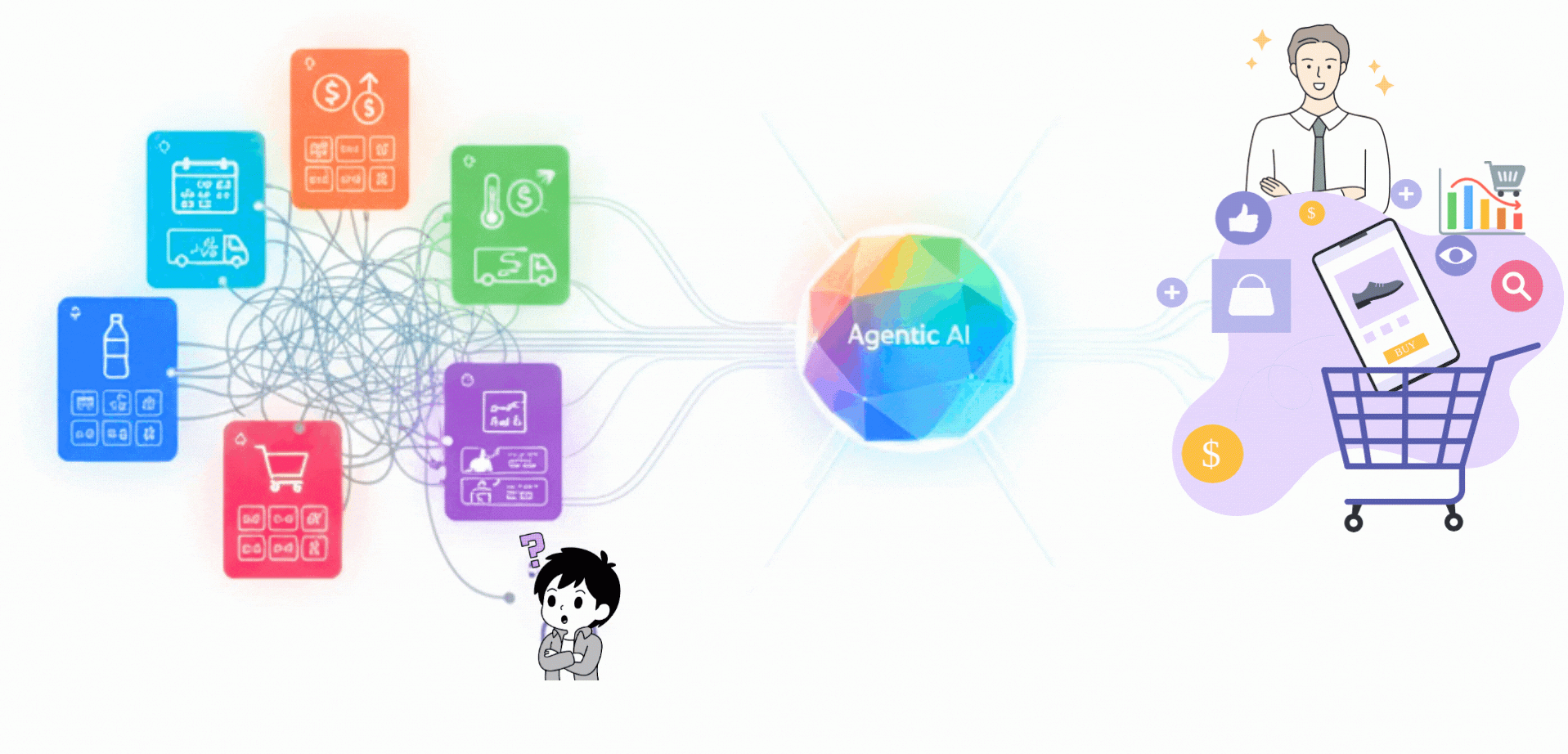
At its core, Agentic Shopping is a model where artificial intelligence (AI) agents are delegated authority and given specific goals by a user. These agents then autonomously perform multi-step tasks—researching, analyzing, comparing, and ultimately making purchase decisions—to fulfill that goal. Unlike traditional e-commerce tools (like recommendation engines or simple chatbots), these agents are proactive, goal-oriented, and capable of complex reasoning and execution.
The Key Difference: From Tools to Agents
Think of the current state of AI in shopping as providing you with better tools: a sharper search filter, a more accurate “customers also bought” suggestion, or a chatbot that can answer FAQs. You still wield every tool yourself. Agentic AI, conversely, provides you with a skilled assistant or agent. You state the objective, and the agent determines the necessary steps, uses the tools at its disposal, and returns with a completed task or a curated set of actionable options.
Core Components of an Agentic System
-
The Agent: A sophisticated AI program capable of understanding intent, breaking down complex goals, planning a sequence of actions, and executing them across various platforms and data sources.
-
Delegation & Goal Setting: The user provides a high-level goal (e.g., “Outfit my new apartment in a mid-century modern style on a $5k budget”).
-
Task Breakdown & Planning: The agent autonomously decomposes this goal into sub-tasks: find a reputable furniture store, identify mid-century modern style guides, compare sofa prices and reviews, source complementary lighting and decor, ensure all items fit the budget and delivery timeline.
-
Execution & Decision-Making: The agent navigates the web, accesses product catalogs, reads reviews, compares specifications and prices, and may even place orders—all with user-defined constraints and permissions.
Why Agentic Shopping Matters Now
This shift matters profoundly for two primary groups: consumers and businesses.
For Consumers: It promises an end to decision fatigue. Agentic shopping delivers hyper-personalization, immense time savings, and potentially better outcomes by removing human bias and analyzing more data points than a person ever could. The shopping experience becomes conversational, goal-oriented, and seamlessly integrated into daily life.
For eCommerce Businesses: The entire customer journey is being compressed and transformed. The traditional “top of the funnel” (awareness via SEO/SEM) is being bypassed. If an AI agent is making recommendations, visibility is no longer about winning the top search result; it’s about being included in the agent’s data set and algorithmic logic. Brands that are not readable, comparable, and trustworthy to AI agents will simply become invisible in this new landscape. It matters because it changes the foundational pillars of digital marketing: discovery, comparison, and trust.
Agentic shopping moves commerce from a model of persuasion (convincing a browsing human) to one of specification (meeting the precise, multi-faceted criteria of an AI agent working for a human). This is why understanding and preparing for this shift isn’t just about adopting the next new tool—it’s about future-proofing your entire business model.
Universal Commerce Protocol (UCP): Making Your Store Readable to AI
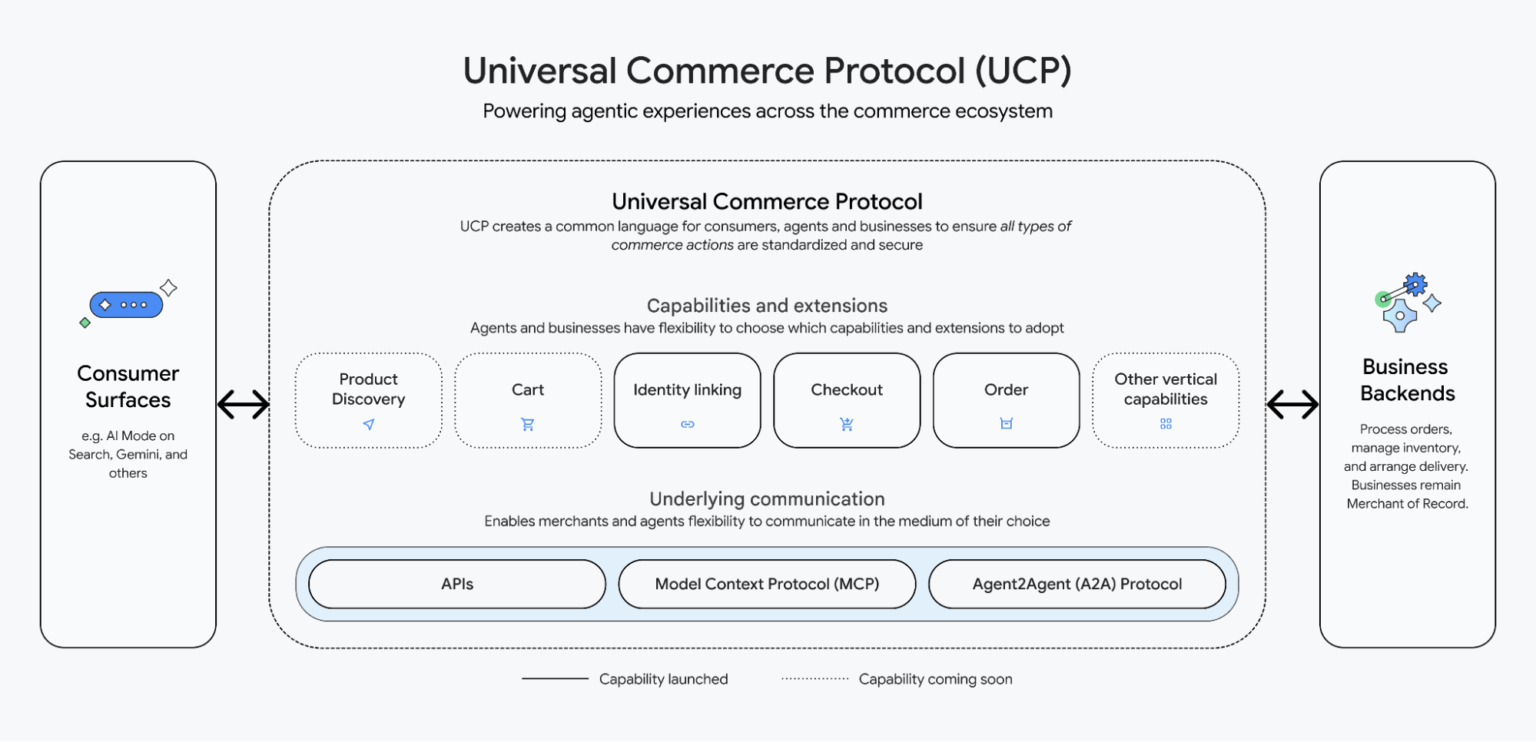
In the traditional web, search engines like Google used crawlers to read and index human-oriented content—the text, images, and links on your website. Success meant optimizing for these crawlers through SEO. In the agentic shopping paradigm, the primary “shopper” is no longer a human browsing a page, but an AI agent scanning and analyzing data to make a decision. This requires a fundamental shift in how product information is published.
Enter the concept of the Universal Commerce Protocol (UCP). Think of UCP not as a single, mandated standard, but as an emerging imperative: a structured, machine-first, and universally interpretable method of presenting commerce data. It’s the framework that allows an AI agent from any platform (a search engine, a virtual assistant, a social app) to reliably understand your product’s attributes, inventory, pricing, and promotions.
Why Your Current Product Feed Isn’t Enough
Many retailers already use product feeds for Google Shopping or social platforms. These are a precursor, but they are often platform-specific, limited in attributes, and lack the rich, contextual detail an AI agent needs to perform complex reasoning. An agent deciding between two tents needs to know not just price and SKU, but material breathability, packed size, pole composition, and how it compares to similar models in durability for a specific climate. Your product data must answer these nuanced questions programmatically.
Key Pillars of a UCP-Ready Data Strategy
-
Structured Data at Scale: Implementing and maintaining rich structured data (like
schema.orgvocabulary—Product, Offer, AggregateRating, etc.) is the absolute baseline. This creates a common language for machines. -
Attribute Comprehensiveness & Accuracy: Go beyond basic title, image, and price. Include all relevant specifications: materials, dimensions, weight, compatibility, care instructions, sustainability credentials (e.g., recycled content), and usage context. Inconsistency or inaccuracy here will cause agents to deprioritize or mistrust your data.
-
Real-Time Dynamism: AI agents will prioritize data sources that reflect absolute truth in real-time. Your protocol must dynamically communicate live inventory levels, current price, delivery windows, and in-stock status without delay. A product “in stock” in a feed but unavailable at checkout destroys agent trust.
-
Accessibility & Security: This rich data layer must be easily discoverable and accessible to authorized agents via APIs or other machine-readable endpoints, while being secured against unauthorized scraping.
For retailers, adopting a UCP mindset means building a “single source of truth” product data layer designed for machines first, and humans second. It’s the essential infrastructure that makes your store visible and understandable in the age of AI-driven discovery. Without it, you are effectively invisible to the most advanced shopping assistants.
Business Agent: Turning Conversations Into Conversions
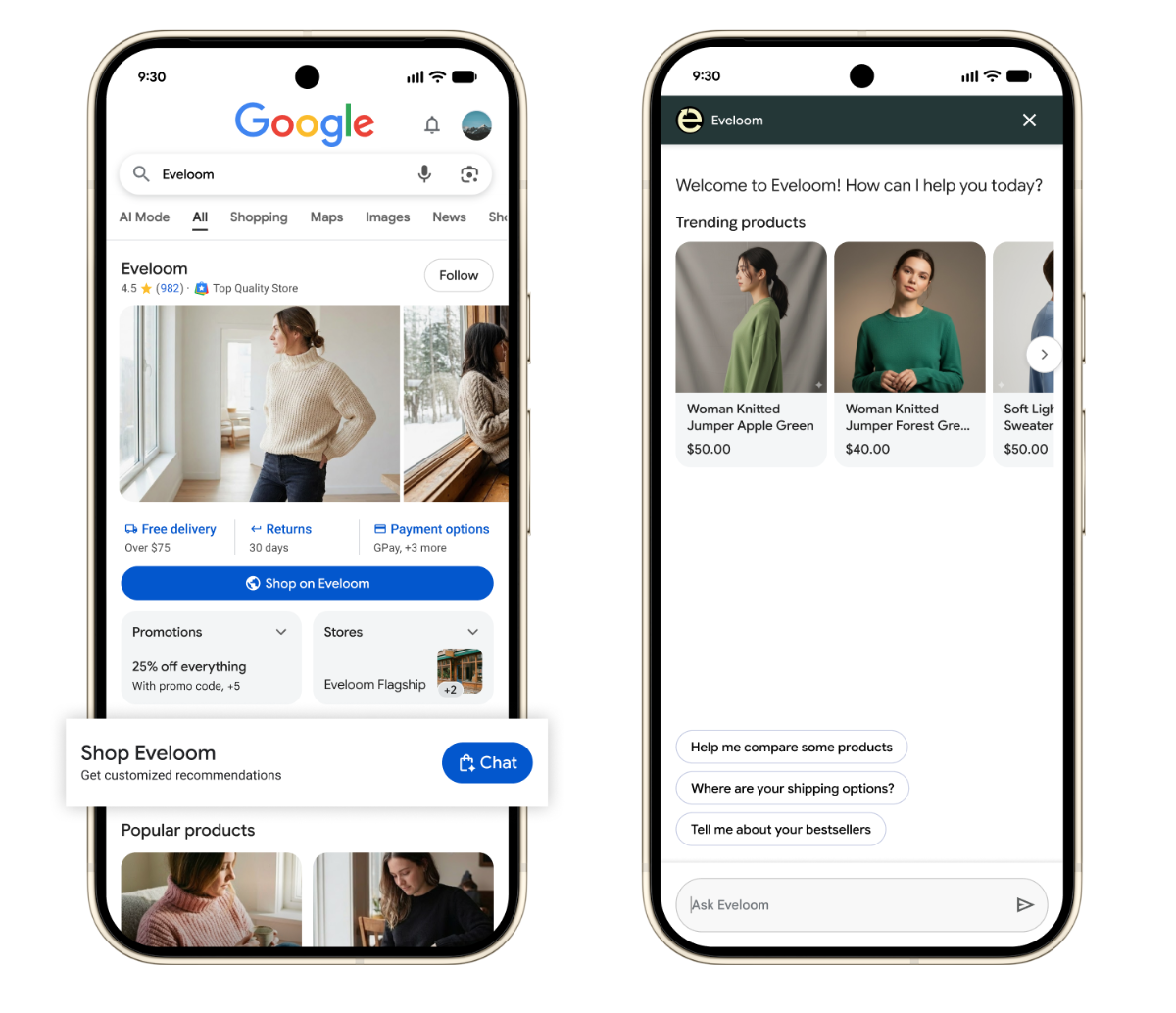
The “Business Agent” represents the evolution of the customer service chatbot into a proactive, goal-completing AI representative of a brand or platform. Imagine a customer service rep, a personal shopper, and a checkout assistant combined into one AI that operates 24/7, with full access to your product catalog and business logic. This is the Business Agent.
From FAQ Bots to Task-Completion Agents
Traditional chatbots are reactive and limited. A user asks a question (“Do you have this in blue?”), and the bot retrieves an answer from a script. The conversation ends there. A Business Agent is fundamentally different. It is built to understand intent and complete a job.
Example Interaction:
-
User: “I need to get a reliable wireless printer for my home office that can also scan my kids’ artwork, all for under $300.”
-
Business Agent Response:
-
Understands Goal: Purchase a multi-function wireless printer under $300 for mixed home use.
-
Asks Clarifying Questions (Proactively): “How important is printing photo quality vs. text documents? I have three options that fit your budget; shall I compare them for you?”
-
Takes Action: After the user selects a model, the agent doesn’t just link to the product page. It says, “I can add the Epson WorkForce to your cart, check that compatible ink is in stock, and apply a 10% first-order discount for you. Would you like me to proceed to secure checkout?”
-
The Mechanics of Conversion
A Business Agent turns conversation into conversion by integrating several key capabilities:
-
Deep Catalog Integration: It doesn’t just know about products; it can interface with them—checking real-time inventory, configuring complex products (like a PC with specific components), and calculating personalized bundles.
-
Transaction Execution: It has the permission and secure framework to perform actions: adding to cart, applying promo codes, initiating checkout, and scheduling delivery—all within the conversational interface.
-
Contextual Memory: It remembers the user’s stated preferences, past interactions, and session context, allowing for a personalized, continuous dialogue that feels helpful, not repetitive.
-
Brand Alignment: It is trained on your brand’s voice, policies, and values, ensuring every interaction reinforces your brand promise and handles exceptions (like returns or complaints) according to your guidelines.
For eCommerce brands, developing or integrating a Business Agent means moving the point of conversion directly into the conversation. The funnel collapses. The moment a user expresses intent, the agent can guide them to a completed purchase in a seamless, assisted flow. This dramatically reduces friction, increases average order value through smart cross-selling, and builds immense loyalty by providing a truly helpful, concierge-like service at scale. The future of customer service isn’t just about answering questions—it’s about autonomously fulfilling needs.
Direct Offers: When PPC Meets AI Decision-Making
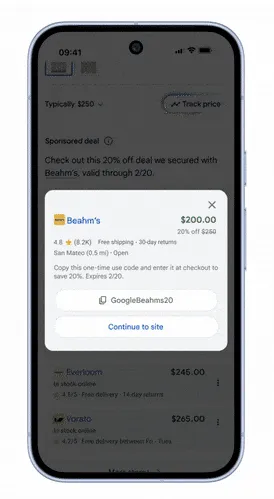
The world of paid advertising, dominated by Pay-Per-Click (PPC) models, is built on a principle of interruption and persuasion. Brands bid on keywords to place visual ads in front of users who are browsing, hoping to attract their click. Direct Offers represent a fundamental reimagining of this concept for an agentic world. Here, the AI agent is not browsing—it is deciding. Therefore, the ad unit transforms from a persuasive banner into a qualified, machine-readable proposal.
The Shift: From Persuasion to Qualification
In traditional PPC, success is measured by click-through rate (CTR) and conversion. The ad creative (headline, image, copy) is designed to grab human attention and emotion. In an agentic model, an AI agent is scanning for the best objective fit against its user’s constraints (budget, specs, timeline). A flashy sale banner is irrelevant. The agent needs a structured, data-rich offer it can automatically evaluate and potentially accept on the user’s behalf.
A Direct Offer is a packaged, actionable proposal that an AI agent can understand and act upon. It goes beyond stating a product’s price to including all necessary terms: final price with taxes, guaranteed delivery window, return policy summary, applicable discounts, and inventory status—all in a clean, machine-parsable format.
How Direct Offers Work: The Mechanisms
-
Structured Offer Feeds: Similar to product feeds, but for promotions and terms. These feeds must comply with emerging standards that allow AI agents to reliably compare “Offer A from Retailer X” with “Offer B from Retailer Y” based on total cost and value, not just sticker price.
-
Agent-Specific Bid Strategies: Instead of bidding for placement on a search results page, retailers may bid for inclusion in an AI agent’s shortlist of recommended options. The “bid” could be a combination of price competitiveness, shipping speed, and historical reliability score.
-
Automated Acceptance: For low-consideration or replenishment items, users may pre-authorize their agent to accept the best Direct Offer that meets predefined criteria. The agent completes the purchase without any further human click.
Example: An AI agent tasked with “buy a standard AA battery pack” receives Direct Offers from several retailers. One offer has a slightly higher price but guarantees 2-hour delivery from a local store. Another is cheaper but has a 5-day shipping window. The agent evaluates based on the user’s implicit need for speed (perhaps inferred from the request being sent from a smart device showing low battery) and autonomously accepts the faster offer.
Implications for Advertisers
For eCommerce brands, this means:
-
Competition on Total Value, Not Just Price: Shipping cost, speed, and hassle-free return policies become directly comparable and decisive competitive levers.
-
The Rise of “Truth in Advertising”: Offers must be 100% accurate and honor-able in real-time. An offer promising next-day delivery that fails will lead an agent to blacklist your brand.
-
New Metrics: Key performance indicators (KPIs) will shift from impressions and clicks to “agent shortlist inclusions” and “automated acceptances.”
Direct Offers turn advertising from a marketing channel into a real-time negotiation API with AI, where the best overall value proposition wins autonomously.
The Rise of Answer Engine Optimization (AEO)
For over two decades, Search Engine Optimization (SEO) has been the doctrine for online visibility. Its goal has been to optimize content to rank highly on a Search Engine Results Page (SERP) filled with links for a human to click. The future belongs to Answer Engine Optimization (AEO). The goal of AEO is to have your content synthesized directly into an answer or recommendation provided by an AI agent or AI-powered search engine, often with zero clicks to your site.
SEO vs. AEO: A Fundamental Difference
-
SEO (Past/Present): Targets a search query. Success = a high-ranking link that earns a click. The content is often broad to capture traffic.
-
AEO (Future): Targets an intent or goal. Success = having your data or content extracted and used to form a complete, actionable answer within the AI interface itself. The content must be precise, authoritative, and structured for extraction.
When a user asks an AI agent, “What’s the best durable water bottle for hiking?,” they don’t want ten blue links. They want a direct answer: “Based on durability, weight, and reviews, the [Brand X] bottle is top-rated. It holds 1 liter, is made from recycled stainless steel, and costs $45. It’s in stock at [Retailer Y] and [Retailer Z].” AEO is the practice of ensuring your product is that recommended product and your data populates that answer.
Core Principles of Answer Engine Optimization
-
Optimize for Data Extraction, Not Just Readability: Create content that is easily parsable by AI. Use clear, concise language, bulleted lists of features and specs, and structured data markup (schema.org) to explicitly label attributes like price, rating, and material.
-
Become the Definitive Source: AI agents are trained to prioritize authoritative, trustworthy sources. Build comprehensive, expert product pages, detailed comparison guides, and authoritative blog content that thoroughly answers complex questions in your niche. E-E-A-T (Experience, Expertise, Authoritativeness, Trustworthiness) becomes more critical than ever.
-
Provide Unbiased, Comprehensive Information: Agents compare multiple sources. A product page that only lists pros will be less trusted than one that also fairly addresses limitations or compares itself to alternatives. Comprehensive, balanced content signals reliability.
-
Structure for Featured Snippets on Steroids: While featured snippets are a precursor to AEO, the future involves more complex data pulls. Structure your content to clearly answer who, what, when, where, why, and how questions about your products and their use.
AEO in Action: Practical Strategies
-
Create Ultimate Guides and Comparison Tables: Build pages that are the internet’s best resource for comparing products in your category. Use table formats that AI can easily scrape.
-
Enrich Product Pages with Q&A: Implement robust, user-generated Q&A sections and provide detailed, keyword-rich answers. This directly feeds the types of questions AI agents are solving.
-
Publish Expert Reviews and Testing Data: Content based on verifiable, original testing (e.g., “Our lab test results for battery life”) creates unique, trusted data points that AI agents will cite.
-
Master Your Structured Data: This is the non-negotiable technical foundation. Implement and maintain Product, FAQ, How-To, and Review schemas meticulously.
For brands, winning at AEO means accepting that the “visit” may not happen. The trade-off is becoming the trusted, cited source that drives purchases through AI agents, often via Direct Offers or other integrated buying channels. It’s about owning the answer, not just the ranking.
Preparing for Seamless AI-Driven Checkout Experiences
The final hurdle in any commerce journey is the checkout process—a stage notorious for abandonment due to friction: form fields, account creation, payment errors, and surprise costs. In an agentic shopping model, this process is not merely streamlined; it is often rendered invisible. The AI agent, having been delegated the authority to purchase, executes the transaction as a final step in its task sequence. Preparing for this requires a fundamental re-engineering of your checkout and payment infrastructure for machine-initiated transactions.
The “Zero-Click Checkout” Paradigm
The end goal is a Zero-Click Checkout from the user’s perspective. The human approves a goal and sets parameters; the AI agent handles the rest, including payment. This requires:
-
Pre-Authorized Transaction Agreements: Users will establish secure, pre-approved spending limits and payment methods with their AI agent platform (e.g., their Google or Apple account). Your e-commerce system must be compatible with these emerging, tokenized payment protocols that allow trusted AI agents to act on a user’s behalf.
-
Universal Digital Identity & Address: Instead of filling forms, the AI agent will securely pass a verified user identity and shipping address (with user consent) via protocols like OpenID Connect. Your checkout must accept and process these authenticated digital credentials.
-
Real-Time, All-Inclusive Price Calculation: The agent must know the final total before committing. Your systems must provide real-time, accurate calculations for tax, shipping, duties, and any applicable discounts via API in milliseconds. Any discrepancy between the offered price and the final charge will break agent trust and trigger transaction failure.
Technical Foundations for AI-Agent Checkout
-
Headless & API-First Commerce: A rigid, monolithic checkout page is obsolete. You need a flexible, API-driven commerce engine that can complete a transaction based on structured data inputs from an AI agent, without a traditional browser session.
-
Explicit Permissions & Audit Trails: Each AI-agent-driven purchase must be associated with a clear user delegation log. Your order management system should record not just the user, but the “acting agent” and the original goal/intent, providing complete transparency for customer service.
-
Robotic Process Automation (RPA) for Legacy Systems: For brands tied to older ERP or inventory systems, RPA bridges may be necessary to allow real-time data sync, ensuring the agent’s view of inventory and price is perfectly accurate.
The New Customer Service Imperative
When checkout is automated, post-purchase support becomes even more critical. Customer service teams must be prepared for inquiries that sound like: “My agent ordered the wrong size based on my preference history—please fix this.” This requires service reps to have access to the “intent log” of the agent-assisted purchase and the authority to resolve issues seamlessly, upholding the promise of a frictionless experience that the agentic model promises.
Preparing for AI-driven checkout means building a transactional environment that is as readable, reliable, and actionable for machines as your product catalog. It is the final, crucial piece in enabling true end-to-end agentic commerce.
What Agentic Commerce Means for eCommerce Brands Today
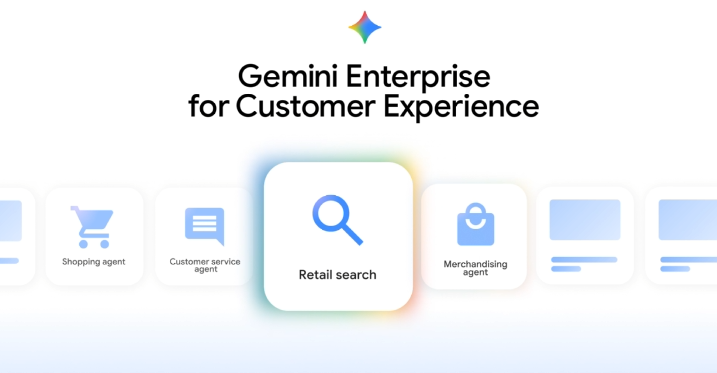
Agentic commerce is not a distant future concept; its early pillars are being built now. For brands, this represents a paradigm shift with immediate implications. The transition from a human-centric web to an agent-augmented one demands a strategic pivot today to remain competitive tomorrow.
Immediate Implications and Actions
-
The Marketing Funnel Collapses, Forcing a Value-First Strategy: The traditional top-funnel (awareness) and middle-funnel (consideration) stages compress as AI agents take over product research. Marketing must focus on becoming the objectively best answer within a specific, well-defined criteria set. Competing on brand halo alone becomes riskier; competing on verifiable attributes, total value, and trust signals becomes essential.
-
Data Infrastructure Becomes Your Primary Competitive Moat: The quality, structure, accuracy, and real-time dynamism of your product and offer data is no longer a backend IT concern—it is your frontline marketing asset. Investing in a PIM (Product Information Management) system and a robust API layer is now a revenue-critical priority.
-
Owned Channels and Direct Relationships Gain Value: As discovery happens through third-party AI agents, owning the direct customer relationship post-purchase is vital. Building loyalty programs, community engagement, and direct communication channels (email, SMS) ensures you retain customer mindshare and can market to them directly, outside of agent-controlled discovery.
-
Brand Authority is Quantified by Machines: Your reputation will be scored by AI systems aggregating reviews, sentiment, delivery reliability data, and policy clarity. Proactively managing all aspects of customer experience—from site performance to return fairness—directly impacts your visibility in agent recommendations. A poor reliability score will make you invisible.
The Strategic Mindset Shift
-
From “Selling To” to “Being Spec’d By”: Your product pages should be written as precise technical specifications for machine inference, supplemented by compelling brand storytelling for the human who might review the agent’s choice.
-
From “Driving Traffic” to “Earning Inclusions”: The key metric shifts from website traffic volume to having your products and offers reliably included in the decision-sets of major AI shopping agents and platforms.
-
From “Conversion Rate Optimization” to “Transaction Success Rate Optimization:” Focus on eliminating any point of failure (data inaccuracy, inventory sync errors, payment friction) that would cause an AI agent to abort a transaction or mark your brand as unreliable.
Agentic commerce today means accepting that a significant portion of your future customer base will never type your URL into a browser, scroll your Instagram feed, or click a Google Ad. They will delegate. Your business must be built to be found, analyzed, trusted, and transacted with by autonomous software agents. The brands that start adapting their technology, data, and strategy to this new reality today will define the winners of the next commerce era.
How Pro Real Tech Helps Retailers Stay Competitive in the Agentic Commerce Age
At Pro Real Tech, we empower eCommerce brands to bridge the gap between today’s digital fundamentals and tomorrow’s AI-driven landscape. We specialize in transforming your online store into an intelligent, AI-ready platform that wins both customer loyalty and algorithmic preference.
Our strategic framework unifies SEO, PPC, and technical optimization to build the robust foundation required for agentic commerce. We prepare your business for this shift by implementing future-proof strategies and building the critical infrastructure that makes your product data seamlessly readable and actionable for AI agents. From optimizing for AI-driven discovery to enabling frictionless checkout experiences, our services ensure your brand remains visible, authoritative, and competitive at every touchpoint.
Don’t just adapt to the future of AI-powered shopping—lead it. Partner with Pro Real Tech to future-proof your commerce strategy and capture your share of the agent-driven market.
Frequently Asked Questions (FAQs) on Agentic Shopping
WHAT ARE AI AGENTS AND HOW DO THEY WORK IN ONLINE SHOPPING?
AI agents are advanced software programs that can autonomously perform complex, multi-step tasks. In shopping, a user delegates a goal (e.g., “find a comfortable office chair under $500”). The agent then researches, compares products based on specs and reviews, and can execute the purchase, all without the user visiting multiple websites.
WHAT IS AGENTIC AI AND HOW IS IT DIFFERENT FROM TRADITIONAL AI AGENTS?
“Agentic AI” emphasizes the agency or autonomy given to the AI. The key difference is proactive goal completion. A traditional chatbot reacts to a question. Agentic AI is given a goal and the authority to independently plan and execute the steps to achieve it, making decisions along the way.
WHAT IS AGENTIC COMMERCE AND HOW DOES IT IMPACT ECOMMERCE BUSINESSES?
Agentic Commerce is the ecosystem where AI agents conduct shopping on behalf of humans. It impacts businesses by compressing the traditional marketing funnel. Visibility no longer depends solely on winning clicks, but on having products that are easily discoverable, comparable, and purchasable by AI agents, shifting competition to data clarity and total value proposition.
HOW DO AI AGENTS FIND PRODUCTS AND RECOMMEND THEM TO SHOPPERS?
Agents find products by crawling and analyzing structured data from the web. They recommend products by matching the user’s goal against product attributes (price, specs, reviews) and retailer reliability (shipping speed, return policy). They present a curated shortlist or a single best-fit option to the user.
DOES GOOGLE FETCH PRODUCT INFORMATION FROM ALL WEBSITES OR ONLY PARTNER RETAILERS?
While Google can crawl public information from any website, it will prioritize and trust data that is accurate, consistently structured, and delivered in real-time. For features like potential future “Direct Offers,” a formalized, reliable data feed partnership would likely be necessary to ensure seamless transaction execution.
WHAT IS THE UNIVERSAL COMMERCE PROTOCOL (UCP) AND WHY IS IT IMPORTANT FOR RETAILERS?
The Universal Commerce Protocol (UCP) is the concept of a standardized, machine-readable method for presenting complete product and offer data. It’s important because it makes your store legible to any AI agent. Without UCP-ready data (rich attributes, real-time inventory, clear pricing), retailers risk becoming invisible in agent-driven discovery.
HOW DOES GOOGLE’S BUSINESS AGENT IMPROVE THE ONLINE SHOPPING EXPERIENCE?
A Business Agent improves the experience by acting as a conversational, proactive shopping assistant. It moves beyond answering questions to completing jobs. It can ask clarifying questions, compare products within a conversation, check inventory, apply discounts, and initiate checkout, creating a seamless, guided path to purchase.
WHAT ARE DIRECT OFFERS AND HOW ARE THEY DIFFERENT FROM TRADITIONAL PPC ADS?
Direct Offers are machine-readable proposals containing final price, terms, and availability. Unlike PPC ads designed to attract a human click, Direct Offers are structured for AI agents to evaluate and autonomously accept. Competition shifts from ad creativity to the best total value proposition (price, shipping, reliability).
WHAT IS ANSWER ENGINE OPTIMIZATION (AEO) AND HOW IS IT RELATED TO AI-DRIVEN SEARCH?
Answer Engine Optimization (AEO) is the practice of optimizing content to be sourced directly into the answers provided by AI agents and AI search. It’s related because success means your product data is extracted and used to form a complete answer within the AI interface, often without the user ever clicking a link.
HOW SHOULD ECOMMERCE BRANDS PREPARE FOR AN AGENTIC SHOPPING FUTURE TODAY?
Brands should: 1) Invest in a “single source of truth” product data management system, 2) Implement and maintain rich structured data (schema.org), 3) Ensure real-time accuracy of inventory and price, 4) Audit and improve shipping/return policies for competitiveness, and 5) Start creating comprehensive, expert content that establishes authority for AEO.


