

Paid search and AI search are often treated as separate marketing channels, but the data generated by your paid advertising campaigns can help shape a stronger AI visibility strategy. Your PPC account contains something that many content teams struggle to obtain: real-world evidence of what potential customers are searching for, what language they use, which problems they want solved, and which messages persuade them to take action.
That makes your paid ads account more than a customer-acquisition tool. It can also function as a source of audience intelligence for your website and content strategy.
The distinction is important, however. Paying for an advertisement does not directly make a business eligible for inclusion in AI-generated answers. Google’s current guidance states that pages appearing as supporting links in AI Overviews or AI Mode must meet the normal technical requirements for Google Search, and there are no separate technical requirements or special AI markup required. Google continues to emphasize helpful, reliable, people-first content and foundational SEO practices.
The opportunity is therefore indirect but valuable: use paid search data to discover genuine demand, then turn those insights into useful, crawlable, authoritative website content. A successful campaign can tell you what your audience wants to know; your organic content can provide the detailed answer.
This creates a feedback loop:
Paid search captures demand → PPC data reveals intent → content addresses that intent → search engines discover the content → AI search may use eligible pages as supporting sources.
The following sections explain how to turn that process into a practical AI visibility strategy.
How Paid Search Supports AI Visibility
Paid search can support AI visibility by providing a continuous stream of customer-intent data that can inform the content and website assets search engines need to understand a business.
When someone clicks a paid search advertisement, the advertiser can learn much more than which keyword generated the click. Search-term data can reveal the actual language people use when looking for a product, service, solution, comparison, or answer. Google Ads’ Search Terms Report is specifically designed to show the searches that triggered ads and provides insights that can be used to improve creative and landing-page content.
For example, suppose a company sells commercial HVAC services. Its initial keyword strategy might target terms such as “commercial HVAC repair” or “commercial HVAC company.” The search-term data could reveal more specific searches such as:
- “commercial HVAC repair for office buildings”
- “how much does commercial HVAC maintenance cost”
- “emergency HVAC repair near me”
- “preventive maintenance for commercial air conditioners”
- “commercial HVAC repair vs replacement”
Those searches represent different forms of intent. Some users want an immediate service. Others are researching costs, comparing options, or trying to understand whether they need repair or replacement.
That information can influence the company’s AI-search content strategy.
Instead of creating another generic page targeting “commercial HVAC services,” the company can build useful resources that directly address those underlying questions. It might create a commercial HVAC maintenance guide, a repair-versus-replacement comparison, an emergency service page, a pricing explanation, and an FAQ addressing common building-owner concerns.
This matters because AI search experiences increasingly help users explore complex and conversational questions, rather than simply returning a list of traditional blue links. Google describes AI Overviews as a way to provide an AI-generated snapshot with links for users who want to explore information further, while AI Mode is designed for more detailed, conversational searches.
Paid search can therefore help identify the questions worth answering before you invest significant resources in content.
Paid Search Provides Real Customer Language
One of the biggest advantages of PPC data is that it reflects how customers actually search.
Your SEO team may brainstorm a keyword such as “enterprise cybersecurity services,” while prospects may search for:
- “how to protect a small business from ransomware”
- “managed cybersecurity services for law firms”
- “cybersecurity company with 24/7 monitoring”
- “how much does managed security cost”
- “best cybersecurity solution for remote employees”
These variations expose different needs, concerns, industries, and stages of the buying journey.
Google’s Search Terms Insights feature goes a step further by grouping searches into intent-based categories and subcategories. It can show metrics such as clicks, impressions, CTR, conversions, conversion rate, conversion value, and search volume for those categories. Google also notes that these insights can be used to improve creatives, landing pages, and Merchant Center feed descriptions.
That makes paid search data particularly useful for identifying content gaps that are grounded in actual demand.
Paid Search Can Reveal High-Value Questions
Not every search deserves a new article. The most valuable opportunities are usually searches that combine meaningful demand with strong business relevance.
Look for search terms that:
- Generate conversions or qualified leads.
- Appear repeatedly across campaigns.
- Represent important customer questions.
- Reveal objections or purchase concerns.
- Indicate comparison or evaluation intent.
- Expose topics that existing website content barely addresses.
A search term that produces only traffic may be interesting. A search term that produces qualified conversions and reveals a recurring customer question is much more strategically valuable.
This helps prevent a common AI-content mistake: producing large volumes of generic pages simply because a keyword exists. Google’s guidance continues to emphasize unique, valuable content that satisfies users rather than content created primarily to manipulate search visibility.
Why Your Paid Ads Account Is an AI Visibility Advantage
Your paid ads account can provide an advantage because it contains first-party marketing intelligence that is closely connected to real customer behavior.
Traditional keyword research can tell you what people search for. PPC performance data can tell you which of those searches are actually producing meaningful business outcomes.
That distinction is extremely useful when deciding what content deserves investment.
Imagine a software company discovers through paid search that searches around “project management software for remote teams” produce a high conversion rate. The company can use that insight to develop a comprehensive resource around remote project management, including:
- How remote teams organize projects.
- Features remote teams should look for.
- Common remote project-management problems.
- How to compare project-management platforms.
- Security and collaboration considerations.
- Implementation advice.
- Frequently asked questions.
The PPC account has essentially helped identify a topic with proven commercial relevance. The website can then build an authoritative content cluster around that demand.
Your PPC Account Contains More Than Keywords
A mature paid search account can reveal several useful signals:
| PPC Signal | Potential AI-Visibility Insight |
|---|---|
| Search terms | Questions and language customers actually use |
| Conversions | Topics associated with meaningful business outcomes |
| High-CTR ad copy | Messages that attract attention |
| High-converting ad copy | Messages that may resonate with qualified prospects |
| Campaign themes | Major customer needs and product categories |
| Landing-page performance | Topics and experiences that drive action |
| Geographic performance | Local or regional demand patterns |
| Device performance | Differences in user behavior and intent |
| Search-term categories | Broader themes behind individual searches |
These signals can help content teams move from keyword-first content planning to intent-first content planning.
Google’s Search Terms Insights specifically supports this type of analysis by organizing search activity into themes and subthemes, helping advertisers understand what customers are interested in and where untapped demand may exist.
PPC Performance Can Help Prioritize Content
Another advantage is prioritization.
A business may have hundreds of potential content topics, but limited resources. Instead of deciding what to publish based only on search volume, marketers can combine PPC information with organic SEO data, conversion data, customer-service questions, sales feedback, and competitive research.
For example:
Topic A: 20,000 monthly searches but little commercial relevance.
Topic B: 2,000 monthly searches and consistently generates qualified PPC leads.
Topic B may be the better business priority.
The goal is not simply to make AI systems notice more pages. It is to build content around the subjects where your business has genuine expertise and where customers demonstrate meaningful interest.
Paid Search and AI Search Serve Different Roles
It is also important not to confuse paid visibility with AI visibility.
Paid search can place an advertisement in front of a user when an eligible search occurs. AI search, by contrast, can synthesize information from multiple sources and provide links to supporting pages. Google’s documentation explains that AI Overviews and AI Mode can surface relevant links to help users explore information, while eligibility is still based on the normal foundations of Google Search.
Therefore, the strategic relationship is best understood as:
PPC = demand intelligence and immediate visibility
SEO/content = discoverable information and long-term authority
AI search = an additional discovery and evaluation environment
Using them together allows paid campaigns to inform the content that supports organic and AI-driven discovery.
How To Redeploy Paid Search Terms Into AI Content
The most practical way to leverage your PPC account for AI visibility is to turn valuable search-term data into helpful, crawlable content that directly answers the underlying intent.
Do not simply copy a list of paid keywords into an article. A search term is a starting point. The goal is to understand the question, problem, comparison, or decision behind it and then create a genuinely useful resource.
1. Export and Organize Your Search-Term Data
Start with your Google Ads Search Terms Report and Search Terms Insights.
Look beyond impressions. Segment the data according to:
- Conversions
- Conversion value
- Conversion rate
- Clicks
- Search intent
- Product or service
- Geographic relevance
- Customer stage
- Recurring questions
Google’s reporting tools allow advertisers to review search terms and associated performance, while Search Terms Insights can organize queries into broader categories and subcategories.
The objective is to find patterns, not just individual keywords.
For example, ten different searches may all express the same underlying intent:
- “best CRM for small business”
- “CRM software for small companies”
- “best CRM platform for startups”
- “affordable CRM for small business”
- “CRM for growing businesses”
Rather than creating five thin pages, recognize the broader topic and determine what comprehensive resource could satisfy the different variations.
2. Classify Searches by Intent
Once the data is organized, assign each search or search theme to an intent category.
Informational intent:
The user wants to understand something.
Examples:
- “What is predictive maintenance?”
- “How does cloud backup work?”
Commercial investigation:
The user is evaluating options.
Examples:
- “best accounting software for startups”
- “CRM vs marketing automation”
Transactional intent:
The user is close to taking action.
Examples:
- “buy accounting software”
- “book emergency plumbing repair”
Problem-solving intent:
The user has a specific issue.
Examples:
- “why is my AC leaking water”
- “how to recover deleted business emails”
This classification helps determine the right content format. An informational query may deserve a guide, while a comparison query may require a detailed comparison page. A transactional query may be better served by a strong service or product page.
3. Map Search Terms to Existing Pages
Before creating new content, check whether your website already answers the question.
You may discover that a valuable paid search term already maps to a page, but that page provides only a brief answer.
In that case, expanding the existing page may be more useful than publishing another URL.
For example, if a service page receives PPC traffic for “how much does commercial roof repair cost,” but the page only contains a short pricing paragraph, consider expanding it with:
- Pricing factors
- Typical project variables
- Repair versus replacement considerations
- What an inspection involves
- Common customer questions
- Examples of situations that change the final cost
- Clear service-area information
- Relevant supporting evidence
This creates a stronger information resource without unnecessarily fragmenting your website.
4. Turn High-Value Queries Into Content Briefs
For searches that represent genuine content gaps, convert them into structured briefs.
A useful brief can include:
Primary customer question:
What does the user actually want to know?
Underlying intent:
Why are they asking?
Supporting questions:
What related questions are likely to follow?
Business relevance:
Why does this topic matter to the company?
Evidence:
What original data, expertise, examples, or sources can strengthen the answer?
Recommended format:
Guide, service page, comparison, FAQ, product page, case study, or another format.
This approach is particularly useful for AI-oriented content because conversational search can involve multiple related questions rather than one isolated keyword.
5. Build Comprehensive Answers Instead of Keyword Variations
Suppose your PPC data reveals the following searches:
- “is solar worth it in 2026”
- “solar panel payback period”
- “how long until solar panels pay for themselves”
- “solar ROI for homeowners”
Creating four short articles around these variations may produce repetitive content.
A better approach could be one comprehensive guide covering:
- Whether solar is financially worthwhile.
- Factors affecting ROI.
- Payback-period calculations.
- Installation costs.
- Energy savings.
- Incentives where applicable.
- System lifespan.
- Maintenance considerations.
- Situations where solar may not make financial sense.
The individual search terms then become subtopics within a useful resource, rather than reasons to produce multiple thin pages.
6. Use Paid Search Data as a Feedback Loop
The process should not end when the content is published.
After publishing, compare the new page’s performance with the original PPC insights.
Monitor:
- Organic impressions
- Organic clicks
- Search queries
- Engagement
- Conversions
- Assisted conversions
- Branded searches
- AI-search visibility where reliable measurement is available
- Referral traffic from AI platforms when identifiable
AI visibility is not guaranteed simply because a page targets a successful paid-search query. Google’s current guidance makes clear that pages must still satisfy normal Search requirements and provide helpful, reliable content.
The real advantage comes from continuously connecting what customers search for in paid campaigns with what your website explains in depth.
That creates a durable content intelligence loop:
Analyze PPC searches → identify high-value intent → map existing content → fill important gaps → publish useful resources → measure results → feed new insights back into PPC and content strategy.
Over time, your paid ads account becomes more than a source of campaign performance data. It becomes a practical customer-intent research engine that helps determine which questions your website should answer, which topics deserve deeper coverage, and where your brand can provide genuinely useful information across traditional and AI-powered search.
How To Turn Winning Ad Copy Into Crawlable Content
Your highest-performing ad copy contains valuable evidence about what makes your audience pay attention. Headlines with strong click-through rates, descriptions that consistently generate conversions, and calls to action that outperform alternatives can reveal the messages customers find relevant. Instead of keeping those insights confined to Google Ads campaigns, use them to strengthen the crawlable content on your website.
The key is to expand the message rather than copy the advertisement word for word. An ad has limited space and is designed to generate an immediate response. A webpage has much more room to explain the claim, provide supporting evidence, answer follow-up questions, and demonstrate expertise.
For example, suppose a paid ad for an accounting software company consistently performs well with the message, “Automate Your Small Business Bookkeeping.” That phrase can become the starting point for a deeper page explaining:
- Which bookkeeping tasks can actually be automated.
- How automation works.
- Which tasks still require human review.
- What types of businesses benefit most.
- How much time businesses can potentially save.
- What information the software needs to operate effectively.
- Common bookkeeping automation mistakes.
- How the solution compares with manual bookkeeping.
This gives search engines substantially more context than a short advertising message.
Identify the Messages That Deserve Expansion
Start by reviewing ad performance at the asset and campaign level. Look for messages associated with meaningful outcomes rather than relying solely on impressions.
Useful signals include:
- High conversion rates
- Strong conversion value
- High-quality leads
- Strong click-through rates
- Repeated performance across campaigns
- Messages that address recurring customer pain points
- Benefits that consistently outperform generic claims
Then ask what the successful message actually communicates.
If “24/7 emergency plumbing service” consistently performs well, the underlying customer need may not simply be emergency plumbing. Users may want to know what qualifies as an emergency, how quickly a plumber can respond, what happens during an emergency repair, which problems require immediate attention, and what they should do while waiting.
Those questions can become sections of a service page or supporting resource.
Turn Ad Claims Into Complete Answers
Every strong advertising claim should have supporting information somewhere on the website.
Consider this framework:
Ad message: “Same-Day Roof Repair”
Crawlable content: Explain what same-day service means, which repair types qualify, service-area limitations, how scheduling works, what customers should prepare before the technician arrives, and when a temporary repair may be more appropriate than a permanent solution.
This is especially useful for AI search because AI-generated answers can involve multiple related aspects of a topic. A page that thoroughly explains the underlying subject gives search systems more meaningful information to understand and potentially surface.
Google’s guidance for AI features continues to emphasize the importance of normal Search fundamentals and helpful, reliable content. There is no special “AI visibility” markup that guarantees inclusion in AI Overviews or AI Mode.
Preserve the Language Customers Respond To
Winning ad copy can also help improve the language used throughout a landing page.
If customers repeatedly respond to a particular benefit, incorporate that concept naturally into:
- Page titles
- Headings
- Introductory copy
- Feature descriptions
- FAQ answers
- Comparison sections
- Calls to action
- Supporting articles
However, avoid mechanically repeating the same keyword or advertising phrase. The goal is to make the page clearer and more useful, not to create a page that reads like an advertisement.
The best approach is to combine validated customer language with original information and genuine expertise.
Connect Ad Messages to Evidence
A claim becomes considerably more useful when the website explains why it is true.
Instead of:
“The fastest way to manage your projects.”
Explain what makes the solution faster. Show the workflow, features, implementation process, or measurable results that support the claim.
For example:
Ad claim: “Reduce project delays.”
Supporting content: Explain how automated task assignments, deadline notifications, workload visibility, approval workflows, or dependency tracking can reduce specific causes of project delays.
This turns persuasive advertising language into substantive content that can be understood by both people and search systems.
How To Improve PPC Landing Pages for AI Visibility
A PPC landing page has traditionally been optimized around one immediate objective: converting the visitor. That objective remains important, but a page designed only around a form, headline, benefits, and CTA may provide insufficient context for organic and AI-powered discovery.
A stronger landing page should satisfy both the visitor’s immediate need and the information requirements of someone researching the problem more deeply.
This does not mean turning every PPC landing page into a 3,000-word article. It means making sure the page clearly communicates what the business offers, who it serves, what problem it solves, why the visitor should trust it, and what questions a potential customer is likely to have.
Make the Page’s Primary Purpose Obvious
The first few sections should make the core subject unmistakable.
A strong service or product landing page should clearly communicate:
- What the product or service is.
- Who it is for.
- What problem it solves.
- Where it is available, when relevant.
- The primary benefits.
- What the visitor can do next.
Avoid vague headlines such as “Transform Your Business Today” when the page could instead say exactly what is being offered.
Clear language helps users understand the page immediately and gives search engines stronger contextual signals.
Expand Beyond the Conversion Form
A landing page does not need to sacrifice conversions to provide useful information.
Instead of placing a form immediately after a short sales pitch, consider adding relevant sections such as:
What the service includes
Explain the actual scope of the offering.
Who it is designed for
Describe the customers, industries, business sizes, or situations that are the best fit.
How the process works
Give visitors a clear explanation of what happens after they contact or purchase from you.
Common problems addressed
Connect the service to specific customer needs.
Pricing or cost factors
Where appropriate, explain what influences pricing rather than hiding all information behind a form.
Frequently asked questions
Answer legitimate questions that repeatedly appear in PPC search terms, sales calls, chats, or customer support.
Proof and experience
Include appropriate case studies, qualifications, reviews, examples, or original evidence.
These sections create a much richer understanding of the business than a conversion-only page.
Match the Landing Page to Search Intent
The page should fulfill the promise made by the advertisement.
If an ad targets “emergency AC repair,” the landing page should immediately address emergency AC repair—not force the visitor to navigate through a generic HVAC services page.
Likewise, if a product ad promotes a specific product, the destination should provide accurate information about that product.
This alignment is important for both user experience and search understanding. Google Merchant Center guidance specifically recommends matching product data to landing-page information and maintaining accurate, current details.
Answer the Questions That Follow the Search
One of the most effective ways to strengthen a PPC landing page is to think beyond the original query.
Someone searching for:
“commercial cleaning service for offices”
may immediately wonder:
- What does commercial cleaning include?
- How often should an office be cleaned?
- Can cleaning happen after business hours?
- Do you provide supplies and equipment?
- Are your cleaners insured?
- How much does commercial office cleaning cost?
- Can you handle large facilities?
- Which locations do you serve?
If these questions are relevant to the service, answering them directly makes the page more useful.
This is particularly valuable in AI-driven search environments, where users increasingly ask longer and more conversational questions.
Keep Important Content Crawlable
Important information should be available in the page’s accessible content rather than being hidden exclusively behind interactions that search crawlers may not process as expected.
Google recommends ensuring that pages intended to appear in Search are accessible to Google and are not blocked by robots.txt, noindex, or login requirements.
For important commercial information, make sure the actual page communicates:
- Product or service details
- Features and benefits
- Pricing information when appropriate
- Availability
- Service areas
- Policies
- Relevant qualifications
- Frequently asked questions
Use JavaScript where appropriate, but do not make critical information unnecessarily dependent on client-side interactions.
Strengthen Internal Links
A PPC landing page can also become an entry point into a broader topical ecosystem.
For example, a cybersecurity service page could link naturally to:
- Ransomware prevention guide
- Managed security comparison
- Cybersecurity checklist
- Security assessment guide
- Industry-specific cybersecurity resources
- Relevant case studies
Internal links help users explore related information and help search engines understand relationships between pages.
The objective is not to add links for the sake of SEO. Each link should provide a useful next step.
How Product Feeds and Structured Data Support AI Search
For businesses that sell products online, product feeds and structured data can make important product information easier for search systems to interpret, validate, and use across eligible search experiences.
Structured data provides standardized information about a webpage and its entities. Google explains that structured data gives Search explicit clues about the meaning of page content and can make pages eligible for certain enhanced search experiences.
For product pages, this can include information such as:
- Product name
- Brand
- Description
- Price
- Availability
- SKU
- GTIN
- Product images
- Reviews and ratings
- Shipping information
- Return information
- Product variants
Google’s current product documentation recommends providing both product structured data on webpages and a Google Merchant Center feed where applicable. Google states that using both can maximize eligibility for experiences and help Google understand and verify product information.
Product Feeds Give Search Systems More Product Context
A Merchant Center feed provides structured product information separately from the visible webpage.
For example, an ecommerce retailer can supply:
- Product ID
- Product title
- Description
- Landing-page URL
- Image URL
- Price
- Availability
- Brand
- GTIN
- Product category
- Shipping information
Accurate product information matters because search systems need to understand what is actually being sold and whether the information matches the customer’s experience.
Google’s current Merchant Center documentation also includes a product_detail attribute that allows merchants to provide additional technical specifications and product details. Google says this information can help customers discover products across AI-driven surfaces such as AI Mode in Google Search.
Structured Data Helps Connect the Page With the Product
Think of structured data as a machine-readable layer that reinforces the information already visible on the page.
For a product page, the visible page might say:
Wireless Noise-Cancelling Headphones
- $199
- Available in stock
- 30-hour battery
- Bluetooth connectivity
- Two-year warranty
The Product structured data can explicitly identify the page as describing a product and associate relevant attributes with that product.
This can help Google process the information more reliably and can make the page eligible for product-related search enhancements. Google currently supports product structured data for experiences that can display information such as price, availability, ratings, shipping, and return details.
Keep Product Data Consistent Everywhere
One of the biggest mistakes is creating discrepancies between the product feed, structured data, landing page, and actual offer.
For example:
Merchant feed: $79.99
Structured data: $79.99
Visible page: $89.99
That inconsistency creates uncertainty and can cause product-data problems.
Google specifically requires structured data values to match the information shown to users, and Merchant Center regularly checks that submitted product data matches the landing page.
Maintain consistency across:
- Product name
- Description
- Price
- Currency
- Availability
- Product identifiers
- Variants
- Shipping information
- Return policies
- Images
For ecommerce brands, keeping this information synchronized should be an ongoing operational process rather than a one-time SEO implementation.
Use Product Structured Data on the Right Pages
Product markup should describe an actual product page, not simply be added to every page because “Product schema” sounds useful.
Google’s current documentation notes that product rich results are designed for pages focused on a single product or variants of the same product.
That means a retailer should prioritize:
- Individual product pages
- Product variant pages where appropriate
- Pages with complete product information
rather than treating a general category page as though it were a single product.
Don’t Treat Structured Data as an AI Ranking Shortcut
Structured data is useful, but it should not be misunderstood.
Adding Schema.org markup does not guarantee that a product or page will appear in an AI-generated answer, AI Overview, or another search feature. Google explicitly notes that search enhancements are shown at its discretion and can change over time.
The strongest strategy is to combine structured information with strong visible content.
That means:
Accurate product feed + complete landing page + valid structured data + accessible technical implementation + useful product information
rather than:
Schema markup alone = AI visibility.
Keep Product Information Detailed and Current
AI-driven search makes accurate product information increasingly important because users can ask more specific questions about products.
For example, instead of searching only for “running shoes,” a customer might ask for a running shoe with:
- A specific use case
- A particular size
- A certain material
- A specific price range
- A certain feature
- Particular shipping requirements
The more accurately your product data describes the actual product, the more useful that information becomes to search systems and customers.
Google’s current Merchant Center guidance recommends providing complete, accurate product data, using detailed product categories, maintaining current prices and availability, and matching product information to the landing page.
For brands using AI-generated product titles or descriptions in Merchant Center, Google also provides dedicated structured attributes such as structured_title and structured_description to identify AI-generated text.
Ultimately, product feeds and structured data should be treated as part of a broader AI search readiness strategy, not as a replacement for useful content. Your paid campaigns can reveal what shoppers want, your product pages can answer those needs, and your structured data and feeds can provide search systems with consistent, machine-readable information about what you actually offer.
How To Track AI Visibility From Paid Search Insights
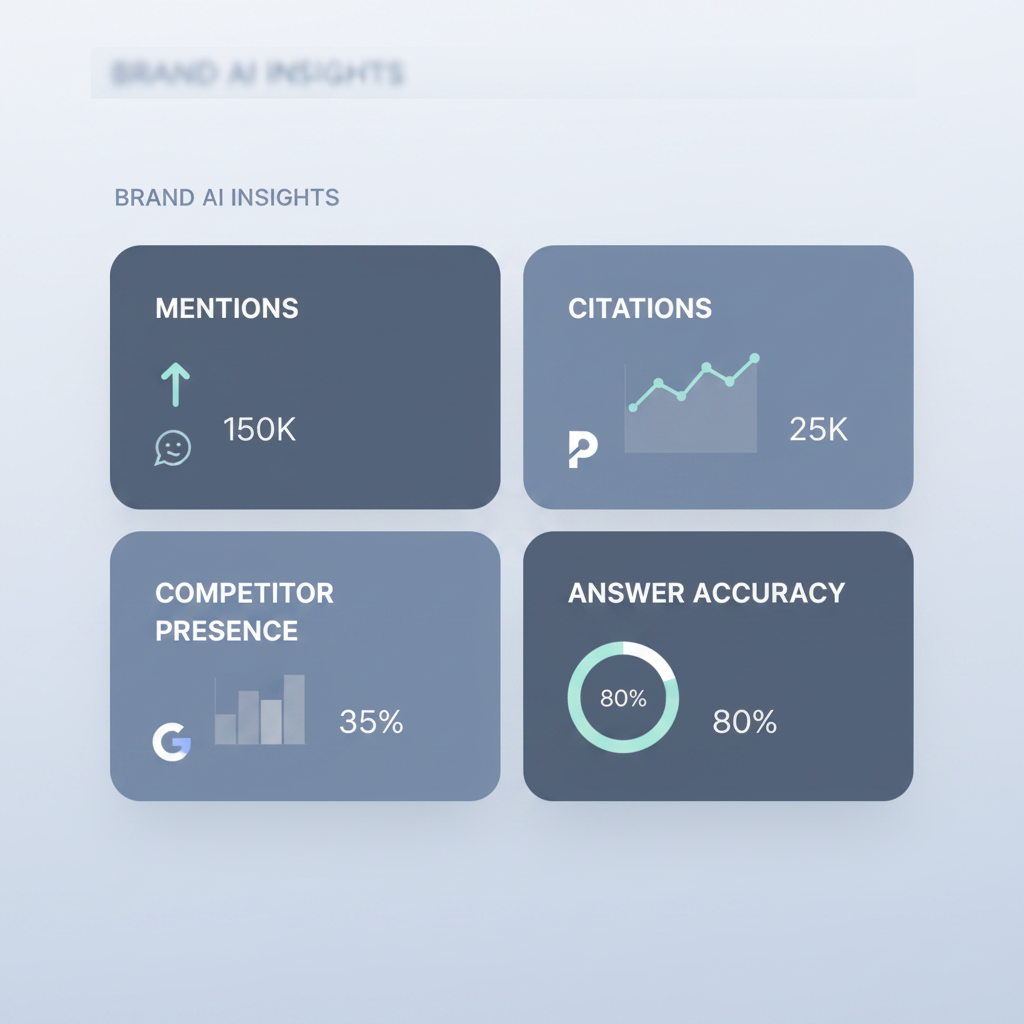
Tracking AI visibility is more complicated than measuring traditional PPC performance because an AI-generated answer may expose a brand without producing a conventional click. A user might see a company mentioned or linked in an AI-generated response, learn about the brand, and later search for it directly or visit through another channel.
That means your PPC account should not be treated as a direct measurement system for AI visibility. Instead, use paid search data as a source of intent and performance intelligence, then combine it with organic search, website, brand, and AI-search signals.
The first step is to establish a baseline.
Separate Paid Search Performance From AI Visibility
Traditional PPC metrics answer questions such as:
- How many people clicked the ad?
- Which search terms generated conversions?
- Which campaigns produced the highest conversion value?
- Which ads generated the strongest engagement?
- What did each lead or sale cost?
AI visibility asks different questions:
- Does the brand appear when customers ask relevant questions in AI search?
- Which topics generate brand mentions?
- Which pages are referenced as sources?
- Are competitors appearing for queries where your business has expertise?
- Are users discovering the brand through AI-generated answers?
- Does increased AI exposure correlate with branded search or website activity?
Keep these measurements separate, but connect them strategically.
A successful PPC campaign does not prove that your brand is visible in AI search. Likewise, an increase in AI mentions does not necessarily mean that a particular paid campaign caused the increase.
Use Paid Search to Identify the Queries Worth Monitoring
Your PPC search-term data can help create an AI visibility monitoring set.
Start with searches that are:
- High-converting.
- Closely related to your products or services.
- Frequently searched.
- Associated with important customer problems.
- Relevant to your core expertise.
- Producing strong commercial intent.
- Generating recurring questions.
Then expand those keywords into natural-language questions.
For example, a cybersecurity company might see strong PPC performance for “managed cybersecurity services.” Instead of monitoring only that phrase in AI search, build a broader query set:
- What are managed cybersecurity services?
- What does managed cybersecurity include?
- Who needs managed cybersecurity?
- How much do managed cybersecurity services cost?
- What should a business look for in a managed security provider?
- What are the best cybersecurity solutions for small businesses?
This approach is more representative of how people use conversational AI search.
Track Mentions, Citations, and Competitors
For selected queries, record whether your business is:
- Mentioned by name.
- Linked as a source.
- Referenced through a specific webpage.
- Included in a recommendation or comparison.
- Absent while competitors are present.
The distinction matters.
A brand mention shows that the system recognizes the business as relevant. A source citation indicates that one of the brand’s pages is being used to support an answer. Those are related but different visibility outcomes.
Google explains that AI Overviews and AI Mode can provide links to supporting webpages, and that the pages eligible for these experiences are generally subject to the same foundational Search requirements as other Google Search results.
Because AI responses can change depending on the query, context, location, language, and other factors, avoid treating a single AI response as a permanent ranking position.
Connect AI Visibility With PPC Insights
Once you identify pages or topics that appear frequently in AI search, compare them with your paid-search intelligence.
You may discover patterns such as:
PPC insight:
A specific problem-related query generates qualified leads.
Content action:
Create or strengthen a detailed resource addressing that problem.
AI visibility observation:
The resource begins appearing as a supporting source for related questions.
Business measurement:
Organic traffic, branded searches, assisted conversions, or qualified inquiries increase.
This creates a more useful measurement framework than attempting to assign every AI interaction to a particular paid click.
Monitor Organic and Branded Search Changes
AI search can influence customer behavior without producing a directly attributable referral.
For example, someone could:
- Ask an AI search engine about a product.
- See your company mentioned.
- Remember the brand.
- Search for your company later.
- Click your organic result.
- Convert through your website.
The eventual conversion may be attributed to organic or direct traffic even though AI search influenced the original discovery.
For this reason, monitor changes in:
- Branded search impressions.
- Branded search clicks.
- Organic traffic to relevant pages.
- Direct traffic.
- New users.
- Assisted conversions.
- Lead quality.
- Returning visitors.
- AI referral traffic where analytics can identify it.
These signals should be interpreted alongside other marketing activity rather than treated as proof of causation.
Build an AI Visibility Reporting Dashboard
A practical reporting dashboard can combine several data sources.
| Area | Useful metrics |
|---|---|
| Paid search | Search terms, conversions, conversion value, CTR |
| Organic search | Impressions, clicks, queries, rankings |
| AI visibility | Mentions, citations, referenced URLs |
| Brand demand | Branded searches, direct traffic |
| Website | Engagement, leads, purchases |
| Business impact | Qualified leads, revenue, assisted conversions |
Review the data regularly and look for directional trends rather than one isolated metric.
AI search is still evolving rapidly, so the measurement framework should evolve with it.
4 Common Mistakes To Avoid
1. Do Not Treat Paid Search and AI as Unrelated Channels
Paid search captures existing demand, while AI search increasingly influences discovery, research, comparison, and evaluation.
Treating them as completely separate channels means losing the information bridge between them.
Your PPC account tells you what people are actively searching for. It can reveal:
- Customer questions.
- Pain points.
- Product comparisons.
- Objections.
- Purchase considerations.
- Geographic demand.
- High-value use cases.
Your content and SEO strategy can then use those insights to build resources that answer those needs.
Both channels ultimately depend on understanding what customers want and providing relevant information.
The mistake is not using the same tactics for PPC and AI search. The mistake is failing to allow insights from one channel to improve the other.
2. Do Not Keep High-Performing Ad Messages Only in Campaigns
A successful headline or description can contain valuable customer intelligence.
If an advertising message consistently generates strong results, ask why.
Is it:
- A specific benefit?
- A pain-point solution?
- A price-related proposition?
- A speed or convenience promise?
- A particular feature?
- A trust signal?
- A location-specific advantage?
Once you understand the reason behind its performance, expand that idea into your website content.
For example, an ad that says “Get Same-Day Tax Filing Help” can inspire content explaining who qualifies for same-day assistance, what documents are required, how the process works, what situations cause delays, and what customers should expect.
Do not simply copy the advertisement onto a page. Turn the successful message into a useful explanation.
3. Do Not Use Thin Landing Pages
A form and a few lines of sales copy may be sufficient for a narrow conversion experiment, but they may not provide enough context for users or search systems trying to understand the business.
Strong landing pages should include helpful information such as:
- A clear description of the product or service.
- Who the offering is intended for.
- Problems it solves.
- Features or deliverables.
- How the process works.
- Relevant costs or pricing factors.
- Service areas where applicable.
- Trust and credibility information.
- FAQs.
- Supporting evidence or examples.
- Relevant internal links.
The solution is not to make every landing page unnecessarily long.
Instead, make every section earn its place by answering a real customer question or reducing meaningful uncertainty.
Google’s guidance continues to emphasize helpful, reliable, people-first content and accessible pages rather than content created primarily to manipulate search systems.
4. Do Not Treat the PPC AI Search Strategy as a One-Time Task
Customer behavior changes. Search queries change. Ad performance changes. Products and services change. Search interfaces change. AI systems also continue to evolve.
A strategy that works today may require adjustment later.
Build an ongoing workflow:
Review PPC data → identify new intent → update content → strengthen landing pages → monitor AI visibility → analyze conversions → repeat.
Regularly review new search terms and identify questions that are becoming more common.
Also revisit existing pages. If your PPC data shows that customers repeatedly ask a question your page barely addresses, update the page rather than automatically creating another URL.
The goal is to create a continuous feedback loop between paid search intelligence, website content, and search visibility.
Using Paid Search Data To Build AI Visibility
Your paid advertising account contains valuable insights into customer intent, search behavior, messaging preferences, and conversion patterns. When you put that data to work beyond your PPC campaigns, it can help strengthen your presence across AI-powered search experiences.
The opportunity lies in turning proven paid-search insights into valuable website assets. Search terms can reveal questions for FAQs and content sections, high-performing ad copy can inspire detailed crawlable content, and landing-page performance can identify areas that need greater depth or clarity. For ecommerce brands, accurate product feeds and structured data can also provide search systems with clearer information about products, pricing, availability, and other important details.
As paid search and AI-powered search continue to influence how customers research, compare, and choose businesses, connecting PPC insights with your SEO and content strategy can create a more unified approach to digital visibility.
Pro Real Tech helps businesses connect paid search, SEO, AI search optimization, and conversion-focused content into a cohesive growth strategy. If you want to turn your PPC data into meaningful opportunities for stronger AI visibility, contact Pro Real Tech today.
Frequently Asked Questions (FAQs) About Paid Search and AI
What Is Paid Search AI Visibility?
Paid search AI visibility refers to using insights from paid search campaigns to improve a brand’s visibility in AI-powered search experiences.
It does not mean that paying for Google Ads automatically causes a brand to appear in AI-generated answers. Instead, PPC data can reveal customer search behavior, questions, and high-value topics that can inform useful website content.
The resulting content can then become eligible for organic and AI-powered search visibility when it meets the relevant search requirements.
How Does Paid Search and AI Search Work Together?
Paid search and AI search can work together as complementary channels.
Paid search provides immediate exposure and valuable customer-intent data. AI search can influence how users discover, research, compare, and evaluate businesses.
For example, PPC search terms can reveal that customers repeatedly ask about the cost, features, or suitability of a particular service. Those insights can be used to create comprehensive content that addresses the same questions.
The channels therefore share a common intelligence layer: customer intent.
Why Is PPC for AI Search Important?
PPC is useful for AI search strategy because it provides real-world data about what customers actually search for and which topics generate business outcomes.
Instead of relying exclusively on theoretical keyword research, marketers can use paid search performance to prioritize topics that demonstrate commercial relevance.
PPC can therefore help answer an important content-planning question:
Which customer questions are worth investing resources to answer?
What Is AI Search Advertising?
AI search advertising generally refers to advertising experiences that appear within or alongside AI-powered search and conversational discovery environments.
These experiences vary by platform and continue to develop. They should not be confused with organic AI visibility, where a brand or webpage is surfaced as part of an AI-generated answer.
Advertising provides paid placement; AI visibility can involve organic mentions or citations.
How Can I Build a Paid Search Strategy for AI?
Start by using your paid campaigns as a source of customer-intent intelligence.
A practical process is:
- Analyze search terms and search-term categories.
- Identify high-value questions and topics.
- Prioritize searches that produce qualified conversions.
- Map those topics to existing website pages.
- Identify content gaps.
- Expand winning ad messages into useful website content.
- Improve PPC landing pages with comprehensive information.
- Implement appropriate structured data.
- Keep product feeds and landing-page information accurate.
- Monitor AI visibility and business outcomes.
- Repeat the process regularly.
The strategy should focus on serving customer needs, not attempting to manipulate AI systems.
How Do Google Ads and AI Search Connect?
Google Ads and Google’s AI search experiences are connected at the broader search-ecosystem level, but advertising does not guarantee organic AI visibility.
Google’s documentation explains that AI Overviews and AI Mode are Search features and that webpages must meet Google’s normal technical requirements to be eligible for Search visibility. Google also states that there are no additional technical requirements or special schema markup required specifically for AI features.
The practical connection is therefore strategic: Google Ads provides valuable search and audience data that can inform the content and landing pages supporting organic search and AI discovery.
What Is a PPC AI Search Strategy?
A PPC AI search strategy is an approach that uses paid search data to improve a brand’s readiness for AI-powered search.
It typically includes:
- Search-term analysis.
- Customer-intent research.
- Content gap analysis.
- Ad-copy analysis.
- Landing-page optimization.
- Structured data implementation.
- Product-feed optimization where relevant.
- AI visibility monitoring.
It is essentially a feedback system between paid demand capture and organic/AI content visibility.
What Does Paid Search AI Optimization Include?
Paid search AI optimization can include several activities:
- Identifying high-value PPC search terms.
- Grouping queries by intent.
- Finding recurring customer questions.
- Turning successful ad messages into detailed content.
- Expanding thin landing pages.
- Improving internal linking.
- Adding relevant structured data.
- Keeping product information consistent.
- Monitoring AI-generated mentions and citations.
- Comparing your visibility with competitors.
- Using new PPC insights to continuously update your content strategy.
It should not be reduced to adding keywords or schema markup.
How Does an AI Search Marketing Strategy Use Paid Data?
An AI search marketing strategy can use paid data to determine what customers care about most.
For example, if PPC data shows that searches related to “best accounting software for freelancers” produce a high number of qualified conversions, that information can justify creating a detailed resource around accounting software for freelancers.
The page could cover features, pricing considerations, common requirements, comparisons, implementation questions, and other relevant concerns.
PPC data provides the signal; the content provides the answer.
Can Paid Ads Directly Improve AI Visibility?
No—not directly.
Running paid advertisements does not guarantee that a brand will be mentioned or cited in an AI-generated answer. Paid placement and organic AI visibility are separate mechanisms.
However, paid campaigns can indirectly contribute to a stronger AI visibility strategy by revealing valuable customer-intent data.
That data can help a business create better content, improve landing pages, address customer questions, and organize product information. Those assets can then become eligible for organic search and AI-powered discovery when they satisfy the relevant requirements.
The most effective approach is therefore not to think of PPC as a shortcut to AI visibility. Think of it as a customer-intelligence engine.
Use paid search to discover what people want. Use that intelligence to build useful, authoritative, crawlable content. Then continuously measure how your brand and content perform across paid, organic, and AI-driven discovery.
Read More: How AI Overviews Are Surfacing Negative Reviews — And What Brands Should Do About It


