

Pay-per-click (PPC) advertising in 2026 is more competitive, automated and data-driven than ever before. Businesses are investing heavily in Google Ads, social PPC, retail media and marketplace advertising to capture high-intent audiences across increasingly crowded digital channels. At the same time, artificial intelligence (AI), privacy regulations and changing search engine behavior are transforming how campaigns are managed and measured.
Modern PPC success is no longer based only on keyword targeting or bid adjustments. Platforms now rely heavily on automation, machine learning and predictive signals to determine ad delivery, bidding and audience matching. As a result, advertisers must focus more on the quality of their inputs — including creative assets, first-party data, conversion tracking and product feeds — to stay competitive.
Another major shift comes from AI-powered search experiences. Google AI Overviews and other AI-driven SERP features are changing how users interact with search results, often reducing traditional organic clicks and reshaping paid click distribution. At the same time, shopping-heavy search results and retail media growth continue increasing auction pressure and CPC inflation across industries.
Understanding the latest PPC statistics and benchmark trends helps marketers make smarter budgeting decisions, improve campaign efficiency and identify where automation truly delivers value. Whether you manage Google Ads, Amazon PPC, paid social campaigns or omnichannel advertising strategies, staying current with 2026 PPC trends is critical for maintaining profitability and sustainable growth.
PPC Trends in 2026
AI-led automation-first campaign management (with “inputs” as the new levers):
Automation is now the foundation of PPC management in 2026. Platforms like Google Ads, Meta Ads and Amazon Ads increasingly prioritize automated bidding, audience targeting and campaign optimization systems powered by machine learning. Smart Bidding, Performance Max campaigns and AI-generated creative testing are becoming standard across industries. According to multiple 2026 PPC reports, automated bidding strategies now manage the majority of Google Ads spend globally.
This shift means advertisers have less direct control over manual bid adjustments and keyword-level optimization. Instead, campaign success depends heavily on the quality of the “inputs” being fed into the algorithm. These inputs include:
- Accurate conversion tracking
- Product feed optimization
- High-quality creative assets
- Audience signals
- CRM and first-party customer data
- Offline conversion imports
- Revenue and lifetime value (LTV) tracking
As automation expands, PPC managers are transitioning from tactical bid managers into strategic performance analysts. Their role now focuses more on data quality, creative strategy, funnel optimization and business outcome alignment rather than manual campaign micromanagement. Industry discussions throughout 2026 consistently highlight that automation performs best when paired with strong human strategy and high-quality data signals.
Shopping-heavy search engine results pages (SERPs) keep raising competition for commercial intent:
Search engine results pages are becoming increasingly dominated by shopping placements, product carousels, sponsored listings and visual commerce features. Commercial-intent searches now trigger more product-focused SERP layouts than traditional text-heavy search experiences. This evolution has significantly increased competition for high-converting search traffic.
As shopping placements occupy more screen space, advertisers are facing:
- Higher average CPCs
- More aggressive bidding environments
- Greater importance of feed optimization
- Increased focus on pricing competitiveness
- Stronger need for product reviews and merchant trust signals
Retailers and ecommerce brands must now optimize not only their ad copy but also product titles, pricing, availability, shipping details and merchant reputation. Google Shopping campaigns, Amazon Ads and retail marketplace PPC are becoming core components of digital advertising strategies instead of optional add-ons.
Additionally, marketplace competition continues intensifying as more brands shift budgets toward high-intent product discovery channels. Amazon PPC costs and shopping auction pressure have continued rising across many verticals entering 2026.
AI-powered SERP features are reshaping click distribution:
AI-generated search experiences are significantly changing how users interact with search results pages. Google AI Overviews, AI summaries and conversational search interfaces increasingly provide direct answers within the SERP itself, reducing traditional click-through behavior across both organic and paid listings.
Recent industry studies show that AI Overviews are appearing more frequently on commercial and transactional queries, not just informational searches. This creates a major shift in click distribution because users may receive answers directly from AI-generated summaries before interacting with standard search results or ads.
For PPC advertisers, this trend creates several challenges:
- Lower click-through rates for some query types
- Increased competition for visible ad positions
- Reduced organic and paid visibility below AI-generated elements
- More zero-click search behavior
- Higher importance of branded search presence
At the same time, advertisers are adapting by expanding testing into newer placements, combining SEO and PPC strategies more closely and focusing on visibility throughout the entire SERP experience instead of isolated ad positions.
Incrementality testing becomes a requirement:
Traditional attribution models are becoming less reliable due to privacy restrictions, cross-device behavior and AI-driven campaign automation. As a result, incrementality testing is rapidly becoming a core measurement strategy for advanced PPC teams in 2026.
Incrementality testing helps advertisers determine whether PPC campaigns are generating truly additional business outcomes instead of simply capturing existing demand. Rather than relying solely on platform-reported attribution, marketers are increasingly using:
- Geo-based experiments
- Holdout testing
- Conversion lift studies
- Media mix modeling
- Controlled audience exclusions
These testing frameworks provide clearer insights into actual campaign contribution and profitability. This is especially important as automated ad platforms continue operating as “black boxes,” where advertisers have less visibility into how traffic is being matched and optimized.
Businesses that fail to validate incremental performance risk overestimating campaign effectiveness and overspending on channels that may not be generating meaningful new conversions.
First-party data and lead quality optimization move to the center:
Privacy changes and the gradual decline of third-party tracking have pushed first-party data strategies to the center of PPC optimization. In 2026, advertisers are investing more heavily in CRM integrations, customer data platforms (CDPs), server-side tracking and consent-based audience collection.
Platforms increasingly reward advertisers that can send high-quality conversion signals back into advertising systems. Instead of optimizing for raw lead volume, marketers are now prioritizing:
- Sales-qualified leads
- Revenue attribution
- Pipeline stages
- Customer lifetime value
- Profitability metrics
- Offline conversion quality
This allows AI-driven bidding systems to optimize toward actual business outcomes rather than vanity metrics like low-cost clicks or form submissions.
First-party data also plays a major role in audience targeting, remarketing and predictive modeling. As privacy regulations continue evolving worldwide, businesses with stronger owned data ecosystems are gaining significant competitive advantages in paid advertising performance.
Creative is the primary performance differentiator (especially in paid social):
As targeting and bidding become increasingly automated, creative quality has emerged as one of the most important performance differentiators in PPC advertising — particularly in paid social campaigns.
Modern advertising platforms can now automate audience matching and bidding decisions efficiently, but they still rely heavily on compelling creative assets to drive engagement and conversions. High-performing advertisers are focusing on:
- Faster creative testing cycles
- Multiple ad variations
- Video-first advertising
- UGC-style content
- Hook optimization
- Offer experimentation
- Creative fatigue monitoring
Paid social platforms such as Meta, TikTok and YouTube are prioritizing engaging visual content within increasingly crowded feeds. This has made creative production speed and testing discipline essential for maintaining efficient acquisition costs.
Many PPC teams now operate structured creative testing systems where new messaging angles, formats and visuals are continuously evaluated against performance benchmarks. In many industries, creative quality now impacts results more than detailed manual audience targeting.
Retail media keeps expanding beyond Amazon:
Retail media advertising continues expanding rapidly in 2026, with platforms beyond Amazon becoming increasingly important for performance marketers. Walmart Connect, Instacart Ads, Target Roundel and other retailer advertising networks are attracting larger shares of digital advertising budgets.
Retail media networks offer advertisers access to highly valuable first-party shopper data, allowing campaigns to target consumers close to purchase decisions. These platforms provide several advantages:
- Strong purchase-intent audiences
- Closed-loop attribution
- Product-level sales tracking
- Retail-specific targeting signals
- High-conversion shopping environments
As ecommerce competition intensifies, many brands are diversifying beyond Amazon PPC to reduce platform dependency and access broader retail ecosystems.
Retail media growth is also reshaping overall PPC budgeting strategies. Many businesses now allocate separate budgets specifically for marketplace advertising and retail media placements alongside traditional Google Ads and paid social campaigns. This diversification helps advertisers reduce risk while expanding visibility across multiple high-intent commerce platforms.
2025 Benchmarks That Will Shape PPC Performance in 2026
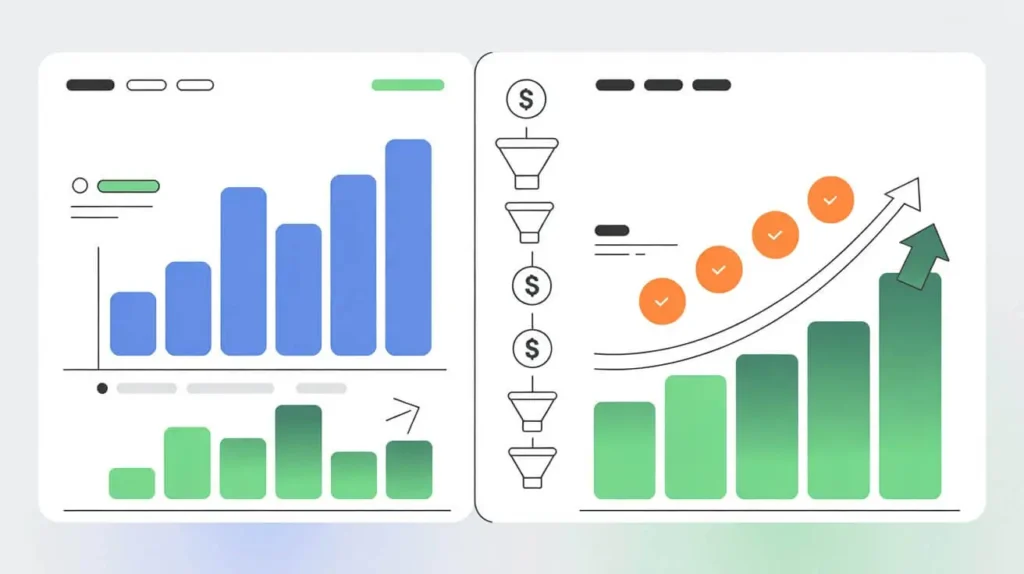
The biggest PPC performance trends in 2026 are being shaped by the benchmark shifts advertisers experienced throughout 2025. Rising CPCs, heavier automation, AI-driven SERP changes and stronger competition across paid search and paid social forced marketers to rethink how they measure profitability and optimize campaigns.
The benchmark data from late 2025 and early 2026 shows a clear pattern: advertising costs are increasing faster than most businesses expected, while platforms continue pushing advertisers toward automation and broader targeting systems. At the same time, conversion efficiency depends more heavily on creative quality, landing page experience and first-party data integration than traditional manual campaign management.
SERP and Shopping Pressure
Search engine results pages became significantly more crowded throughout 2025, especially for commercial and ecommerce queries. Google continued expanding shopping modules, sponsored product placements, AI-generated summaries and Performance Max inventory across high-intent searches. These changes increased auction pressure across nearly every industry.
Benchmark reports entering 2026 show:
- Average Google Search CPCs increased between 10% and 13% year over year across many industries
- Shopping CPCs continued rising faster than standard search CPCs
- Ecommerce ROAS declined as auction competition intensified
- CTR improvements often failed to offset higher acquisition costs
- AI Overviews reduced organic visibility, pushing more brands into paid placements
According to 2026 Google Ads benchmark analysis, average search CPCs reached approximately $2.96 across industries, with many verticals experiencing double-digit increases compared to 2025. Legal, B2B and insurance-related keywords remained among the most expensive search categories.
Ecommerce advertisers faced additional pressure inside Shopping campaigns. Recent ecommerce benchmark studies show Google Shopping CPCs increased roughly 26% over a three-year period, while click-through rates and conversion rates gradually declined. Average ecommerce Shopping CPCs rose from around $0.54 in 2024 to approximately $0.68 entering 2026.
This benchmark shift matters because profitability is becoming harder to maintain through bidding strategies alone. Advertisers now rely more heavily on:
- Product feed optimization
- Conversion rate optimization (CRO)
- Better landing page experiences
- First-party audience signals
- Higher-quality product imagery
- Pricing competitiveness
- Merchant trust indicators
Many PPC specialists also reported that broader-match targeting and automated bidding systems increased irrelevant search exposure when accounts lacked strong negative keyword management.
Another major factor influencing SERP pressure is the growing visibility of AI-generated search features. AI Overviews increasingly occupy premium screen space above traditional search listings, reducing both organic and paid click opportunities for lower-position advertisers. This has intensified bidding competition for top-of-page visibility across commercial search terms.
Amazon PPC Benchmarks
Amazon PPC became substantially more competitive throughout 2025 and continues evolving rapidly in 2026. Rising CPCs, thinner profit margins and stronger marketplace saturation are forcing brands to become more disciplined with campaign structure and profitability management.
Industry discussions and benchmark reporting consistently show that Amazon advertising costs increased across most major product categories during 2025. Sellers in supplements, electronics, beauty and health products experienced some of the steepest CPC inflation.
Benchmark discussions entering 2026 indicate:
- Amazon PPC CPCs increased roughly 15%–30% year over year in many categories
- ACoS volatility became more common
- Profit margins tightened due to both ad costs and fulfillment fee increases
- External traffic became increasingly important for organic ranking growth
- Automation tools gained stronger adoption among larger sellers
Several Amazon-focused PPC discussions throughout early 2026 highlighted how rising competition and marketplace saturation are making manual bid management less effective than in previous years. Sellers increasingly rely on automation systems that adjust bids dynamically based on conversion probability, inventory status and margin thresholds.
Another important benchmark trend involves the relationship between Amazon PPC and external traffic sources. Many sellers now use Google Ads, influencer campaigns and affiliate traffic to strengthen Amazon organic rankings while reducing dependence on expensive internal Amazon clicks.
At the same time, some advertisers still achieve highly profitable results using disciplined low-bid automation strategies. Community case studies show that well-managed auto campaigns with strong negative keyword controls can still maintain low ACoS performance in certain niches.
These benchmark shifts suggest that successful Amazon PPC management in 2026 depends on:
- Margin-aware bidding
- Better product positioning
- Inventory management
- External traffic integration
- Keyword cleanup discipline
- Conversion-focused listing optimization
- Long-term profitability measurement rather than short-term sales volume
Social PPC Benchmarks
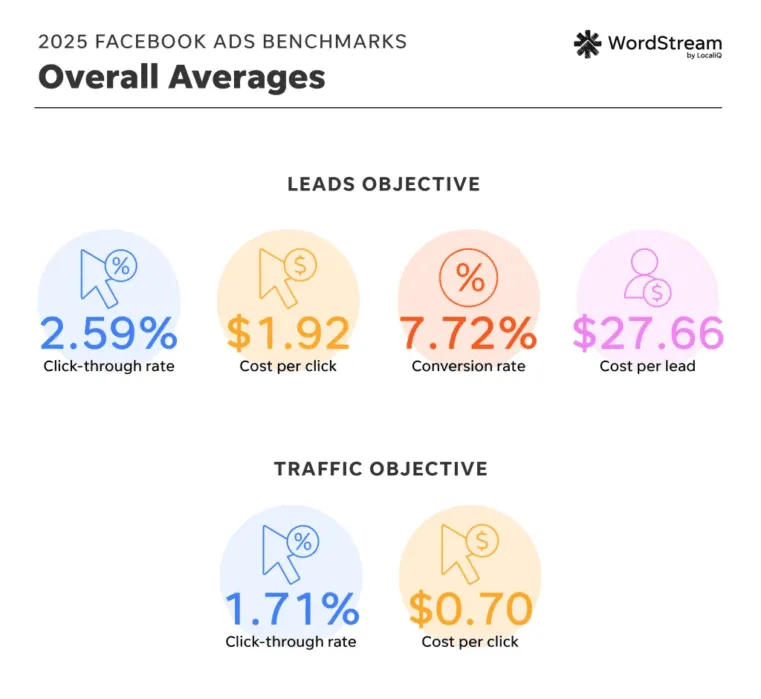
Paid social advertising benchmarks also shifted considerably throughout 2025. Meta, TikTok and LinkedIn continued evolving into increasingly AI-driven advertising ecosystems where creative quality and engagement signals matter more than traditional interest targeting alone.
TikTok experienced one of the fastest advertising growth rates entering 2026. Industry benchmark reports show TikTok ad spend rebounded strongly, with global advertiser investment increasing significantly year over year. Average in-feed CPCs remained relatively affordable compared to Google Search and Meta Ads.
Current TikTok benchmark estimates show:
- Average in-feed CPC around $0.50–$1.02
- CPMs generally ranging between $9 and $13
- CTR averages near 1%
- Lower CPCs than Meta and Google Search in many industries
This pricing structure keeps TikTok attractive for upper-funnel awareness campaigns and ecommerce brands seeking scalable video traffic. However, competition continues increasing as more advertisers adopt video-first acquisition strategies.
Meta advertising benchmarks also shifted due to auction pressure and stronger AI-driven optimization systems. CPM inflation remained a major concern for advertisers during 2025, especially across conversion-focused campaigns. Industry discussions show that campaign objectives increasingly influence auction pricing behavior within Meta’s advertising ecosystem.
One of the biggest benchmark trends across paid social platforms is the growing importance of creative performance. As targeting automation improves, advertisers increasingly compete through:
- Short-form video quality
- User-generated content (UGC)
- Hook optimization
- Faster creative refresh cycles
- Native-style ad formats
- Creator-led advertising
In B2B advertising, LinkedIn continued maintaining some of the highest CPCs among major advertising platforms. However, marketers increasingly evaluate LinkedIn using revenue-quality metrics instead of raw click costs. Benchmark discussions show that LinkedIn may produce stronger company-level influence despite higher CPCs compared to Meta or Google Search.
Overall, 2025 social PPC benchmarks reinforced an important 2026 trend: creative quality and audience relevance now influence performance more than hyper-detailed manual targeting.
Google Ads Statistics
Google Ads remained the dominant PPC platform entering 2026, but benchmark data shows advertisers are facing more expensive and more automated auctions than ever before.
Several major benchmark studies published in early 2026 reported:
- Average search CPCs between roughly $2.96 and $5.26 depending on dataset scope
- Average CTRs ranging from approximately 3.5% to 6.7%
- Average conversion rates between 4.4% and 7.5%
- Rising cost-per-lead pressure across most industries
- Increasing dominance of AI-powered bidding systems
One of the clearest trends is accelerating CPC inflation. Benchmark reports repeatedly show that increased advertiser competition, AI Overviews and Smart Bidding adoption are driving higher auction prices across Google Search inventory.
At the same time, many advertisers are seeing stronger click-through rates due to improved automation and ad personalization. However, higher CTRs do not always translate into improved profitability. Multiple reports noted that conversion rates declined or remained inconsistent across many industries despite higher engagement metrics.
This benchmark pattern highlights a critical shift in PPC optimization:
- Ad visibility alone is no longer enough
- Landing page quality matters more than ever
- Conversion optimization directly impacts profitability
- First-party data improves bidding efficiency
- Search intent quality is becoming more important than traffic volume
Another major benchmark development is the increasing share of spend flowing into Performance Max campaigns. Google continues integrating Search, Shopping, Display, YouTube and Discovery placements into unified automated campaign systems. Benchmark reports estimate that Performance Max now absorbs a large portion of total Google Ads budgets globally.
This transition is reshaping how advertisers evaluate performance because channel-level transparency has become more limited inside automated campaign environments.
Automation Adoption
Automation became the defining PPC trend of 2025 and will continue dominating campaign management throughout 2026. Across Google Ads, Meta Ads and Amazon Ads, advertisers increasingly rely on machine learning systems for bidding, targeting, budget allocation and creative optimization.
Benchmark reporting entering 2026 estimates that approximately 78% of Google Ads spend now operates through AI-driven bidding systems such as:
- Target CPA
- Target ROAS
- Maximize Conversions
- Performance Max automation
This marks a major transformation from previous years when manual bidding still played a central role in campaign optimization.
Automation adoption accelerated because many advertisers reported:
- Lower CPA efficiency
- Faster optimization cycles
- Better audience prediction
- Improved scaling capabilities
- Reduced manual management workload
However, benchmark discussions also show that automation introduced new challenges:
- Reduced transparency
- Less search term visibility
- Greater dependence on platform algorithms
- Higher auction volatility
- Increased importance of accurate conversion tracking
Many PPC professionals now describe campaign management as an “input optimization” discipline rather than direct bid management. In 2026, advertisers increasingly compete based on the quality of the signals fed into automated systems, including:
- First-party customer data
- Offline conversion imports
- CRM integrations
- Creative assets
- Product feeds
- Revenue attribution
- Lead quality signals
Industry conversations throughout 2025 also revealed growing concern about overreliance on automation without proper human oversight. Many poorly structured accounts experienced wasted spend due to broad targeting expansion, weak negative keyword management and poor landing page alignment.
As automation becomes standard across PPC platforms, advertisers that combine strong human strategy with high-quality data inputs are expected to outperform competitors relying solely on platform defaults.
Boost Your Lead Generation With Data-Backed PPC
PPC remains one of the fastest and most scalable ways to generate leads and sales in 2026. Businesses can instantly place their brand in front of high-intent audiences across search engines, ecommerce marketplaces and social platforms. However, today’s PPC landscape is far more competitive than in previous years. Rising CPCs, AI-driven automation and shopping-heavy search results mean advertisers must focus on precision, efficiency and measurable business outcomes.
The PPC statistics and benchmark trends covered in this guide highlight how paid search and paid social continue driving growth for businesses across North America and global markets. When managed strategically, PPC campaigns can strengthen brand visibility, support product launches, stabilize lead flow during seasonal fluctuations and complement long-term SEO strategies by capturing immediate demand.
Success in 2026 depends on more than simply launching ads. Businesses need accurate conversion tracking, strong creative assets, optimized landing pages and data-backed bidding strategies to compete effectively in modern advertising auctions.
If your business wants to improve campaign performance using real-world PPC benchmarks and current advertising trends, Pro Real Tech can help. Pro Real Tech provides data-driven PPC management services designed to support lead generation, ecommerce growth and long-term revenue performance across Google Ads, paid search, Amazon advertising, Shopping campaigns and paid social media platforms.
Contact Pro Real Tech today to transform PPC performance data into scalable leads, stronger conversions and predictable business growth.
Frequently Asked Questions (FAQs) — PPC Stats You Should Know in 2026
WHAT ARE THE MOST IMPORTANT PPC ADVERTISING STATISTICS TO TRACK IN 2026?
The most important PPC statistics in 2026 go beyond simple click metrics. Advertisers should closely monitor click-through rate (CTR), cost per click (CPC), conversion rate (CVR), cost per acquisition (CPA), return on ad spend (ROAS) and impression share. However, modern PPC strategies also require deeper business-focused metrics such as customer lifetime value (LTV), lead quality, offline conversion tracking and incremental revenue impact.
As automation continues dominating Google Ads, Meta Ads and Amazon Ads, marketers increasingly rely on first-party data and revenue attribution rather than vanity metrics like traffic volume alone. Tracking high-intent conversions and profitability is now more important than generating low-cost clicks.
WHAT PPC MARKET SHARE STATISTICS SHOULD ADVERTISERS WATCH IN 2026?
In 2026, advertisers should monitor market share shifts across Google Ads, Amazon Ads, Meta Ads, TikTok Ads and expanding retail media networks. Google still dominates paid search advertising globally, while Amazon continues controlling a major portion of ecommerce product-search advertising.
At the same time, retail media platforms such as Walmart Connect and Instacart Ads are growing rapidly as brands diversify beyond Amazon. TikTok also continues increasing its share of social advertising spend, particularly among ecommerce and direct-to-consumer brands. Monitoring where audiences search, shop and engage helps advertisers allocate budgets more effectively across channels.
HOW SHOULD I INTERPRET DIGITAL ADVERTISING STATISTICS FOR PPC WHEN MY RESULTS VARY BY INDUSTRY?
PPC benchmarks vary significantly by industry, audience behavior and competition level. For example, legal, insurance and B2B industries often experience much higher CPCs than retail or entertainment sectors. Conversion rates also differ depending on sales cycles, customer intent and product pricing.
Instead of comparing your campaigns to broad averages alone, use industry-specific benchmarks as directional guidance. The goal is not always achieving the lowest CPC or highest CTR, but improving profitability, lead quality and return on ad spend relative to competitors in your market.
ARE GOOGLE ADS BENCHMARKS THE SAME AS PAID SEARCH BENCHMARKS OVERALL?
No. Google Ads benchmarks represent only one portion of the broader paid search landscape. While Google remains the largest search advertising platform, paid search benchmarks may also include Microsoft Ads, Amazon sponsored search and retail marketplace advertising.
Additionally, different platforms produce different user behaviors and conversion patterns. Google Ads benchmarks often emphasize search intent and commercial queries, while marketplace advertising may focus more heavily on product-level purchase behavior.
WHAT IS A “GOOD” PPC CLICK-THROUGH RATE IN 2026?
A “good” PPC click-through rate in 2026 depends heavily on the platform, industry and campaign type. Across Google Search campaigns, average CTRs commonly range between 3% and 7%, while branded campaigns often perform much higher.
For social PPC campaigns, CTRs are typically lower because users are not actively searching for products or services. TikTok, Meta and LinkedIn campaigns may all produce different engagement benchmarks depending on creative quality and targeting strategy. Rather than chasing universal CTR goals, advertisers should focus on whether clicks are generating profitable conversions.
WHAT PPC PERFORMANCE STATISTICS SHOULD ECOMMERCE ADVERTISERS FOCUS ON FIRST?
Ecommerce advertisers should prioritize metrics directly tied to profitability and customer acquisition efficiency. The most important include ROAS, conversion rate, cart abandonment rate, customer acquisition cost (CAC), product-level profitability and average order value (AOV).
Shopping campaigns and Amazon PPC performance also depend heavily on product feed quality, pricing competitiveness and merchant trust signals. In 2026, many ecommerce advertisers are shifting focus from maximizing traffic volume to improving margin efficiency and long-term customer value.
HOW DO AMAZON PPC ADVERTISING STATISTICS COMPARE WITH GOOGLE ADS STATISTICS?
Amazon PPC and Google Ads serve different customer behaviors. Google Ads captures active search intent across the web, while Amazon Ads targets users already inside a purchasing environment. Because of this, Amazon campaigns often produce stronger purchase intent but also face intense marketplace competition.
Amazon PPC metrics such as ACoS (Advertising Cost of Sales) and TACoS (Total Advertising Cost of Sales) are more ecommerce-focused than traditional Google Ads metrics. Meanwhile, Google Ads often provides broader reach and stronger top-of-funnel visibility.
DO SOCIAL PPC BENCHMARKS MATTER IF MOST OF MY BUDGET IS IN PAID SEARCH?
Yes. Even if paid search drives most direct conversions, social PPC benchmarks still matter because social platforms influence awareness, retargeting performance and customer discovery. Many users first discover brands through social advertising before converting later through Google Search or branded searches.
Modern attribution models increasingly show that paid social and paid search often work together rather than independently. Monitoring both channels helps advertisers understand the full customer journey more accurately.
HOW OFTEN SHOULD PPC INDUSTRY STATS AND BENCHMARKS BE UPDATED IN A 2026 STRATEGY?
PPC benchmarks should be reviewed regularly because advertising costs, platform features and user behavior change rapidly. Most advertisers should evaluate campaign benchmarks quarterly, while highly competitive industries may require monthly performance reviews.
AI-driven automation, changing SERP layouts and evolving privacy regulations continue reshaping PPC performance trends throughout 2026. Relying on outdated benchmark data can lead to poor budgeting decisions and inaccurate performance expectations.
WHERE CAN I FIND RELIABLE PPC ADVERTISING STATISTICS AND DIGITAL ADVERTISING STATISTICS FOR PPC?
Reliable PPC statistics can come from platform benchmark reports, digital marketing research firms, ecommerce advertising studies and reputable industry publications. Google Ads benchmark reports, ecommerce PPC studies, retail media research and platform earnings reports often provide valuable performance insights.
Advertisers should also compare external benchmarks against their own first-party campaign data. Real business performance, conversion quality and customer profitability are often more valuable than generalized industry averages alone.
Read More: AI Girlfriend Apps in 2026: A Tech-Focused Deep Dive Into What Actually Works


